DUBAI, United Arab Emirates (AP) — As the war between Israel and Iran hits the one-week mark, Iranians have spent nearly half of the conflict in a near-communication blackout, unable to connect not only with the outside world but also with their neighbors and loved ones across the country.
Civilians are left unaware of when and where Israel will strike next, despite Israeli forces issuing warnings through their Persian-language online channels. When the missiles land, disconnected phone and web services mean not knowing for hours or days if their family or friends are among the victims. That’s left many scrambling on various social media apps to see what’s happening — again, only a glimpse of life able to reach the internet in a nation of over 80 million people.
Activists see it as a form of psychological warfare for a nation all-too familiar with state information controls and targeted internet shutdowns during protests and unrest.
“The Iranian regime controls the information sphere really, really tightly,” Marwa Fatafta, the Berlin-based policy and advocacy director for digital rights group Access Now, said in an interview with The Associated Press. “We know why the Iranian regime shuts down. It wants to control information. So their goal is quite clear.”
But this time, it’s happening during a deadly conflict that erupted on June 13 with Israeli airstrikes targeting nuclear and military sites, top generals and nuclear scientists. At least 657 people, including 263 civilians, have been killed in Iran and more than 2,000 wounded, according to a Washington-based group called Human Rights Activists.
Iran has retaliated by firing 450 missiles and 1,000 drones at Israel, according to Israeli military estimates. Most have been shot down by Israel’s multitiered air defenses, but at least 24 people in Israel have been killed and hundreds others wounded. Guidance from Israeli authorities, as well as round-the-clock news broadcasts, flows freely and consistently to Israeli citizens, creating in the last seven days an uneven picture of the death and destruction brought by the war.
The Iranian government contended Friday that it was Israel who was “waging a war on truth and human conscience." In a post on X, a social media platform blocked for many of its citizens, Iran's Foreign Ministry asserted Israel banned foreign media from covering missile strikes.
The statement added that Iran would organize “global press tours to expose Israel's war crimes” in the country. Iran is one of the world’s top jailer of journalists, according to the Committee to Protect Journalists, and in the best of times, reporters face strict restrictions.
Internet-access advocacy group NetBlocks.org reported on Friday that Iran had been disconnected from the global internet for 36 hours, with its live metrics showing that national connectivity remained at only a few percentage points of normal levels. The group said a handful of users have been able to maintain connectivity through virtual private networks.
Those lucky few have become lifelines for Iranians left in the dark. In recent days, those who have gained access to mobile internet for a limited time describe using that fleeting opportunity to make calls on behalf of others, checking in on elderly parents and grandparents, and locating those who have fled Tehran.
The only access to information Iranians do have is limited to websites in the Islamic Republic. Meanwhile, Iran’s state-run television and radio stations offer irregular updates on what’s happening inside the country, instead focusing their time on the damage wrought by their strikes on Israel.
The lack of information going in or out of Iran is stunning, considering that the advancement of technology in recent decades has only brought far-flung conflicts in Ukraine, the Gaza Strip and elsewhere directly to a person's phone anywhere in the world.
That direct line has been seen by experts as a powerful tool to shift public opinion about any ongoing conflict and potentially force the international community to take a side. It has also turned into real action from world leaders under public and online pressure to act or use their power to bring an end to the fighting.
But Mehdi Yahyanejad, a key figure in promoting internet freedom in Iran, said that the Islamic Republic is seeking to “purport an image” of strength, one that depicts only the narrative that Israel is being destroyed by sophisticated Iranian weapons that include ballistic missiles with multiple warheads.
“I think most likely they’re just afraid of the internet getting used to cause mass unrest in the next phase of whatever is happening,” Yahayanejad said. “I mean, some of it could be, of course, planned by the Israelis through their agents on the ground, and some of this could be just a spontaneous unrest by the population once they figure out that the Iranian government is badly weakened.
Associated Press writers Sarah El Deeb in Beirut and Julia Frankel in Jerusalem contributed to this report.
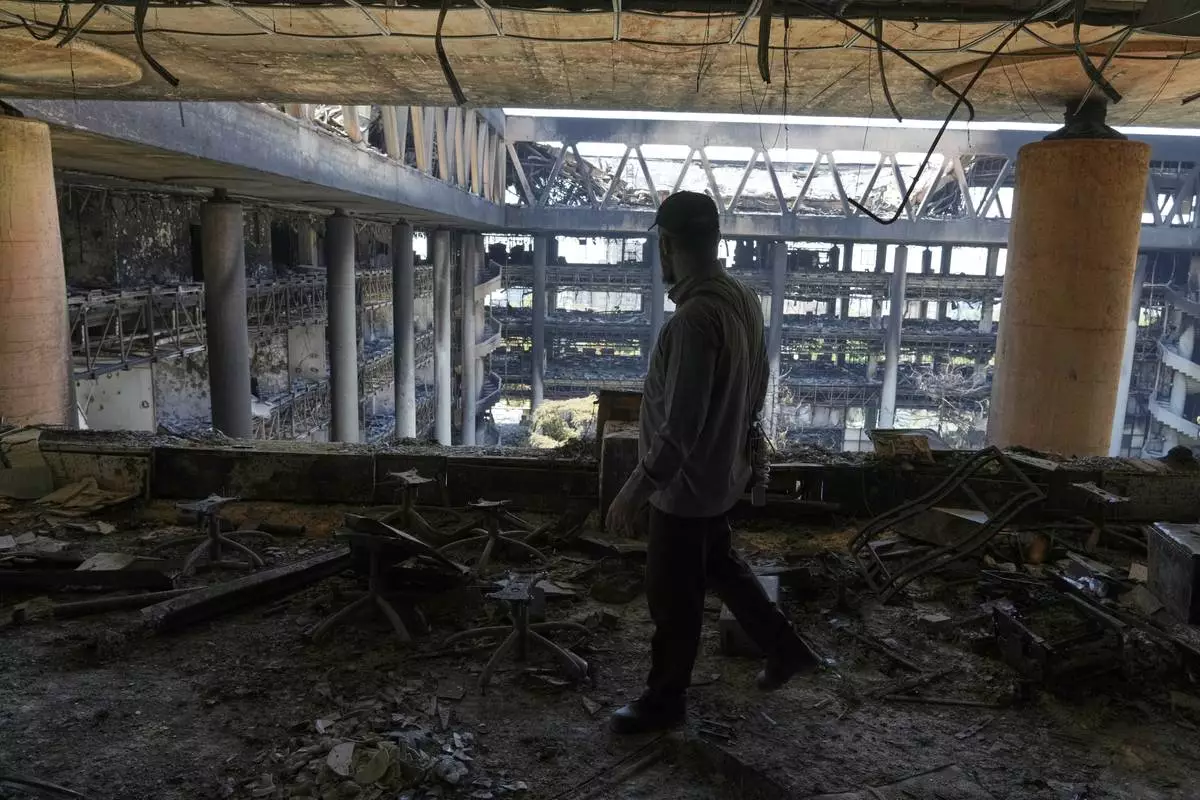
A man walks in the damaged headquarters of Islamic Republic of Iran Broadcasting, Iranian state television, in Tehran, Iran, Thursday, June 19, 2025. (AP Photo/Vahid Salemi)