WASHINGTON (AP) — A close ally of fugitive Jalisco New Generation boss known as “El Mencho” for years orchestrated a prolific drug trafficking operation, using a semi-submersible and other methods to avoid detection, and provided weapons to one of Mexico’s most powerful cartels, prosecutors say.
On Friday, José González Valencia, was sentenced in Washington’s federal court to 30 years in a U.S. prison following his 2017 arrest at a beach resort in Brazil while vacationing with his family under a fake name.
González Valencia, 49, known as “Chepa,” along with his two brothers, led a group called “Los Cuinis” that financed the drug trafficking operations of Jalisco New Generation, or CJNG — the violent cartel recently designated a foreign terrorist organization by the Trump administration. His brother-in-law is CJNG leader Nemesio Rubén “El Mencho” Oseguera Cervantes, whom for years has been sought by the U.S. government.
Meanwhile, El Mencho’s son-in-law, Cristian Fernando Gutiérrez Ochoa, appeared in the same courtroom earlier Friday to plead guilty in a separate case to a money laundering conspiracy charge. Gutierrez Ochoa was arrested toward the end of the Biden administration last year in California, where authorities have said he was living under a bogus name after faking his own death and fleeing Mexico.
Together, the prosecutions reflect the U.S. government’s efforts to weaken the brutal Jalisco New Generation cartel that’s responsible for importing staggering amounts of cocaine, methamphetamine and fentanyl into the U.S. — and track down its elusive leader. The Trump administration has sought to turn up the pressure on CJNG and other cartels with the foreign terrorist organization designation, which gives authorities new tools to prosecute those associated with cartels.
“You can’t totally prosecute your way out of the cartel problem, but you can make an actual impact by letting people know that we’re going to be enforcing this and showing that Mexico is being cooperative with us and then ultimately trying to get high level targets to sort of set the organization back,” Matthew Galeotti, who lead the Justice Department’s criminal division, said in an interview with The Associated Press.
Trump’s Justice Department has declared dismantling CJNG and other cartels a top priority, and Galeotti said the U.S. in recent months has seen increased cooperation from Mexican officials. In February, Mexico sent 29 cartel figures — including drug lord Rafael Caro Quintero, who was behind the killing of a U.S. DEA agent in 1985 — to the U.S. for prosecution.
The Trump administration has already charged a handful of defendants with terrorism offenses since designating CJNG and seven other Latin American crime organizations as foreign terrorist organizations in February. Galeotti said several additional indictments related to CJNG and other cartels remain under seal.
“We are taking a division-wide approach to this,” Galeotti said. “We’ve got money laundering prosecutors who are not just focused on the cartels themselves ... but also on financial facilitators. So when we’re taking this broad approach … that’s why I think we’ve had some of the really significant cases that we’ve had, and we’ve seen a very significant pipeline.”
González Valencia pleaded guilty to international cocaine trafficking in 2022. Authorities say he went into hiding in Bolivia in 2015 after leading “Los Cuinis” alongside his brothers for more than a decade. He was arrested in 2017 under the first Trump administration after traveling to Brazil, and was later extradited to the U.S.
“Los Cuinis” used “air, land, sea, and under-the-sea methods” to smuggle drugs bound for the U.S., prosecutors say. In one instance, authorities say González Valencia invested in a shipment of 4,000 kilograms of cocaine that was packed in a semi-submersible vessel to travel from Colombia to Guatemala. Other methods employed by “Los Cuinis” include hiding drugs in frozen shark carcasses, prosecutors say. He’s also accused of directing the killing of a rival.
He appeared in court wearing an orange jumpsuit and listened to the hearing through an interpreter over headphones. U.S. District Judge Beryl Howell sealed part of the hearing, keeping the press and public out of the courtroom while lawyers argued over the sentence. It was not clear why the judge determined it had to be sealed. González Valencia’s lawyer declined to comment after the hearing.
In the other case, Gutiérrez Ochoa was wanted in Mexico on allegations that he kidnapped two Mexican Navy members in 2021 in the hopes of securing the release of “El Mencho’s” wife after she had been arrested by Mexican authorities, prosecutors have said. Authorities have said he faked his own death and fled to the U.S. to avoid Mexican authorities, and “El Mencho” told associates that he killed Gutiérrez Ochoa for lying.
“El Mencho’s” son, Rubén Oseguera — known as “El Menchito” — was sentenced to March to life in prison after his conviction in Washington’s federal court of conspiring to distribute cocaine and methamphetamine for U.S. importation and using a firearm in a drug conspiracy.
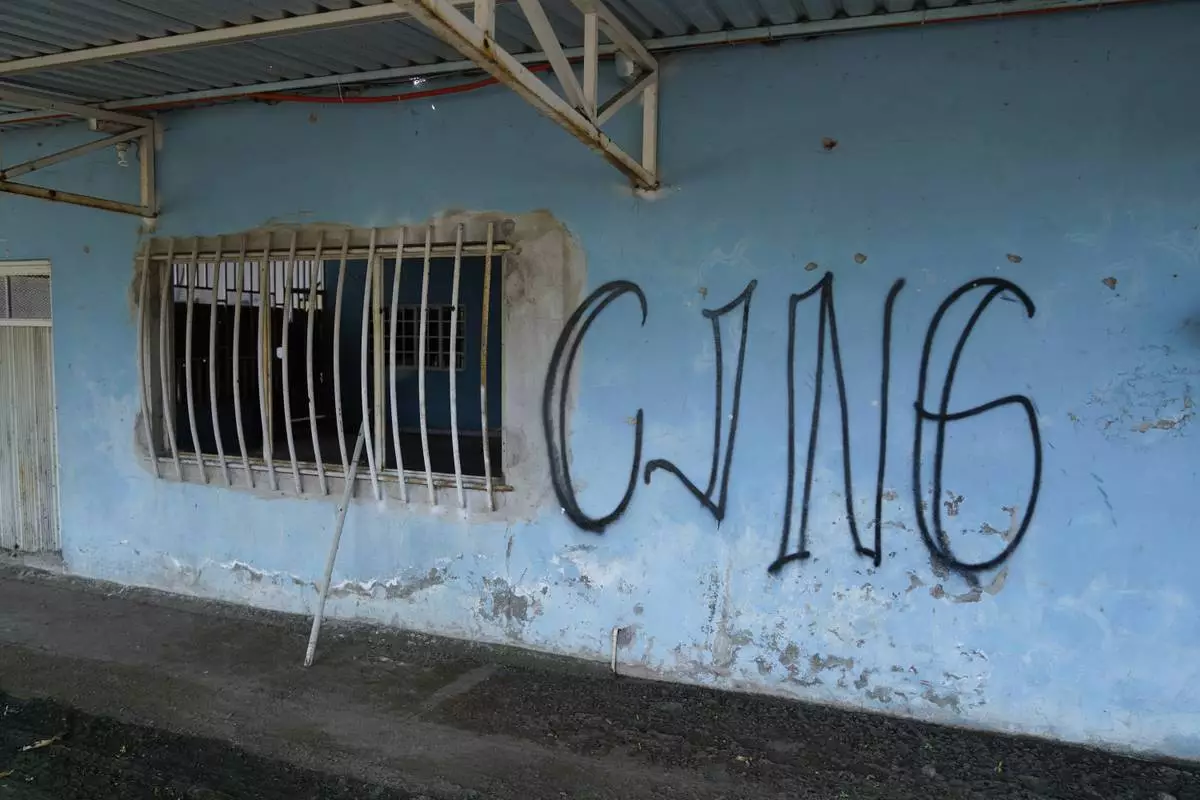
FILE - The letters "CJNG" for the group's formal name, Jalisco New Generation Cartel, covers the facade of an abandoned home in El Limoncito, in the Michoacan state of Mexico, Oct. 30, 2021. (AP Photo/Eduardo Verdugo, File)
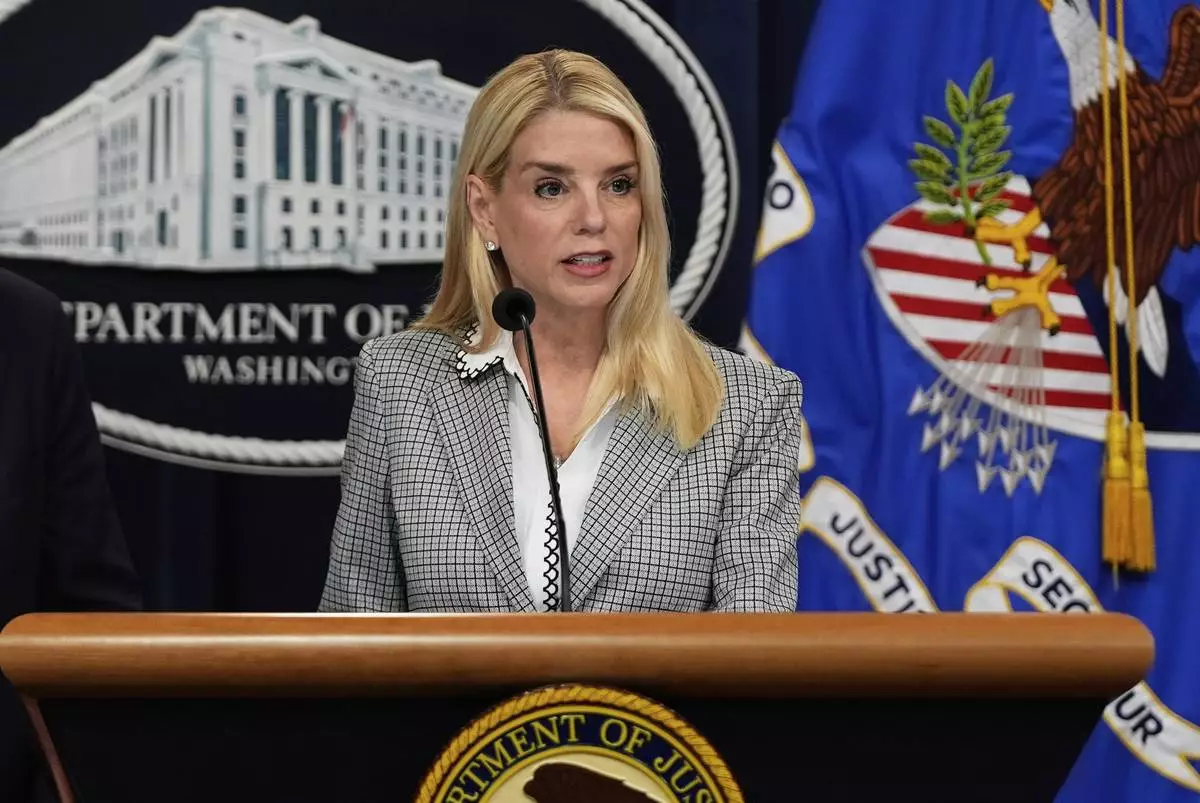
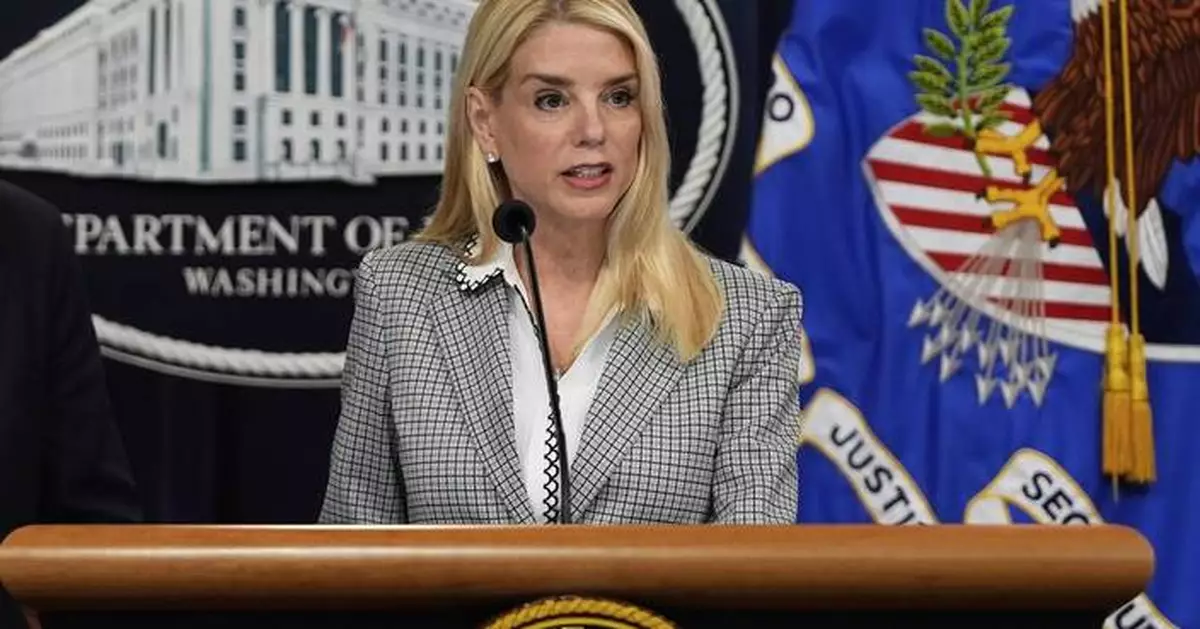
Attorney General Pam Bondi speaks during a news conference about Kilmar Abrego Garcia at the Justice Department, Friday June 6, 2025, in Washington. (AP Photo/Julia Demaree Nikhinson)
CARACAS, Venezuela (AP) — Venezuela’s acting President Delcy Rodríguez used her first state of the union message Thursday to advocate for opening the crucial state-run oil industry to more foreign investment following the Trump administration's pledge to seize control of Venezuelan crude sales.
For the first time, Rodríguez laid out a vision for Venezuela’s new political reality — one that challenges her government’s most deeply rooted beliefs less than two weeks after the United States captured and toppled former President Nicolás Maduro.
Under pressure from the U.S. to cooperate with its plans for reshaping Venezuela’s sanctioned oil industry, Maduro's former vice president declared that a “new policy is being formed in Venezuela."
She urged the foreign diplomats in attendance to tell investors abroad about the changes and called on lawmakers to approve oil sector reforms that would secure foreign firms' access to Venezuela’s vast reserves.
“Venezuela, in free trade relations with the world, can sell the products of its energy industry,” she said.
The Trump administration has said it plans to control future oil export revenues to ensure it benefits the Venezuelan people.
In that vein, Rodríguez described cash from the oil sales flowing into two sovereign wealth funds, one to support crisis-stricken health services and another to bolster public infrastructure, much of which was built under Maduro’s predecessor, Hugo Chávez, and has since deteriorated.
These days the country's hospitals are so poorly equipped that patients are asked to provide supplies needed for their care, from syringes to surgical screws.
While Rodríguez criticized the U.S. capture of Maduro and referred to a “stain on our relations," she also promoted the resumption of diplomacy between the historic adversaries. Her succinct, 44-minute speech and mollifying tone marked a dramatic contrast to her predecessors' fiery rants against U.S. imperialism that often went on for hours.
“Let us not be afraid of diplomacy,” Rodriguez. “I ask that politics not be transformed, that it not begin with hatred and intolerance.”
The day before, she gave a 4-minute briefing to the media to say her government would continue releasing prisoners detained under Maduro's harsh rule. But human rights groups have verified just a fraction of the releases that she claimed took place.
Rodríguez appears to be threading a needle.
A portrait of Maduro and his wife, Cilia Flores, was displayed next to her as she spoke. She called for the U.S. government to "respect the dignity" of Maduro, who is being held in a Brooklyn jail after pleading not guilty to drug-trafficking charges. She portrayed herself as defending Venezuela's sovereignty even as the country warmed up to the U.S. with dizzying speed.
“If one day, as acting president, I have to go to Washington, I will do so standing up, walking, not being dragged," she said. "I'll go standing tall ... never crawling.”
Rodríguez delivered her speech as Venezuela's Nobel Prize-winning opposition leader María Corina Machado was the one in Washington to meet President Donald Trump.
Since Maduro's ouster, Trump has frozen Machado out of discussions about the nation's political fate while embracing Rodríguez, praising Maduro’s long-time loyalist as a “terrific person” after holding his first known phone call with her on Wednesday.
Machado, whose party is considered to have won the tumultuous 2024 presidential elections despite Maduro's claims of victory, said she presented her Nobel Peace Prize medal to Trump during their closed-door conversation.
Emerging from the White House afterward, she greeted dozens of cheering supporters. "We can count on President Trump,” she told them, without elaborating.
Her role in Venezuelan politics remains uncertain as Rodríguez’s government has been effectively relieved of having to hold elections for the foreseeable future.
Machado’s meeting with Trump received no coverage in Venezuela.
The country's state-run TV still pumps out a steady stream of pro-government images, including various statements from Iranian and Russian officials decrying “U.S. aggression" and wall-to-wall coverage of state-orchestrated rallies demanding Maduro's return.
Crowds of teachers on Thursday marched through the streets of Venezuela’s capital, Caracas, carrying posters condemning the U.S. for “kidnapping” Maduro and chanting slogans in support of the government. National police wearing riot gear were everywhere. Pro-government graffiti scrawled across city walls read: “To doubt is to betray."
“They've kept the same anti-imperialist rhetoric going, but more moderated," said David Smilde, a Venezuela expert at Tulane University who has studied Venezuela for 30 years. “Their idea is to give Trump everything he wants economically, but stay the course politically."
On the streets of central Caracas, most Venezuelans going about their days declined to be interviewed about their opinions, fearful of government reprisals as Maduro's security apparatus remains intact. Others were simply at a loss of what to say about their country's strange new reality in which the U.S. claims to call the shots.
“It’s a complete sea of uncertainty, and the only one who now has the power to make decisions is the United States government,” said Pablo Rojas, 28, a music producer.
He said he was following Trump's meeting with Machado closely "to see if she takes a leadership position, if they consider her ready to lead the country or be a candidate." He shook his head in puzzlement. “It’s impossible to know what will happen.”
Associated Press writers Isabel DeBre in Buenos Aires, Argentina, and Megan Janetsky in Mexico City contributed to this report.
Follow AP’s coverage of Latin America and the Caribbean at https://apnews.com/hub/latin-america
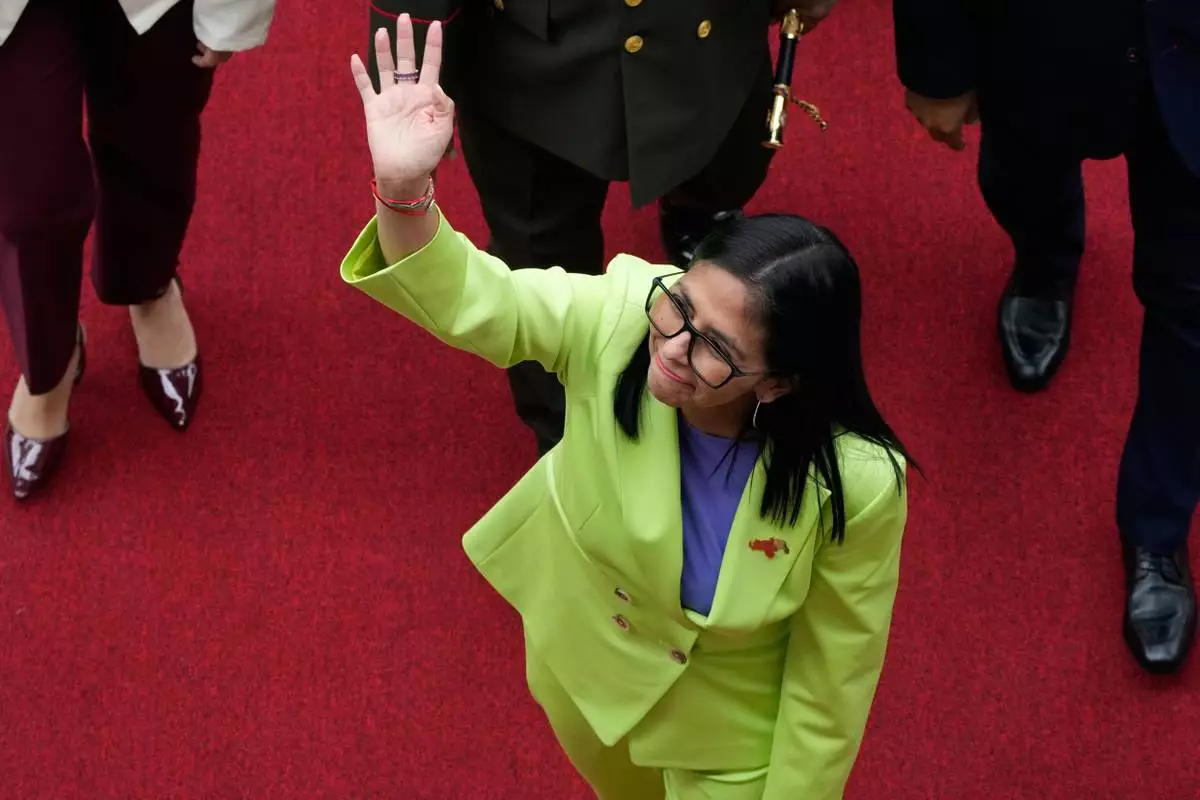
Venezuela's acting President Delcy Rodriguez arrives at the National Assembly in Caracas, Venezuela, Thursday, Jan. 15, 2026. (AP Photo/Ariana Cubillos)
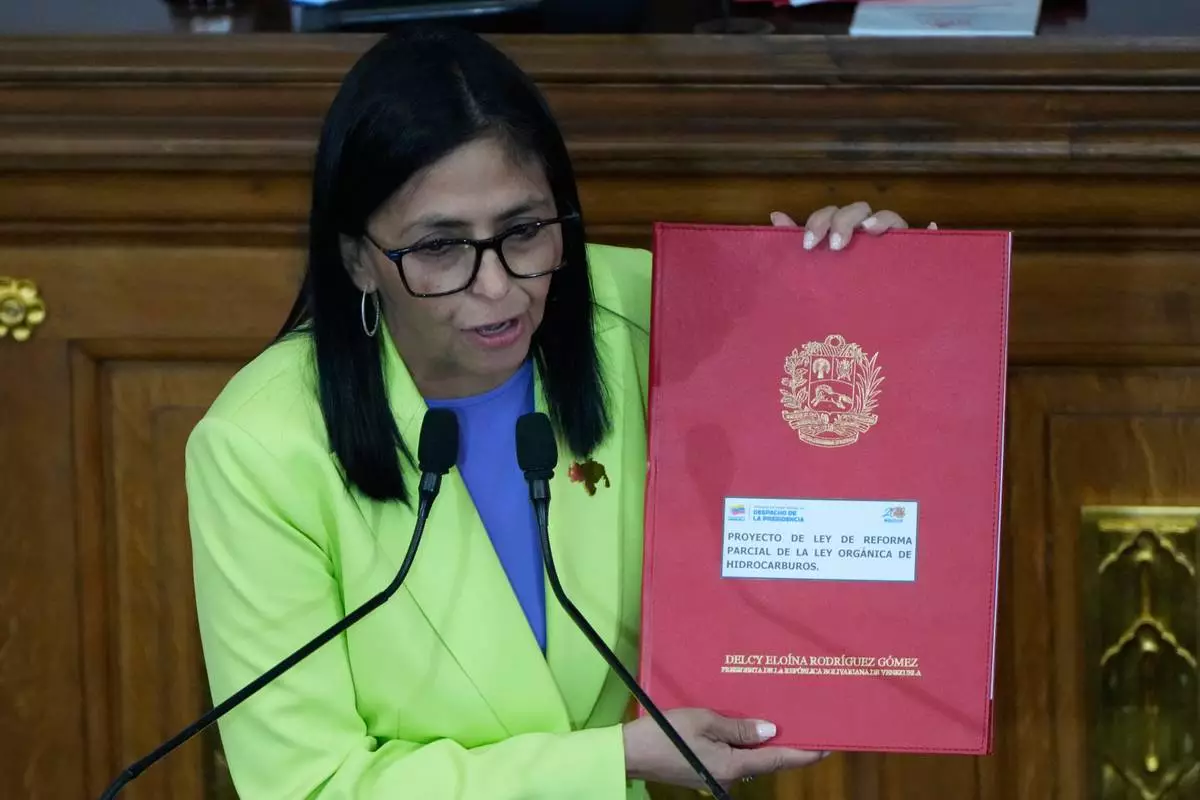
Venezuela's acting President Delcy Rodriguez delivers her first state of the union address at the National Assembly in Caracas, Venezuela, Thursday, Jan. 15, 2026. (AP Photo/Ariana Cubillos)
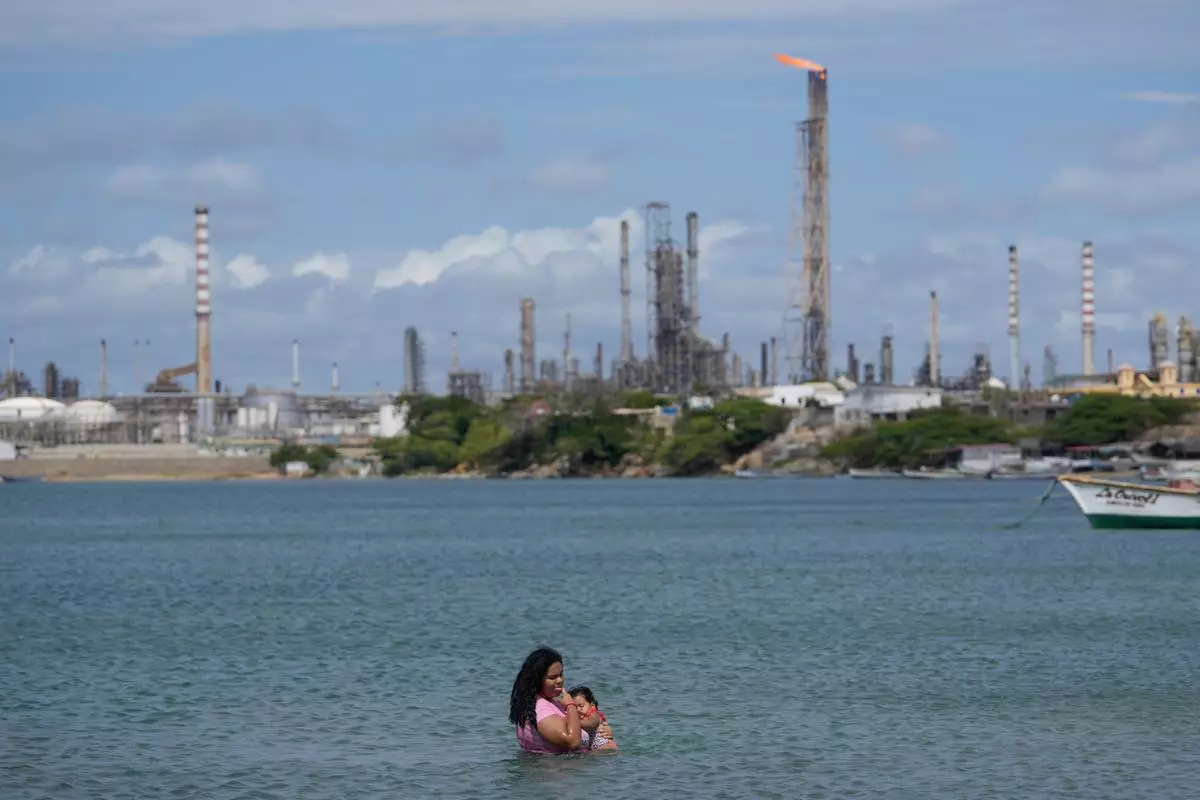
Ceylis Mendez and her daughter Zoe cool off in the Gulf of Venezuela in front of the Cardon oil refinery off the shore of Punta Cardon, Venezuela, Wednesday, Jan. 14, 2026. (AP Photo/Matias Delacroix)
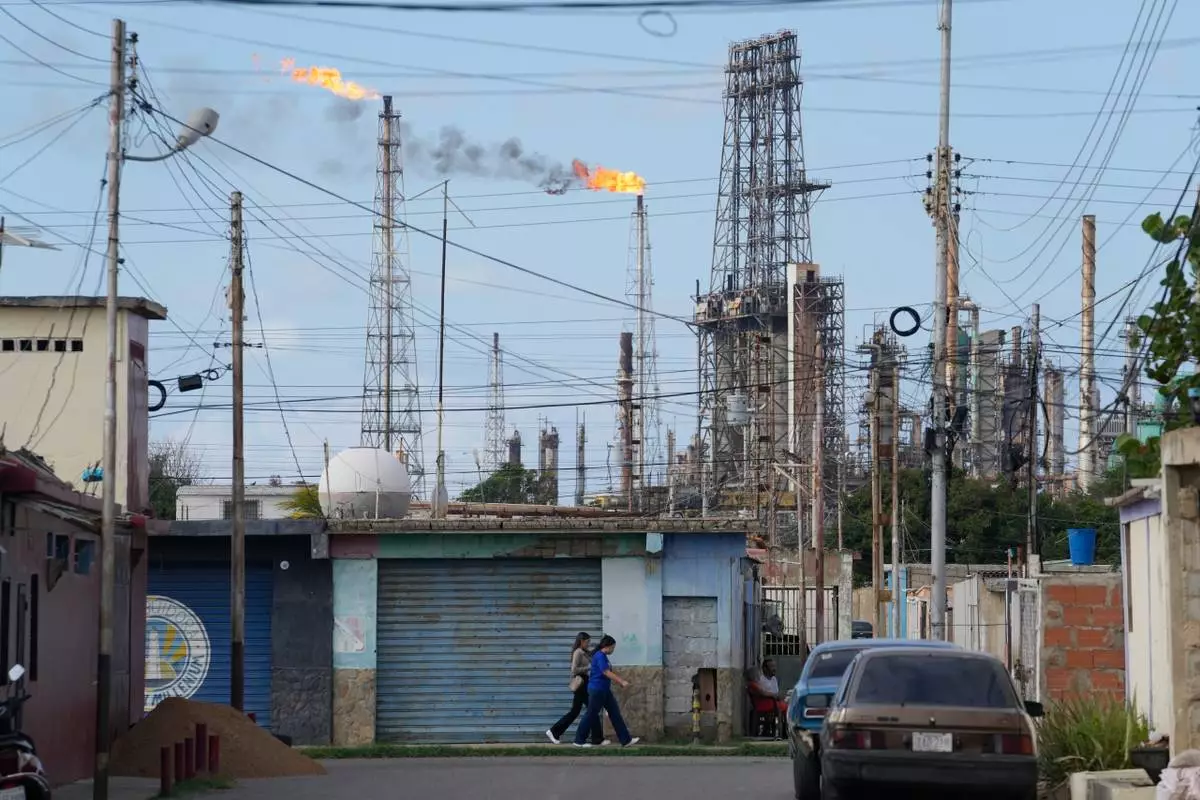
Flames rise from flare stacks at the Amuay refinery in Los Taques, Venezuela, Wednesday, Jan. 14, 2026. (AP Photo/Matias Delacroix)
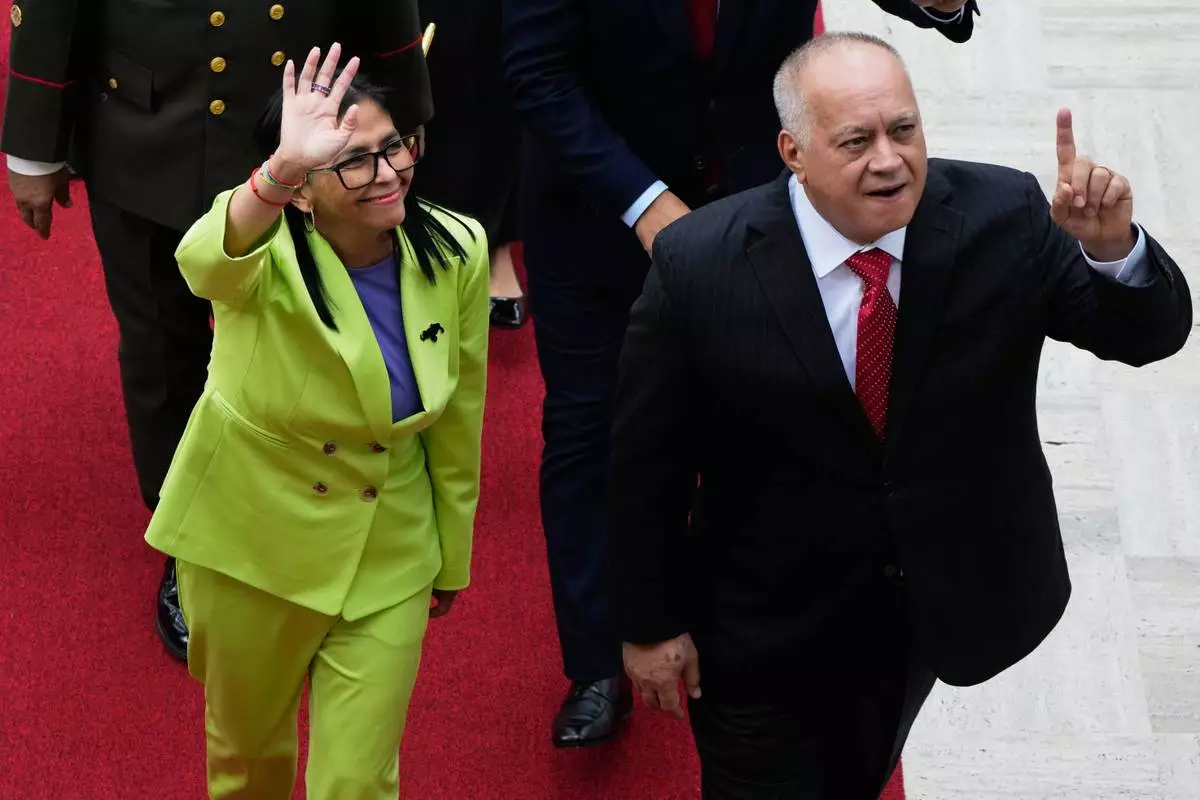
Venezuela's acting President Delcy Rodriguez, left, and Interior Minister Diosdado Cabello arrive at the National Assembly in Caracas, Venezuela, Thursday, Jan. 15, 2026. (AP Photo/Ariana Cubillos)
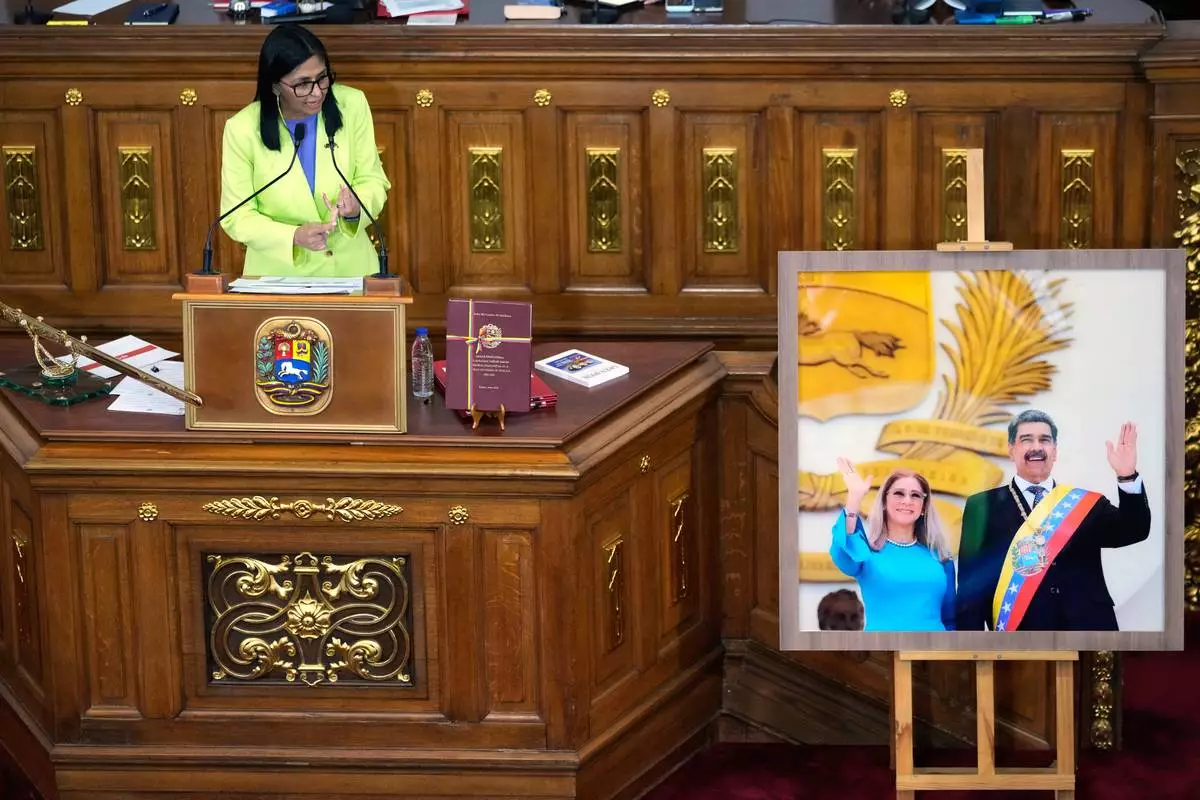
Venezuela's acting President Delcy Rodriguez addresses lawmakers next to a picture of former President Nicolas Maduro and his wife Cilia Flores, at the National Assembly in Caracas, Venezuela, Thursday, Jan. 15, 2026. (AP Photo/Ariana Cubillos)
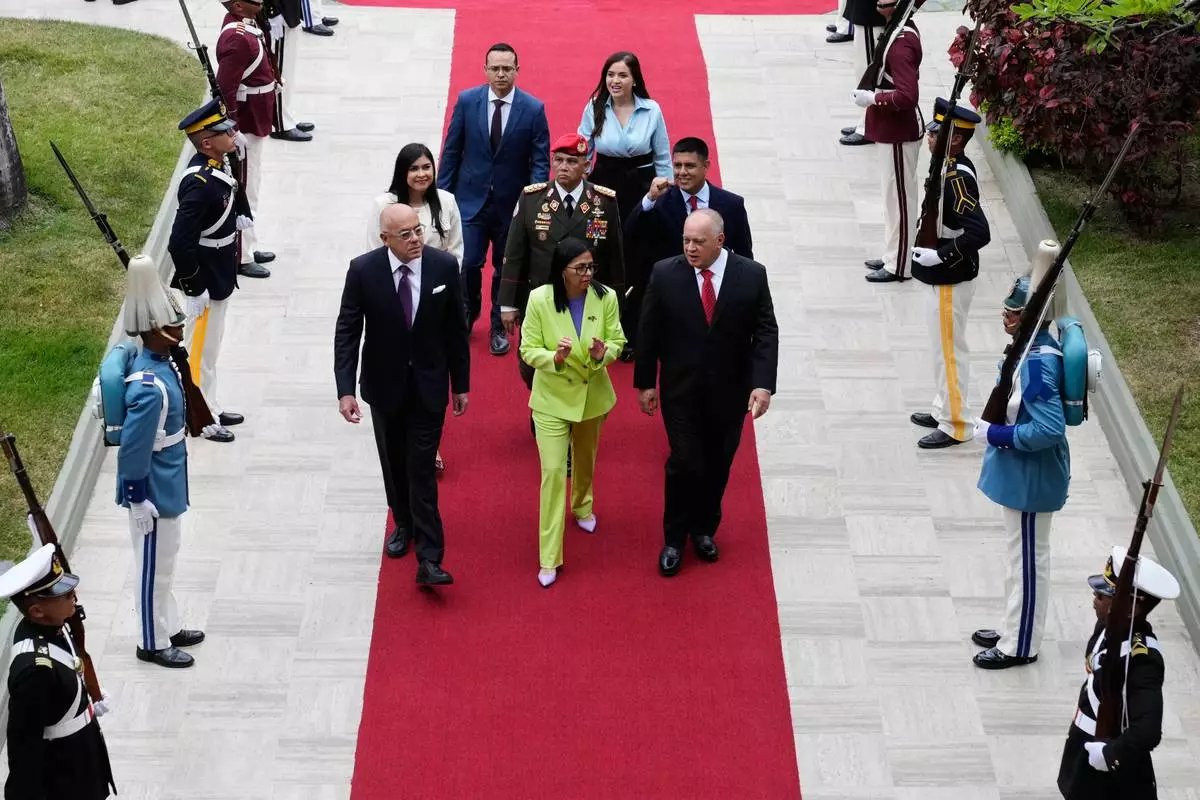
Venezuela's acting President Delcy Rodriguez, center, her brother National Assembly President, Jorge Rodriguez, left, and Interior Minister Diosdado Cabello arrive at the National Assembly in Caracas, Venezuela, Thursday, Jan. 15, 2026. (AP Photo/Ariana Cubillos)
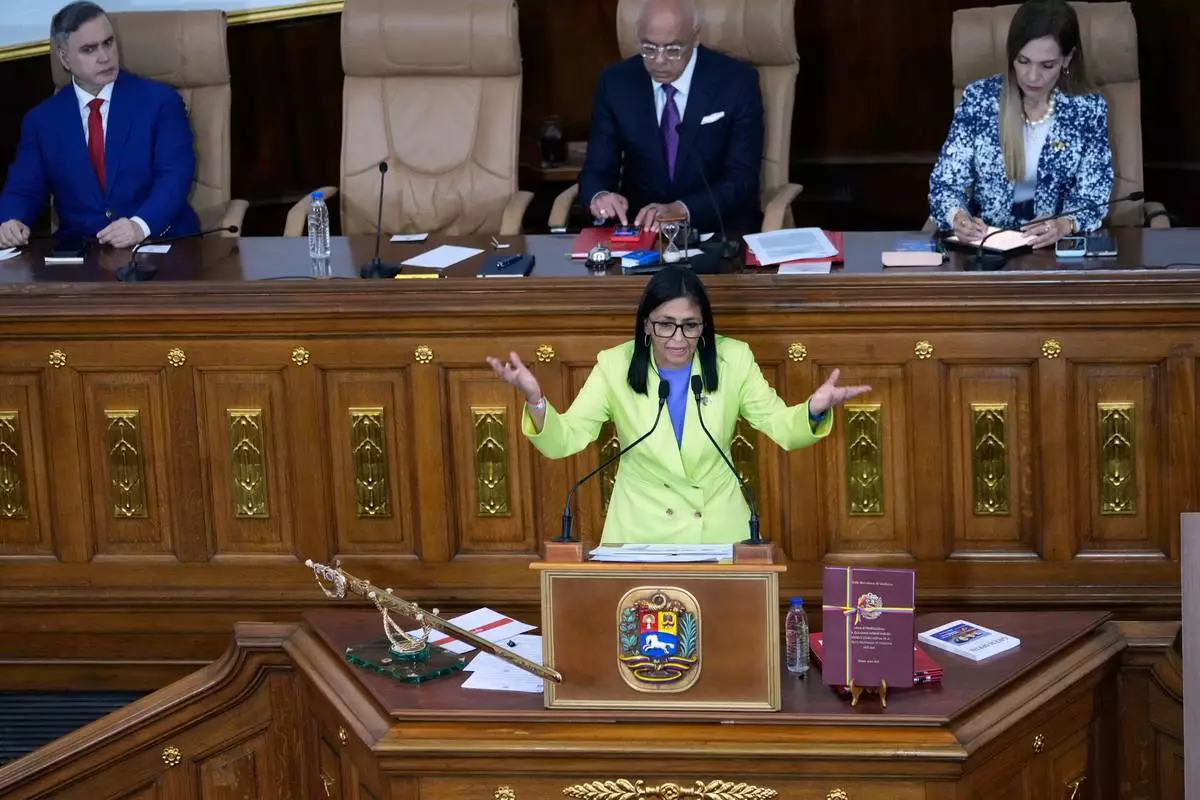
Venezuela's acting President Delcy Rodriguez addresses the National Assembly in Caracas, Venezuela, Thursday, Jan. 15, 2026. (AP Photo/Ariana Cubillos)
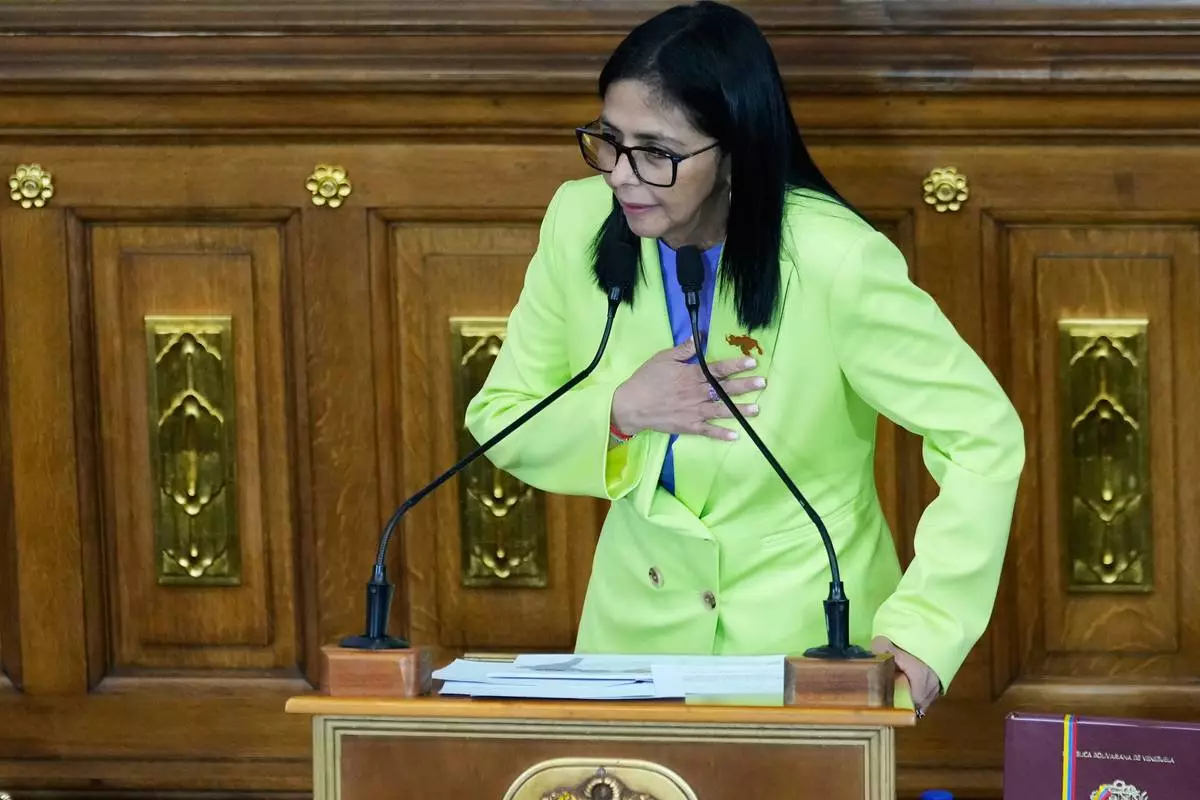
Venezuela's acting President Delcy Rodriguez addresses the National Assembly in Caracas, Venezuela, Thursday, Jan. 15, 2026. (AP Photo/Ariana Cubillos)
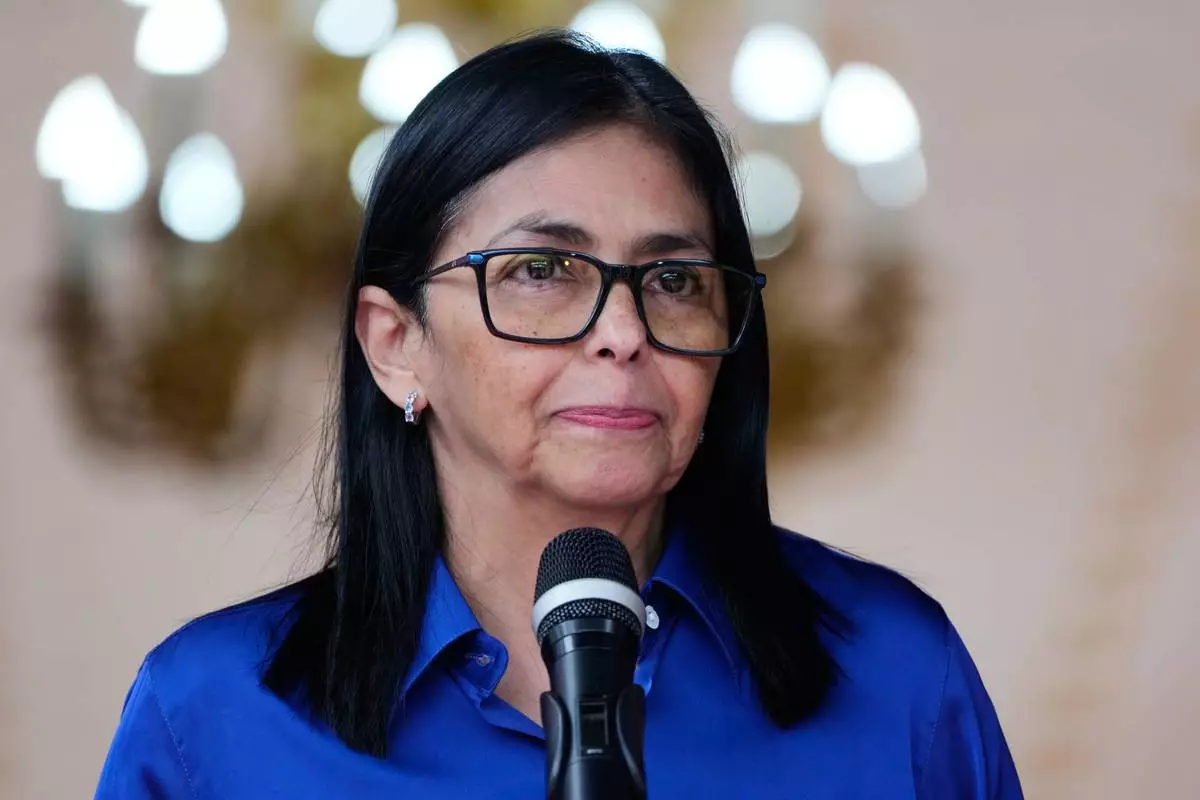
Venezuela's acting President Delcy Rodriguez makes a statement to the press at Miraflores presidential palace in Caracas, Venezuela, Wednesday, Jan. 14, 2026. (AP Photo/Ariana Cubillos)
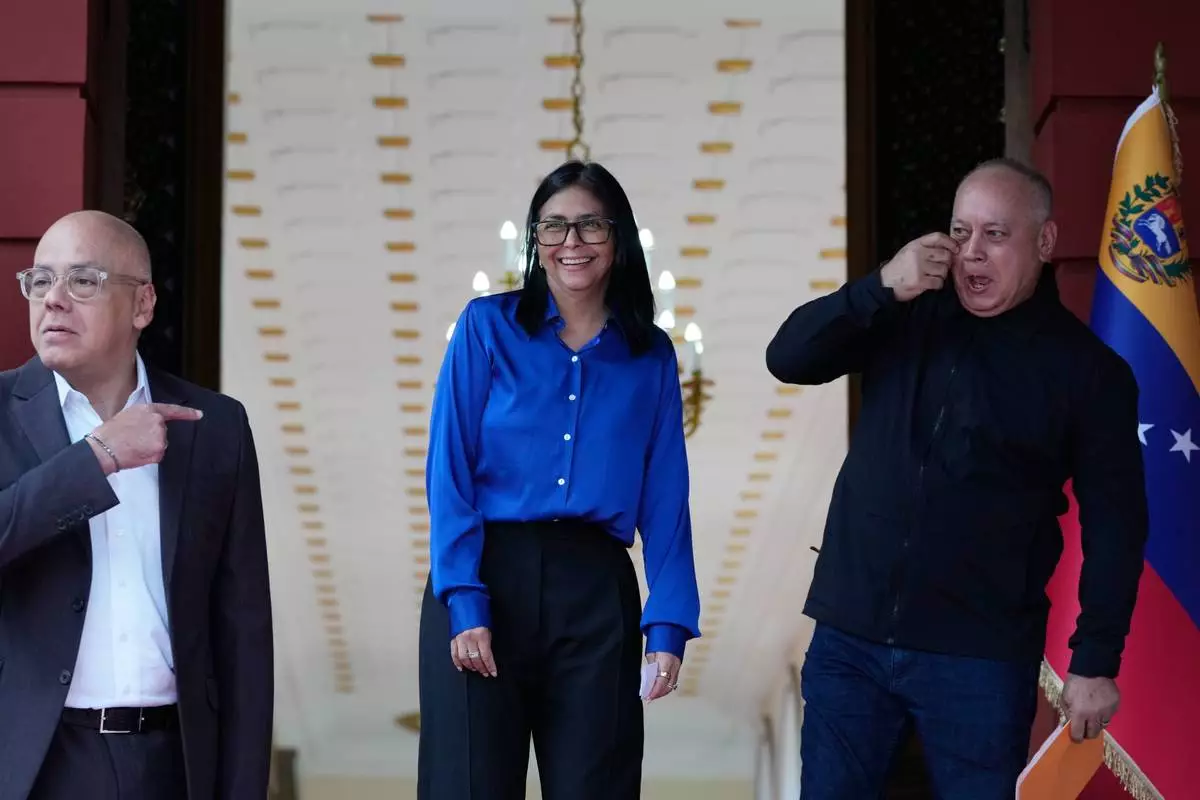
Venezuela's acting President Delcy Rodriguez, center, smiles flanked by Interior Minister Diosdado Cabello, right, and National Assembly President Jorge Rodriguez after making a statement to the press at Miraflores presidential palace in Caracas, Venezuela, Wednesday, Jan. 14, 2026. (AP Photo/Ariana Cubillos)