KHAN YOUNIS, Gaza Strip (AP) — Each day, Palestinians in Gaza run a deadly gantlet in hopes of getting food. Israeli troops open barrages of gunfire toward crowds crossing military zones to get to the aid, they say, and knife-wielding thieves wait to ambush those who succeed. Palestinians say lawlessness is growing as they are forced into a competition to feed their families.
A lucky few manage to secure some packets of lentils, a jar of Nutella or a bag of flour. Many return empty-handed and must attempt the ordeal again the next day.
Click to Gallery
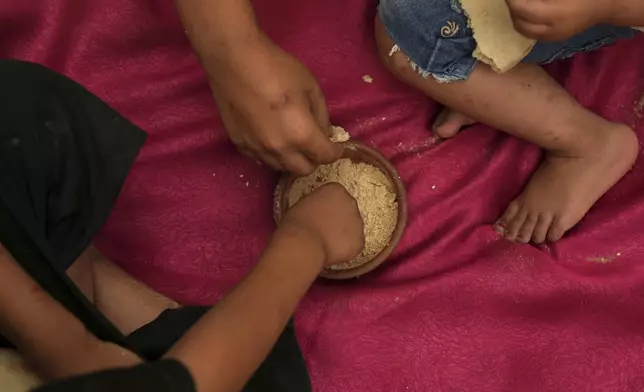
The children of Jamil Atili, 51, eat ground lentils after their father returned empty-handed from an attempt to collect donated food at a distribution center run by private contractor the Gaza Humanitarian Foundation in the southern Gaza Strip, in Khan Younis, Wednesday, June 11, 2025. (AP Photo/Abdel Kareem Hana)
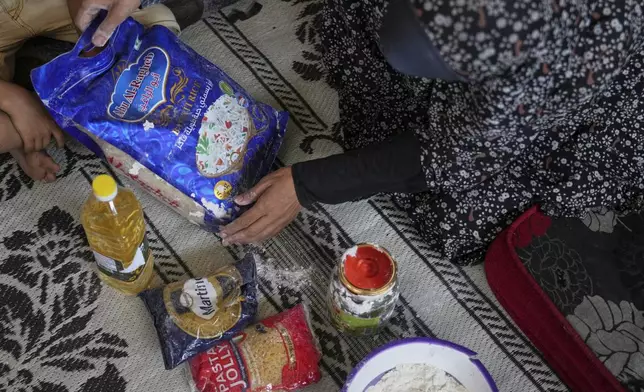
Anwaar Saleh, 32, displays the donated food her husband, Omar al-Hobi, collected at a distribution center run by private contractor the Gaza Humanitarian Foundation in the southern Gaza Strip, after he arrived at their family's tent in Khan Younis, Tuesday, June 10, 2025. (AP Photo/Abdel Kareem Hana)
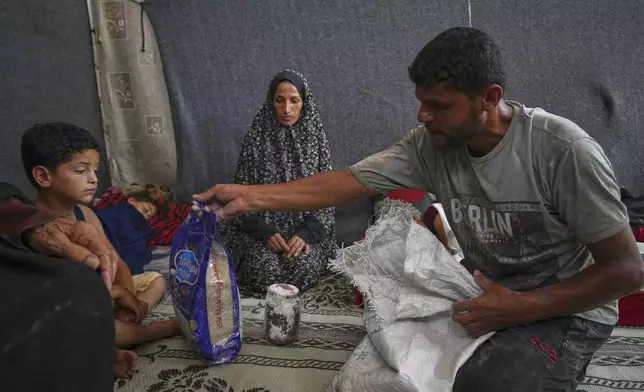
Omar al-Hobi, 43, from Rafah, unpacks a bag of food he collected at a distribution center run by private contractor the Gaza Humanitarian Foundation in the southern Gaza Strip, as he arrives at his family's tent in Khan Younis, Tuesday, June 10, 2025. At left are his children and his wife, Anwaar Saleh.(AP Photo/Abdel Kareem Hana)
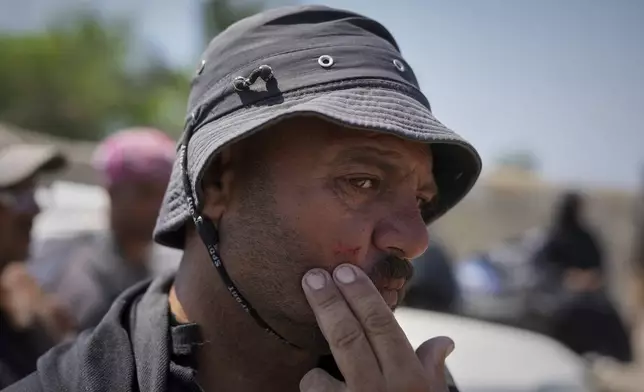
Jamil Atili, 51, shows a knife cut across his cheek, which he says he suffered amid the scramble for food at a distribution center run by private contractor the Gaza Humanitarian Foundation in the southern Gaza Strip, as he arrives empty-handed in Khan Younis, Wednesday, June 11, 2025. (AP Photo/Abdel Kareem Hana)
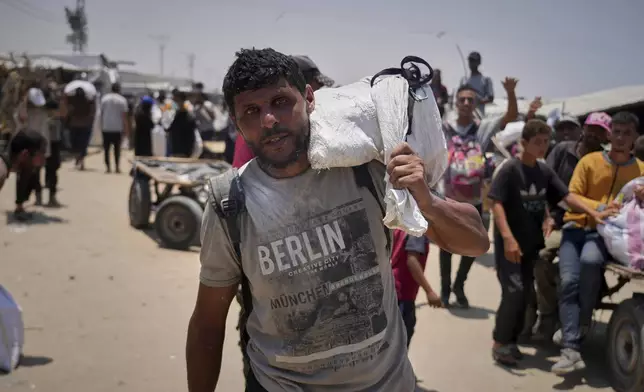
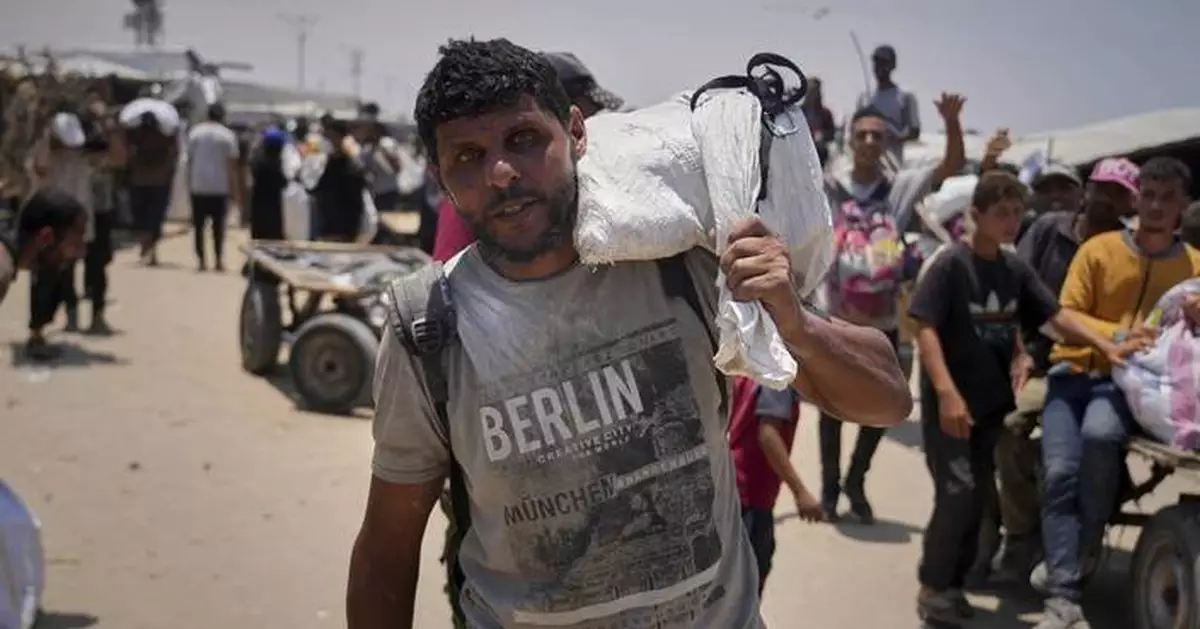
Omar al-Hobi, 43, from Rafah, carries a bag of food he collected at a distribution center run by private contractor the Gaza Humanitarian Foundation in the southern Gaza Strip, as he arrives at his tent in Khan Younis, Tuesday, June 10, 2025. (AP Photo/Abdel Kareem Hana)
“This isn’t aid. It’s humiliation. It’s death,” said Jamil Atili, his face shining with sweat as he made his way back last week from a food center run by the Gaza Humanitarian Foundation, an Israeli-backed private contractor. He had suffered a knife cut across his cheek amid the scramble for food and said a contractor guard pepper-sprayed him in the face. Still, he emerged with nothing for his 13 family members.
“I have nothing to feed my children,” he said, nearly crying. “My heart is broken.”
Israel began allowing food into Gaza this past month after cutting it off completely for 10 weeks, though United Nations officials say it is not enough to stave off starvation. Most of the supplies go to GHF, which operates four food distribution points inside Israeli military zones. A trickle of aid goes to the U.N. and humanitarian groups.
Both systems are mired in chaos. Daily gunfire by Israeli troops toward crowds on the roads heading to the GHF centers has killed several hundred people and wounded hundreds more in past weeks, according to Gaza’s Health Ministry.
At the same time, in past weeks, hungry crowds overwhelm most of the U.N.'s truck convoys and strip away the supplies. Israeli troops have opened fire to disperse crowds waiting for trucks near military zones, witnesses say — and on Tuesday, more than 50 people were killed, according to the ministry. The Israeli military says it is investigating.
“I don’t see how it can get any worse, because it is already apocalyptic. But somehow it does get worse,” said Olga Cherevko, spokesperson for the U.N. humanitarian affairs office.
Israel says it has only fired warning shots at suspects who approached its forces along the roads to the GHF food centers.
Palestinian witnesses say the troops fire to prevent crowds from moving past a certain point before the centers open or because people leave the road designated by the military. They describe heavy barrages from tanks, snipers, drones and even guns mounted on cranes.
Asked how its soldiers control movement, the military told The Associated Press its “operational conduct ... is accompanied by systematic learning processes.” It said it was looking into safety measures like fences and road signs.
GHF says no shootings have taken place in or near its hubs. A spokesperson, speaking on condition of anonymity under GHF rules, said incidents take place before sites open involving aid-seekers who move “during prohibited times ... or trying to take a short cut.” They said GHF is trying to improve safety, in part by changing opening times to daylight hours.
Israel intends for GHF to replace the U.N.-led aid network in Gaza, contending that Hamas diverts large amounts of aid from it. The U.N. denies the claim.
Thousands of people must walk miles to reach the GHF centers, three of which are in the far south outside the city of Rafah. Palestinians said the danger begins when the crowds enter the Israeli military zone encompassing Rafah.
Mohammed Saqer, a father of three who risked the trip multiple times, said that when he went last week, tanks were firing over the heads of the crowds as drone announcements told everyone to move back.
It’s “like it was ‘Squid Game,’” Saqer said, referring to the dystopian thriller TV series in which contestants risk their lives to win a prize. Just raising your head might mean death, he said.
He and others crawled forward, then left the main road. A shot rang out nearby and they ducked, he said. They found a young man on the ground, shot in the back. The others assumed he was dead, but Saqer felt his chest — it was still warm, and he found a pulse. They carried him to a point where a car could pick him up.
Saqer said he stood for a moment, traumatized by the scene. Then people shouted that the site had opened.
Everyone broke into a crazed run, he said. He saw several people wounded on the ground. One man, bleeding from his abdomen, reached out his hand, pleading for help. No one stopped.
“Everyone is just running to get to the aid, to get there first,” Saqer said.
Omar al-Hobi described the same scene the four times he went last week. Twice, he returned empty-handed; once, he managed to grab a pack of lentils. On the fourth day, he was determined to secure flour for his three children and pregnant wife.
He said he and others inched their way forward under tank fire. He saw several people shot in the legs. One man fell bleeding to the ground, apparently dead, he said.
Horrified, al-Hobi froze, unable to move, “but I remembered I have to feed my children.”
He took cover in a greenhouse, then heard the announcement that the center was open and began to run.
At the center, food boxes are stacked on the ground in an area surrounded by fences and earthen berms. Thousands rush in to grab what they can in a frantic melee.
You have to move fast, Saqer said. Once supplies run out, some of those who came too late rob those leaving. He swiftly tore open a box and loaded the contents into a sack — juice, chickpeas, lentils, cheese, beans, flour and cooking oil.
Then he took off running. There's only one route in and out of the center. But, knowing thieves waited outside, Saqer clambered over a berm, running the risk of being fired on by Israeli troops.
“It all depends on the soldiers’ mood. If they are in a bad mood … they will shoot at me. If not, they will let me be,” he said.
Heba Jouda said she saw a group of men beat up a boy of 12 or 13 years old and take his food as she left one of the Rafah centers. Another time, she said, thieves attacked an older man, who hugged his sack, weeping that his children had no food. They sliced his arm with a knife and ran off with the sack.
Al-Hobi said he was trampled in the scramble for boxes. He managed to grab a bag of rice, a packet of macaroni. He snagged flour — but much of it was ruined in the chaos.
At his family tent outside Khan Younis, his wife, Anwaar Saleh, said she will ration it all to make it last a week or so.
“We hope he doesn’t have to go back. His life is the most important thing,” she said.
Al-Hobi remains shaken — both by his brushes with death and the callousness that the race for food has instilled in everyone.
“No one will show you mercy these days. Everybody fends for themselves.”
El Deeb reported from Beirut, Keath from Cairo. AP correspondent Samy Magdy in Cairo contributed.
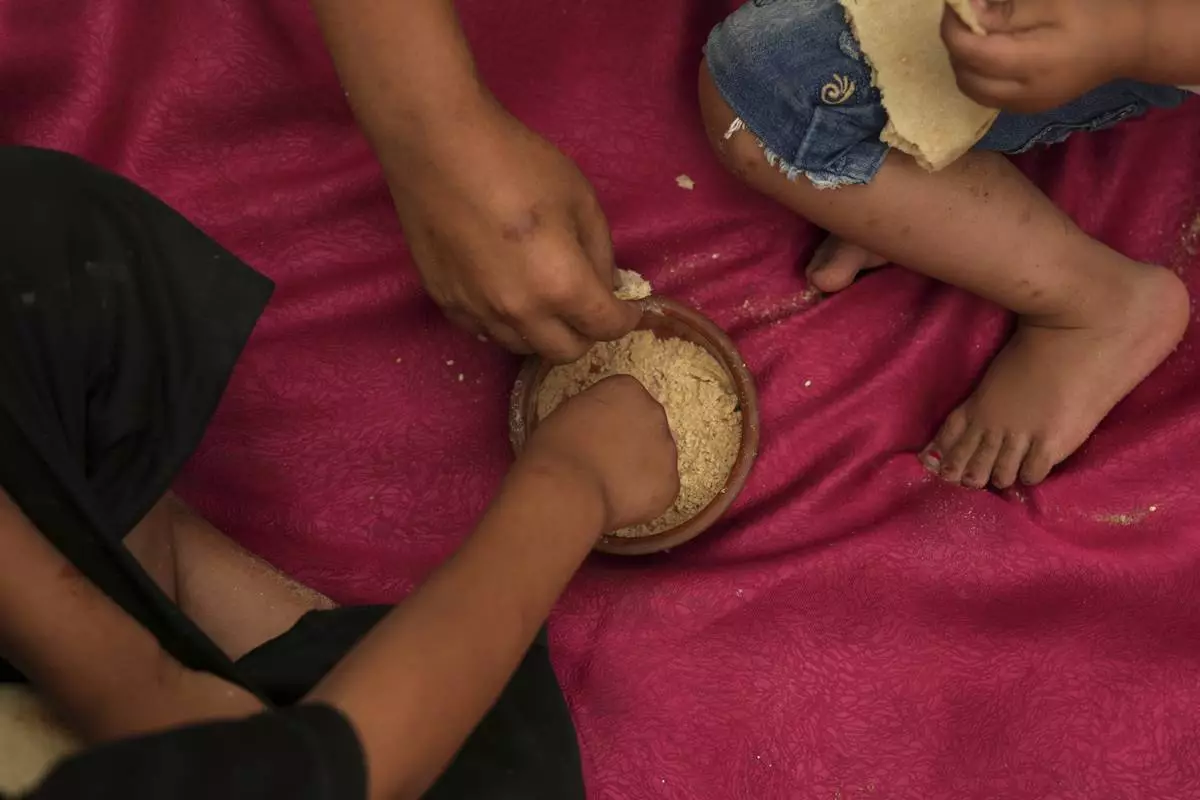
The children of Jamil Atili, 51, eat ground lentils after their father returned empty-handed from an attempt to collect donated food at a distribution center run by private contractor the Gaza Humanitarian Foundation in the southern Gaza Strip, in Khan Younis, Wednesday, June 11, 2025. (AP Photo/Abdel Kareem Hana)
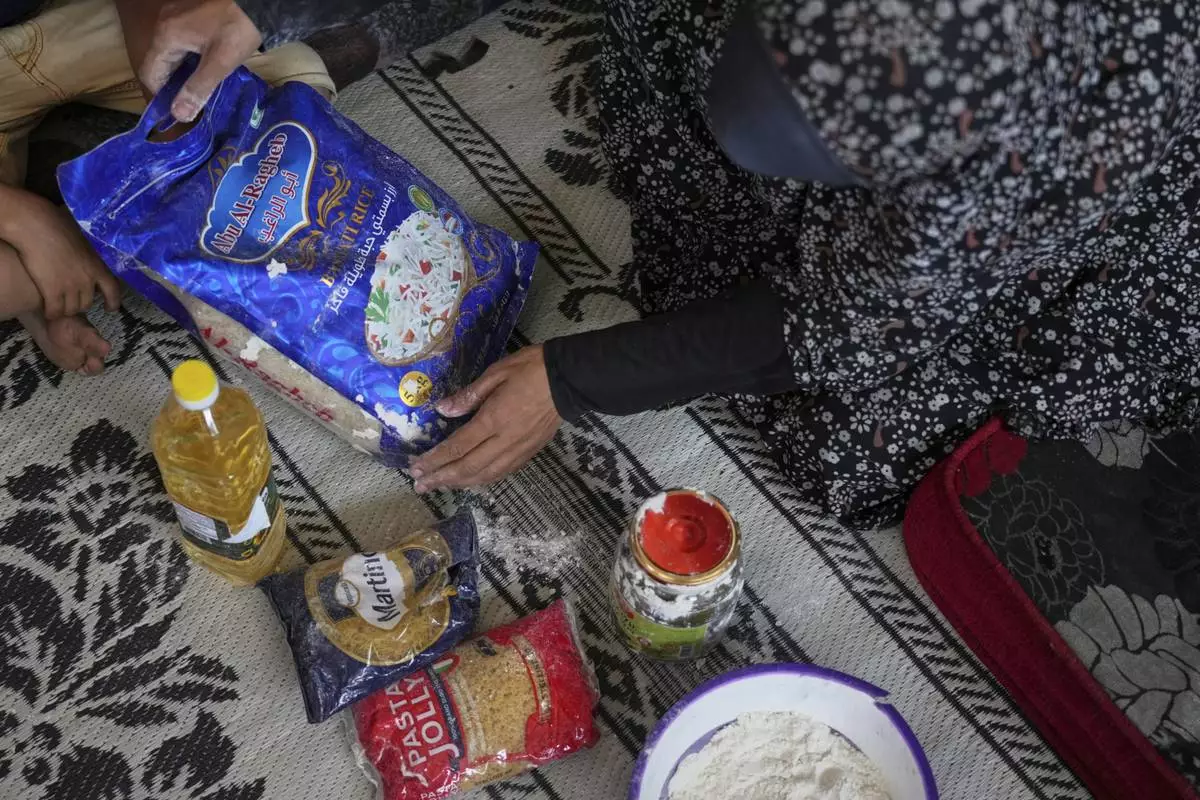
Anwaar Saleh, 32, displays the donated food her husband, Omar al-Hobi, collected at a distribution center run by private contractor the Gaza Humanitarian Foundation in the southern Gaza Strip, after he arrived at their family's tent in Khan Younis, Tuesday, June 10, 2025. (AP Photo/Abdel Kareem Hana)
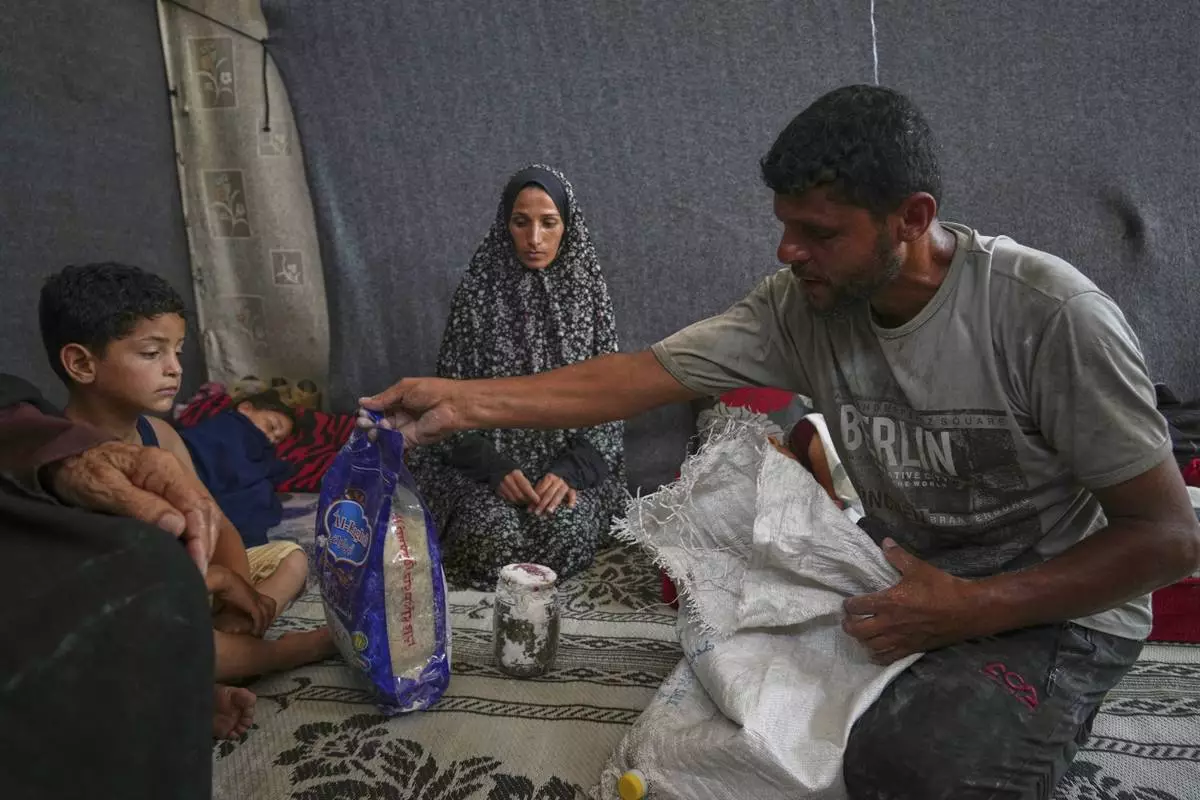
Omar al-Hobi, 43, from Rafah, unpacks a bag of food he collected at a distribution center run by private contractor the Gaza Humanitarian Foundation in the southern Gaza Strip, as he arrives at his family's tent in Khan Younis, Tuesday, June 10, 2025. At left are his children and his wife, Anwaar Saleh.(AP Photo/Abdel Kareem Hana)
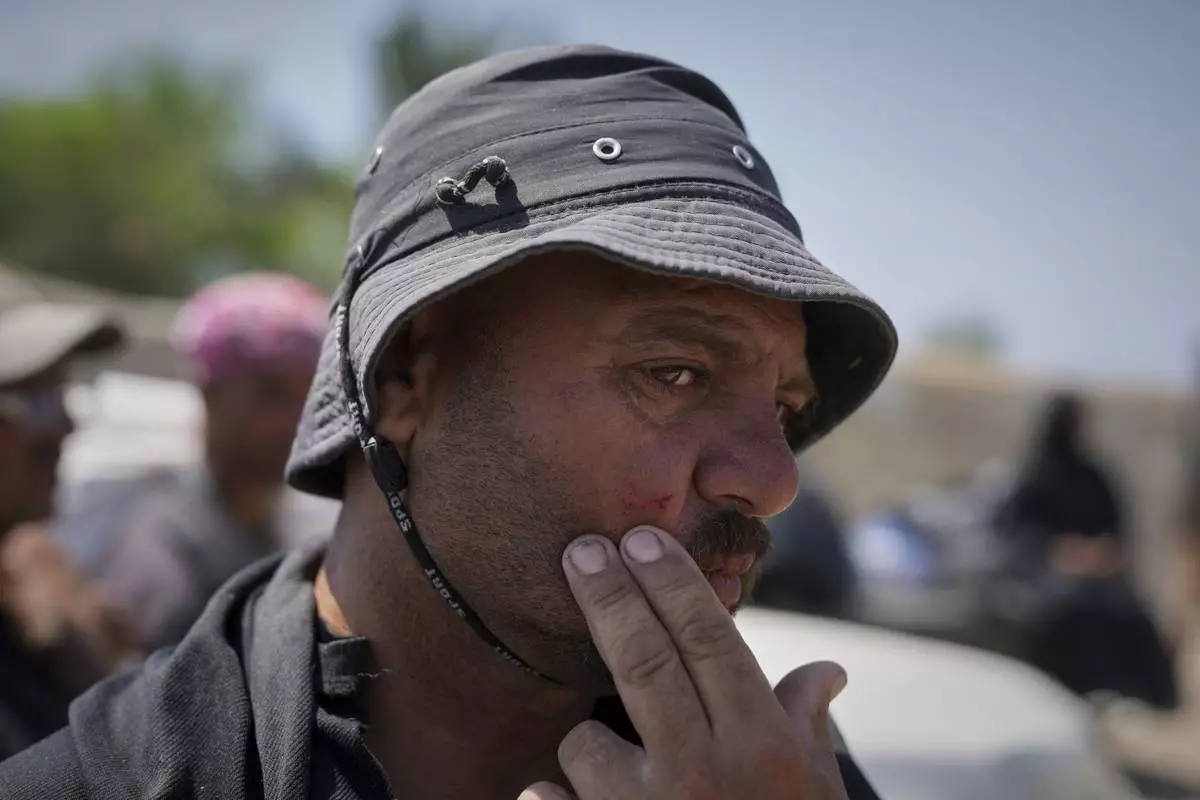
Jamil Atili, 51, shows a knife cut across his cheek, which he says he suffered amid the scramble for food at a distribution center run by private contractor the Gaza Humanitarian Foundation in the southern Gaza Strip, as he arrives empty-handed in Khan Younis, Wednesday, June 11, 2025. (AP Photo/Abdel Kareem Hana)
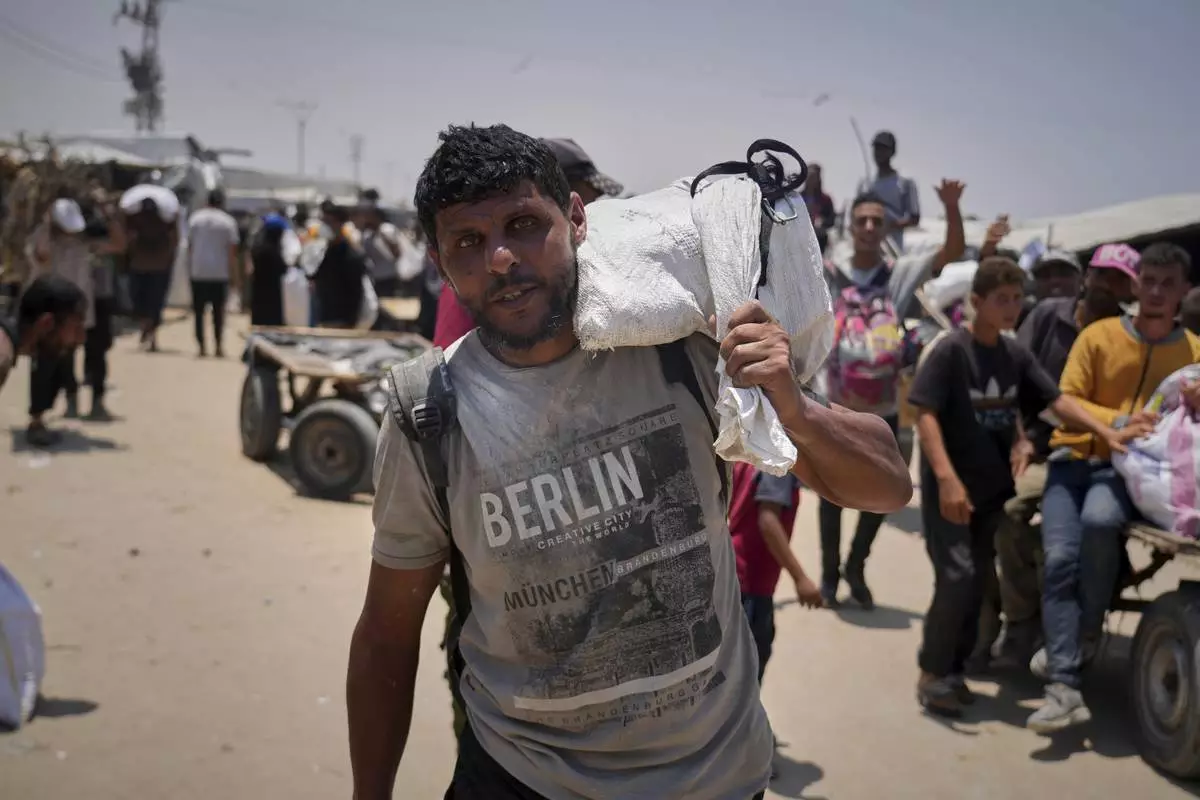
Omar al-Hobi, 43, from Rafah, carries a bag of food he collected at a distribution center run by private contractor the Gaza Humanitarian Foundation in the southern Gaza Strip, as he arrives at his tent in Khan Younis, Tuesday, June 10, 2025. (AP Photo/Abdel Kareem Hana)