WASHINGTON (AP) — President Donald Trump on Sunday called into question the future of Iran's ruling theocracy after a surprise attack on three of the country’s nuclear sites, seemingly contradicting his administration's earlier calls to resume negotiations and avoid an escalation in fighting.
“It’s not politically correct to use the term, ‘Regime Change,’ but if the current Iranian Regime is unable to MAKE IRAN GREAT AGAIN, why wouldn’t there be a Regime change???” Trump posted on social media. “MIGA!!!"
Click to Gallery
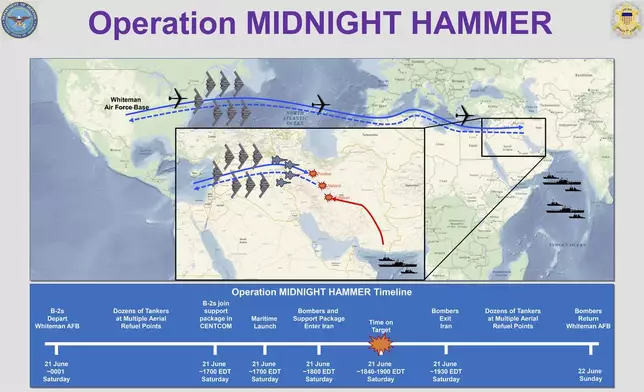
This image provided by the Department of Defense shows a chart that was displayed during a news conference by Defense Secretary Pete Hegseth and Chairman of the Joint Chiefs of Staff Gen. Dan Caine at the Pentagon in Washington, Sunday, June 22, 2025. (Department of Defense via AP)
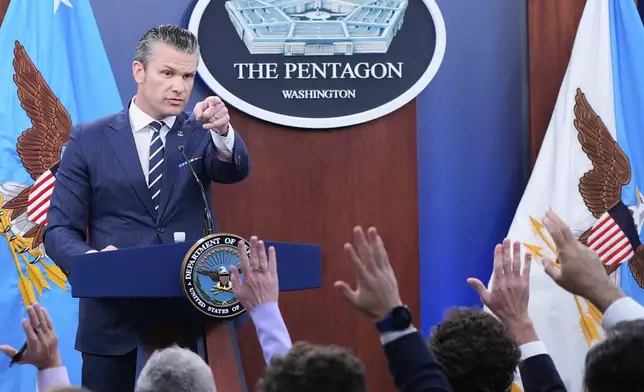
Defense Secretary Pete Hegseth calls on reporters for questions during a news conference at the Pentagon in Washington, Sunday, June 22, 2025, after the U.S. military struck three sites in Iran, directly joining Israel's effort to destroy the country's nuclear program. (AP Photo/Alex Brandon)
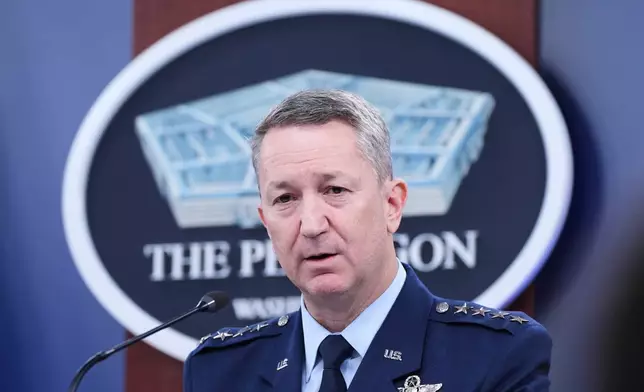
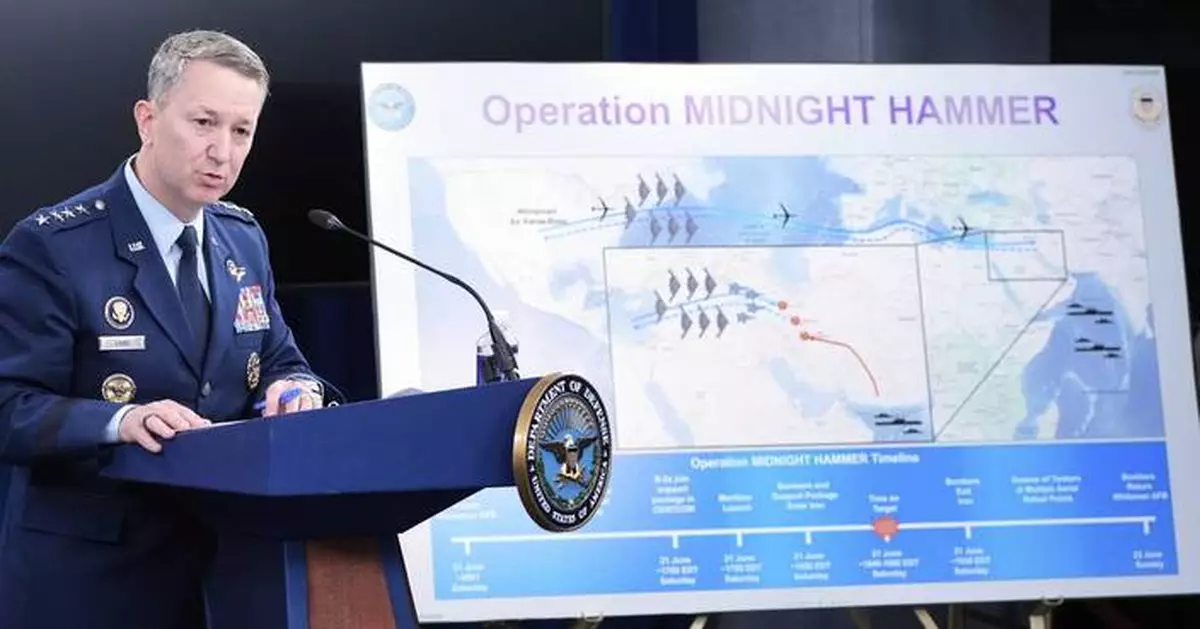
Joint Chiefs Chairman Gen. Dan Caine speaks during a news conference at the Pentagon in Washington, Sunday, June 22, 2025, after the U.S. military struck three sites in Iran, directly joining Israel's effort to destroy the country's nuclear program. (AP Photo/Alex Brandon)
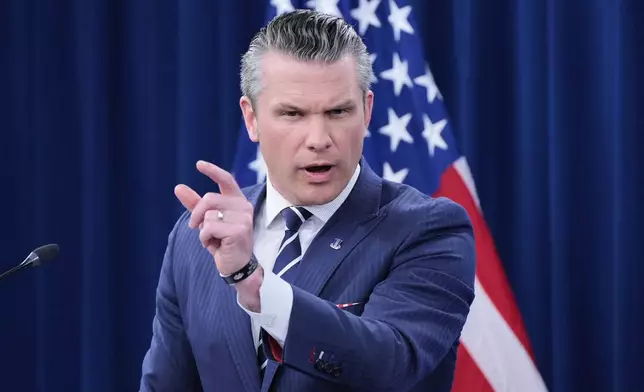
Defense Secretary Pete Hegseth speaks during a news conference at the Pentagon in Washington, Sunday, June 22, 2025, after the U.S. military struck three sites in Iran, directly joining Israel's effort to destroy the country's nuclear program. (AP Photo/Alex Brandon)
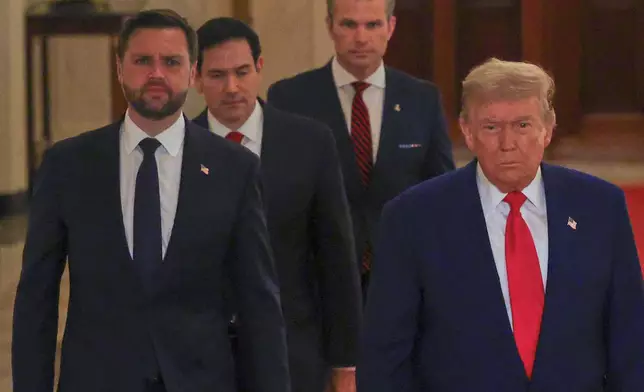
President Donald Trump arrives with Vice President JD Vance, Secretary of State Marco Rubio and Defense Secretary Pete Hegseth to speak from the East Room of the White House in Washington, Saturday, June 21, 2025, after the U.S. military struck three Iranian nuclear and military sites, directly joining Israel's effort to decapitate the country's nuclear program. (Carlos Barria/Pool via AP)
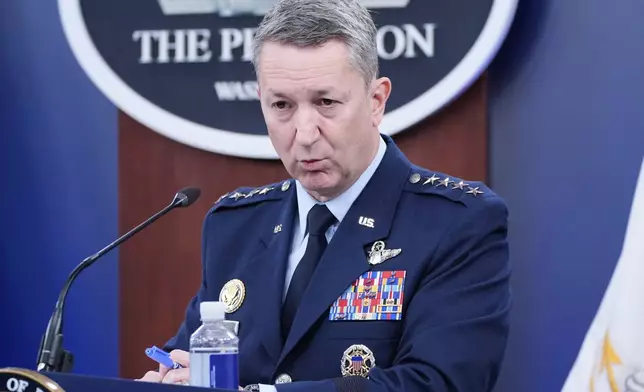
Joint Chiefs Chairman Gen. Dan Caine speaks during a news conference at the Pentagon in Washington, Sunday, June 22, 2025, after the U.S. military struck three sites in Iran, directly joining Israel's effort to destroy the country's nuclear program. (AP Photo/Alex Brandon)
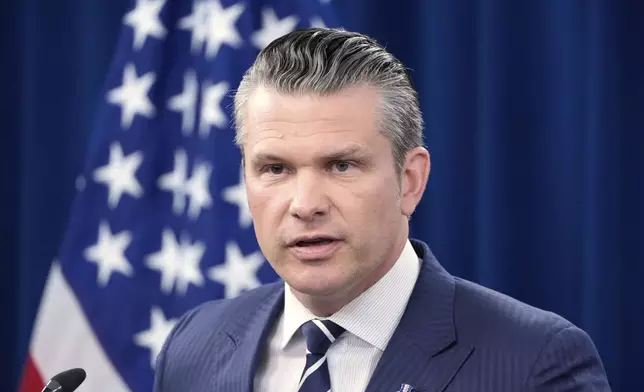
Defense Secretary Pete Hegseth speaks during a news conference at the Pentagon in Washington, Sunday, June 22, 2025, after the U.S. military struck three sites in Iran, directly joining Israel's effort to destroy the country's nuclear program. (AP Photo/Alex Brandon)
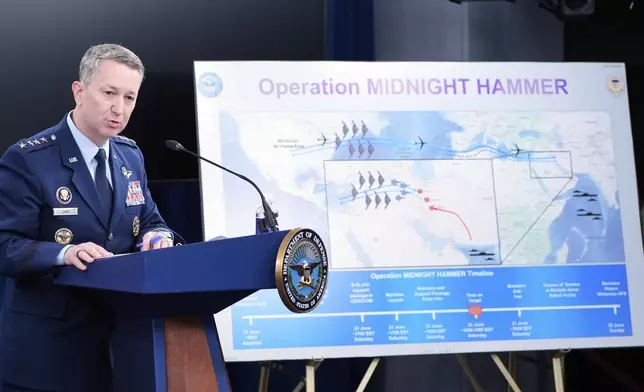
Joint Chiefs Chairman Gen. Dan Caine speaks during a news conference at the Pentagon in Washington, Sunday, June 22, 2025, after the U.S. military struck three sites in Iran, directly joining Israel's effort to destroy the country's nuclear program. (AP Photo/Alex Brandon)
The posting on Truth Social marked something of a reversal from Defense Secretary Pete Hegseth’s Sunday morning news conference that detailed the aerial bombing.
“This mission was not and has not been about regime change,” Hegseth said.
What the administration has made clear is that it wants Iran to stop any development of nuclear weapons, with Secretary of State Marco Rubio warning on Fox News' “Sunday Morning Futures” that any retaliation against the U.S. or a rush toward building a nuclear weapon would “put the regime at risk.”
But beyond that, the world is awash in uncertainty at a fragile moment that could decide whether parts of the globe tip into war or find a way to salvage a relative peace. Trump's warning to Iran's leadership comes as the U.S. has demanded that Iran not respond to the bombardment of the heart of a nuclear program that it spent decades developing.
The Trump administration has made a series of intimidating statements even as it has simultaneously called to restart negotiations, making it hard to get a complete read on whether the U.S. president is simply taunting an adversary or using inflammatory words that could further widen the war between Israel and Iran that began earlier this month.
Up until the U.S. president's post on Sunday afternoon, the coordinated messaging by Trump's vice president, Pentagon chief, top military adviser and secretary of state suggested a confidence that any fallout would be manageable and that Iran’s lack of military capabilities would ultimately force it back to the bargaining table.
Hegseth had said that America “does not seek war” with Iran, while Vice President JD Vance said the strikes have given Tehran the possibility of returning to negotiate with Washington.
But the unfolding situation is not entirely under Washington's control, as Tehran has a series of levers to respond to the aerial bombings that could intensify the conflict in the Middle East with possible global repercussions.
Iran can block oil being shipped through the Strait of Hormuz, attack U.S. bases in the region, engage in cyber attacks or double down on a nuclear program that might seem like more of a necessity after the U.S. strike.
All of that raises the question of whether the strikes will open up a far more brutal phase of fighting or revive negotiations out of an abundance of caution. Inside the U.S., the attack quickly spilled over into domestic politics with Trump choosing to spend part of his Sunday going after his critics in Congress.
Trump also used a social media post to lambaste Rep. Thomas Massie, R-Ky., who had objected to the president taking military action without specific congressional approval.
“We had a spectacular military success yesterday, taking the ‘bomb’ right out of their hands (and they would use it if they could!)” Trump wrote.
At their joint Pentagon briefing, Hegseth and Air Force Gen. Dan Caine, chairman of the Joint Chiefs of Staff, said that “Operation Midnight Hammer" involved decoys and deception, and met with no Iranian resistance.
Caine indicated that the goal of the operation — destroying nuclear sites in Fordo, Natanz and Isfahan — had been achieved.
“Final battle damage will take some time, but initial battle damage assessments indicate that all three sites sustained extremely severe damage and destruction,” Caine said.
Vance said he felt “very confident that we’ve substantially delayed their development of a nuclear weapon.”
Pressed further, he told NBC's “Meet the Press” that “I think that we have really pushed their program back by a very long time. I think that it’s going to be many many years before the Iranians are able to develop a nuclear weapon.”
The vice president said the U.S. had “negotiated aggressively’ with Iran to try to find a peaceful settlement and that Trump made his decision after assessing the Iranians were not acting “in good faith.”
"I actually think it provides an opportunity to reset this relationship, reset these negotiations and get us in a place where Iran can decide not to be a threat to its neighbors, not to be a threat to the United States, and if they’re willing to do that, the United States is all ears,” Vance said.
Rubio said on CBS's “Face the Nation” that "there are no planned military operations right now against Iran, unless, unless they mess around and they attack" U.S. interests.
Trump has previously threatened other countries, but often backed down or failed to follow through, given his promises to his coalition of voters not to entangle the United States in an extended war. It was not immediately clear whether Iran saw the avoidance of a wider conflict as in its best interests.
Much of the world is absorbing the consequences of the strikes and the risk that they could lead to more fighting across the Middle East after the U.S. inserted itself into the war between Israel and Iran. Israeli airstrikes that began on June 13 local time targeted Iran's nuclear facilities and generals, prompting retaliation from Iran and creating a series of events that contributed to the U.S. attack.
While U.S. officials urged caution and stressed that only nuclear sites were targeted by Washington, Iran criticized the actions as a violation of its sovereignty and international law.
Iran’s foreign minister, Abbas Araghchi, said Washington was “fully responsible” for whatever actions Tehran may take in response.
“They crossed a very big red line by attacking nuclear facilities," he said at a news conference in Turkey. “I don’t know how much room is left for diplomacy.”
China and Russia, where Araghchi was heading for talks with President Vladimir Putin, condemned the U.S. military action. The attacks were “a gross violation of international law,” said Russia's Foreign Ministry, which also advocated “returning the situation to a political and diplomatic course.” A Turkish Foreign Ministry statement warned about the risk of the conflict spreading to “a global level.”
British Prime Minister Keir Starmer said the United Kingdom was moving military equipment into the area to protect its interests, people and allies. His office said he talked on Sunday with Trump about the need for Tehran to resume negotiations, but Trump would have posted his remarks about regime change after their conversation.
The leaders of Italy, Canada, Germany and France agreed on the need for “a rapid resumption of negotiations.” France’s Emmanuel Macron held talks with the Saudi crown prince and sultan of Oman.
Iran trying to stop oil exports through the Strait of Hormuz could create the same kind of inflationary shocks that the world felt after Russia invaded Ukraine in 2022. Oil prices have increased as the war between Israel and Iran intensified, climbing by 21% over the past month.
The price of oil rose and U.S. stock futures fell on Sunday, amid uncertainty over Iran — which could undermine Trump's promises to tame inflation and bring consumer prices down.
The Pentagon briefing did not provide any new details about Iran's nuclear capabilities. Hegseth said the timeline for the strikes was the result of a schedule set by Trump for talks with Iran about its nuclear ambitions.
“Iran found out" that when Trump "says 60 days that he seeks peace and negotiation, he means 60 days of peace and negotiation," Hegseth said. "Otherwise, that nuclear program, that new nuclear capability will not exist. He meant it.”
That statement was complicated as the White House had suggested Thursday that Trump could take as much as two weeks to determine whether to strike Iran or continue to pursue negotiations. But the U.S. benefited from Iran's weakened air defenses and was able to conduct the attacks without resistance from Iran.
“Iran’s fighters did not fly, and it appears that Iran’s surface to air missile systems did not see us throughout the mission," Caine said.
Hegseth said that a choice to move a number of B-2 bombers from their base in Missouri earlier Saturday was meant to be a decoy to throw off Iranians. Caine added that the U.S. used other methods of deception as well, deploying fighters to protect the B-2 bombers that dropped a total of 14 bunker-buster bombs on Iran’s sites at Fordo and Natanz.
__
Associated Press writers Brian Melley and Elise Morton in London, Samuel Petrequin in Paris and Giada Zampano in Rome and Will Weissert in Washington contributed to this report.
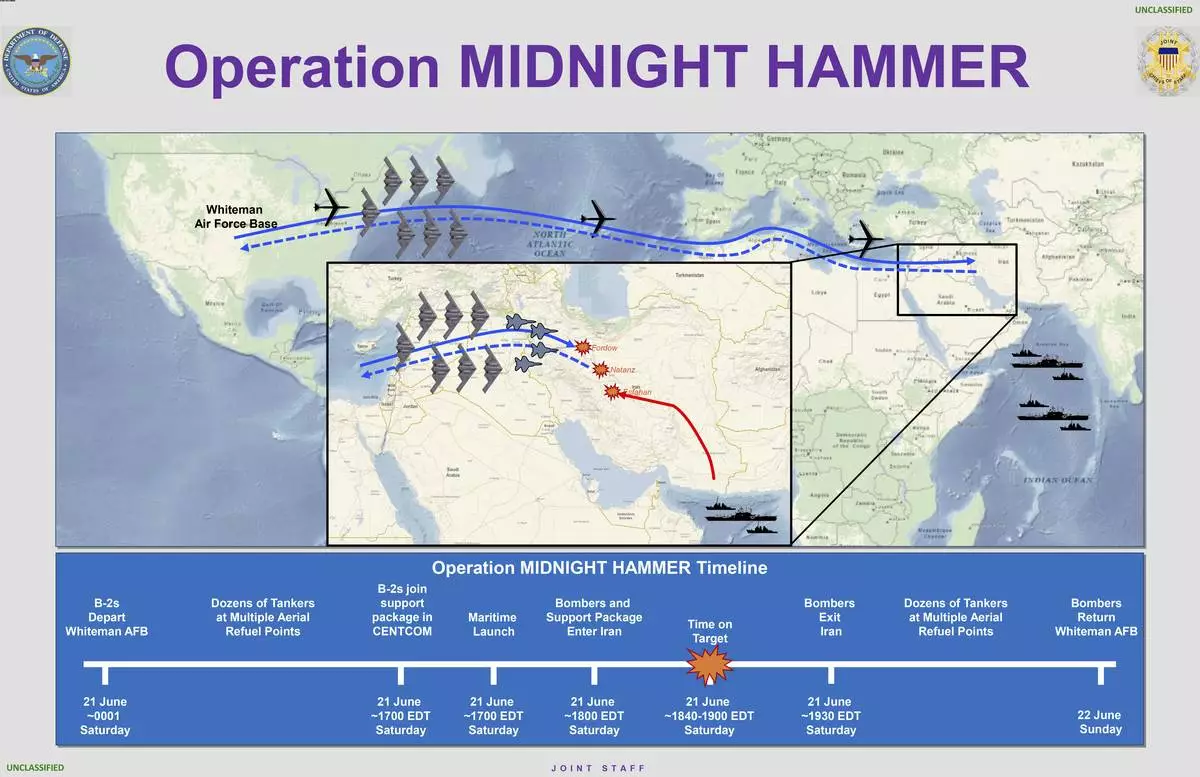
This image provided by the Department of Defense shows a chart that was displayed during a news conference by Defense Secretary Pete Hegseth and Chairman of the Joint Chiefs of Staff Gen. Dan Caine at the Pentagon in Washington, Sunday, June 22, 2025. (Department of Defense via AP)
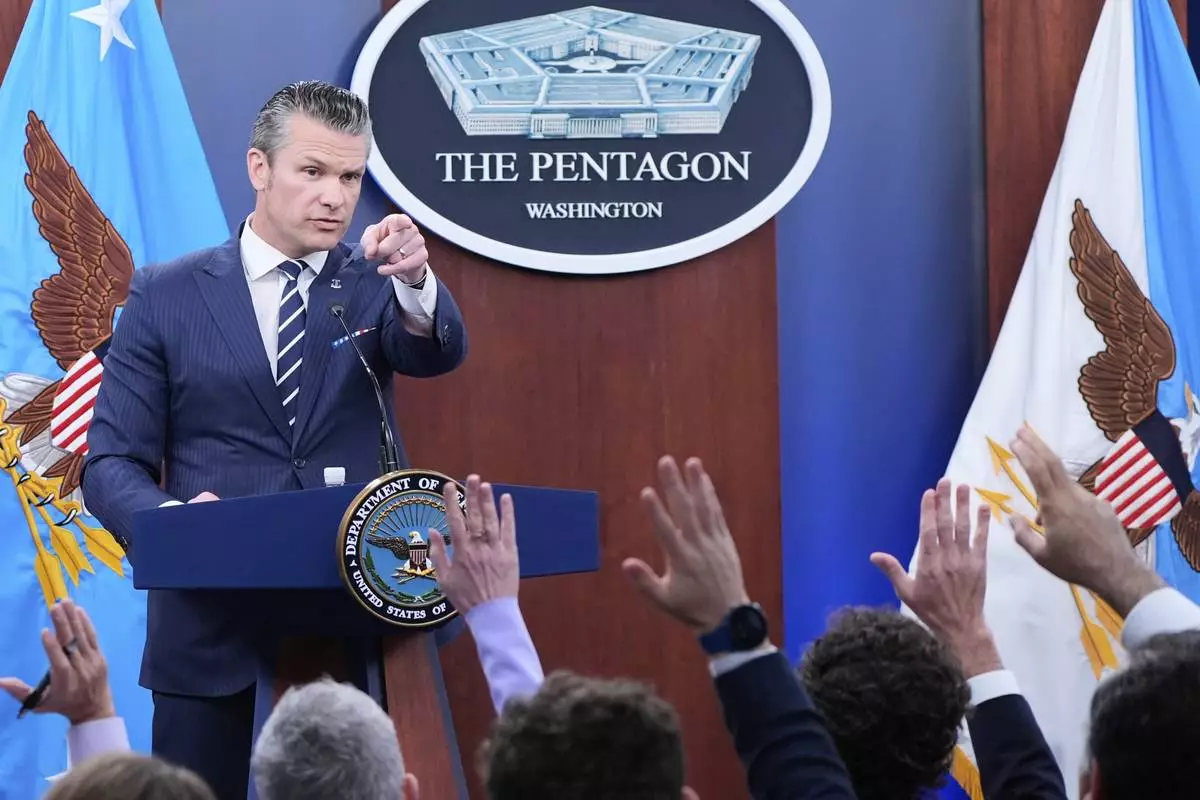
Defense Secretary Pete Hegseth calls on reporters for questions during a news conference at the Pentagon in Washington, Sunday, June 22, 2025, after the U.S. military struck three sites in Iran, directly joining Israel's effort to destroy the country's nuclear program. (AP Photo/Alex Brandon)
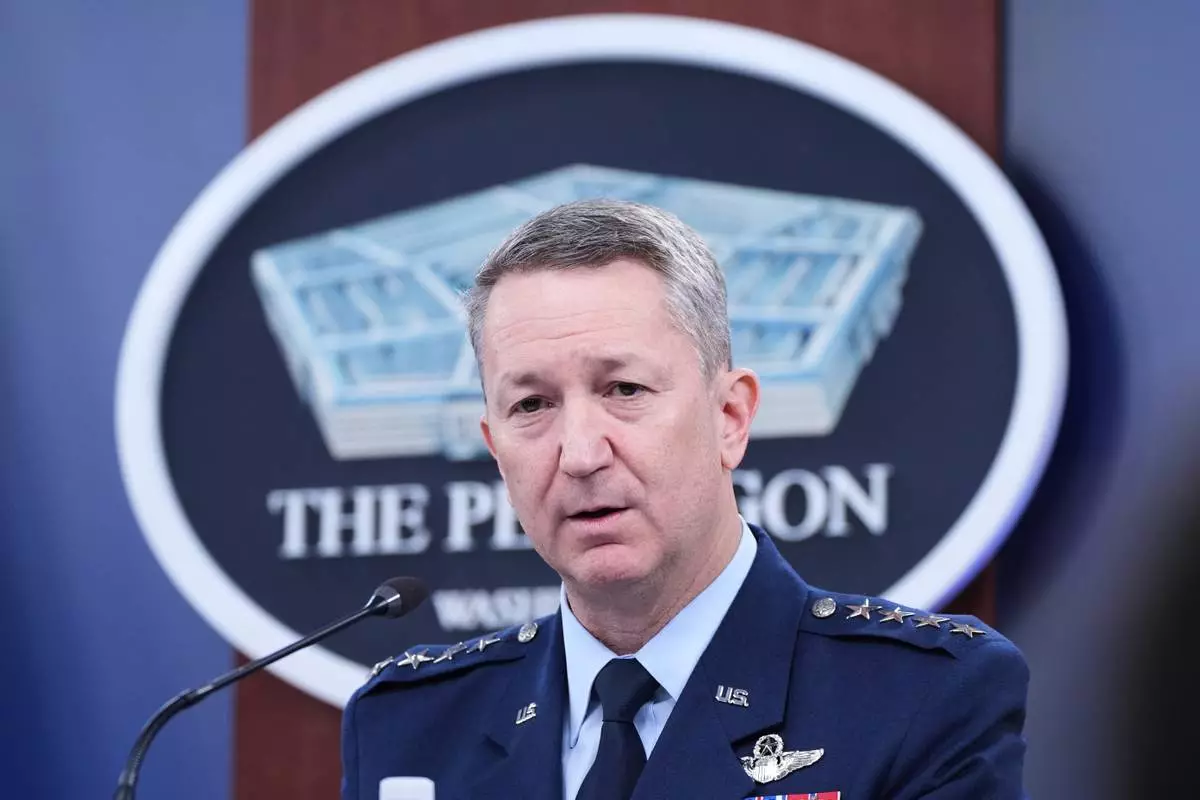
Joint Chiefs Chairman Gen. Dan Caine speaks during a news conference at the Pentagon in Washington, Sunday, June 22, 2025, after the U.S. military struck three sites in Iran, directly joining Israel's effort to destroy the country's nuclear program. (AP Photo/Alex Brandon)
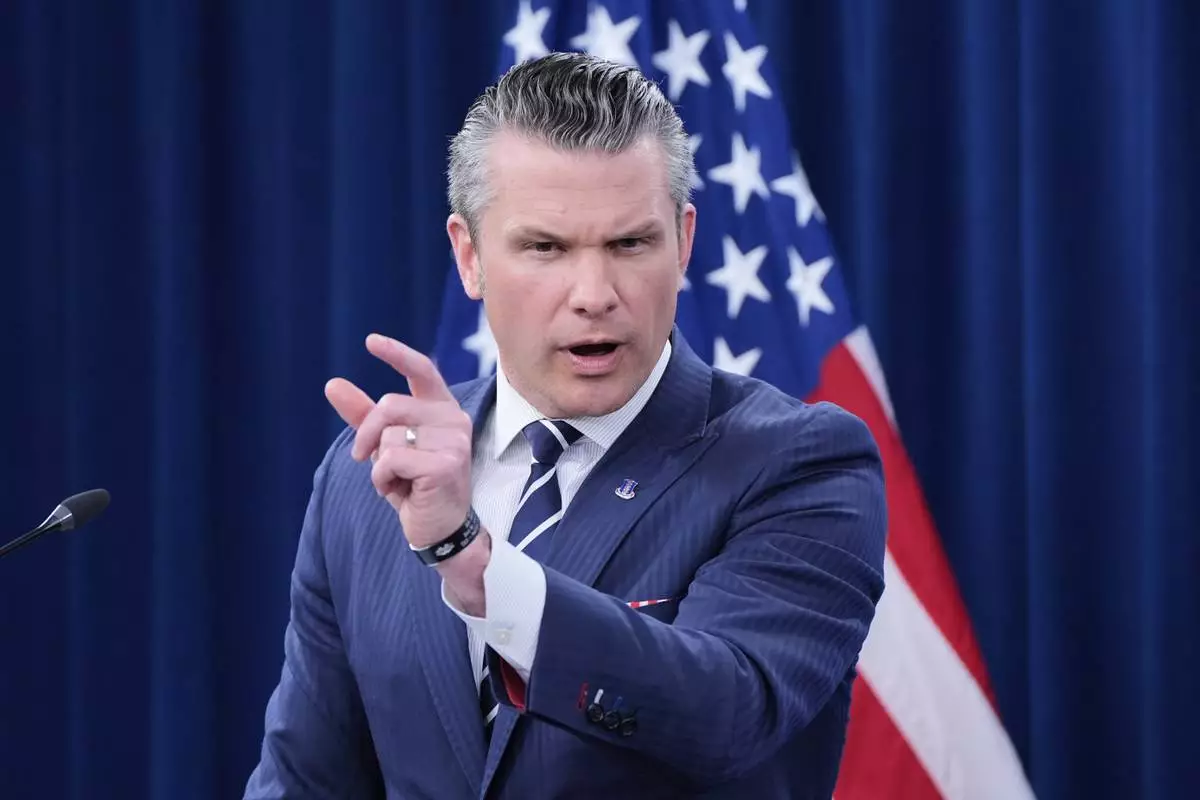
Defense Secretary Pete Hegseth speaks during a news conference at the Pentagon in Washington, Sunday, June 22, 2025, after the U.S. military struck three sites in Iran, directly joining Israel's effort to destroy the country's nuclear program. (AP Photo/Alex Brandon)
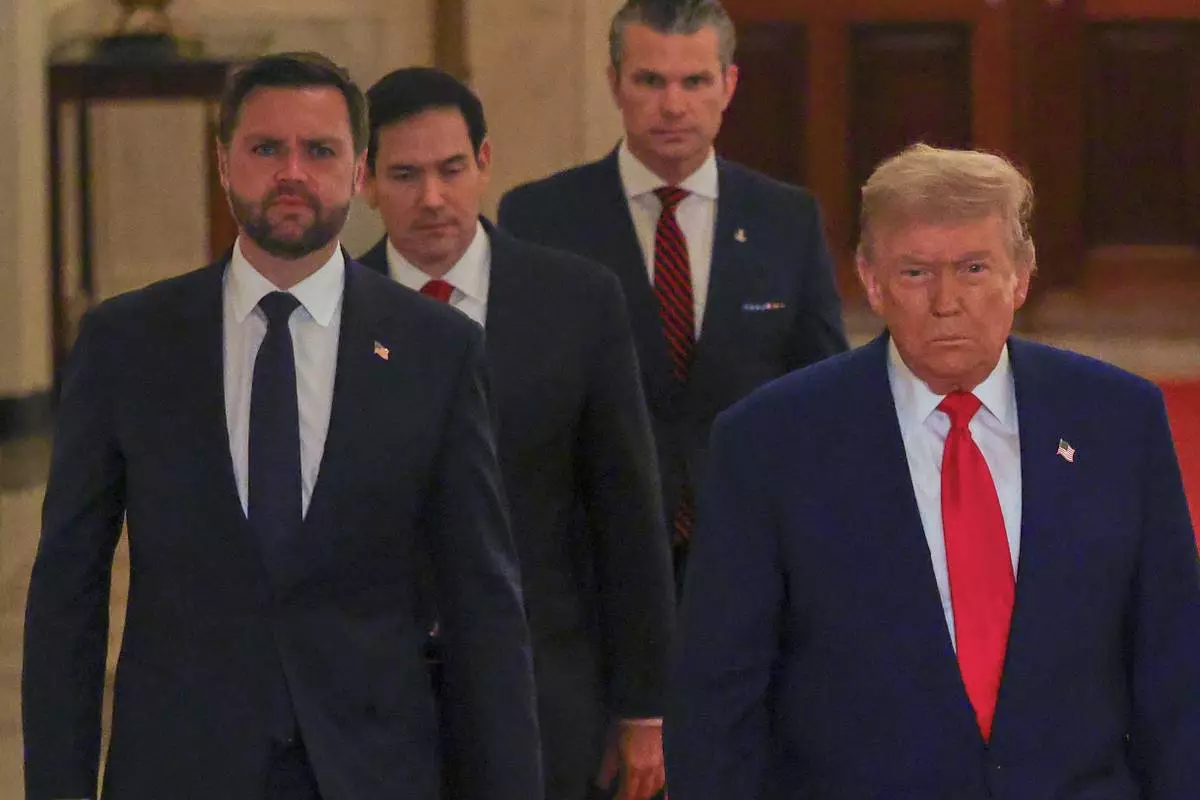
President Donald Trump arrives with Vice President JD Vance, Secretary of State Marco Rubio and Defense Secretary Pete Hegseth to speak from the East Room of the White House in Washington, Saturday, June 21, 2025, after the U.S. military struck three Iranian nuclear and military sites, directly joining Israel's effort to decapitate the country's nuclear program. (Carlos Barria/Pool via AP)
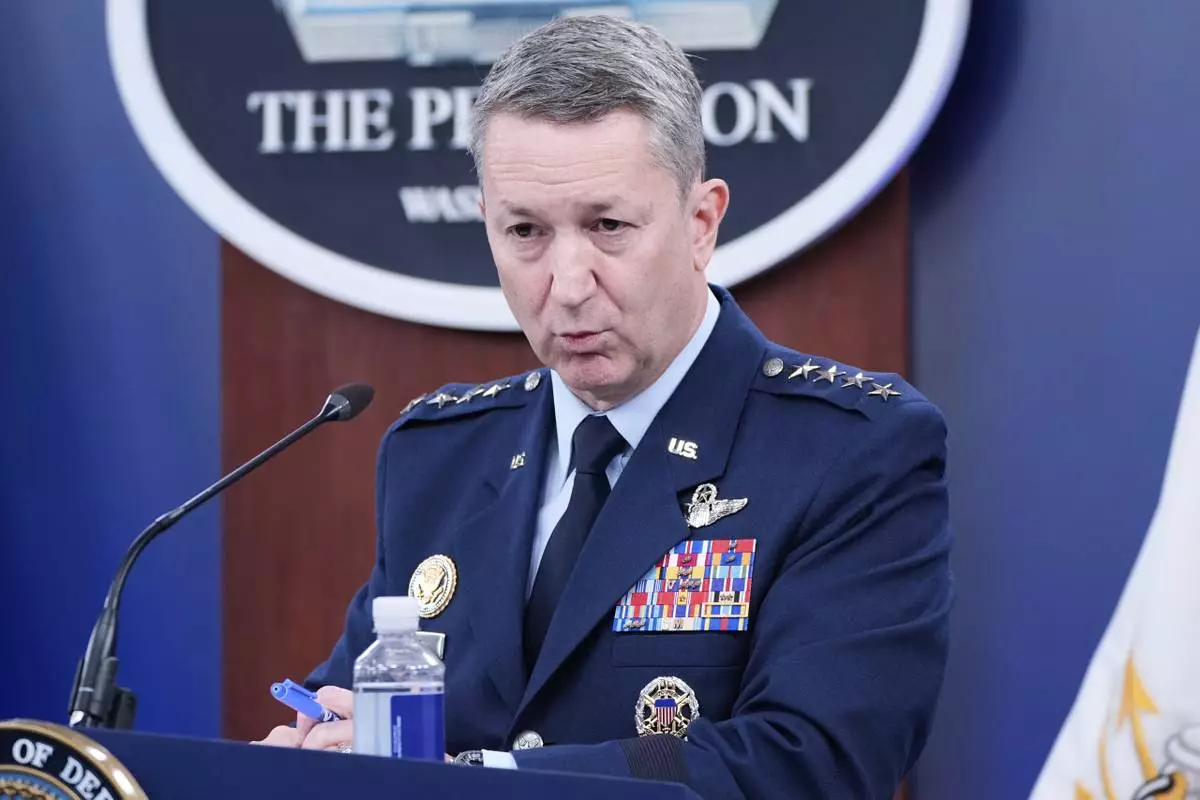
Joint Chiefs Chairman Gen. Dan Caine speaks during a news conference at the Pentagon in Washington, Sunday, June 22, 2025, after the U.S. military struck three sites in Iran, directly joining Israel's effort to destroy the country's nuclear program. (AP Photo/Alex Brandon)
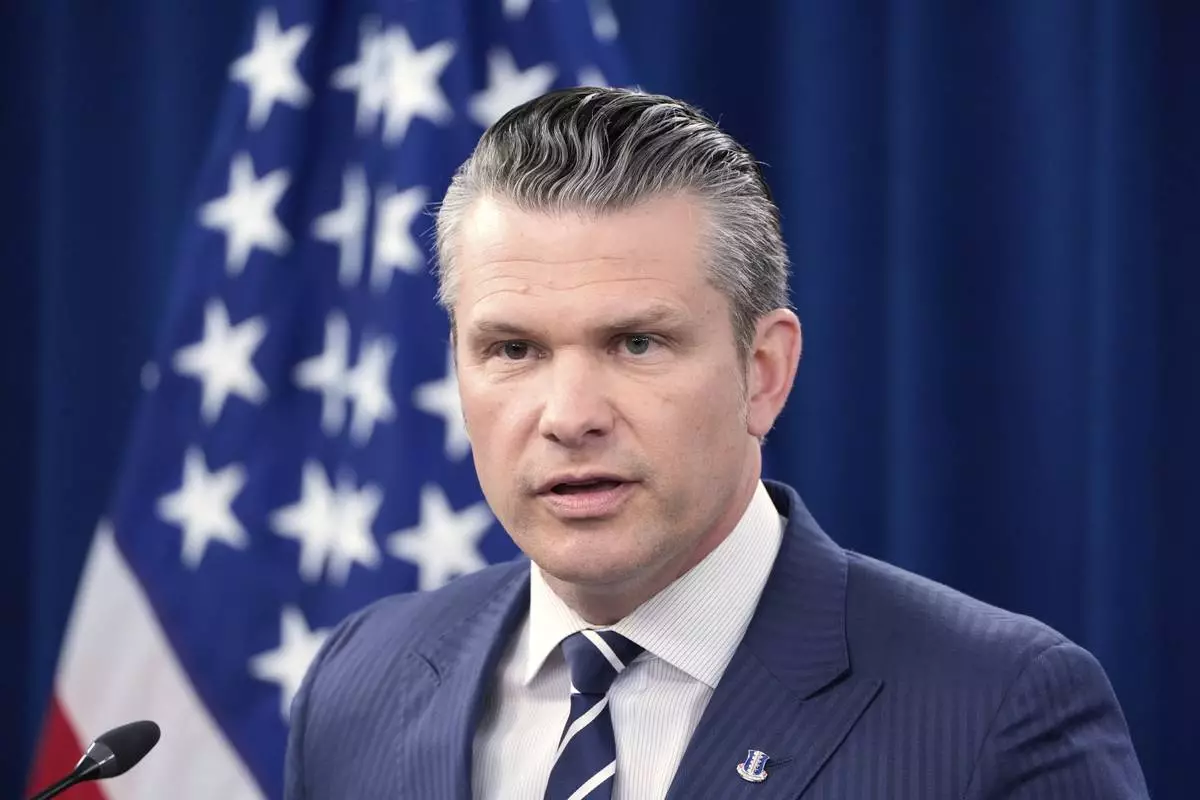
Defense Secretary Pete Hegseth speaks during a news conference at the Pentagon in Washington, Sunday, June 22, 2025, after the U.S. military struck three sites in Iran, directly joining Israel's effort to destroy the country's nuclear program. (AP Photo/Alex Brandon)
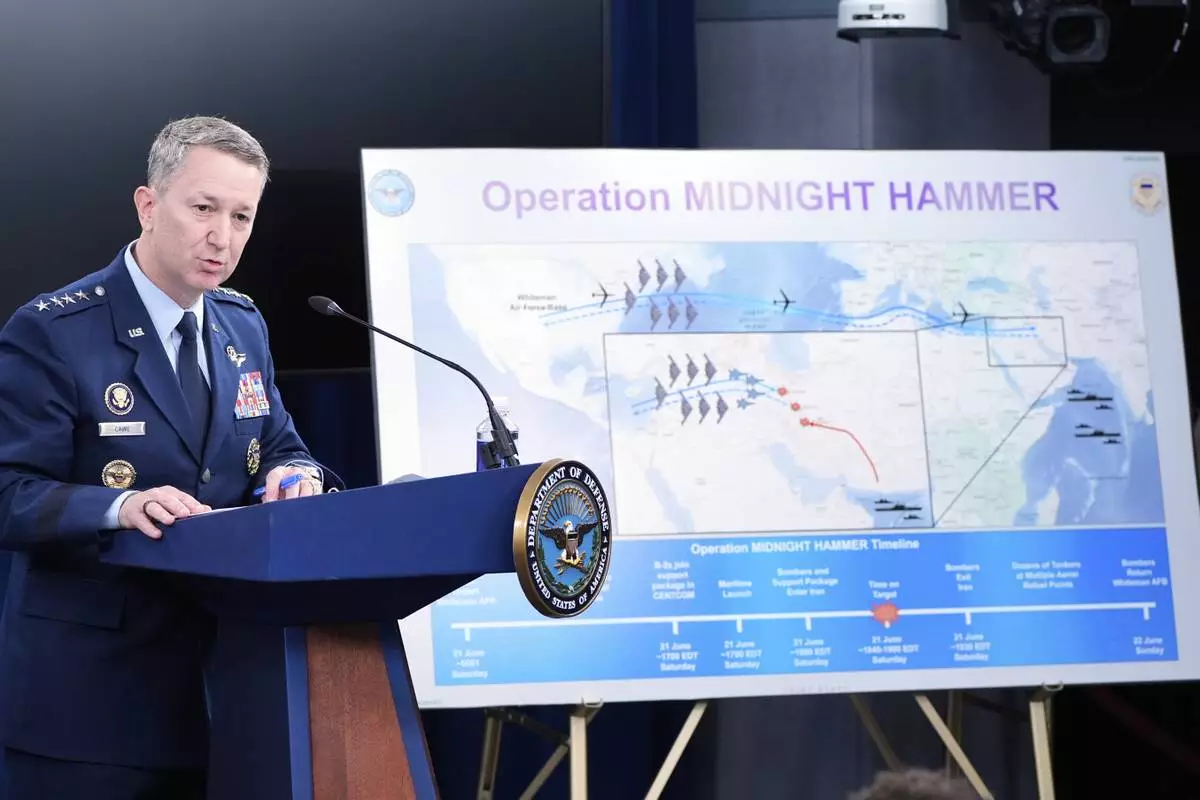
Joint Chiefs Chairman Gen. Dan Caine speaks during a news conference at the Pentagon in Washington, Sunday, June 22, 2025, after the U.S. military struck three sites in Iran, directly joining Israel's effort to destroy the country's nuclear program. (AP Photo/Alex Brandon)