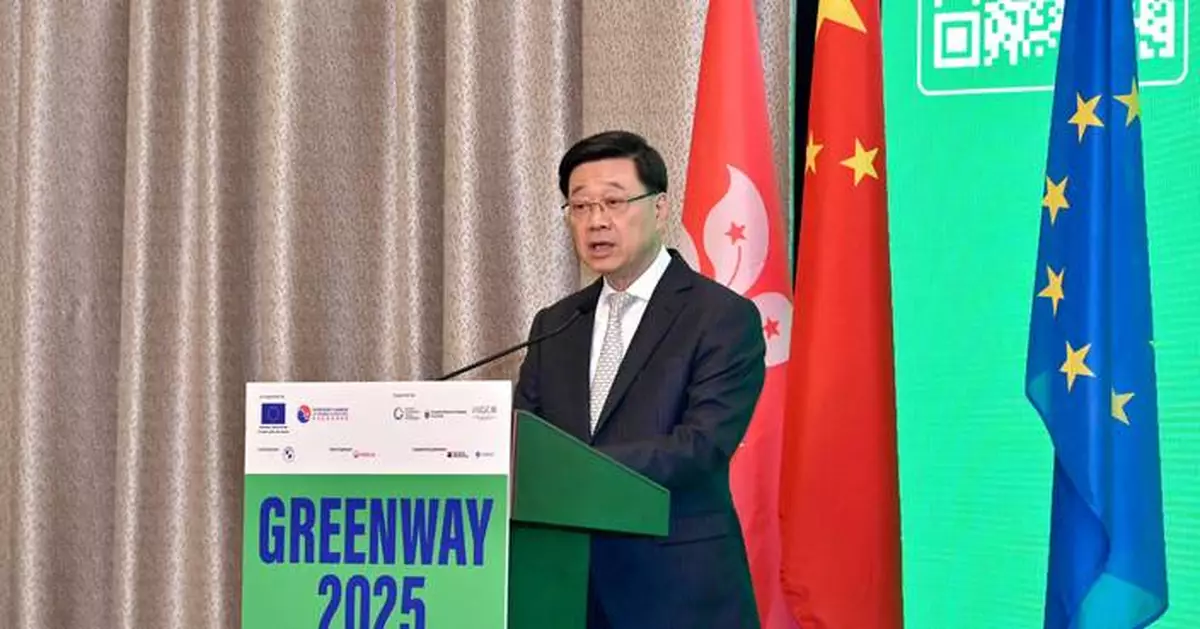
Speech by CE at Greenway 2025 - Accelerating Changes (with photos/video)
Following is the speech by the Chief Executive, Mr John Lee, at Greenway 2025 - Accelerating Changes today (June 23):
Your Excellency Ambassador Harvey Rouse (Ambassador and Head of Office of the European Union to Hong Kong), Mr Iñaki Amate (Chair of the European Chamber of Commerce in Hong Kong), consuls-general, heads of chambers, ladies and gentlemen,
Good afternoon. It is a great pleasure to join you, once again, at the Greenway forum, the fourth edition, this year under the theme of "Accelerating Changes". And, as before, it's organised by the European Union Office to Hong Kong and Macao, and the European Chamber of Commerce in Hong Kong.
The European Union (EU) has long been one of Hong Kong's long-standing business partners. Hong Kong takes pride in being home to 1 640 EU (European Union) companies, which makes the EU the largest foreign business community in Hong Kong. Thank you and welcome indeed.
Alongside business, we come together in so many others areas of mutual interest, from education and cultural exchange to innovation and technology pursuits. And, yes, to the environment - to global warming and all the complexities it entails.
Because climate change affects us all, it must involve us all. Each and every one of us.
The World Meteorological Organization's latest report, published last month, notes that there is a 70 per cent chance that the five-year average warming, for 2025 to 2029, will exceed 1.5 degrees Celsius. That's up significantly from the 47 per cent chance forecast in its report last year. So from a 47 per cent chance the forecast jumped to 70 per cent.
Allow me, for the next few minutes, to tell you what Hong Kong is doing to work against the universal threat of climate change, and to achieve climate neutrality.
Since Hong Kong reached its carbon peak, in 2014, our carbon emissions have dropped by about a quarter. In 2023, our per capita carbon emissions were about 4.58 tonnes. To put that in perspective, it is 60 per cent of the EU's emissions, so we aren't doing too badly, and only one quarter of that of the United States.
Hong Kong is well on its way to cutting its carbon emissions in half by 2035, achieving carbon neutrality before 2050, which is our stated goal.
Last week, we welcomed the news that Hong Kong is once again one of the world's top three most-competitive economies. We are dedicated to decarbonising this international financial, shipping and trade centre while keeping up with our competitiveness. And we do that by engineering green transformation through innovation.
Hong Kong's prowess in financial services places us, favourably, in becoming Asia's premier hub for green and sustainable finance. With our financing platforms, we could help to mobilise the capital for climate solutions, while ensuring robust integrity within our financial markets.
Last year, the total green and sustainable debts issued in Hong Kong exceeded US$84 billion. And the volume of green and sustainable bonds arranged here amounted to US$43 billion. That places us first in the Asian market for seven years in a row, capturing 45 per cent of the region's total.
Our regulatory framework is fundamental to creating a sustainable finance ecosystem. The Hong Kong Monetary Authority published the Hong Kong Taxonomy for Sustainable Finance last year, aligning our taxonomy with the two mainstream taxonomies of the Mainland and the European Union. Encompassing economic activities in power generation, transportation, construction, and water and waste management, it will facilitate green finance flows and promote sustainable development.
Like our economy, Hong Kong's resolve to green transformation goes beyond finance. Consider green transport, a transformation moving into the fast lane on our roads. The adoption of electric vehicles has been remarkable.
Just five years ago, Hong Kong was home to about 14 000 electric vehicles. By the end of last year, that number had surged to about 110 000, that's seven times more.
Today, seven out of every 10 newly registered private cars in our city are electric. That, ladies and gentlemen, is among the highest growth rates in the world.
Vehicles, of course, are only one part of a complex equation. An extensive and convenient charging network is the backbone of any electric vehicle revolution.
Our strategy is people-centric, recognising that the best place to charge is at home or at the workplace. Through our EV-charging at Home Subsidy Scheme, we expect to see charging infrastructure installed in about 140 000 parking spaces in private residential buildings by the 2027-28 financial year. That will enable a smooth and non-disruptive electric vehicle transition for thousands of households.
As for our world-class public transport system, we have unveiled a clear Green Transformation Roadmap for public buses and taxis.
Through targeted subsidy schemes, that will fast-track the introduction of about 600 electric buses and 3 000 electric taxis. We are managing the transition in an orderly manner, using incentives rather than penalties, to ensure that our green ambitions don't translate into additional costs for passengers.
Our vision for green mobility goes well beyond the road. As one of the world's premier aviation hubs, we're looking to the skies, too, to chart the green way to our transport future.
Sustainable Aviation Fuel, or SAF, is critical to the long-term future of air travel. It's also essential to ensuring Hong Kong's continuing leadership in aviation.
SAF has the potential to reduce life-cycle carbon emissions by more than 80 per cent compared to conventional jet fuel. The Hong Kong SAR (Special Administrative Region) Government is working closely with the Airport Authority to set a clear target for SAF consumption.
Globally, SAF supply is limited, and the cost remains high. And we see this as an opportunity for Hong Kong to innovate and lead.
We are exploring a range of supply options, including collaborations with enterprises in the Mainland and internationally. Our goal is to establish a stable and competitive regional supply chain for SAF, taking advantage of our unique position within the Guangdong-Hong Kong-Macao Greater Bay Area. It will accelerate the decarbonisation of our aviation industry and provide greener travel options.
Our green ambitions also extend to the iconic Victoria Harbour, a vital artery for our city. Our Pilot Scheme for Electric Ferries will shape the future of maritime transport.
With a commitment of HK$350 million, the Government is subsidising the construction of new electric ferries and their charging infrastructure, allowing operators to test the new green technology in local waters with full support.
The first two of these pioneering vessels are already navigating Victoria Harbour, following rigorous testing.
Beyond the local waters, we are greening the vast shipping lanes that connect Hong Kong to the world. Hong Kong is already a top 10 port for vessel refuelling.
To build on this, we launched an Action Plan on Green Maritime Fuel Bunkering late last year, with the goal of transforming Hong Kong into a leading international centre for green maritime fuel bunkering.
Industry response has been overwhelmingly positive, with key partners worldwide expressing strong interest in developing the services here. Hong Kong will spearhead the global effort in decarbonising shipping and, in doing so, create new economic opportunities. Something my good friend has already said: "Green actually means business."
When it comes to environmental connectivity, I'm pleased to note that EU companies play an important role in Hong Kong’s waste management and recycling facilities.
And I look forward to the expertise and support of EU companies in the Northern Metropolis, our new engine for growth dedicated to green living, and the area's long-term green development.
Ladies and gentlemen, Hong Kong has an iconic skyline. It also holds a treasure of having some 40 per cent of its land pulsing as the city's green lungs, with country parks breathing life into our metropolis, conservation areas cradling biodiversity little seen in other global financial hubs.
This is Hong Kong's defining paradox: where business and ecology coexist in symphony. For us, economic dynamism and environmental stewardship aren't just compatible - they're dual engines propelling our future. We balance development with sustainability. And we will do all we can to work with other places, the EU very much included, on the green way forward.
I look forward to building strong ties with the EU, to finding solutions to climate change, to creating far-reaching opportunities for us all.
My thanks to the organisers, the European Union Office to Hong Kong and Macao and the European Chamber of Commerce in Hong Kong. I'm grateful, too, to today's supporting organisations - the Business Environment Council, the Consulate General of Sweden and the Hong Kong General Chamber of Commerce.
I am certain you will enjoy today's Greenway forum, and I look forward to our continuing, rewarding, co-operation in the years to come. Thank you.
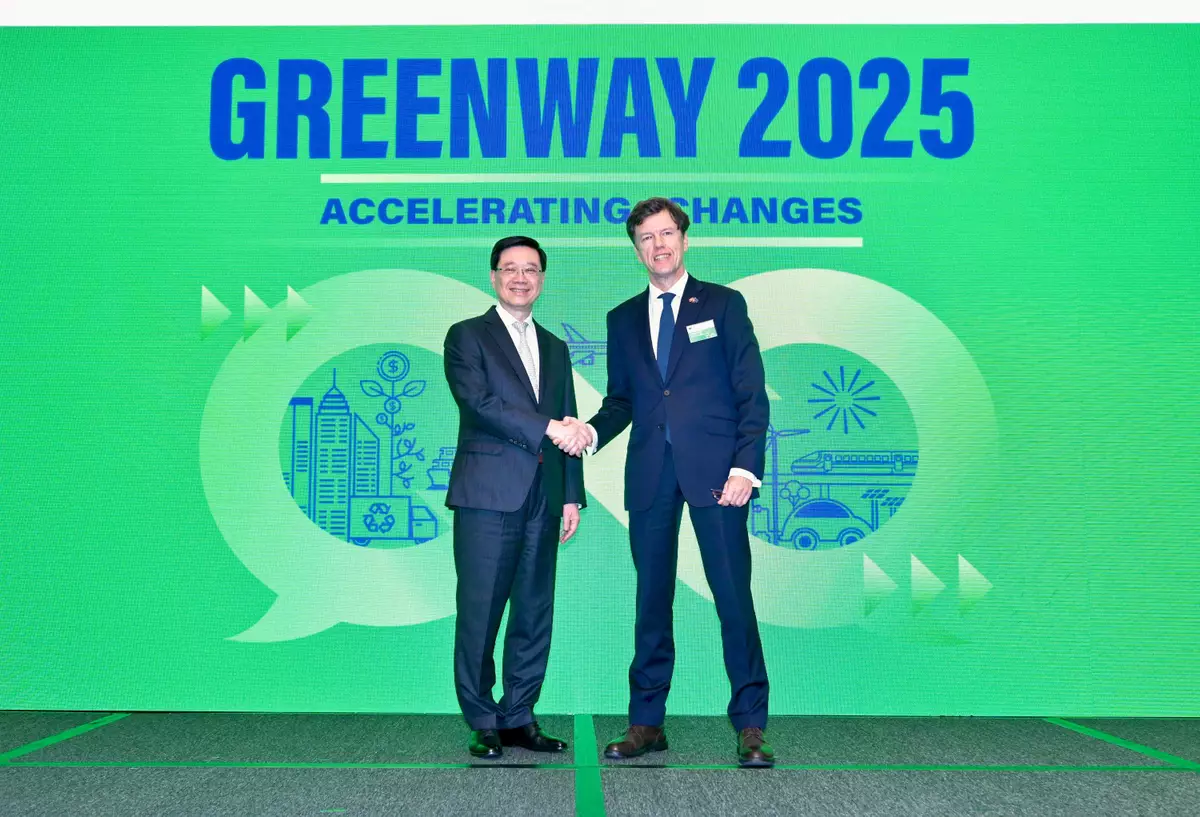
Speech by CE at Greenway 2025 - Accelerating Changes (with photos/video) Source: HKSAR Government Press Releases
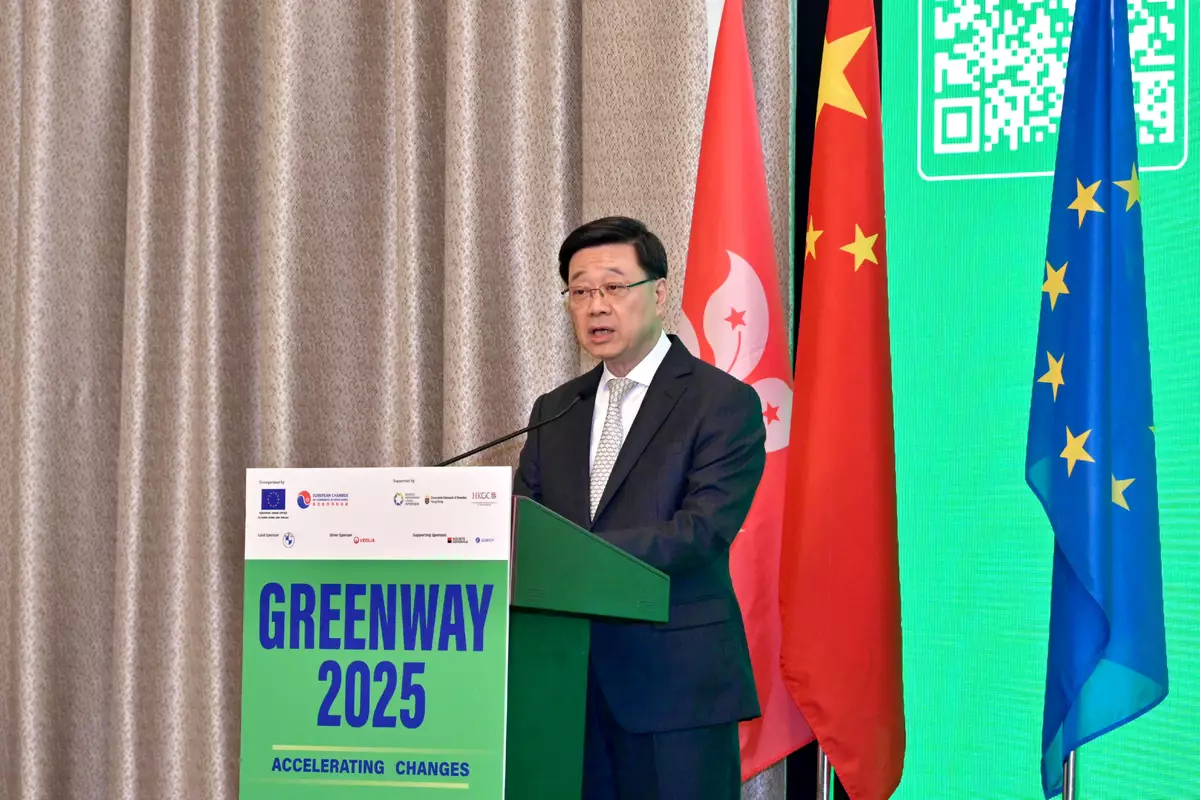
Speech by CE at Greenway 2025 - Accelerating Changes (with photos/video) Source: HKSAR Government Press Releases