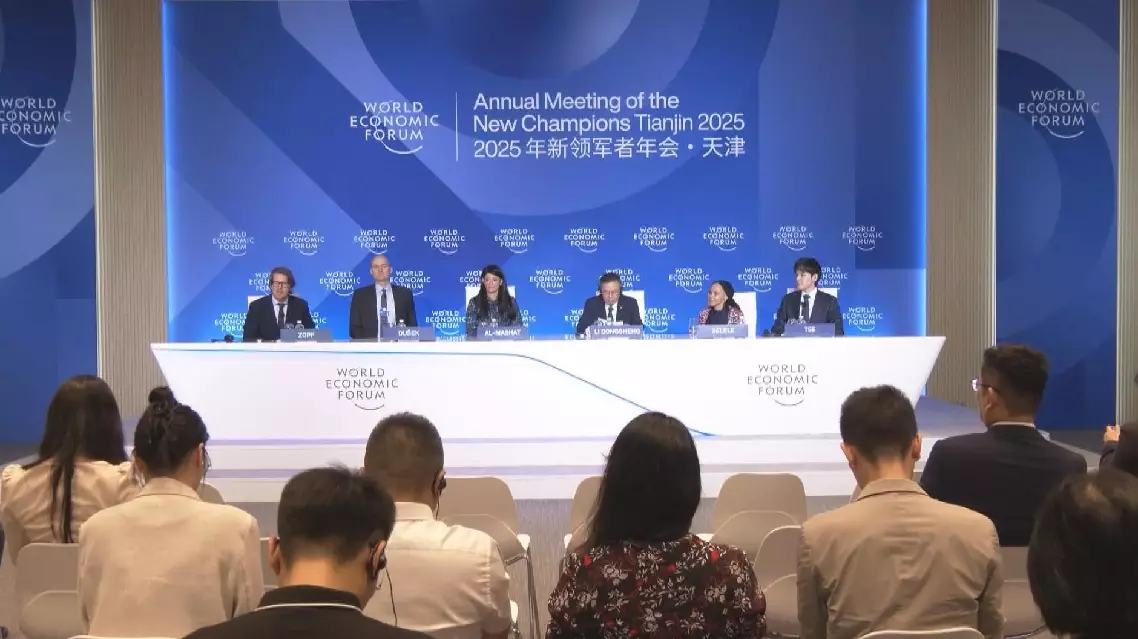
The 16th World Economic Forum (WEF) Annual Meeting of the New Champions, known as Summer Davos forum, opened at Tianjin's National Convention and Exhibition Center on Tuesday, bringing together global leaders to explore the future of the world economy through innovation and entrepreneurship.
From Tuesday to Thursday, around 1,800 participants from nearly 90 countries and regions, one of the largest gatherings in recent years, will center on the theme of "Entrepreneurship in the New Era" to discuss issues in five key areas, namely, the world economy, China outlook, industrial transformation, investing in humanity and the planet, and new energy and materials.
Opening discussions on Tuesday morning covered a range of hot global topics, from deep integration of artificial intelligence across various industries, new regulatory challenges brought by the shift from traditional currency to blockchain, to advancements in battery technology fueling the surge in electric vehicles, and green energy transition driving industrial transformation.
"We have a lot of unicorns and other entrepreneurs and innovators from within China corresponding to the different technologies that are really shaping the economies of tomorrow from AI and blockchain quantum, but then really going through health tech, clean tech, biotech, biopharma, space tech, really covering all these technologies," said Mirek Dusek, managing director of the World Economic Forum. "All of us know that a very big challenge for the global economy is sluggish growth. And World Economic Forum has the legacy of bringing everyone together, and we say everyone, it's policy makers, private sector, civil society and entrepreneurs particularly. When we talk about entrepreneurship, it's not just about technology, but also entrepreneurial policy making and trying to create resilient and innovative policy framework so that we are able to weather the different shocks we are facing," said Rania Al-Mashat, Egypt's Minister of Planning, Economic Development, and International Cooperation.
Also unveiled on Tuesday morning was the "Top 10 Emerging Technologies of 2025" list, which spans fields of engineered biotherapies, Internet of Things (IoT), and smart transportation. Relevant policymakers and experts believe they have the potential to drive exponential transformation in the future economy and society.
"That's going to be rapidly scaling and deployed over. I mean any of you can count how many IoT devices you have on you in person right now, then in your household, in your larger environment and now having those devices actually starting to talk to one another, understand each other and supported by a genetic services underneath. That's already in place and we'll see that rapidly emerging," said Jeremy Jurgens, managing director and head of the WEF's Center for the Fourth Industrial Revolution and Center for Cybersecurity.
Highlighting China's growing role in global AI advancement, Sheikh Tanjeb Islam, head of the WEF's event editorial team, pointed to the participation of major Chinese AI firms, particularly from Hangzhou, known as the hub of emerging tech giants.
"So of the Hangzhou 'Six (Little) Dragons,' we have four of them present in this year's Summer Davos and four of them will also speak. We feel that it gives a spotlight on China's AI ecosystem, which obviously is now one of the top most when it comes to the world AI ecosystem," he said.
The "Six Little Dragons" refer to the six enterprises of Game Science, DeepSeek, Unitree Robotics, DEEP Robotics, BrainCo and Manycore Tech - all "tech upstarts" that have risen to prominence in Hangzhou over the past two years and hold significant influence within their respective industries.
Summer Davos opens in Tianjin, focusing on innovation