The 2025 Summer Davos forum concluded its second day in north China's Tianjin Municipality on Wednesday, with global leaders and economists stressing the importance of upholding globalization, strengthening mutual understanding, and fostering greater connectivity in order to tackle the threat posed by rising unilateralism which risks plunging the global economy into greater uncertainty.
This year's three-day event, organized by the World Economic Forum (WEF) and also officially known as the 16th Annual Meeting of the New Champions 2025, has gathered more than 1,700 guests from over 90 countries and regions across the world, making it one of the largest attended editions to date.
Themed "Entrepreneurship for a New Era," the major gathering of global business leaders is focusing on five key areas: deciphering the world economy, outlook on China, industries disrupted, investing in people and the planet, and new energy and materials.
Delivering a keynote speech at Wednesday's opening plenary, Chinese Premier Li Qiang called on the international community to take constructive actions in economic and trade cooperation and urged more practical measures to safeguard free trade and multilateralism while promoting the stable development of the world economy.
He also called on global entrepreneurs to stay committed to the principles of multilateralism and avoid politicizing trade or security issues.
"The new era requires entrepreneurs to play bigger roles, assume greater responsibilities and add more new dimensions to entrepreneurship. I encourage you to do more things for the greater good. I hope you will always follow the laws of the market, do what is right, champion openness and cooperation, uphold economic globalization, oppose decoupling and severing of supply chains and not to turn trade into a political or security issue," Li said.
Former British Prime Minister Tony Blair, while acknowledging the potential problems that may arise in differences between China and the West, stressed the importance of gaining a better understanding of the Chinese perspective in order to overcome biased views which may hurt bilateral ties.
"Whatever differences there are, it's important we stay engaged and we try and understand China, try and see China through Chinese eyes, not just through Western eyes, because otherwise you will end up with more ignorance, misunderstanding and potentially conflict when we really can't afford to have that happen," Blair said in an interview on the sidelines of the forum.
The Tianjin forum also saw discussions on how China's manufacturing sector is navigating challenges faced with disruptive impact of rising unilateralism and trade protectionism on the global supply chains.
"Restricting and suppressing China may in turn stimulate China's manufacturing industry to further accelerate the process of amending and reinforcing the supply chain. According to the forecast of UN Industrial Development Organization, China's manufacturing output is expected to reach 40 percent or more of the world total in five years. This is an increase in quantity, and China's manufacturing industry is gradually becoming the engine of global manufacturing," said Peng Sen, president of the China Society of Economic Reform.
At another session, many economists expressed concerns that global fragmentation, if not reined in, could cause further shocks across the world, and risks damaging every entity from companies to individuals.
"If you've have got a high level of uncertainty, firms are reluctant to invest, and consumers are reluctant to spend, we have seen some closures [on the market]," said Paul Gruenwald, global chief economist for leading financial services firm S and P Global Ratings.
A key focus of this year’s gathering is China’s vibrant startup ecosystem, which has been recognized as a hub of cutting-edge innovation and future-oriented growth,.
Verena Kuhn, head of the WEF's Innovator Communities program, emphasized the private sector’s vital role as a driving force behind global innovation, noting developments including the open source AI model developed by Chinese start-up DeepSeek which made global headlines earlier this year.
She also stressed the role of the forum in fostering global connectivity, saying it helps bridge China's ecosystem with international innovation networks.
"think connection is a really good word, right? When you look at start-up ecosystems and you measure their strengths, what we see is there is a direct correlation between a number of connection speed within an ecosystem, but also globally. And so connections is something that helps us to drive innovation, to come up with better companies. In that sense, the more connections, the better," she said.
"This is really what we try as a forum to offer a platform for collaboration between private-sector companies, but also policy makers. That's also something that we try and do with the communities that I lead. Just yesterday, we had our welcome dinner for more than 100 founders that are with us here in Tianjin. And I can say there were several international companies, companies from the from the U.S., from Europe, that probably wouldn't have come otherwise. And they are really very amazed to discover things that they find here in China and the great ecosystem," Kuhn added.
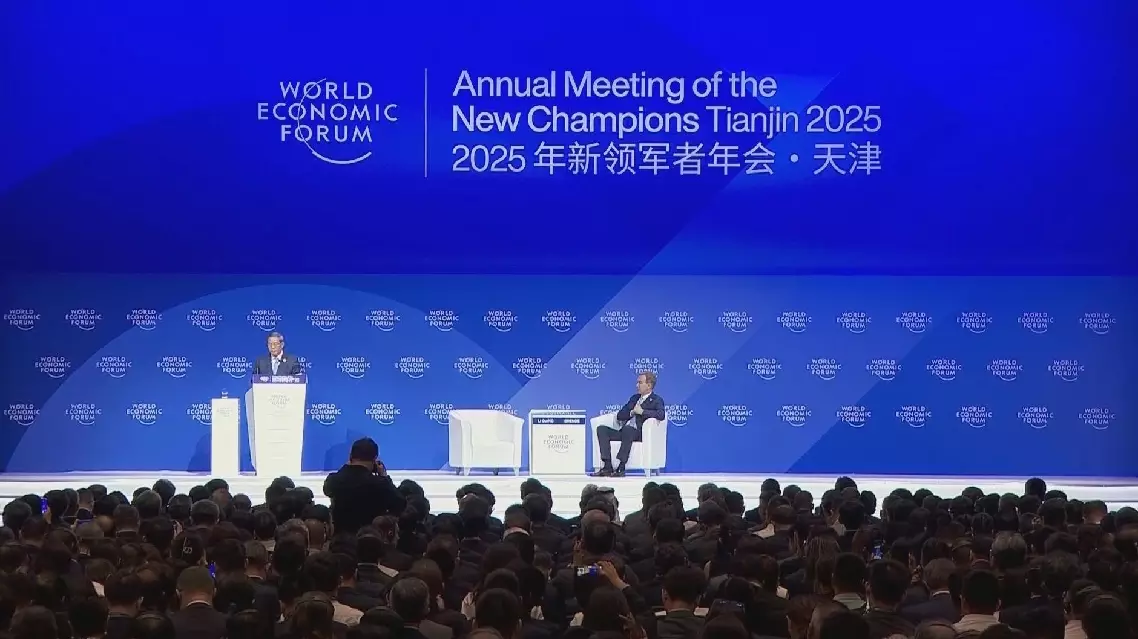
Global leaders, economists call for upholding globalization, fostering greater connectivity at Summer Davos