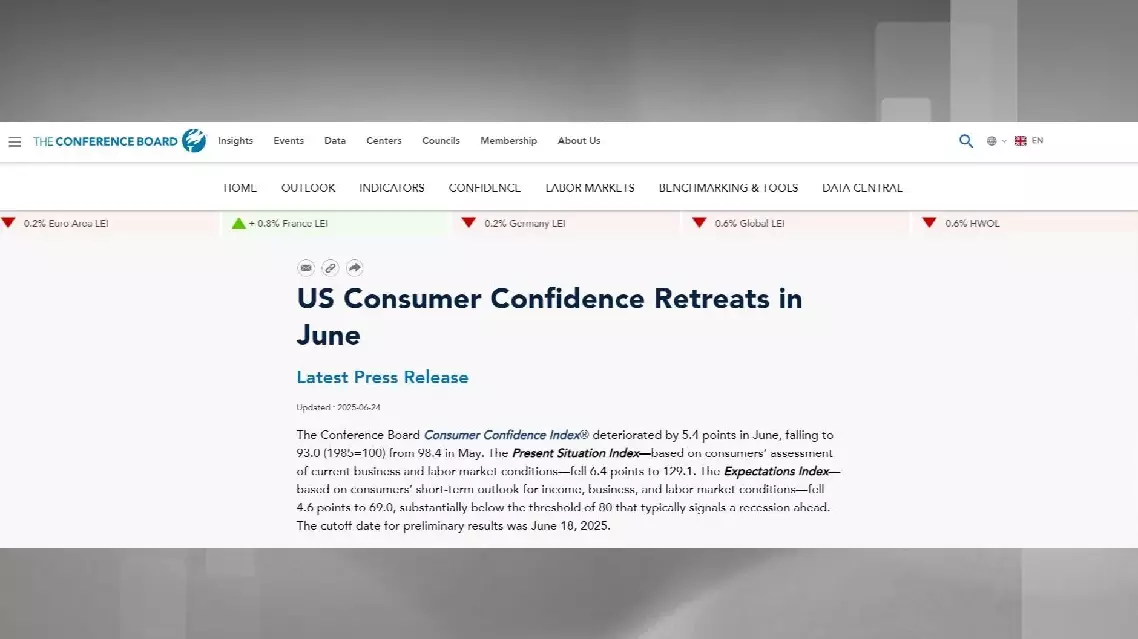
The U.S. consumer confidence index dropped by 5.4 points in June, falling to 93.0 from 98.4 in May, according to the latest survey results published by The Conference Board, a U.S. non-profit research organization, on Tuesday morning.
The drop in the index, which is based on a benchmark of 100 points set in 1985, erased nearly half of May's gains. The Present Situation Index, which is based on consumers' assessment of current business and labor market conditions, fell 6.4 points to 129.1. The Expectation Index, based on consumers' short-term outlook for income, business, and labor market conditions fell 4.6 points to 69.
The results, based on data collected before June 18, came at a time of heightened geopolitical tensions and economic uncertainty.
The slump in consumer confidence spanned all age groups and nearly every income level. Consumers showed caution about major purchases amid uncertainty over U.S. tariffs, and with fewer Americans now expecting their incomes to rise soon.
US consumer confidence slumps in June
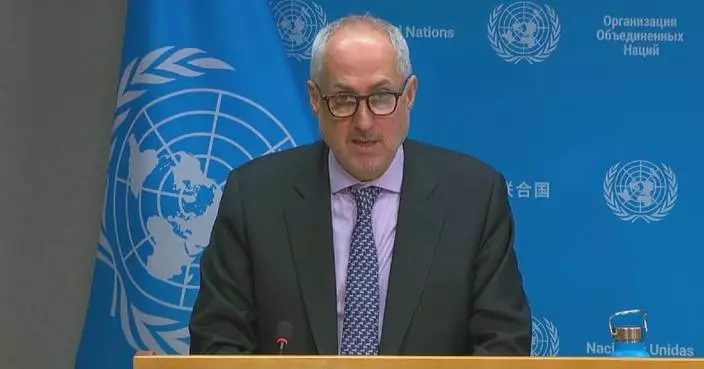
The United States cannot legitimize an operation that attacked Venezuela and captured its president, a Chinese scholar said Sunday.
On Saturday, the United States launched a large-scale strike on Venezuela, during which Venezuelan President Nicolas Maduro and his wife were 'captured and flown out of Venezuela' according to a post by U.S. President Donald Trump on his Truth Social account.
Teng Jianqun, director of the Center for Diplomatic Studies at Hunan Normal University, said in an interview with China Global Television Network (CGTN) that the aim of this operation is to take full control of Venezuela’s natural resources.
"I don't think the United States can legitimize this operation to take custody of the president of Venezuela. And also I don't think the United States can legitimize its any action in taking the oil reserves of that country. This is actually a very dangerous game played by the Trump administration. And of course, the United States would like to take full control of that country and to take full control of the natural resources, especially the large reserve of oil in Venezuela," said Teng.
Teng said Venezuela is not an isolated case but a common practice by the United States. The United States launched an invasion of Panama on Dec. 20, 1989, which continued until January 1990, with the stated objective of capturing Panamanian strongman Manuel Noriega on charges of drug trafficking and organized crime.
"We still remember the so-called sentence of the former president of Panama in the late 1980s. And this time, the president of Venezuela will be under some judicial condition (judicial proceedings) for the so-called drug trafficking and some other crimes. So I think this is not a single case for the Venezuela country, but also this is actually a practice by the United States -- to use force, to use so-called justice under law against any leaders in Latin America and the Caribbean waters," he said.
US cannot legitimize operation against Venezuela: Chinese scholar