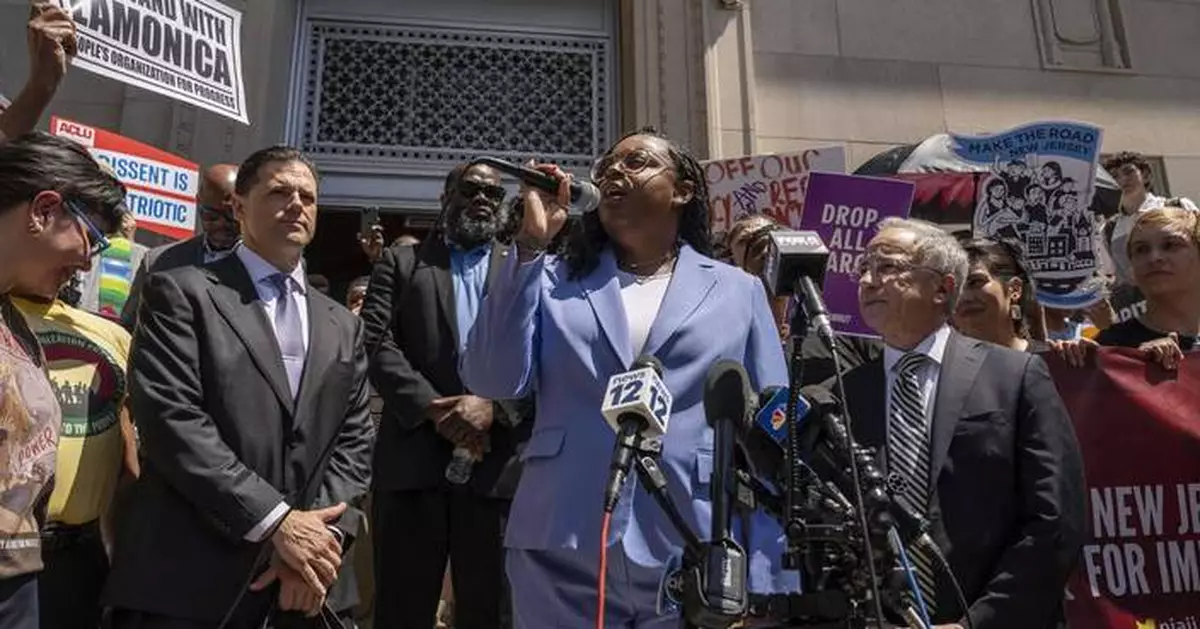
NEWARK, N.J. (AP) — U.S. Rep. LaMonica McIver pleaded not guilty Wednesday to charges she assaulted officials during an oversight visit to an immigration detention center in May. It's a rare federal prosecution against a current member of Congress on charges other than corruption or fraud.
Outside court, the congresswoman was defiant, saying the charges won't stop her from doing her job.
The 39-year-old Newark, New Jersey, native is in her first full term in Congress, and has garnered more attention than many longer-tenured members.
Here's a closer look at the 10th District Democrat:
McIver was born in Newark, New Jersey's largest city, and grew up in what Newark Mayor Ras Baraka — who was her elementary school teacher — said was a tough neighborhood. Baraka has become one of her most vocal and highest profile supporter and was in court Wednesday to support her.
Federal immigration officials arrested Baraka outside the Delaney Hall detention center on May 9 on a trespassing charge they later dropped. McIver was seen guarding him in video released from the encounter.
In an interview, he recalled McIver as a smart student whose mother sent her to help with one of his elections, passing out campaign literature. He recalled running unsuccessfully for years before finally getting elected, and said McIver was at his side for much of it.
“She’s the same person in spirit who she was in the fifth and sixth grade,” Baraka said. “She still has that fight in her, that ability and desire, you know, not to be bullied or pushed around and to, you, know, represent herself, her community—she's still doing that.”
McIver attended Bloomfield College and Seton Hall University in South Orange, New Jersey, where she obtained a master's degree. She worked in public education, including stints with Newark and Montclair public schools, and in 2018 was elected to the Newark City Council.
She became the council's president in 2022. A measure lowering the voting age to 16 for school board elections in the city passed under her tenure, among others.
New Jersey state Senate Majority Leader Teresa Ruiz said she forged a bond with McIver during the COVID-19 pandemic when they attended their daughters' soccer games. They discussed balancing work and life.
“This is a women who loves her family,” Ruiz said. This is woman who loves public office. This is the woman who loves her city, her state and her country."
A request for an interview or comment sent to McIver's office was not answered.
In 2024 McIver emerged victorious from the Democratic field and won a special election in September after Rep. Donald Payne Jr. died in office. She won a full two-year term in November.
LeRoy Jones, who chairs the state Democratic Party as well as its Essex County counterpart, described her as a rising star. She can “walk with Kings and Queens but still has the common touch,” he said.
In Congress, McIver sponsored legislation to remove a cap on shelter expenses that beneficiaries can claim for the Supplemental Nutrition Assistance Program as well as a gun buyback measure aimed at making neighborhoods safer. Neither bill has advanced in the GOP-led House.
McIver faces three counts of assaulting, resisting, impeding and interfering with federal officials. If convicted, she could potentially face prison time, though a judge could impose a lesser penalty.
McIver’s lawyer, former U.S. Attorney for New Jersey Paul Fishman, said Wednesday "she pleaded not guilty because she is not guity."
The charges stem from a congressional oversight visit to the center that McIver and Reps. Bonnie Watson Coleman and Rob Menendez undertook that resulted in Baraka's arrest after officials determined he wasn't authorized to enter. Members of Congress are authorized by law to conduct visits.
A criminal complaint alleges that she “slammed” her forearm into an agent and then tried to restrain the agent by grabbing him.
The indictment also says she placed her arms around the mayor to try to stop his arrest and says again that she slammed her forearm into and grabbed an agent.
A nearly two-minute video clip released by the Homeland Security Department shows McIver at the facility inside a chain-link fence just before Baraka’s arrest on the other side of the barrier, where other people were protesting. McIver and uniformed officials go through the gate, and she joins others shouting that they should circle the mayor.
The video shows McIver in a tightly packed group of people and officers. At one point, her left elbow and then her right elbow push into an officer.
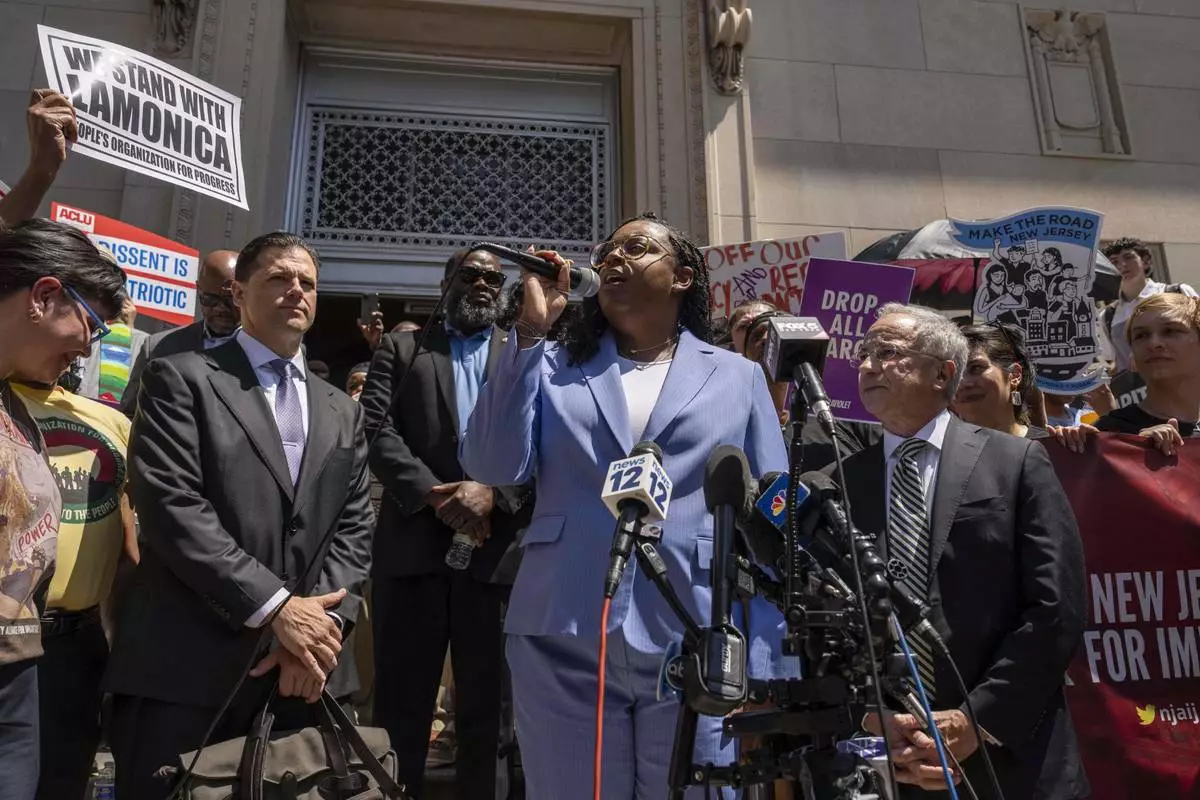
Rep. LaMonica Mclver (D-10th) speaks during a press conference with her supporters outside a federal court Wednesday, June 25, 2025, in Newark, N.J. (AP Photo/Yuki Iwamura)
A group of Buddhist monks and their rescue dog are striding single file down country roads and highways across the South, captivating Americans nationwide and inspiring droves of locals to greet them along their route.
In their flowing saffron and ocher robes, the men are walking for peace. It's a meditative tradition more common in South Asian countries, and it's resonating now in the U.S., seemingly as a welcome respite from the conflict, trauma and politics dividing the nation.
Their journey began Oct. 26, 2025, at a Vietnamese Buddhist temple in Texas, and is scheduled to end in mid-February in Washington, D.C., where they will ask Congress to recognize Buddha’s day of birth and enlightenment as a federal holiday. Beyond promoting peace, their highest priority is connecting with people along the way.
“My hope is, when this walk ends, the people we met will continue practicing mindfulness and find peace,” said the Venerable Bhikkhu Pannakara, the group’s soft-spoken leader who is making the trek barefoot. He teaches about mindfulness, forgiveness and healing at every stop.
Preferring to sleep each night in tents pitched outdoors, the monks have been surprised to see their message transcend ideologies, drawing huge crowds into churchyards, city halls and town squares across six states. Documenting their journey on social media, they — and their dog, Aloka — have racked up millions of followers online. On Saturday, thousands thronged in Columbia, South Carolina, where the monks chanted on the steps of the State House and received a proclamation from the city's mayor, Daniel Rickenmann.
At their stop Thursday in Saluda, South Carolina, Audrie Pearce joined the crowd lining Main Street. She had driven four hours from her village of Little River, and teared up as Pannakara handed her a flower.
“There’s something traumatic and heart-wrenching happening in our country every day,” said Pearce, who describes herself as spiritual, but not religious. “I looked into their eyes and I saw peace. They’re putting their bodies through such physical torture and yet they radiate peace.”
Hailing from Theravada Buddhist monasteries across the globe, the 19 monks began their 2,300 mile (3,700 kilometer) trek at the Huong Dao Vipassana Bhavana Center in Fort Worth.
Their journey has not been without peril. On Nov. 19, as the monks were walking along U.S. Highway 90 near Dayton, Texas, their escort vehicle was hit by a distracted truck driver, injuring two monks. One of them lost his leg, reducing the group to 18.
This is Pannakara's first trek in the U.S., but he's walked across several South Asian countries, including a 112-day journey across India in 2022 where he first encountered Aloka, an Indian Pariah dog whose name means divine light in Sanskrit.
Then a stray, the dog followed him and other monks from Kolkata in eastern India all the way to the Nepal border. At one point, he fell critically ill and Pannakara scooped him up in his arms and cared for him until he recovered. Now, Aloka inspires him to keep going when he feels like giving up.
“I named him light because I want him to find the light of wisdom,” Pannakara said.
The monk's feet are now heavily bandaged because he's stepped on rocks, nails and glass along the way. His practice of mindfulness keeps him joyful despite the pain from these injuries, he said.
Still, traversing the southeast United States has presented unique challenges, and pounding pavement day after day has been brutal.
“In India, we can do shortcuts through paddy fields and farms, but we can’t do that here because there are a lot of private properties,” Pannakara said. “But what’s made it beautiful is how people have welcomed and hosted us in spite of not knowing who we are and what we believe.”
In Opelika, Alabama, the Rev. Patrick Hitchman-Craig hosted the monks on Christmas night at his United Methodist congregation.
He expected to see a small crowd, but about 1,000 people showed up, creating the feel of a block party. The monks seemed like the Magi, he said, appearing on Christ’s birthday.
“Anyone who is working for peace in the world in a way that is public and sacrificial is standing close to the heart of Jesus, whether or not they share our tradition,” said Hitchman-Craig. “I was blown away by the number of people and the diversity of who showed up.”
After their night on the church lawn, the monks arrived the next afternoon at the Collins Farm in Cusseta, Alabama. Judy Collins Allen, whose father and brother run the farm, said about 200 people came to meet the monks — the biggest gathering she’s ever witnessed there.
“There was a calm, warmth and sense of community among people who had not met each other before and that was so special,” she said.
Long Si Dong, a spokesperson for the Fort Worth temple, said the monks, when they arrive in Washington, plan to seek recognition of Vesak, the day which marks the birth and enlightenment of the Buddha, as a national holiday.
“Doing so would acknowledge Vesak as a day of reflection, compassion and unity for all people regardless of faith,” he said.
But Pannakara emphasized that their main goal is to help people achieve peace in their lives. The trek is also a separate endeavor from a $200 million campaign to build towering monuments on the temple’s 14-acre property to house the Buddha’s teachings engraved in stone, according to Dong.
The monks practice and teach Vipassana meditation, an ancient Indian technique taught by the Buddha himself as core for attaining enlightenment. It focuses on the mind-body connection — observing breath and physical sensations to understand reality, impermanence and suffering. Some of the monks, including Pannakara, walk barefoot to feel the ground directly and be present in the moment.
Pannakara has told the gathered crowds that they don't aim to convert people to Buddhism.
Brooke Schedneck, professor of religion at Rhodes College in Memphis, Tennessee, said the tradition of a peace walk in Theravada Buddhism began in the 1990s when the Venerable Maha Ghosananda, a Cambodian monk, led marches across war-torn areas riddled with landmines to foster national healing after civil war and genocide in his country.
“These walks really inspire people and inspire faith,” Schedneck said. “The core intention is to have others watch and be inspired, not so much through words, but through how they are willing to make this sacrifice by walking and being visible.”
On Thursday, Becki Gable drove nearly 400 miles (about 640 kilometers) from Cullman, Alabama, to catch up with them in Saluda. Raised Methodist, Gable said she wanted some release from the pain of losing her daughter and parents.
“I just felt in my heart that this would help me have peace,” she said. “Maybe I could move a little bit forward in my life.”
Gable says she has already taken one of Pannakara’s teachings to heart. She’s promised herself that each morning, as soon as she awakes, she’d take a piece of paper and write five words on it, just as the monk prescribed.
“Today is my peaceful day.”
Freelance photojournalist Allison Joyce contributed to this report.
Associated Press religion coverage receives support through the AP’s collaboration with The Conversation US, with funding from Lilly Endowment Inc. The AP is solely responsible for this content.
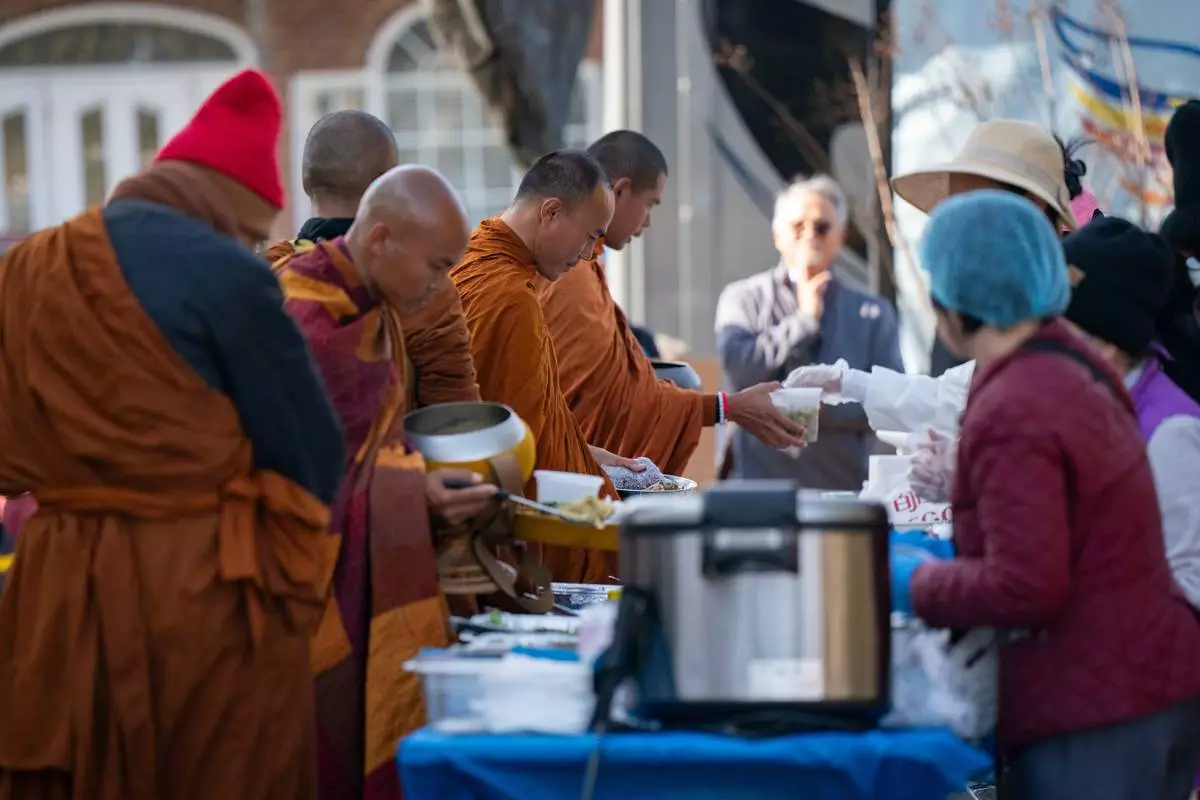
Buddhist monks who are participating in the, "Walk For Peace," get lunch Thursday, Jan. 8, 2026, in Saluda, S.C. (AP Photo/Allison Joyce)
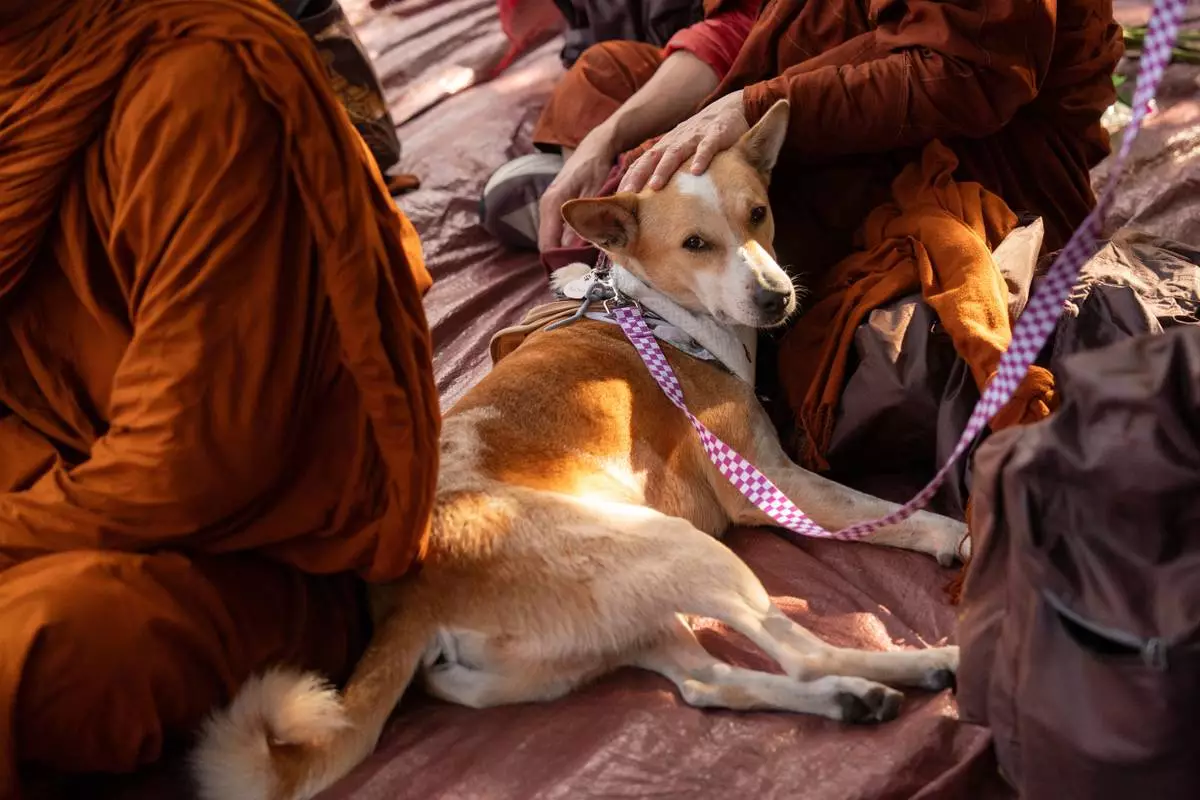
Aloka rests with Buddhist monks who are participating in the, "Walk For Peace," Thursday, Jan. 8, 2026, in Saluda, S.C. (AP Photo/Allison Joyce)
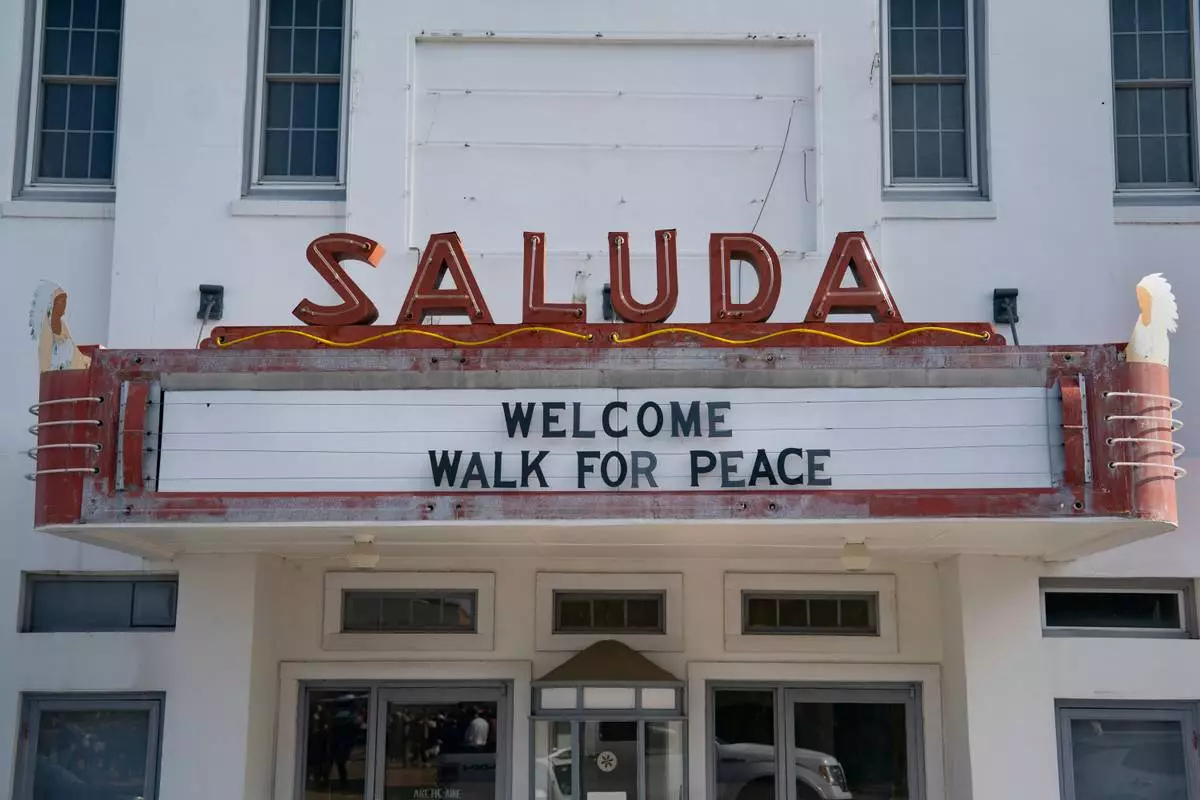
A sign is seen greeting the Buddhist monks who are participating in the, "Walk For Peace," Thursday, Jan. 8, 2026, in Saluda, S.C. (AP Photo/Allison Joyce)
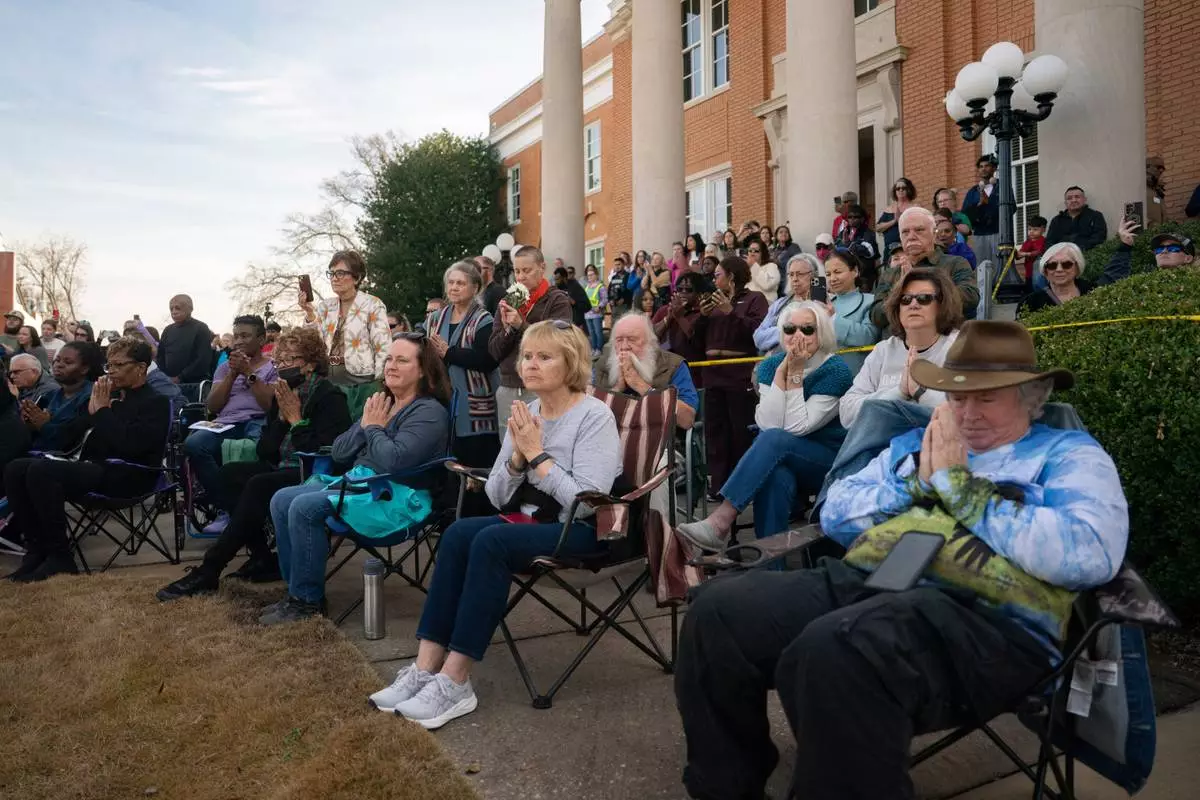
Supporters pray with Buddhist monks who are participating in the, "Walk For Peace," Thursday, Jan. 8, 2026, in Saluda, S.C. (AP Photo/Allison Joyce)
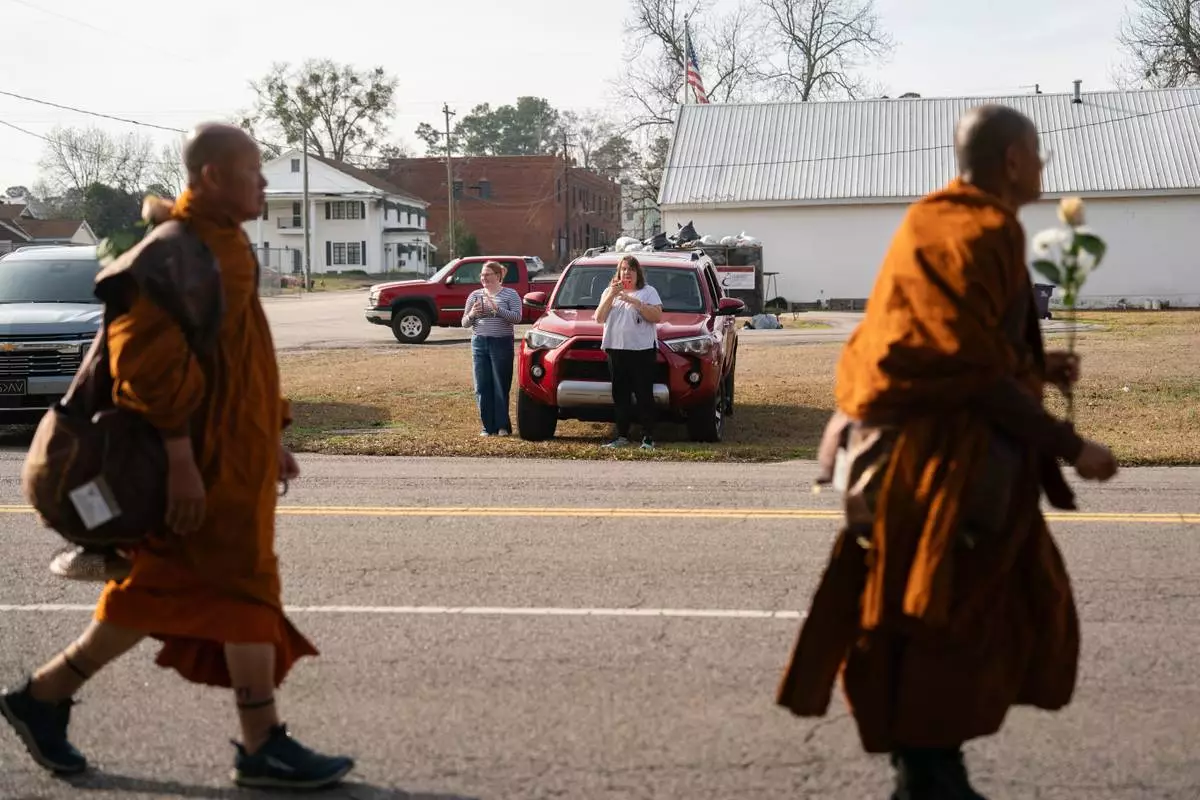
Supporters watch Buddhist monks who are participating in the, "Walk For Peace," Thursday, Jan. 8, 2026, in Saluda, S.C. (AP Photo/Allison Joyce)
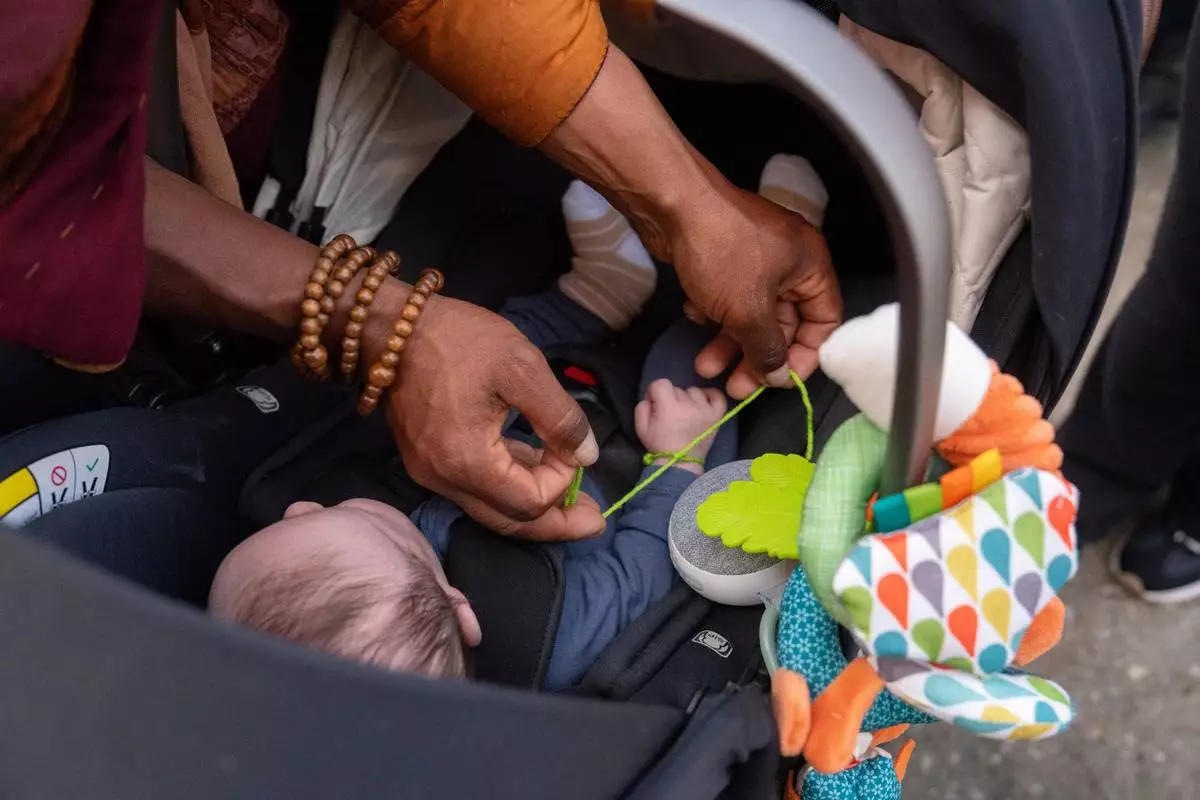
A Buddhist monk ties a prayer bracelet around the wrist of Josey Lee, 2-months-old, during the, "Walk For Peace," Thursday, Jan. 8, 2026, in Saluda, S.C. (AP Photo/Allison Joyce)
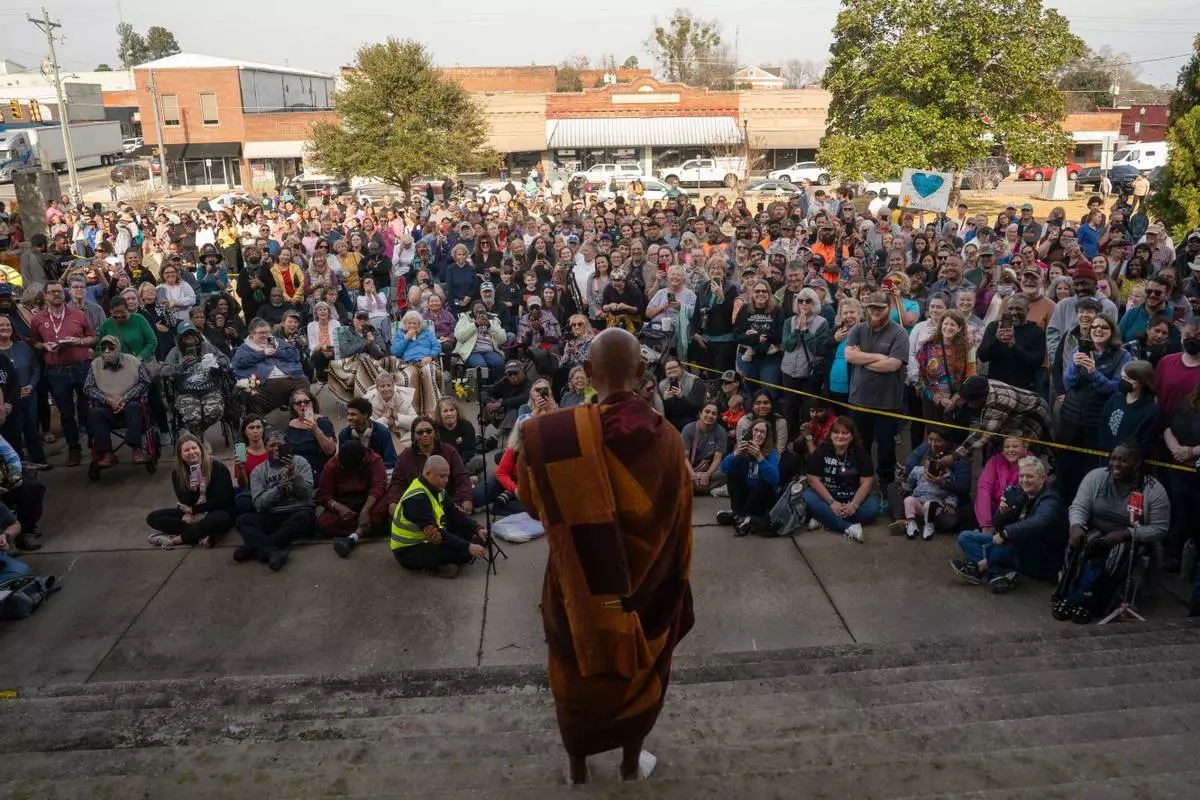
Bhikkhu Pannakara, a spiritual leader, speaks to supporters during the, "Walk For Peace," Thursday, Jan. 8, 2026, in Saluda, S.C. (AP Photo/Allison Joyce)
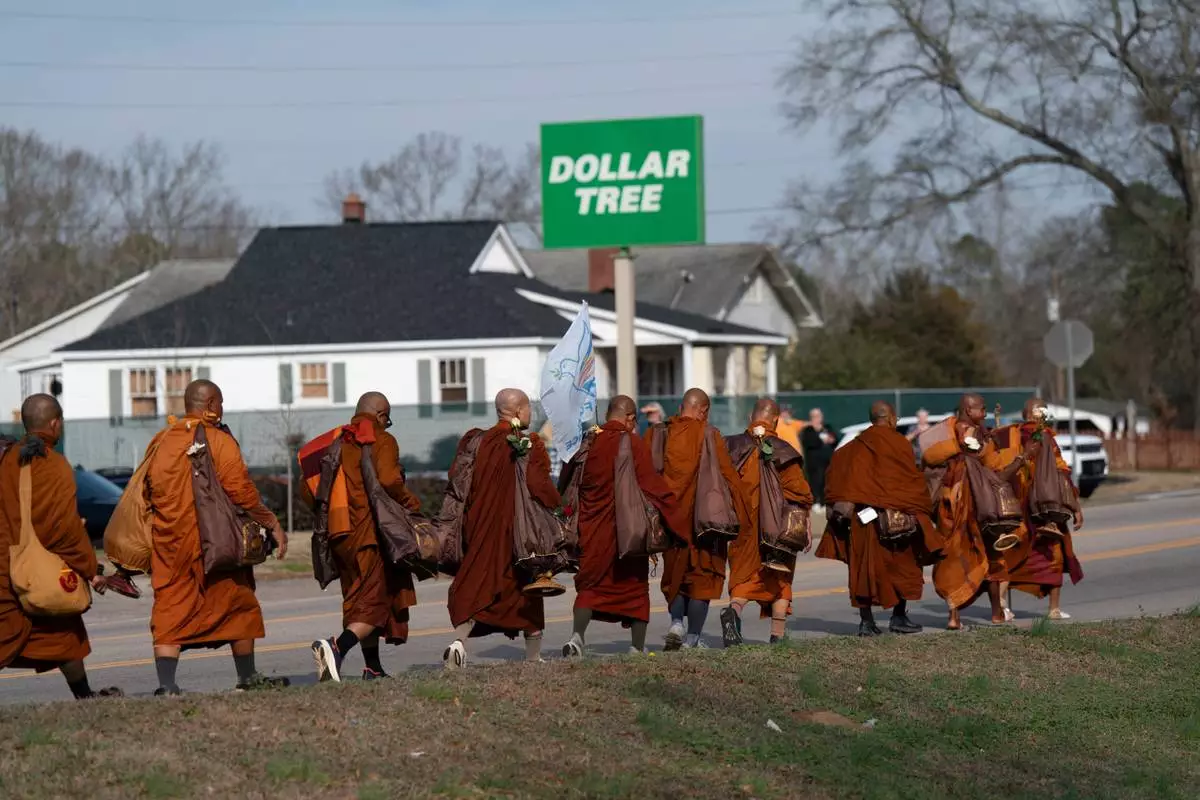
Buddhist monks participate in the, "Walk For Peace," Thursday, Jan. 8, 2026, in Saluda, S.C. (AP Photo/Allison Joyce)
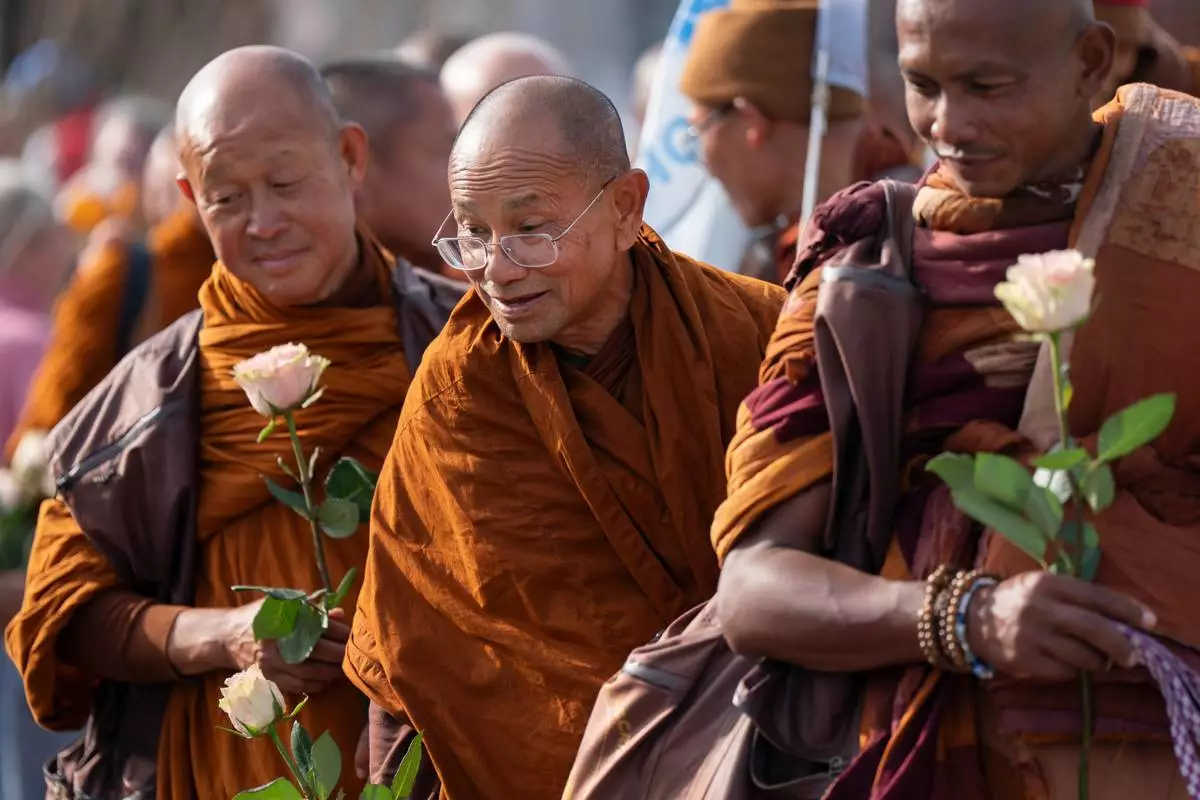
Buddhist monks participate in the, "Walk For Peace," Thursday, Jan. 8, 2026, in Saluda, S.C. (AP Photo/Allison Joyce)
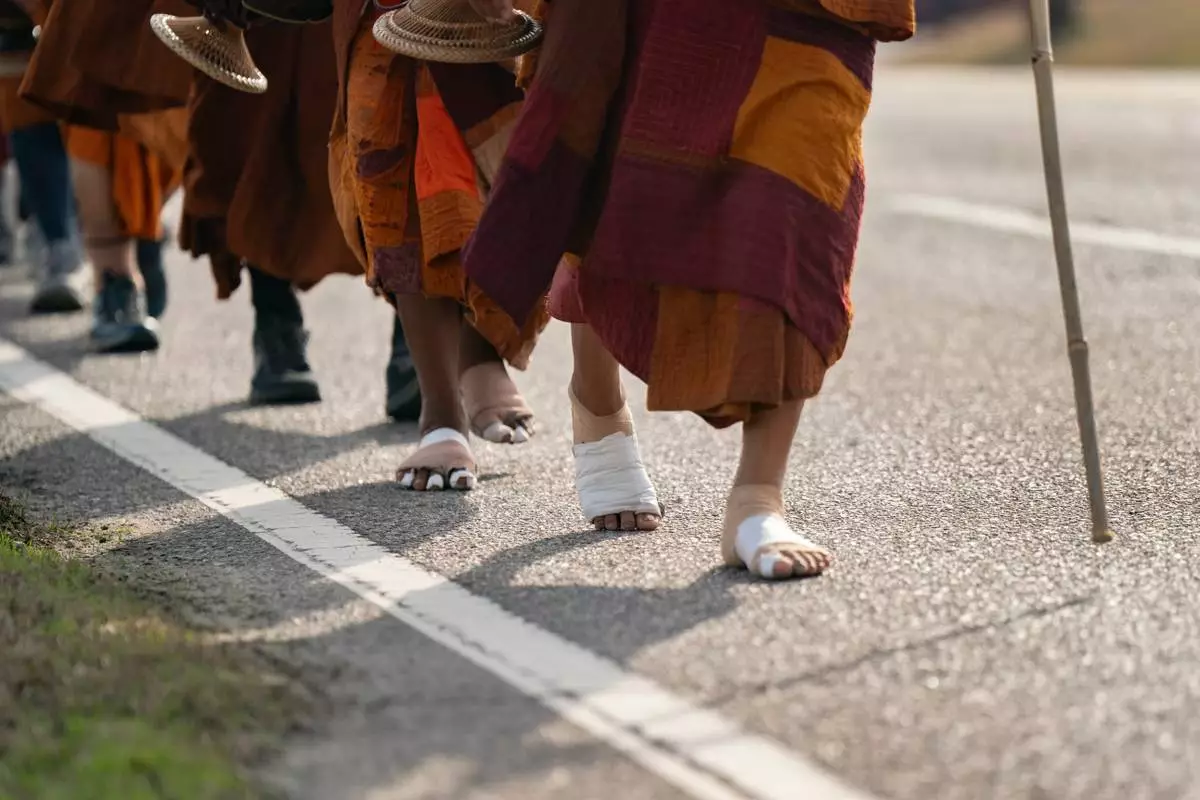
Bhikkhu Pannakara leads other buddhist monks in the, "Walk For Peace," Thursday, Jan. 8, 2026, in Saluda, S.C. (AP Photo/Allison Joyce)
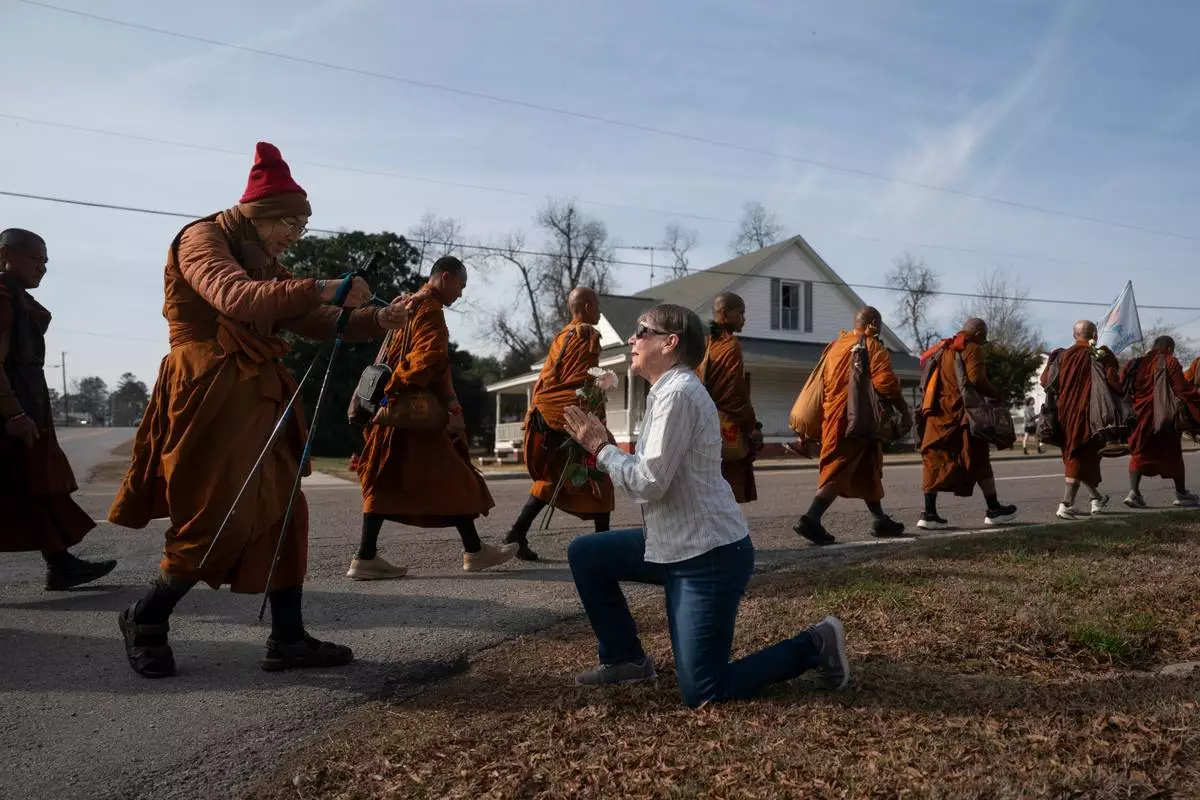
Audrie Pearce greets Buddhist monks who are participating in the, "Walk For Peace," Thursday, Jan. 8, 2026, in Saluda, S.C. (AP Photo/Allison Joyce)
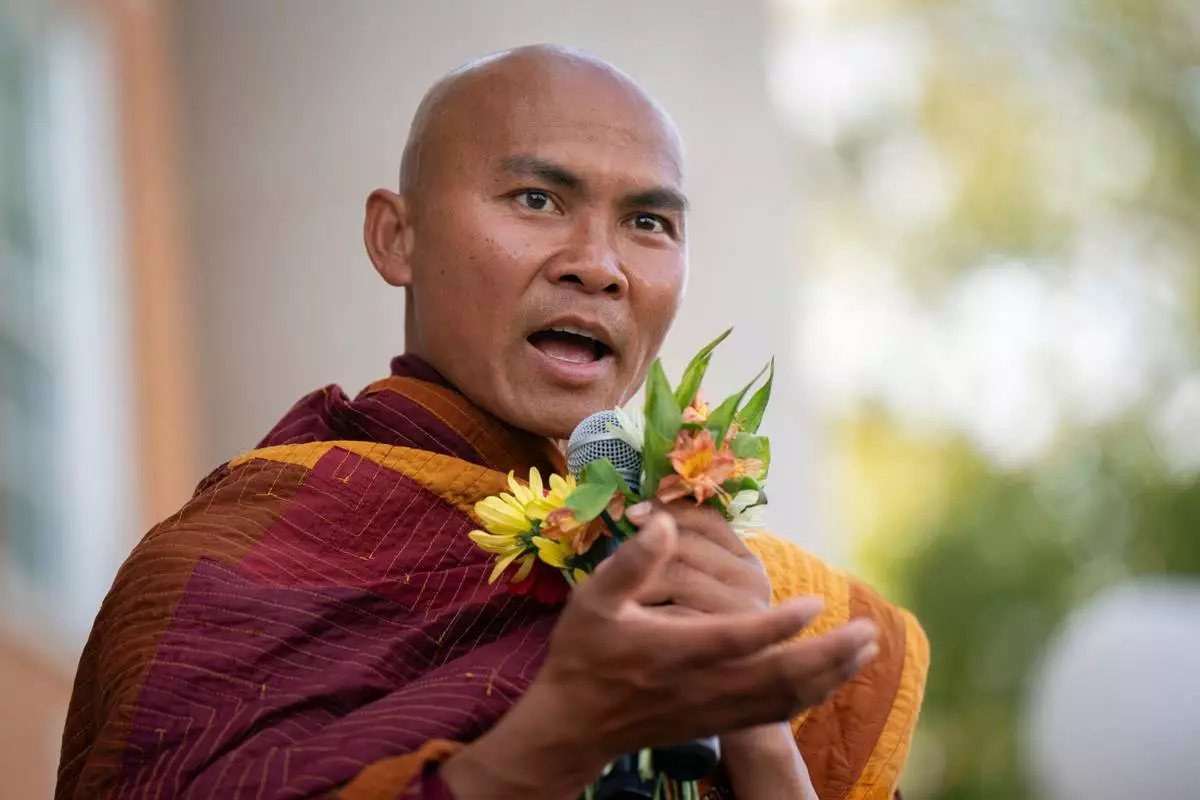
Bhikkhu Pannakara, a spiritual leader, speaks to supporters during the, "Walk For Peace," Thursday, Jan. 8, 2026, in Saluda, S.C. (AP Photo/Allison Joyce)
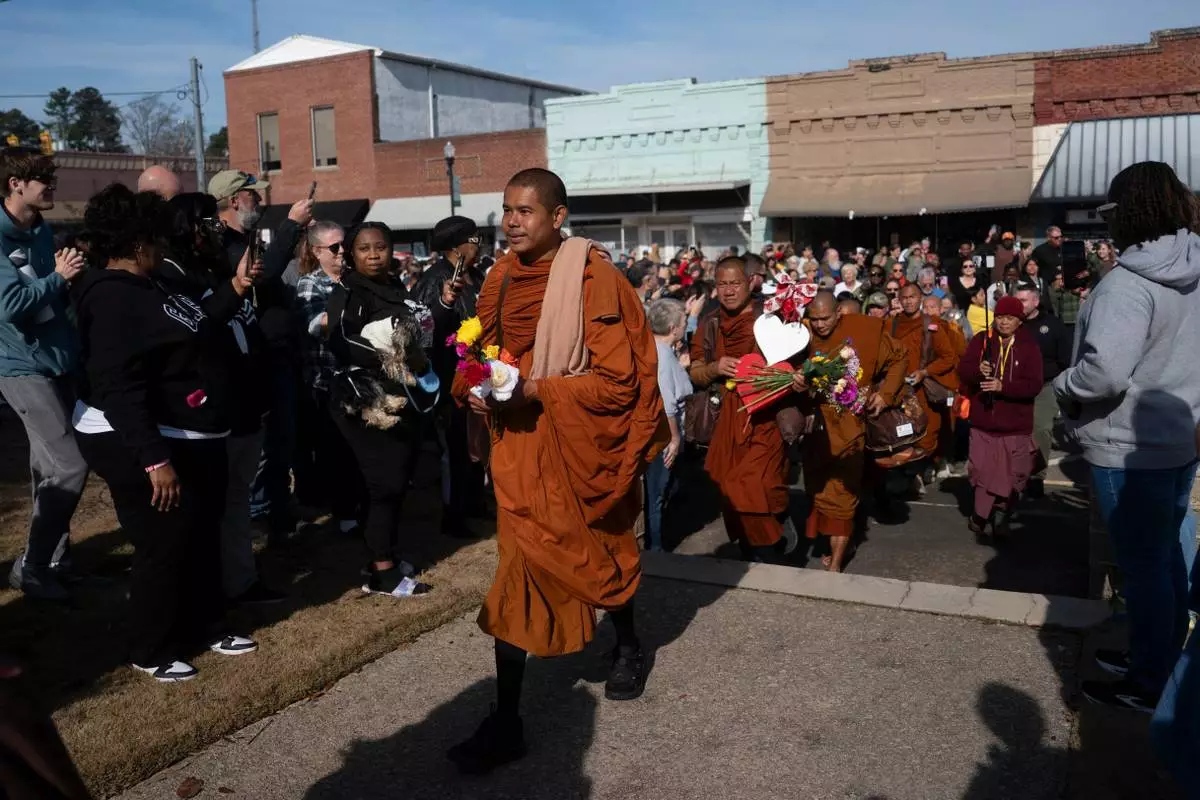
Buddhist monks who are participating in the, "Walk For Peace," arrive in Saluda, Thursday, Jan. 8, 2026, in Saluda, S.C. (AP Photo/Allison Joyce)
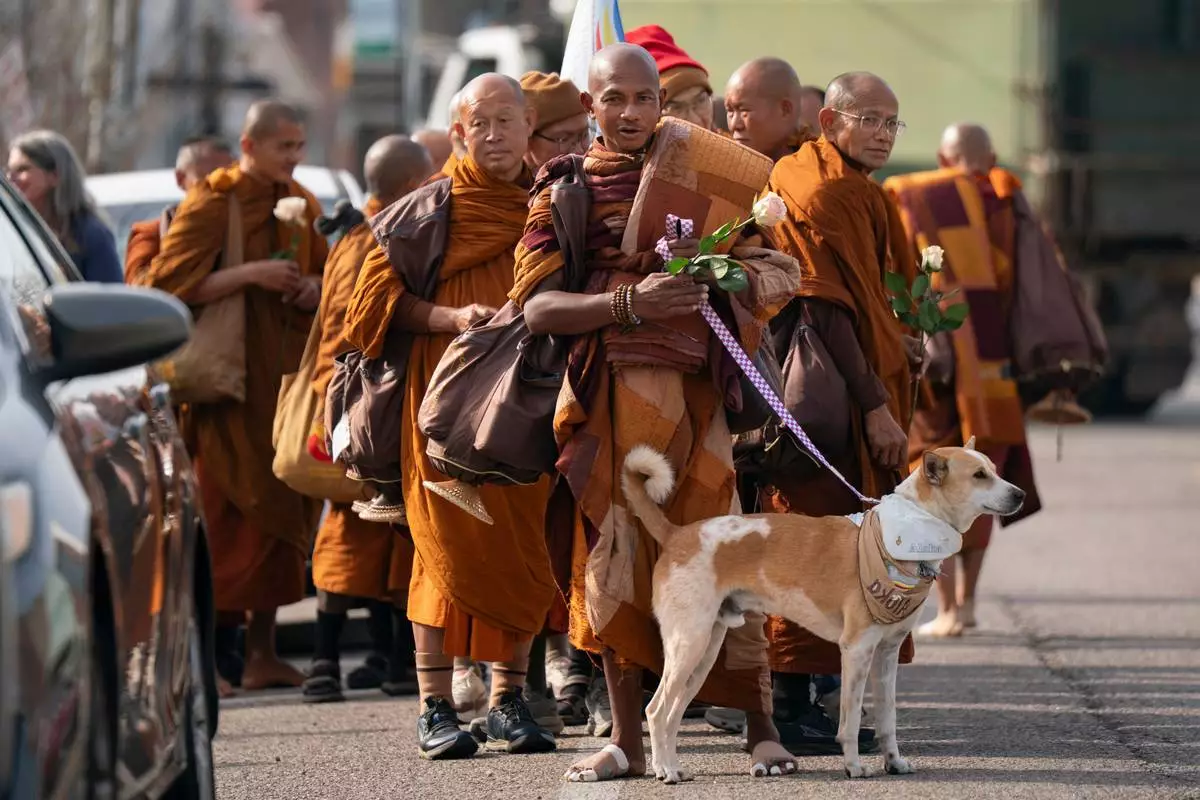
Buddhist monks who are participating in the, "Walk For Peace," are seen with their dog, Aloka, Thursday, Jan. 8, 2026, in Saluda, S.C. (AP Photo/Allison Joyce)