Skip to Content Facebook Feature Image

Bigger, better, more popular: Women's Euro 2025 set to break records

Sport

Bigger, better, more popular: Women's Euro 2025 set to break records
Sport

Sport

Bigger, better, more popular: Women's Euro 2025 set to break records

2025-06-26 23:30 Last Updated At:23:41

Around 1,000 fans were on hand when England played one of the very first matches of the inaugural Women’s European Championship in 1984.

How things have changed.

More Images
A giant soccer ball displayed in front of the Bern railway station plaza ahead of the Women's Euro 2025 soccer tournament, Thursday, June 26, 2025, in Bern, Switzerland. (Anthony Anex/Keystone via AP)

A giant soccer ball displayed in front of the Bern railway station plaza ahead of the Women's Euro 2025 soccer tournament, Thursday, June 26, 2025, in Bern, Switzerland. (Anthony Anex/Keystone via AP)

FILE - Supporters arrive for the final of the Women's Euro 2020 soccer match between England and Germany at Wembley stadium in London, Sunday, July 31, 2022. (AP Photo/Daniel Cole, file)
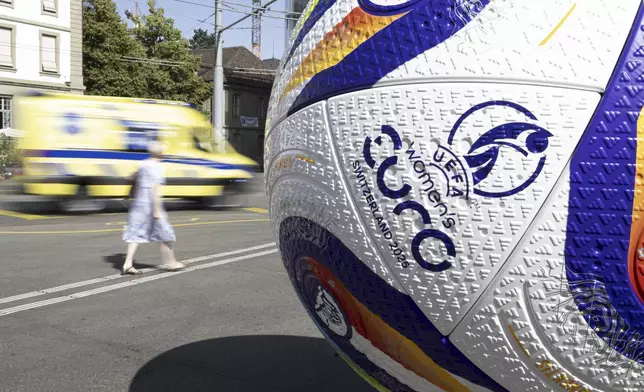
FILE - Supporters arrive for the final of the Women's Euro 2020 soccer match between England and Germany at Wembley stadium in London, Sunday, July 31, 2022. (AP Photo/Daniel Cole, file)

A giant soccer ball displayed in front of the Bern railway station plaza on the occasion of the Women's Euro 2025 soccer tournament, Wednesday, June 25, 2025, in Bern, Switzerland. (Anthony Anex/Keystone via AP)

A giant soccer ball displayed in front of the Bern railway station plaza on the occasion of the Women's Euro 2025 soccer tournament, Wednesday, June 25, 2025, in Bern, Switzerland. (Anthony Anex/Keystone via AP)

FILE - England's Chloe Kelly, right, celebrates after scoring her side's second goal during the Women's Euro 2022 final soccer match between England and Germany at Wembley stadium in London, Sunday, July 31, 2022. (AP Photo/Alessandra Tarantino, File)

FILE - England's Chloe Kelly, right, celebrates after scoring her side's second goal during the Women's Euro 2022 final soccer match between England and Germany at Wembley stadium in London, Sunday, July 31, 2022. (AP Photo/Alessandra Tarantino, File)

FILE - A video screen shows the attendance during the Women's Euro 2022 final soccer match between England and Germany at Wembley stadium in London, Sunday, July 31, 2022. (AP Photo/Alessandra Tarantino, FIle)

FILE - A video screen shows the attendance during the Women's Euro 2022 final soccer match between England and Germany at Wembley stadium in London, Sunday, July 31, 2022. (AP Photo/Alessandra Tarantino, FIle)

More than half a million tickets have already been sold for the 31 matches of this year's edition of the tournament, which kicks off next week in Switzerland.

Organizers expect to break the attendance record of 575,000 set at the previous women's euros in England in 2022 when 87,000 people packed into Wembley Stadium for the final.

The popularity of women’s soccer in Europe — and around the world — has accelerated in leaps and bounds in recent years. Players are becoming stronger, faster and more technically skilled, making the game more entertaining to watch.

While it hasn’t yet closed the gap with men’s soccer in revenue, the women’s game is seeing rapid growth in investment at both the international and club level. Players who started their careers over a decade ago say the pace of change has been stunning.

“If you look at a match from five years ago, it has nothing to do with the ones being played now,” said Barcelona’s two-time Ballon d’Or winner Alexia Putellas, who made her senior debut in 2010.

The 31-year-old Spain midfielder told The Associated Press that her generation and earlier generations never thought they would be able to make a living from playing soccer when they grew up.

“For sure it’s about making our sport a little more visible, so that girls can dream of being soccer players," she said. “I think that in recent years there has been a very good evolution. In the end, we just needed people to invest in us, to help us improve, and I think that change is happening."

Governing bodies have set up initiatives to drive the game forward, such as European soccer body UEFA’s “Unstoppable” strategy — aimed at making football the most-played team sport for women and girls in every European country by 2030, while increasing the number of professional leagues across the continent.

A major shift has happened at the club level, as Europe's powerhouse clubs such as Barcelona, Real Madrid and Chelsea started taking women’s soccer seriously.

More women’s leagues across Europe have turned professional over the past decade, inspiring a new generation of female soccer players.

“In the last decade real progress happened, especially on the club side. You see real professionalization,” Norway FA president Lise Klaveness told AP. “It is very important to have a full pyramid that girls can see that they can have this as a job.”

She said the real DNA in soccer is the connection with local clubs.

“We haven’t really had that with women. Now you see it more and more,” she said.

She added that many top leaders on the men's side show real ambitions to raise their women's teams.

“If you meet the Arsenal president or (Joan) Laporta at Barcelona he feels very close to his women’s team. When the women’s team plays, he is there,” Klaveness said.

As the club game has gotten bigger — England’s top women’s league is expanding — so have the international competitions.

At Euro 1984, there were just four teams in the inaugural tournament: England, Italy, Sweden and Denmark.

It wasn’t until 1997 that it was expanded to eight teams, becoming 12 in 2009 and increased to the current format of 16 from the 2017 edition.

At Euro 2009 there was an average attendance of just over 5,000 at the matches in England. In the same country in 2022, the average was 18,544.

And just as attendance levels have soared, so have television viewing figures.

Euro 2022 had a global cumulative live viewership of 365 million across TV, out-of-home viewing and streaming. That was more than double the number of live viewers compared to the 2017 edition (178 million) and 214% more live viewers than in 2013 (116 million).

The rise in attendances is also evident in club soccer as women start playing in stadiums with bigger capacities and clubs start to invest more in their women’s teams. A couple of Barcelona's Women's Champions League matches in 2022 drew more than 90,000 fans.

A major change that's happened in recent years is investors are now looking at women's soccer as something you can make money off, said Seattle Reign coach Laura Harvey, who coached Arsenal and Birmingham City in her native England before moving to the U.S.

“For those of us who’ve been in this a long time — I was Birmingham City’s head coach in 2006 — and to think where the game’s evolved in 19 years or whatever it’s been, it’s just wild,” she told AP. “I’m glad that I can be part of it.”

The continued growth in popularity of women’s soccer has the knock-on effect of more sponsorship, more prize money and more to invest in grassroots soccer and clubs.

In 2017, UEFA made what was perceived as a bold move: unbundling sponsorship rights for its women’s competitions and selling the commercial rights separately from the men’s.

That was done with the express purpose of “accelerating the growth of women’s football competitions” and was considered a success.

So much so that FIFA has followed suit, as have governing bodies of other sports.

UEFA now counts 11 dedicated women’s soccer partners among its wider portfolio, including Visa, Amazon and Adidas.

There are more than 20 sponsors for Euro 2025 and that revenue is projected to increase by 145% compared to 2022, according to UEFA.

“The impact of Women’s Euro 2025 extends far beyond the competition itself,” UEFA President Aleksander Ceferin said in a report last month. “With record prize money and unprecedented interest from sponsors, the tournament will bring more investment into the women’s game than ever before.”

The prize pot at Euro 2025 has been set at 41 million euros ($47 million), more than double the 16 million euros ($18.3 million) received by national associations in 2022.

Moreover, players will receive a guaranteed share from their national associations for the first time.

The men’s Euro 2024 had a total prize fund of 331 million euros ($347 million), with each of the 24 teams receiving a minimum of 9.25 million euros and champion Spain earning 28.25 million euros.

UEFA’s aim is that Euro 2025 will act as a catalyst for further progress in the women's professional game in Switzerland and across Europe.

However, Klaveness has a warning: that the richest leagues shouldn't financially separate themselves completely from the currently semi-pro ones.

“Now I think the next step that’s really important to go further now is … not to let the head move away from the body, then we would do the same as the men’s side,” she said.

AP Sports Writers Tales Azzoni in Madrid, Graham Dunbar in Geneva and Anne M. Peterson in Portland, Ore, contributed to this report.

AP soccer: https://apnews.com/hub/soccer

A giant soccer ball displayed in front of the Bern railway station plaza ahead of the Women's Euro 2025 soccer tournament, Thursday, June 26, 2025, in Bern, Switzerland. (Anthony Anex/Keystone via AP)
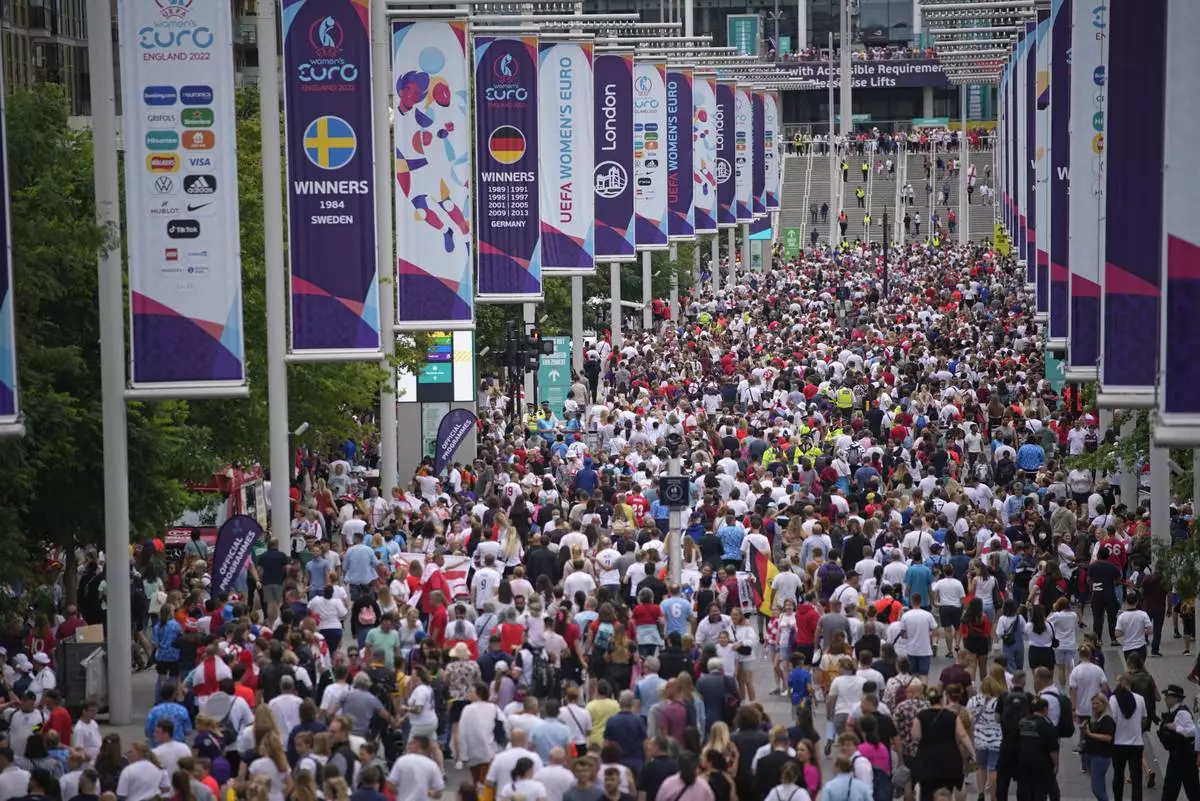
A giant soccer ball displayed in front of the Bern railway station plaza ahead of the Women's Euro 2025 soccer tournament, Thursday, June 26, 2025, in Bern, Switzerland. (Anthony Anex/Keystone via AP)

FILE - Supporters arrive for the final of the Women's Euro 2020 soccer match between England and Germany at Wembley stadium in London, Sunday, July 31, 2022. (AP Photo/Daniel Cole, file)
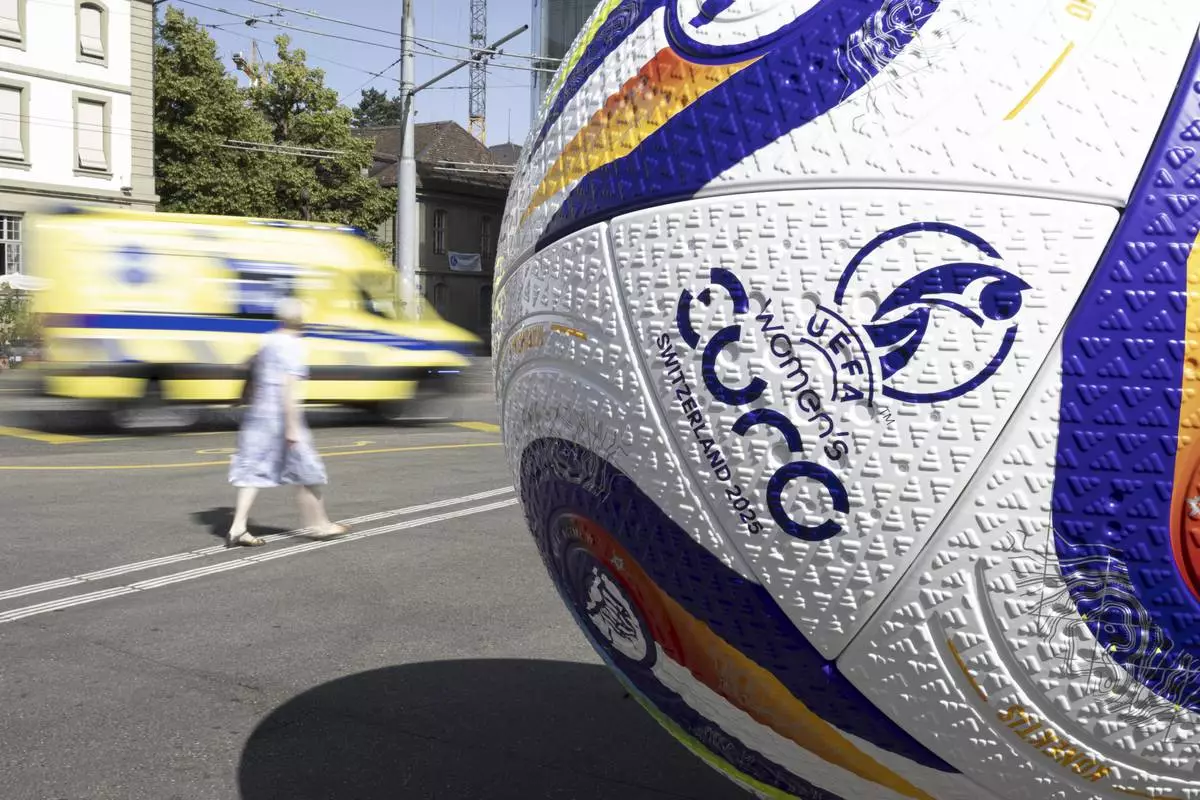
FILE - Supporters arrive for the final of the Women's Euro 2020 soccer match between England and Germany at Wembley stadium in London, Sunday, July 31, 2022. (AP Photo/Daniel Cole, file)

A giant soccer ball displayed in front of the Bern railway station plaza on the occasion of the Women's Euro 2025 soccer tournament, Wednesday, June 25, 2025, in Bern, Switzerland. (Anthony Anex/Keystone via AP)

A giant soccer ball displayed in front of the Bern railway station plaza on the occasion of the Women's Euro 2025 soccer tournament, Wednesday, June 25, 2025, in Bern, Switzerland. (Anthony Anex/Keystone via AP)

FILE - England's Chloe Kelly, right, celebrates after scoring her side's second goal during the Women's Euro 2022 final soccer match between England and Germany at Wembley stadium in London, Sunday, July 31, 2022. (AP Photo/Alessandra Tarantino, File)

FILE - England's Chloe Kelly, right, celebrates after scoring her side's second goal during the Women's Euro 2022 final soccer match between England and Germany at Wembley stadium in London, Sunday, July 31, 2022. (AP Photo/Alessandra Tarantino, File)

FILE - A video screen shows the attendance during the Women's Euro 2022 final soccer match between England and Germany at Wembley stadium in London, Sunday, July 31, 2022. (AP Photo/Alessandra Tarantino, FIle)
FILE - A video screen shows the attendance during the Women's Euro 2022 final soccer match between England and Germany at Wembley stadium in London, Sunday, July 31, 2022. (AP Photo/Alessandra Tarantino, FIle)

TENERIFE, Spain (AP) — The head of the World Health Organization sought Saturday to reassure residents of the Spanish island where passengers of a hantavirus-stricken cruise ship are expected to be evacuated, issuing them a direct message that the virus was “not another COVID.”

The Dutch-flagged MV Hondius, with more than 140 passengers and crew on board, is headed to Spain's Canary Islands, off the coast of West Africa, and is expected to arrive at the island of Tenerife early Sunday.

WHO Director-General Tedros Adhanom Ghebreyesus, along with Spain’s Health Minister Monica Garcia and Interior Minister Fernando Grande-Marlaska, were due on the island Saturday to coordinate the disembarkation of passengers and some crew.

“I know you are worried. I know that when you hear the word ‘outbreak’ and watch a ship sail toward your shores, memories surface that none of us have fully put to rest. The pain of 2020 is still real, and I do not dismiss it for a single moment,” Tedros said in a message to the people of Tenerife.

“But I need you to hear me clearly: This is not another COVID. The current public health risk from hantavirus remains low. My colleagues and I have said this unequivocally, and I will say it again to you now,” Tedros added.

The WHO, Spanish authorities and cruise company Oceanwide Expeditions said nobody on the Hondius is currently showing symptoms of the virus.

Hantavirus can cause life-threatening illness. It usually spreads when people inhale contaminated residue of rodent droppings and isn’t easily transmitted between people. But the Andes virus detected in the cruise ship outbreak may be able to spread between people in rare cases. Symptoms usually show between one and eight weeks after exposure.

Three people have died since the outbreak, and five passengers who left the ship are infected with hantavirus.

Some on Tenerife say they are worried. On board the cruise ship, some Spanish passengers have voiced concern about being stigmatized.

“I tell you, I don’t like this very much,” said 69-year-old resident Simon Vidal. “Anyone can say what they want. Why did they have to bring a boat from another country here? Why not anywhere else, why bring it to the Canary Islands?”

Others said they empathized with the boat's passengers, but were still concerned.

“The truth is that it is very worrying,” said 27-year-old Venezuelan immigrant Samantha Aguero. She added: “We feel a bit unsafe, we don’t feel as there are 100% security measures in place to welcome it. This is a virus after all and we have lived this during the pandemic. But we also need to have empathy.”

Spanish Health Minister Monica Garcia said passengers and some crew would disembark in Tenerife “under maximum safety conditions.”

The ship will not dock but will remain at anchor. Everyone disembarking will be checked for symptoms and won't be taken off the ship until a flight is already in Tenerife waiting to fly them off the island, Garcia said during a news conference in Madrid. There are currently people of more than 20 different nationalities on board.

Both the U.S. and the U.K. have agreed to send planes to evacuate their citizens. Americans are to be quarantined at a medical center in Nebraska.

All Spanish passengers will be transferred to a medical facility and quarantined, Garcia said. Oceanwide has listed 13 Spanish passengers and one Spanish crew member on board.

Those disembarking will leave behind their luggage, Garcia said, and will be allowed to take only a small bag with essential items, a cellphone, charger and documentation.

Some crew, as well as the body of a passenger who died on board, will remain on the ship, which will sail on to the Netherlands, where it will undergo disinfection, the minister added.

According to a letter sent by the Dutch foreign and health ministers to parliament late Friday, Spain has activated the EU civil protection mechanism for a medical evacuation plane equipped for infections diseases to be on standby in case anyone on the ship becomes ill. That person would then be transported by air to the European mainland.

The Dutch government will work with Spanish authorities and the ship company to arrange repatriation of Dutch passengers and crew as soon as possible after arrival in Tenerife, subject to medical conditions and advice from the European Centre for Disease Prevention and Control, the letter said. Those without symptoms will go into home quarantine for six weeks and be monitored by local health services.

As the ship is Dutch-flagged, the Netherlands may also temporarily accommodate people of other nationalities and monitor them in quarantine, it said.

Health authorities across four continents were tracking down and monitoring more than two dozen passengers who disembarked before the deadly outbreak was detected. They were also scrambling to trace others who may have come into contact with them.

On April 24, nearly two weeks after the first passenger had died on board, more than two dozen people from at least 12 different countries left the ship without contact tracing, Dutch officials and the ship’s operator have said.

It wasn’t until May 2 that health authorities first confirmed hantavirus in a passenger.

Dutch public health authorities have been monitoring people who were on a flight that was briefly boarded by a Dutch ship passenger who later died and was confirmed to have hantavirus. Three people who were on the flight and had symptoms have all tested negative for hantavirus, Dutch National Institute for Public Health spokesperson Harald Wychgel told The Associated Press on Saturday.

Becatoros reported from Sparta, Greece. Associated Press reporters Angela Charlton in Paris and Helena Alves in Tenerife contributed to this report.

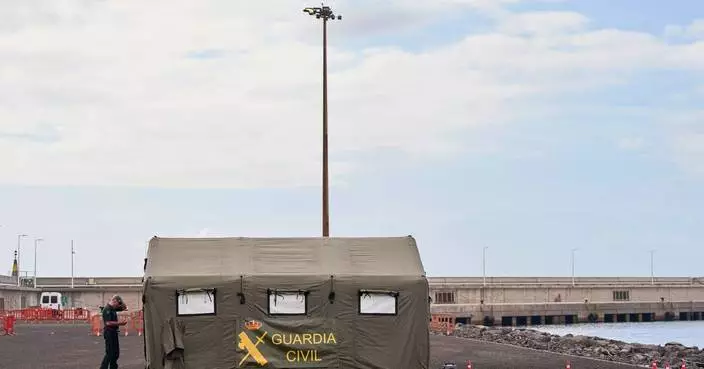
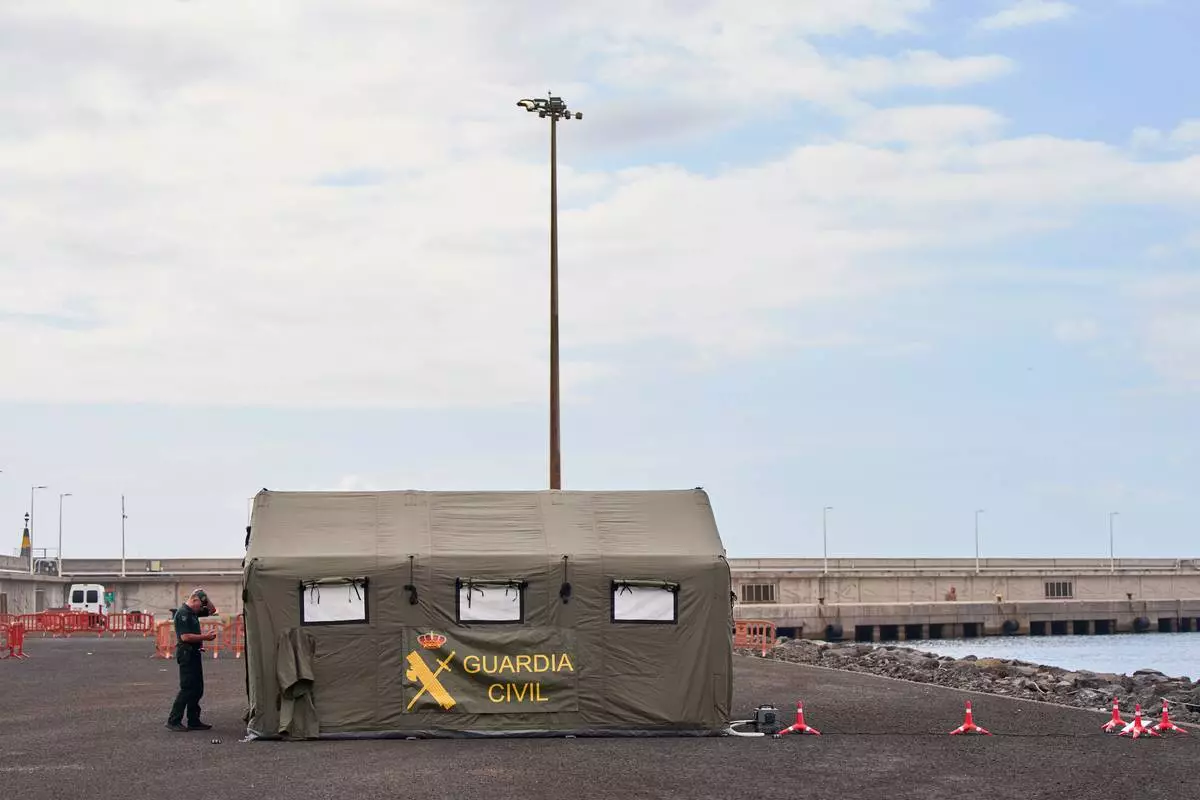
A Spanish Civil Guard officer inspects the area where passengers from the MV Hondius cruise ship are expected to arrive at the port of Granadilla in Tenerife, Canary Islands, Spain, Saturday, May 9, 2026. (AP Photo/Manu Fernandez)

A Spanish Civil Guard officer inspects the area where passengers from the MV Hondius cruise ship are expected to arrive at the port of Granadilla in Tenerife, Canary Islands, Spain, Saturday, May 9, 2026. (AP Photo/Manu Fernandez)

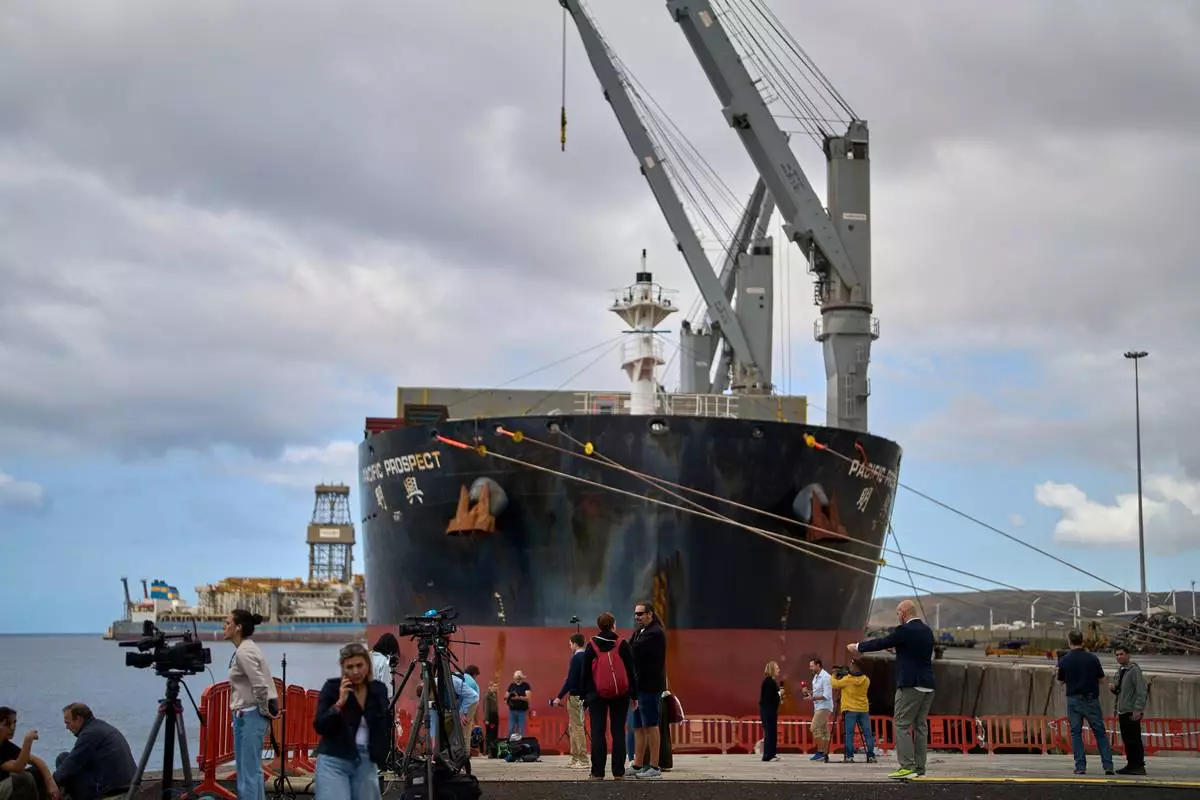
Media crew members stand in the area where passengers from the MV Hondius cruise ship are expected to arrive at the port of Granadilla in Tenerife, Canary Islands, Spain, Saturday, May 9, 2026. (AP Photo/Manu Fernandez)

Media crew members stand in the area where passengers from the MV Hondius cruise ship are expected to arrive at the port of Granadilla in Tenerife, Canary Islands, Spain, Saturday, May 9, 2026. (AP Photo/Manu Fernandez)

Workers set up temporary shelters in the area where passengers from the MV Hondius cruise ship are expected to arrive at the port of Granadilla in Tenerife, Canary Islands, Spain, Saturday, May 9, 2026. (AP Photo/Manu Fernandez)

Workers set up temporary shelters in the area where passengers from the MV Hondius cruise ship are expected to arrive at the port of Granadilla in Tenerife, Canary Islands, Spain, Saturday, May 9, 2026. (AP Photo/Manu Fernandez)

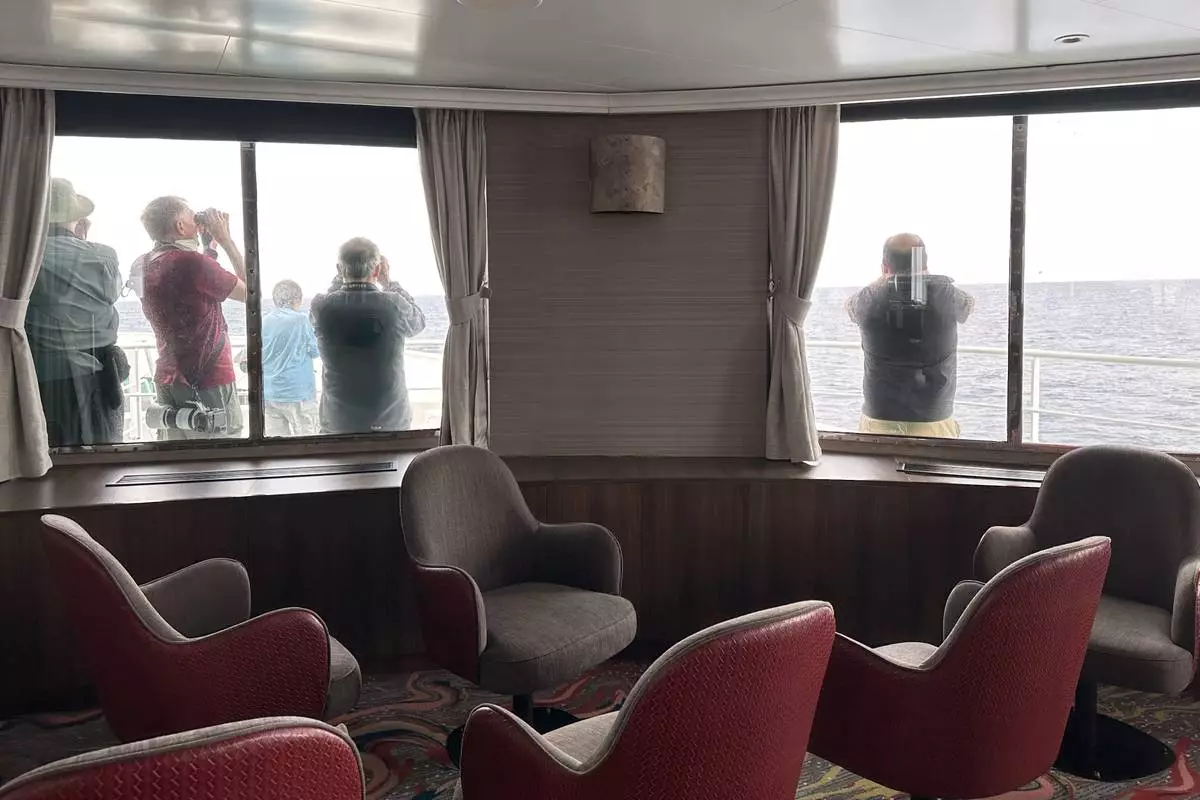
Passengers on the hantavirus-stricken cruise ship, MV Hondius, scan the horizon with binoculars during their voyage to Spain's port of Tenerife, May 6, 2026. (AP Photo)

Passengers on the hantavirus-stricken cruise ship, MV Hondius, scan the horizon with binoculars during their voyage to Spain's port of Tenerife, May 6, 2026. (AP Photo)

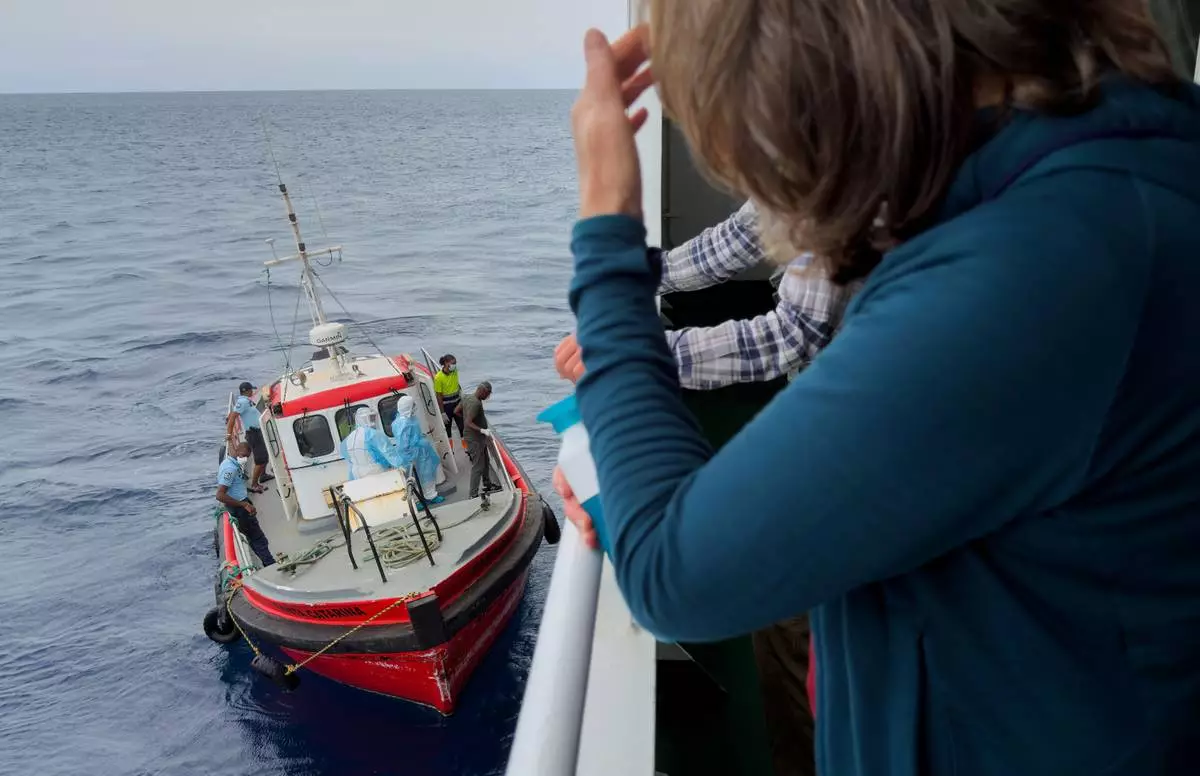
Passengers on the the hantavirus-stricken cruise ship, MV Hondius, watch epidemiologists board the boat in Praia, during their voyage to Spain's port of Tenerife, May 6, 2026. (AP Photo)

Passengers on the the hantavirus-stricken cruise ship, MV Hondius, watch epidemiologists board the boat in Praia, during their voyage to Spain's port of Tenerife, May 6, 2026. (AP Photo)

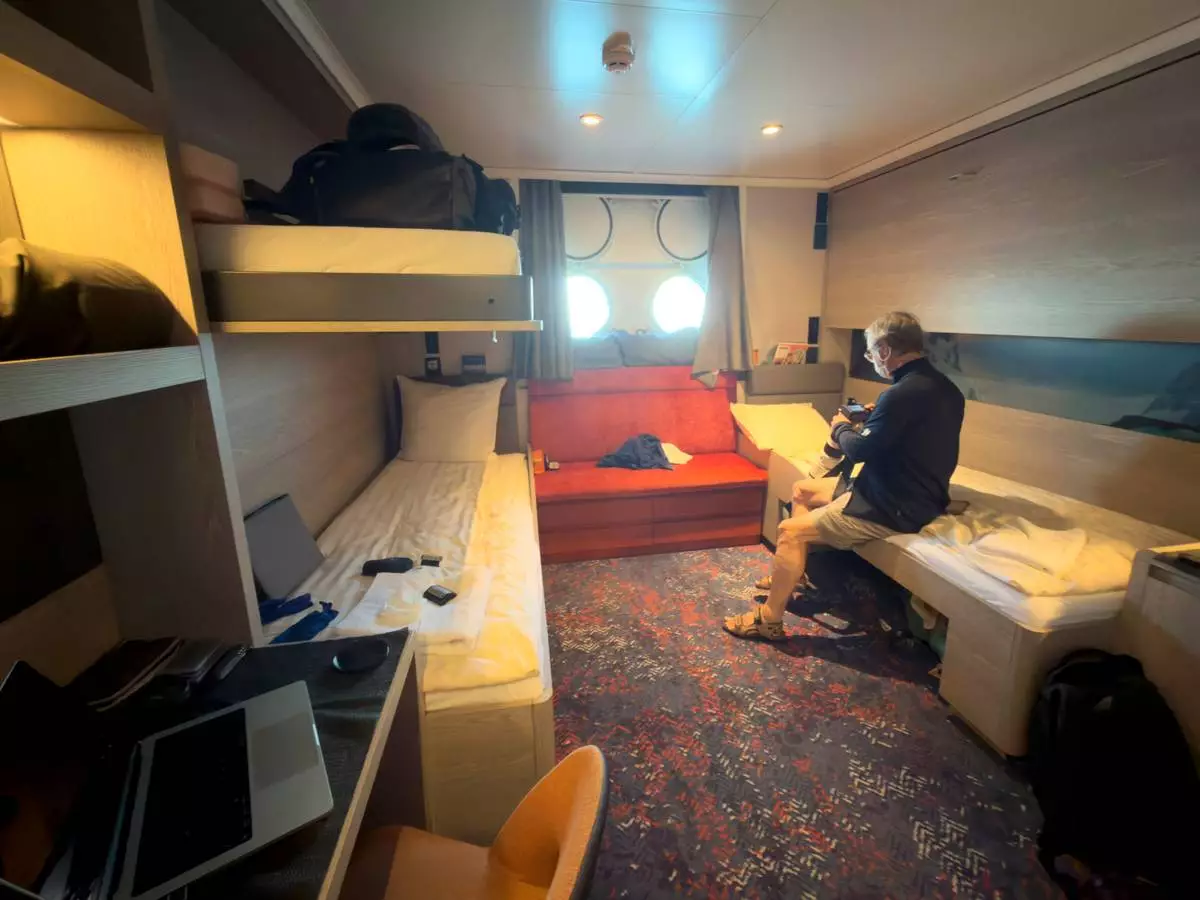
A passenger checks his camera inside his cabin on the hantavirus-stricken cruise ship, MV Hondius, during the voyage to Spain's port of Tenerife, May 6, 2026. (AP Photo)

A passenger checks his camera inside his cabin on the hantavirus-stricken cruise ship, MV Hondius, during the voyage to Spain's port of Tenerife, May 6, 2026. (AP Photo)

Crew members of the hantavirus-stricken cruise ship, MV Hondius, wait their turns for a first interview with epidemiologists, during the voyage to Spain's port of Tenerife, May 6, 2026. (AP Photo)

Crew members of the hantavirus-stricken cruise ship, MV Hondius, wait their turns for a first interview with epidemiologists, during the voyage to Spain's port of Tenerife, May 6, 2026. (AP Photo)

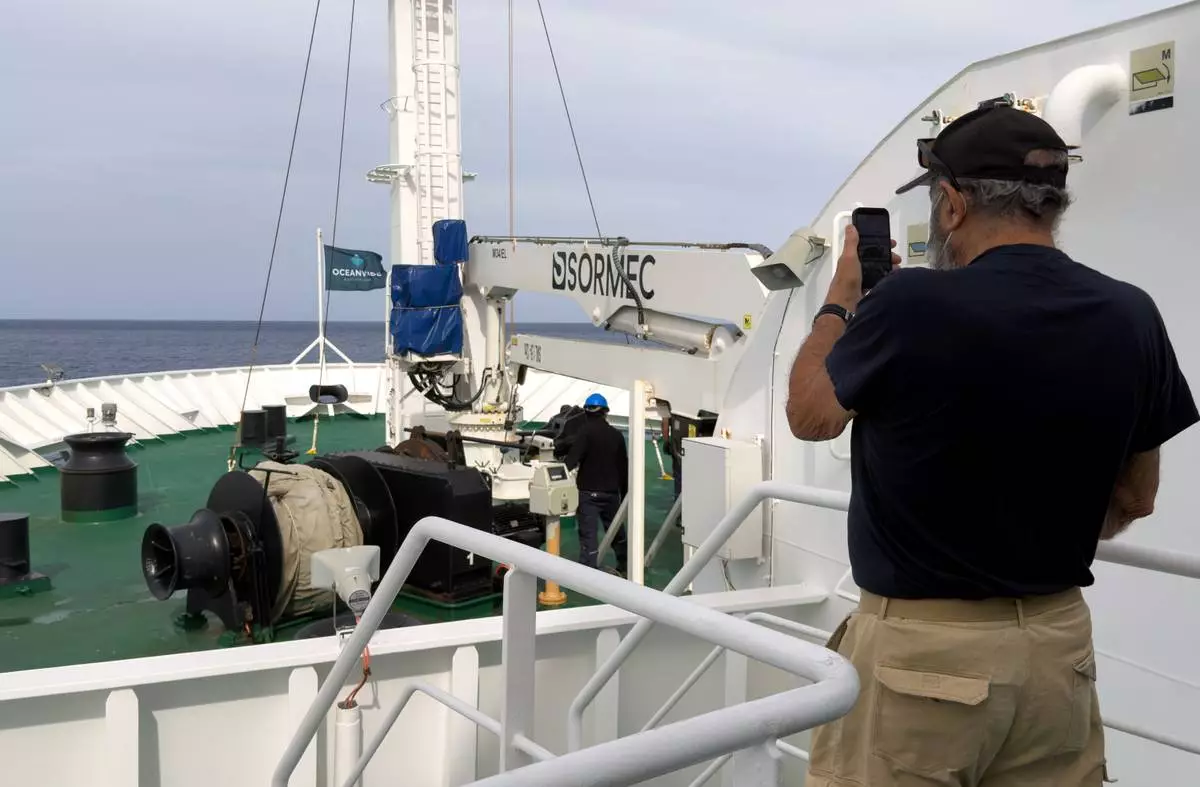
A passenger on the the hantavirus-stricken cruise ship, MV Hondius, takes a photo of the ship's weighing anchor in Praia, during the voyage to Spain's port of Tenerife, May 6, 2026. (AP Photo)

A passenger on the the hantavirus-stricken cruise ship, MV Hondius, takes a photo of the ship's weighing anchor in Praia, during the voyage to Spain's port of Tenerife, May 6, 2026. (AP Photo)

Recommended Articles