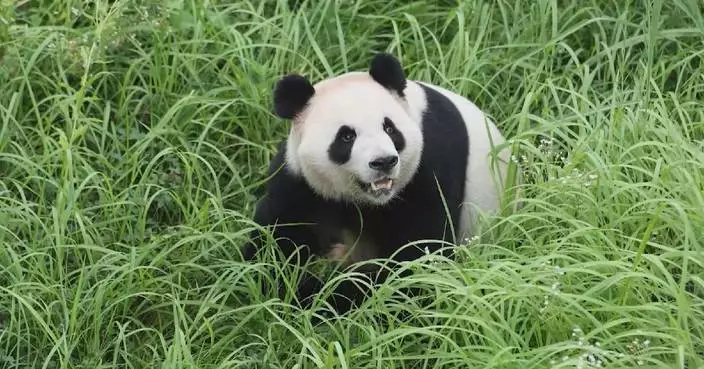
China's largest training base for rewilding South China Tigers was put into operation in east China's Fujian Province on Thursday.
"Tiger's jumping ability is quite strong. They can jump about three meters high from a standstill, reaching the middle position between the third and fourth steel cables. Therefore, when designing the enclosure, we chose a height of 4.5 meters and added an inward-bent structure at the top," said Huang Cheng, an assistant engineer of Meihua Mountain South China Tiger Breeding Research Institute.
The main function of the adaptation field is to provide a natural living environment for the tigers. Therefore, researchers have specially selected an original ecological forest area. They also periodically release a controlled number of artificially bred animals such as sika deer, wild boars, and rabbits to establish a food chain suitable for the South China tigers.
"According to preliminary research, the adaptation area is naturally distributed with such animals as the muntjac, ring-necked pheasants, and yellow-bellied weasels. When constructing the adaptation area, we made every effort to preserve its native environment, aiming to provide a natural training ground for the tigers," said Huang.
The complex terrain of the wild environment has also been preserved, allowing the tigers to move freely, patrol their territory, and exercise their physical strength and sense of direction.
To monitor the living conditions of South China tigers in the adaptation area in real time, the staff have set up eight infrared cameras and 16 peripheral surveillance cameras. Meanwhile, drones are also used for regular patrols.
"This new infrared cameras we recently purchased is equipped with a solar panel for power supply. When setting it up, we positioned it based on tigers' shoulder height, ranging from 1 to 1.5 meters. It is installed near the intersections of animal trails and water source, allowing it to capture images of tigers and their prey as they pass in front of it," said Li Hao, another assistant engineer at the breeding research institute.
According to the staff, the South China tigers will have a brief transition in the adaptation area. Once they can hunt independently and adapt to the wild environment, they will move to a broader wild training area.
The South China tiger is a unique subspecies of tiger in China and also the most endangered subspecies. Statistics for 2024 show that there are currently only 247 left in China.
The Meihua Mountain Nature Reserve in Longyan, Fujian Province, was one of the main habitats of wild South China tigers in history. In 1998, Longyan launched the South China Tiger Rescue Project and established the South China Tiger Breeding Research Institute on Meihua Mountain. After 27 years of continuous conservation efforts, scientific research breakthroughs and wild training, the breeding research center in the Meihua Mountains Nature Reserve has now successfully bred 76 South China tigers.
Re-wild training is an important way to expand the population of South China tigers. With the official operation of the newly-built wild training base for South China tigers on Meihua Mountain, two adult South China tigers will move into their "new home". The transfer of the first female South China tiger named "Weiwei" has been completed.
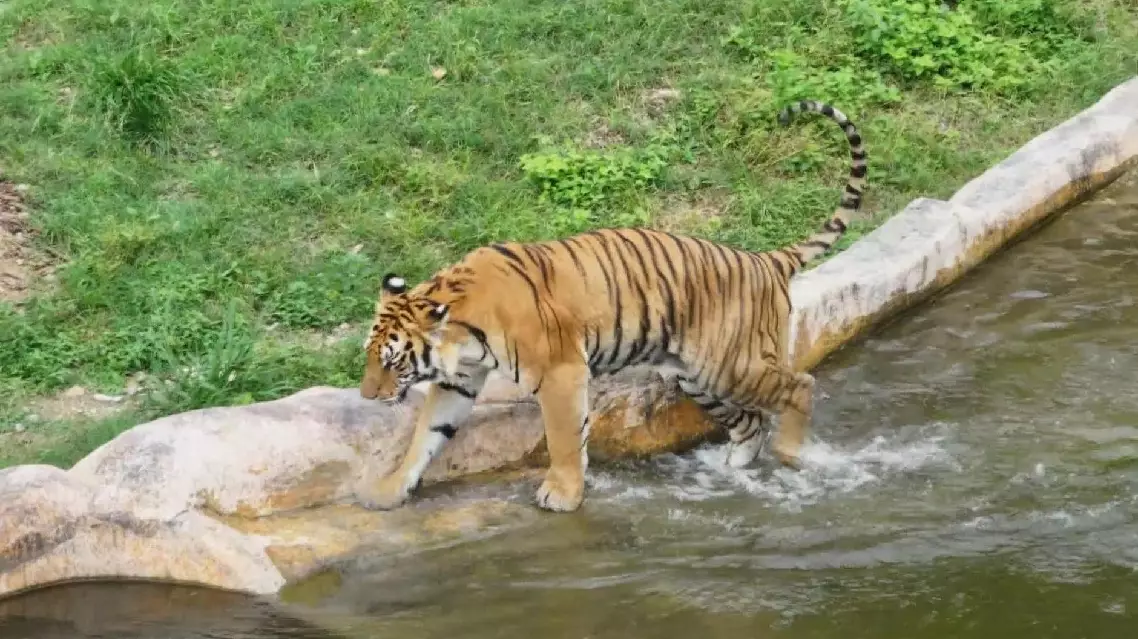
China's largest training base for rewilding South China Tigers put into operation
China's largest training base for rewilding South China Tigers put into operation
Traditional Chinese medicine (TCM), with a history dating back more than 2,000 years, is drawing growing interest from Americans, particularly through social media, and continues to serve as a strong bridge for cultural exchange between China and the United States.
Jin Guanyuan, who founded his own acupuncture clinic in the United States and has practiced there for over 30 years, has written numerous books and spoken at lectures in both countries advocating for TCM.
During the course of his career, he has witnessed significant changes in American attitudes toward the practice.
"When I first came to the U.S. about 37 years ago, most Americans had never tried acupuncture. With every new patient, we had to spend a lot of time explaining what acupuncture was. But things are different now. Most Americans who come to us already know about acupuncture. Now, they ask, 'Can you help with my condition?' The way they ask the question reflects how their understanding has changed," Jin said.
For Abram Ojure, founder of New England Integrated Health, the evolving perspectives of young Americans have been evident through his work with college students at MIT and Tufts University.
"We are usually seeing students for the first time, like it's their first experience with acupuncture. These are young people from some of the leading institutions in the world. We also see patients from Harvard -- it's like these students are going to go on and do things in their communities wherever they land professionally. And they already have this idea of using TCM as a part of their health care," Ojure said.
While American practitioners are seeing growing acceptance at home, young Chinese researchers are also thinking about how to build on that momentum and deepen understanding of TCM abroad.
Yi Jingyan, a PhD student studying integrated cancer treatments with TCM in Beijing, hopes growing interest among Americans might lead to greater communication between Western and Chinese medicine.
"A lot of young people overseas, they first discover TCM through social media. So we can use the same platforms to show a fuller and more realistic picture of TCM. I mean, not only Guasha, acupuncture or herbal tea, but maybe the real patient stories, the clinical practice or the scientific research evidence," she said.
While TCM may be a relatively new concept for many Americans, it is a medical practice with thousands of years of development for Chinese people. Western medicine, too, carries valuable knowledge -- its own traditions, history and technology -- that can benefit people and improve health worldwide.
At Mulan Women's Health Clinic in Beijing, which has served women for years, clinic head Yang Qi has worked to show how technology can be incorporated into TCM practice.
"Pulse-taking and tongue examination are traditional diagnostic methods in TCM. They give us more of a directional judgment. I can use these traditional TCM diagnostic methods to guide my treatment, while using modern Western medical equipment to evaluate my treatment results. So the integration of Chinese and Western medicine involves, on the one hand, combining treatment methods and diagnostic methods. On the other hand, we also draw on a lot of the wisdom of modern medicine," Yang said.
As connections between people in the U.S. and China continue to grow, both online and offline, both countries are benefiting from the sharing of knowledge and wellness practices.
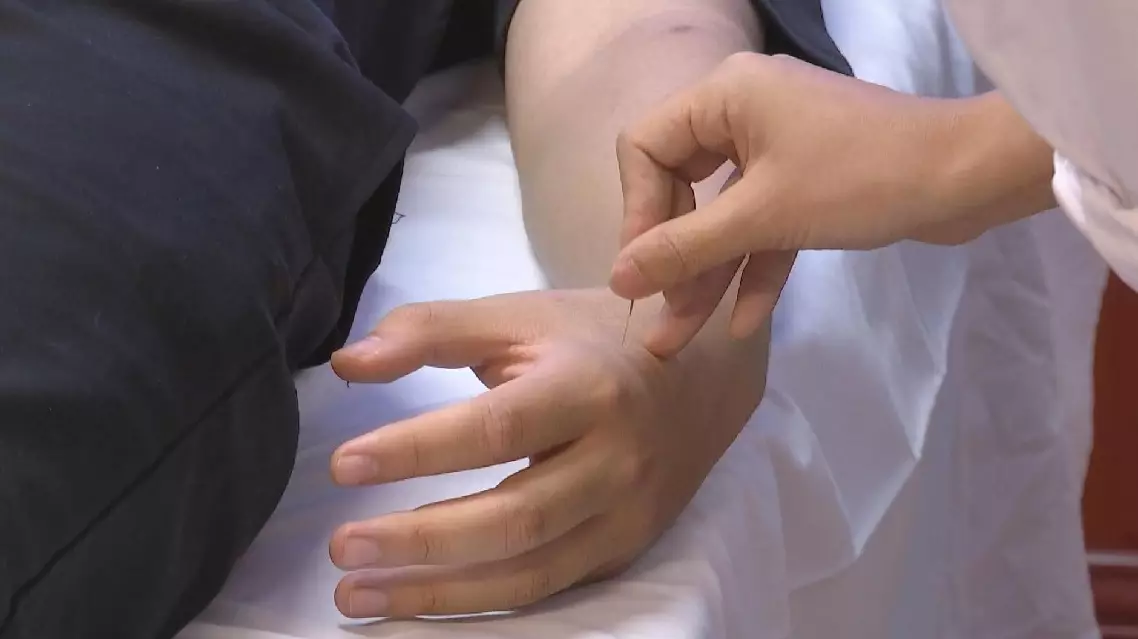
American interest in traditional Chinese medicince serves as valuable bridge for cultural exchange