WASHINGTON (AP) — The deep penetrating bombs that the U.S. dropped into two Iranian nuclear facilities were designed specifically for those sites and were the result of more than 15 years of intelligence and weapons design work, the Pentagon’s top leaders said Thursday.
Defense Secretary Pete Hegseth and Gen. Dan Caine, chairman of the Joint Chiefs of Staff, said at a press briefing that they are confident the weapons struck exactly as planned.
Click to Gallery
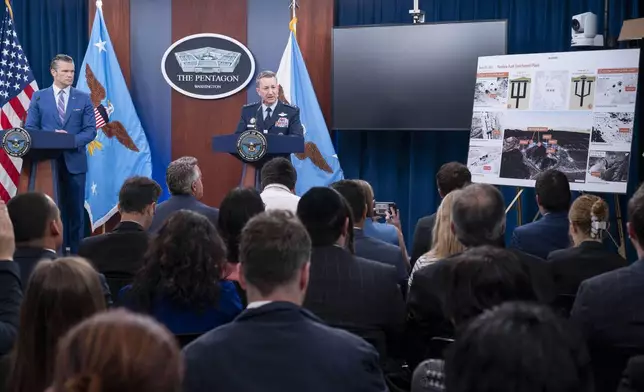
Joint Chiefs Chairman Gen. Dan Caine, right, speaks during a news conference with Defense Secretary Pete Hegseth at the Pentagon, Thursday, June 26, 2025 in Washington. (AP Photo/Kevin Wolf)

Joint Chiefs Chairman Gen. Dan Caine speaks during a news conference at the Pentagon, Thursday, June 26, 2025 in Washington. (AP Photo/Kevin Wolf)

Defense Secretary Pete Hegseth speaks during a news conference at the Pentagon, Thursday, June 26, 2025 in Washington. (AP Photo/Kevin Wolf)
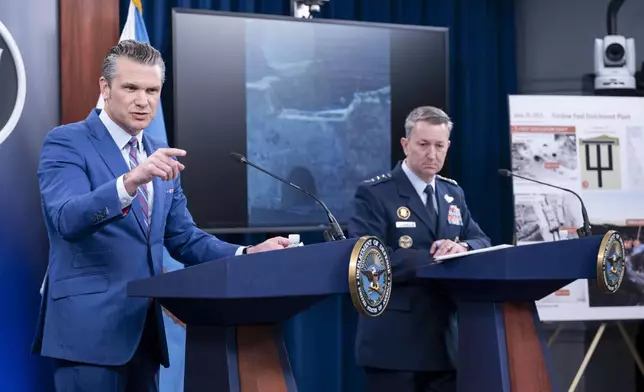
Defense Secretary Pete Hegseth, left, speaks at a news conference with Joint Chiefs Chairman Gen. Dan Caine at the Pentagon, Thursday, June 26, 2025 in Washington. (AP Photo/Kevin Wolf)
Caine, the nation’s top military officer, offered new details about the work that went into building the “bunker-buster” bombs and how the U.S. used them to burrow into the Iranian sites. He sought to show the level of destruction but did not directly address President Donald Trump’s assertion that Tehran’s nuclear program has been “obliterated.”
The bombs, called the GBU-57 A/B Massive Ordnance Penetrator, have their roots in a decades-old classified briefing “of what looked like a major construction project in the mountains of Iran,” Caine said.
That turned out to be the Fordo fuel enrichment plant, with construction believed to have started around 2006. It became operational in 2009, the same year Tehran publicly acknowledged its existence.
The classified briefing was shown in 2009 to a Defense Threat Reduction Agency officer, who with a colleague “lived and breathed” Fordo for the next 15 years, studying the geology, construction dig, the earth moved and “every piece of equipment going in and every piece of equipment going out," Caine said.
What they concluded: The U.S. didn't have a bomb that could destroy those sites. So the Pentagon got to work, Caine said.
“We had so many Ph.D.s working on the mock program — doing modeling and simulation — that we were quietly and in a secret way the biggest users of supercomputer hours within the United States of America,” he said.
The 30,000-pound bomb is comprised of steel, explosive and a fuse programmed to a specific detonation time. The longer the fuse, the deeper the weapon will penetrate before exploding.
Over the years, the military tested and retested it hundreds of times on mock facilities, Caine said. Crews fine-tuned the bombs to detonate in the mock enrichment rooms, delaying detonation until they had reached a position to send a pressure blast through open tunnels to destroy equipment underground.
Fordo had two main ventilation routes into the underground facility — and officials carefully eyed these entry points as a way to target the site.
Each route had three shafts — a main shaft and a smaller shaft on either side, which looked almost like a pitchfork in graphics provided by the Pentagon. In the days preceding the U.S. attack, Iran placed large concrete slabs on top of both ventilation routes to try to protect them, Caine said.
In response, the U.S. crafted an attack plan where six bunker-buster bombs would be used against each ventilation route, using the main shaft as a way down into the enrichment facility.
Seven B-2 stealth bombers were used, carrying two of the massive munitions apiece. The first bomb was used to eliminate the concrete slab, Caine said.
The next four bombs were dropped down the main shaft and into the complex at a speed of more than 1,000 feet per second before exploding, he said. A sixth bomb was dropped as a backup, in case anything went wrong.
In addition to the 12 bombs dropped on Fordo, with six on each ventilation route, two more hit Iran's main Natanz facility, Caine said.
Each crew was able to confirm detonation as they saw the bombs drop from the aircraft in front of them: “We know that the trailing jets saw the first weapons function,” Caine said.
The pilots reported back that it was the brightest explosion they had ever seen — that it looked like daylight, he said.
Caine said the munitions were built, tested and loaded properly, guided to their intended targets and then exploded as designed.
“Iran’s nuclear facilities have been destroyed,” Hegseth said.
However, questions remained as to whether the highly enriched uranium that Iran would need to develop a nuclear weapon was at the site at the time. Asked repeatedly, Hegseth did not say if the uranium had been destroyed or moved.
“I’m not aware of any intelligence that I’ve reviewed that says things were not where they were supposed to be — moved or otherwise,” Hegseth said.
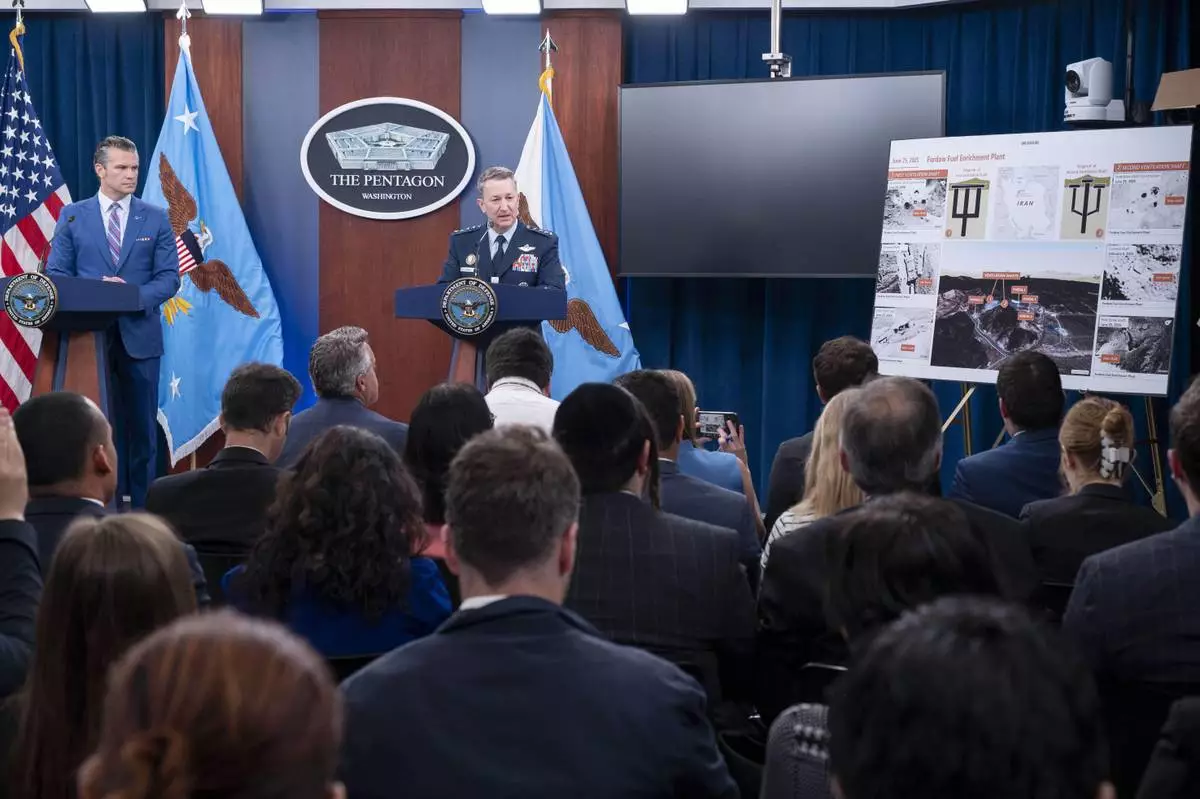
Joint Chiefs Chairman Gen. Dan Caine, right, speaks during a news conference with Defense Secretary Pete Hegseth at the Pentagon, Thursday, June 26, 2025 in Washington. (AP Photo/Kevin Wolf)

Joint Chiefs Chairman Gen. Dan Caine speaks during a news conference at the Pentagon, Thursday, June 26, 2025 in Washington. (AP Photo/Kevin Wolf)

Defense Secretary Pete Hegseth speaks during a news conference at the Pentagon, Thursday, June 26, 2025 in Washington. (AP Photo/Kevin Wolf)
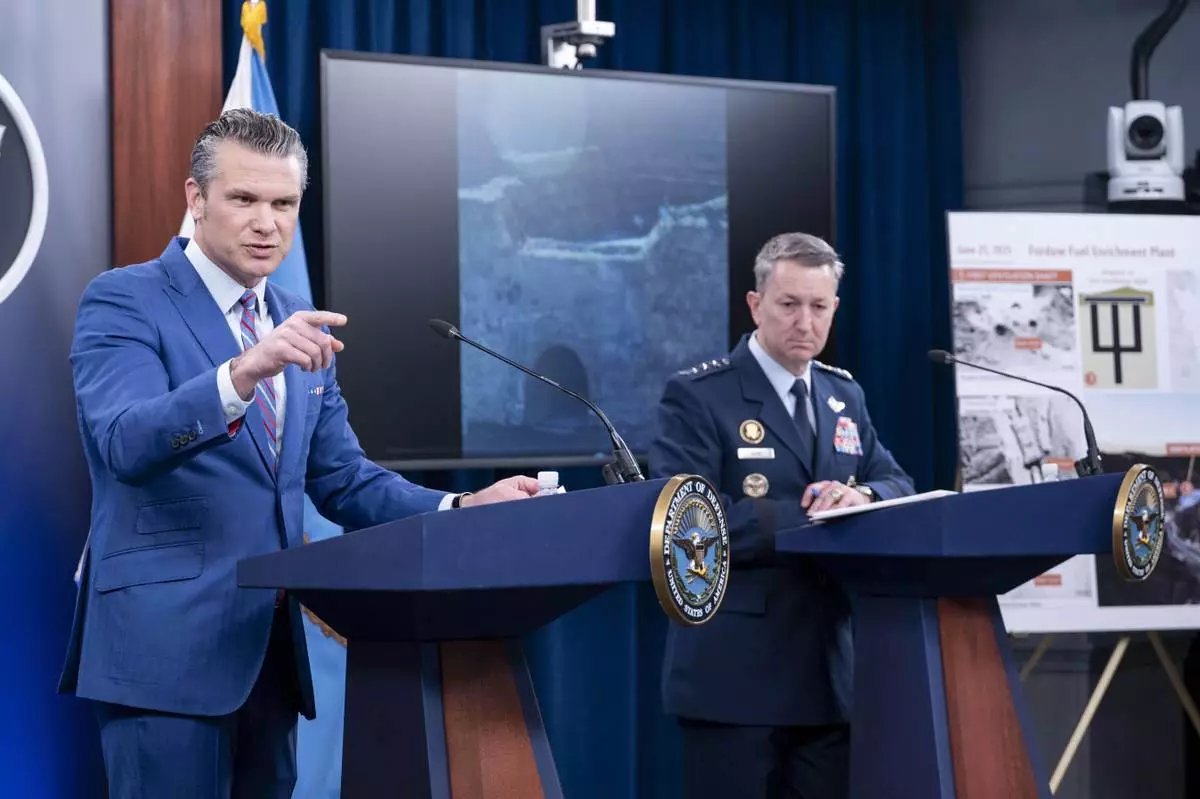
Defense Secretary Pete Hegseth, left, speaks at a news conference with Joint Chiefs Chairman Gen. Dan Caine at the Pentagon, Thursday, June 26, 2025 in Washington. (AP Photo/Kevin Wolf)