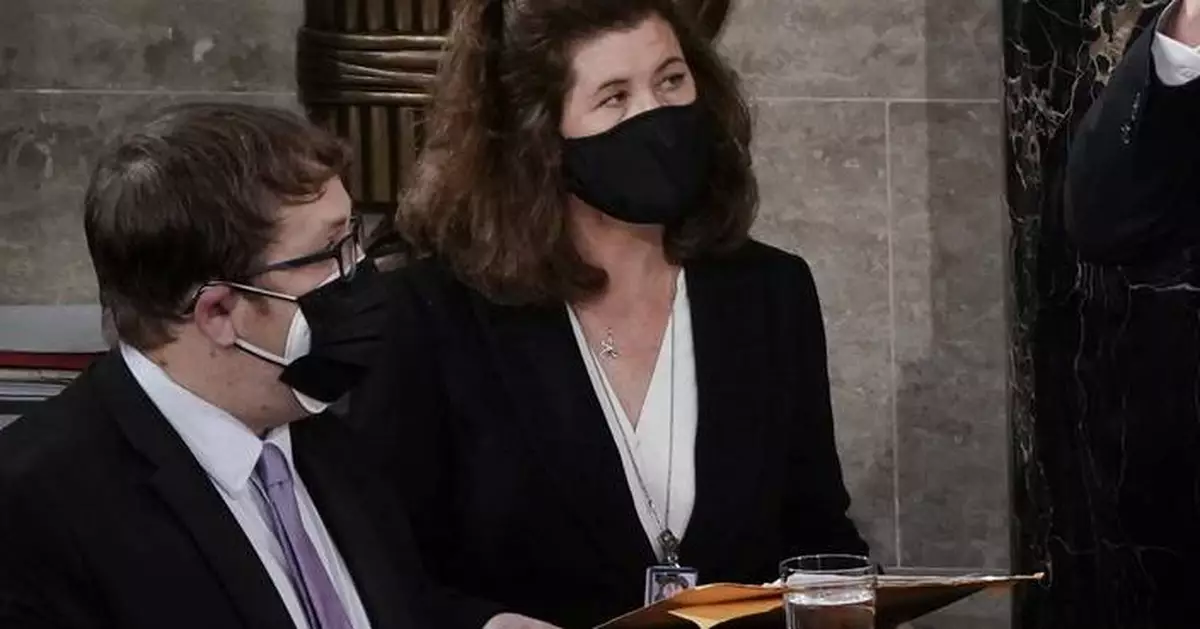
WASHINGTON (AP) — A few Republicans reacted with indignation Thursday after the Senate parliamentarian advised that some of the measures in their tax and immigration bill could not be included in the legislation.
Sen. Tommy Tuberville, R-Ala., tweeted on X that Senate Parliamentarian Elizabeth MacDonough should be fired, “ASAP.” Rep. Greg Steube, R-Fla., intimated that she was partisan, asking why an “unelected swamp bureaucrat, who was appointed by Harry Reid over a decade ago” gets to decide what’s in the bill?”
It's hardly the first time the parliamentarian's normally low-key and lawyerly role has drawn a blast of public criticism.
MacDonough also dashed Democratic plans over the years, advising in 2021 that they couldn't include a minimum wage increase in their COVID-19 relief bill. Later that same year, she advised that Democrats needed to drop an effort to let millions of immigrants remain temporarily in the U.S. as part of their big climate bill.
But the attention falling on MacDonough's rulings in recent years also reflects a broader change in Congress, with lawmakers increasingly trying to wedge their top policy priorities into bills that can't be filibustered in the Senate. The process comes with special rules designed to deter provisions unrelated to spending or taxes — and that's where the parliamentarian comes in, offering analysis of what does and doesn't qualify.
Her latest round of decisions Thursday was a blow to the GOP’s efforts to wring hundreds of billions of dollars from Medicaid over the next decade. Senate Republicans could opt to try to override her recommendations, but they are unlikely to do so.
Here's a closer look at what the Senate parliamentarian does and why lawmakers are so focused on her recommendations right now.
Both the House and Senate have a parliamentarian to provide assistance on that chamber's rules and precedents. They are often seen advising whoever is presiding over the chamber on the proper procedures to be followed and the appropriate responses to a parliamentary inquiry.
They are also charged with providing information to lawmakers and their respective staff on a strictly nonpartisan and confidential basis.
The parliamentarians and their staff only offer advice. Their recommendations are not binding. In the case of the massive tax and spending bill now before both chambers, the parliamentarian plays a critical role in advising whether the reconciliation bill's provisions remain focused on fiscal issues.
MacDonough, an English literature major, is the Senate’s first woman to be parliamentarian and just the sixth person to hold the position since its creation in 1935.
She began her Senate career in its library before leaving to get a law degree at Vermont Law School. She worked briefly as a Justice Department trial attorney before returning to the Senate in 1999, this time as an assistant in the parliamentarian’s office. She was initially appointed parliamentarian in 2012 by Democrat Harry Reid of Nevada, Senate majority leader at the time. She was retained by Sen. Mitch McConnell, R-Ky., when he became majority leader in 2015.
She helped Chief Justice John Roberts preside over Trump’s 2020 Senate impeachment trial and was beside then-Sen. Patrick Leahy, D-Vt., for Trump’s second trial the following year. Trump was acquitted both times.
When Trump supporters fought past police and into the Capitol in hopes of disrupting Congress’ certification of Joe Biden’s Electoral College victory, MacDonough and other staffers rescued those ballots and hustled mahogany boxes containing them to safety. MacDonough’s office, on the Capitol’s first floor, was ransacked and declared a crime scene.
Yes. The parliamentarian makes the recommendation, but it's the presiding officer overseeing Senate proceedings who rules on provisions in the bill. If there is a dispute, it would be put to a vote.
Michael Thorning, director of structural democracy at the Bipartisan Policy Center, a think tank, said he doubts Republicans will want to go that route. And indeed, some Republican senators said as much Thursday.
“It’s the institutional integrity, even if I’m convinced 100% she’s wrong,” said Sen. Kevin Cramer, R-N.D.
Thorning said lawmakers from both parties view MacDonough as “very much an honest broker.”
"And the Senate relies on her,” Thorning said. “Sometimes, those decisions cut your way, and sometimes, they don't. I also think members recognize that once you start treating the parliamentarian's advice as just something that could be easily dismissed, then the rules start to matter less.”
Majority leaders from both parties have replaced the parliamentarian. For more than three decades, the position alternated between Robert Dove and Alan Frumin depending upon which party was in the majority.
Thorning said the two parliamentarians weren't far apart though, in how they interpreted the Senate's rules and precedents.
MacDonough succeeded Frumin as parliamentarian. He said the small number of calls Thursday for her dismissal “tells you all people need to know about the current parliamentarian.”
“Senators know this isn't somebody playing politics,” Thorning said.
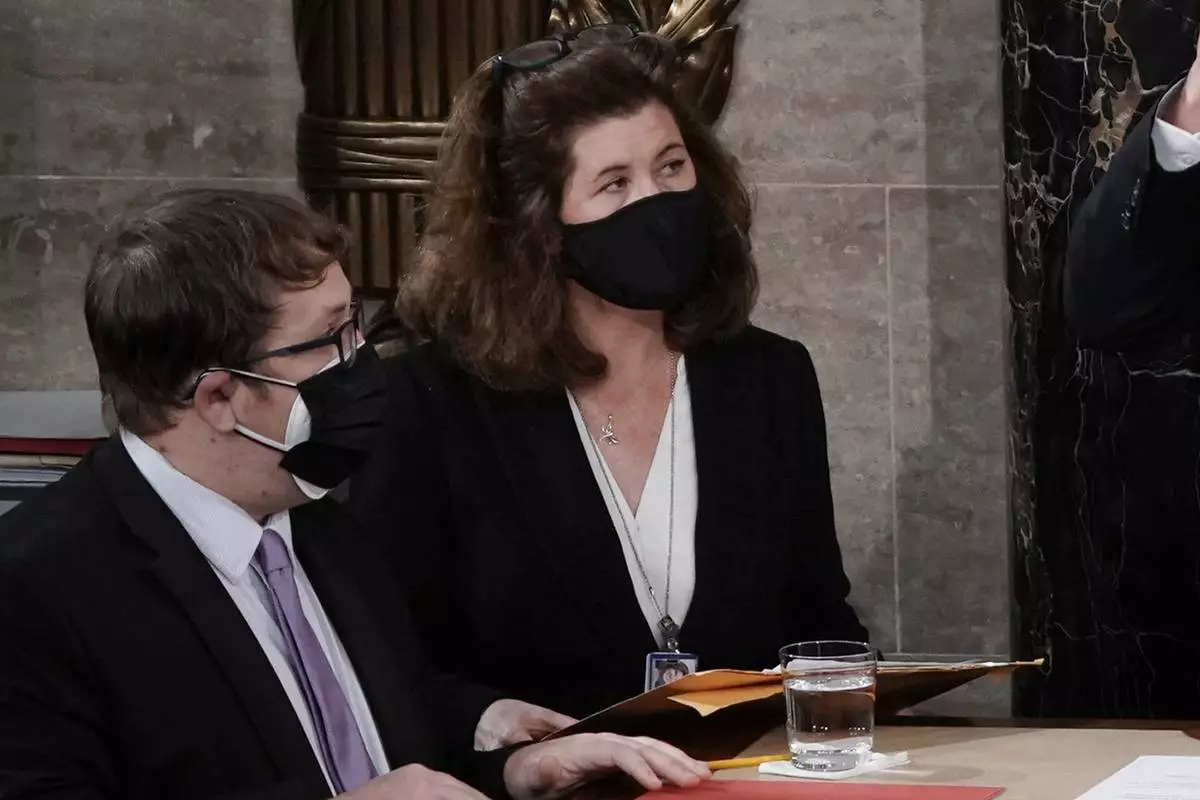
FILE - Senate Parliamentarian Elizabeth MacDonough watches during the certification of Electoral College ballots in the presidential election, in the House chamber at the Capitol in Washington, Jan. 6, 2021. (AP Photo/J. Scott Applewhite, File)
NEW YORK (AP) — Thousands of nurses in three hospital systems in New York City went on strike Monday after negotiations through the weekend failed to yield breakthroughs in their contract disputes.
The strike was taking place at The Mount Sinai Hospital and two of its satellite campuses, with picket lines forming. The other affected hospitals are NewYork-Presbyterian and Montefiore Medical Center in the Bronx.
About 15,000 nurses are involved in the strike, according to New York State Nurses Association.
“After months of bargaining, management refused to make meaningful progress on core issues that nurses have been fighting for: safe staffing for patients, healthcare benefits for nurses, and workplace violence protections,” the union said in a statement issued Monday. “Management at the richest hospitals in New York City are threatening to discontinue or radically cut nurses’ health benefits.”
The strike, which comes during a severe flu season, could potentially force the hospitals to transfer patients, cancel procedures or divert ambulances. It could also put a strain on city hospitals not involved in the contract dispute, as patients avoid the medical centers hit by the strike.
The hospitals involved have been hiring temporary nurses to try and fill the labor gap during the walkout, and said in a statement during negotiations that they would “do whatever is necessary to minimize disruptions.” Montefiore posted a message assuring patients that appointments would be kept.
“NYSNA’s leaders continue to double down on their $3.6 billion in reckless demands, including nearly 40% wage increases, and their troubling proposals like demanding that a nurse not be terminated if found to be compromised by drugs or alcohol while on the job," Montefiore spokesperson Joe Solmonese said Monday after the strike had started. "We remain resolute in our commitment to providing safe and seamless care, regardless of how long the strike may last.”
New York-Presbyterian accused the union of staging a strike to “create disruption,” but said in a statement that it has taken steps to ensure patients receive the care they need.
"We’re ready to keep negotiating a fair and reasonable contract that reflects our respect for our nurses and the critical role they play, and also recognizes the challenging realities of today’s healthcare environment,” the statement said.
The work stoppage is occurring at multiple hospitals simultaneously, but each medical center is negotiating with the union independently. Several other hospitals across the city and in its suburbs reached deals in recent days to avert a possible strike.
The nurses’ demands vary by hospital, but the major issues include staffing levels and workplace safety. The union says hospitals have given nurses unmanageable workloads.
Nurses also want better security measures in the workplace, citing incidents like a an incident last week, when a man with a sharp object barricaded himself in a Brooklyn hospital room and was then killed by police.
The union also wants limitations on hospitals’ use of artificial intelligence.
The nonprofit hospitals involved in the negotiations say they’ve been working to improve staffing levels, but say the union’s demands overall are too costly.
Nurses voted to authorize the strike last month.
Both New York Gov. Kathy Hochul and Mayor Zohran Mamdani had expressed concern about the possibility of the strike. As the strike deadline neared, Mamdani urged both sides to keep negotiating and reach a deal that “both honors our nurses and keeps our hospitals open.”
“Our nurses kept this city alive through its hardest moments. Their value is not negotiable,” Mamdani said.
State Attorney General Letitia James voiced similar support, saying "nurses put their lives on the line every day to keep New Yorkers healthy. They should never be forced to choose between their own safety, their patients’ well-being, and a fair contract.”
The last major nursing strike in the city was only three years ago, in 2023. That work stoppage, at Mount Sinai and Montefiore, was short, lasting three days. It resulted in a deal raising pay 19% over three years at those hospitals.
It also led to promised staffing improvements, though the union and hospitals now disagree about how much progress has been made, or whether the hospitals are retreating from staffing guarantees.
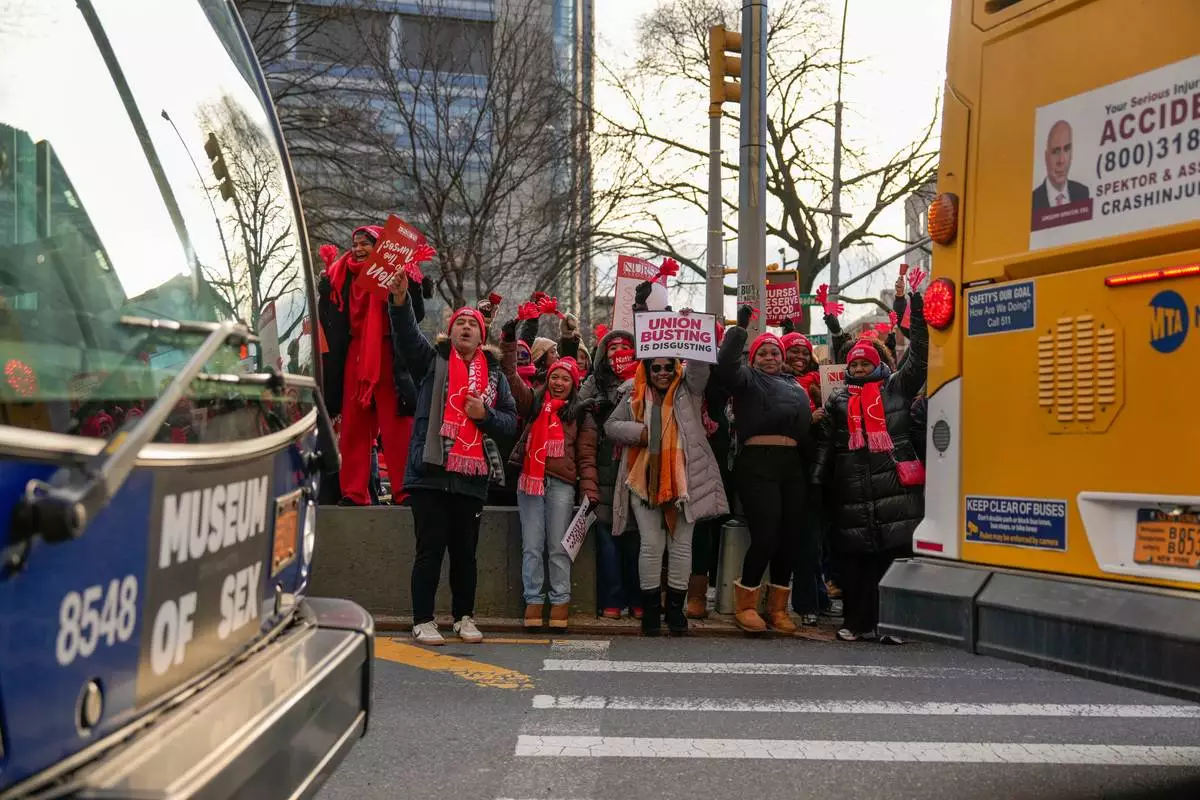
Nurses strike outside New York-Presbyterian Hospital, Monday, Jan. 12, 2026, in New York. (AP Photo/Yuki Iwamura)
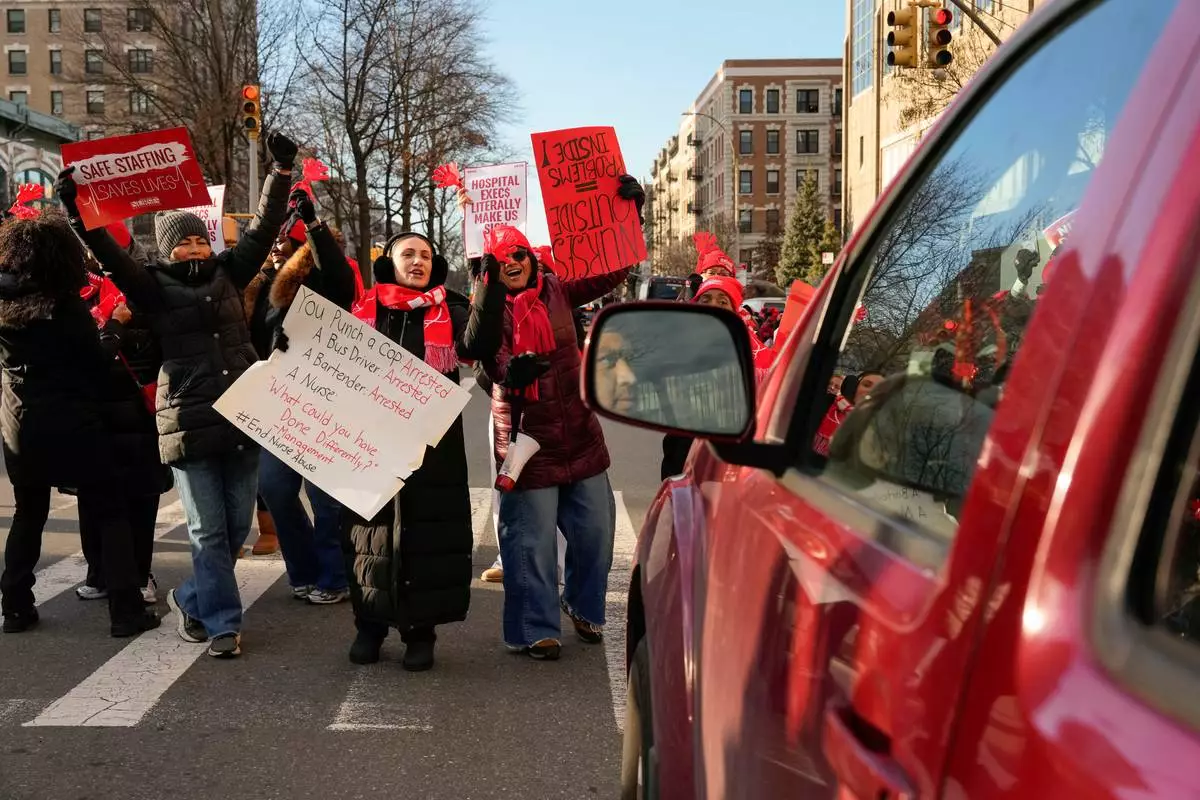
Nurses strike outside New York-Presbyterian Hospital, Monday, Jan. 12, 2026, in New York. (AP Photo/Yuki Iwamura)
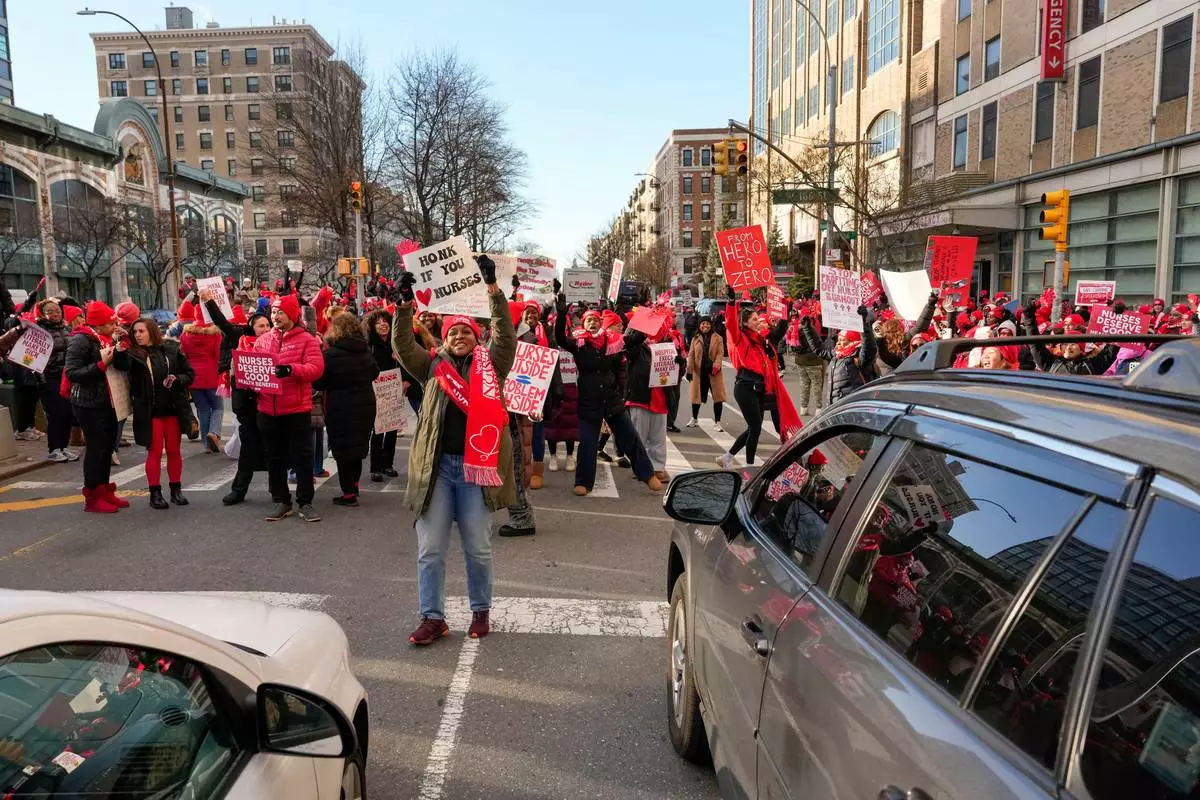
Nurses strike outside New York-Presbyterian Hospital, Monday, Jan. 12, 2026, in New York. (AP Photo/Yuki Iwamura)
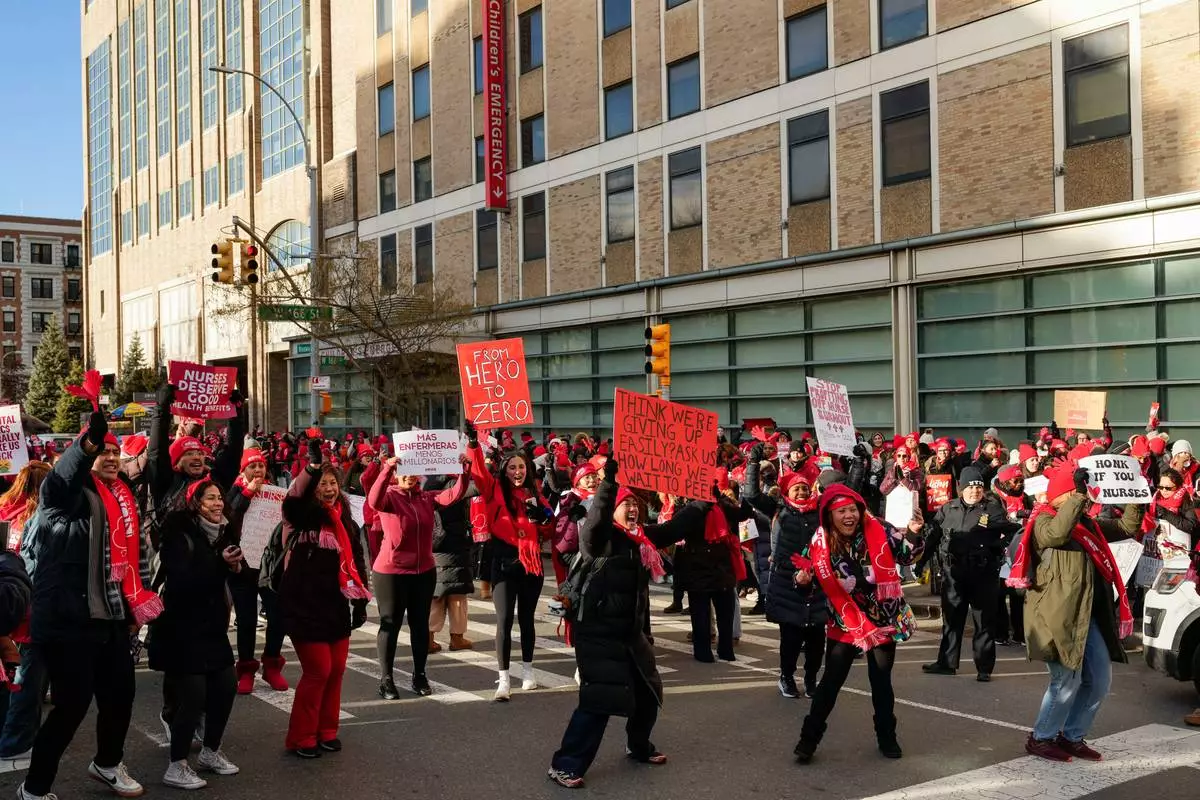
Nurses strike outside New York-Presbyterian Hospital, Monday, Jan. 12, 2026, in New York. (AP Photo/Yuki Iwamura)
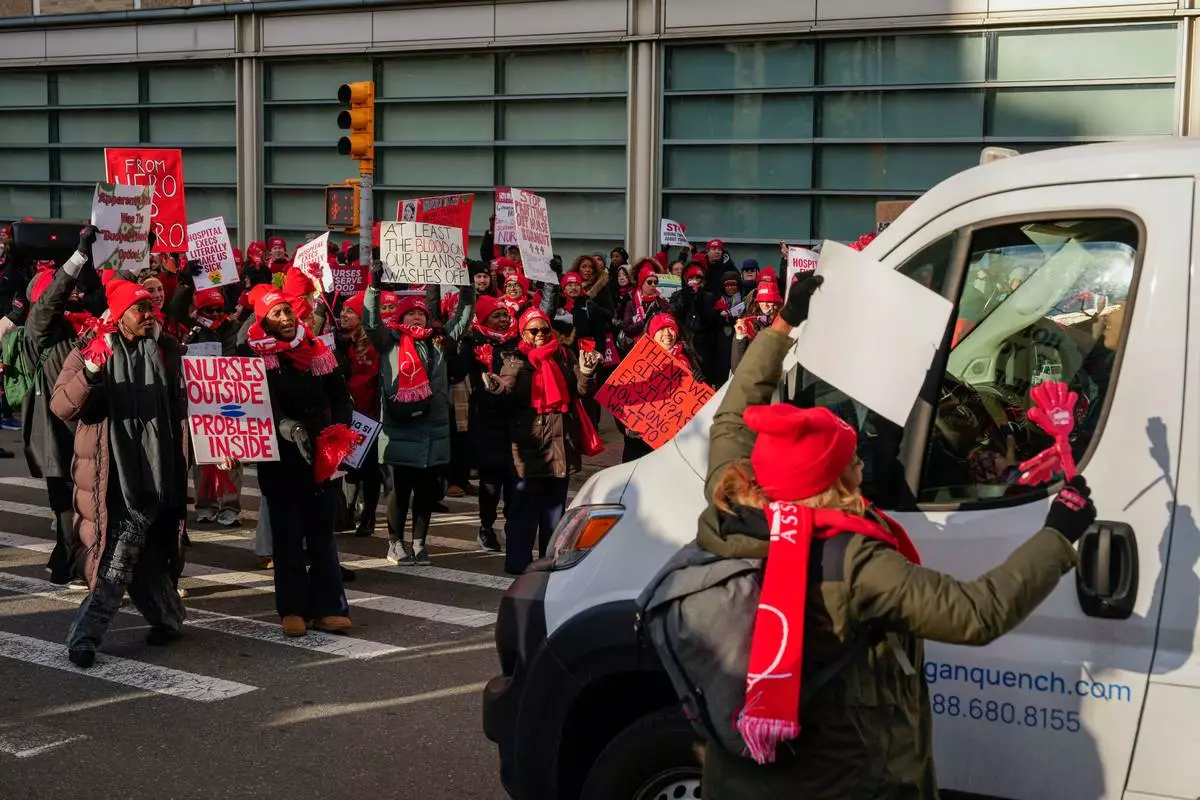
Nurses strike outside New York-Presbyterian Hospital, Monday, Jan. 12, 2026, in New York. (AP Photo/Yuki Iwamura)
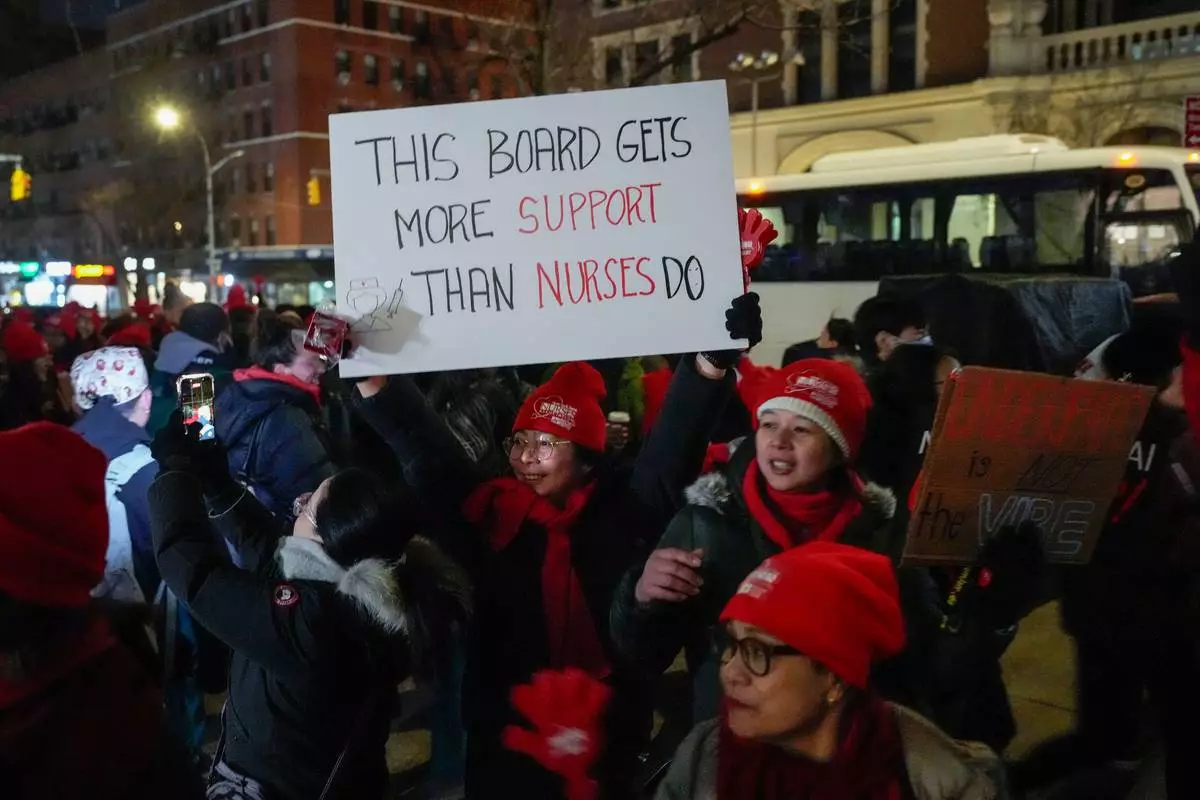
Nurses strike outside Mount Sinai West Hospital, Monday, Jan. 12, 2026, in New York. (AP Photo/Yuki Iwamura)
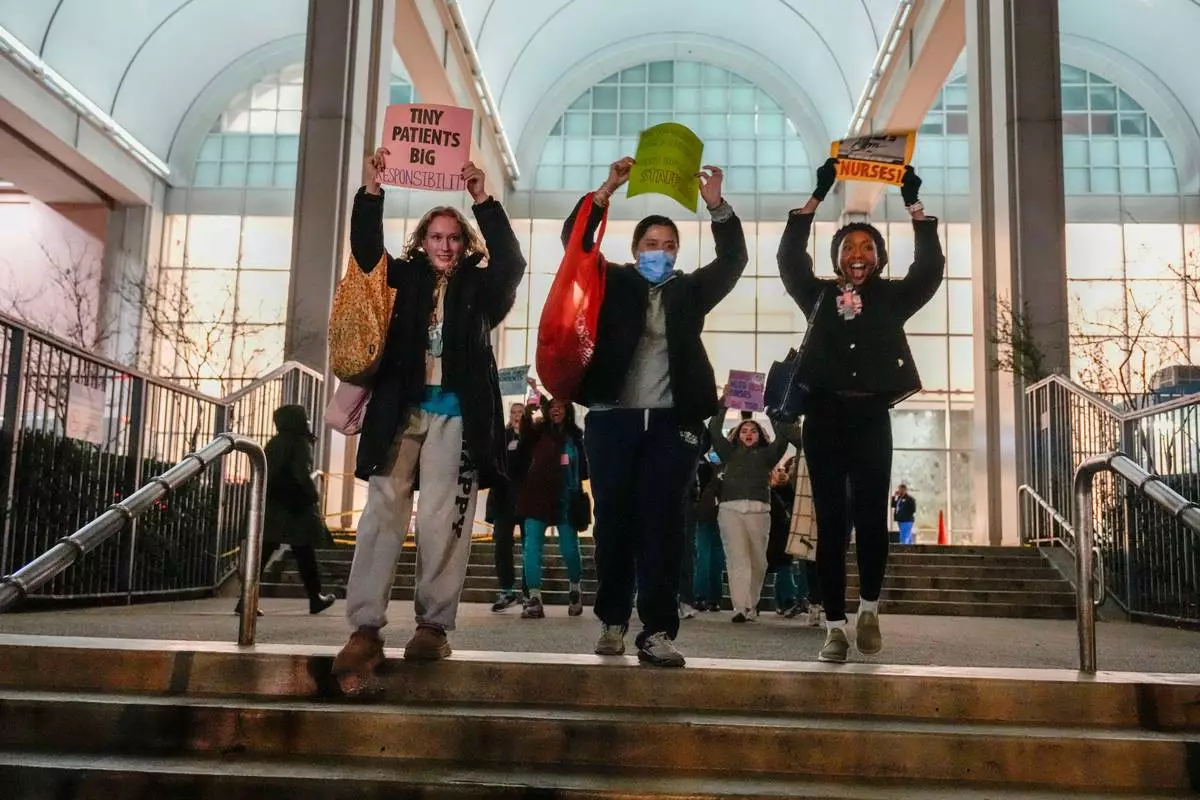
Nurses strike outside Mount Sinai West Hospital, Monday, Jan. 12, 2026, in New York. (AP Photo/Yuki Iwamura)
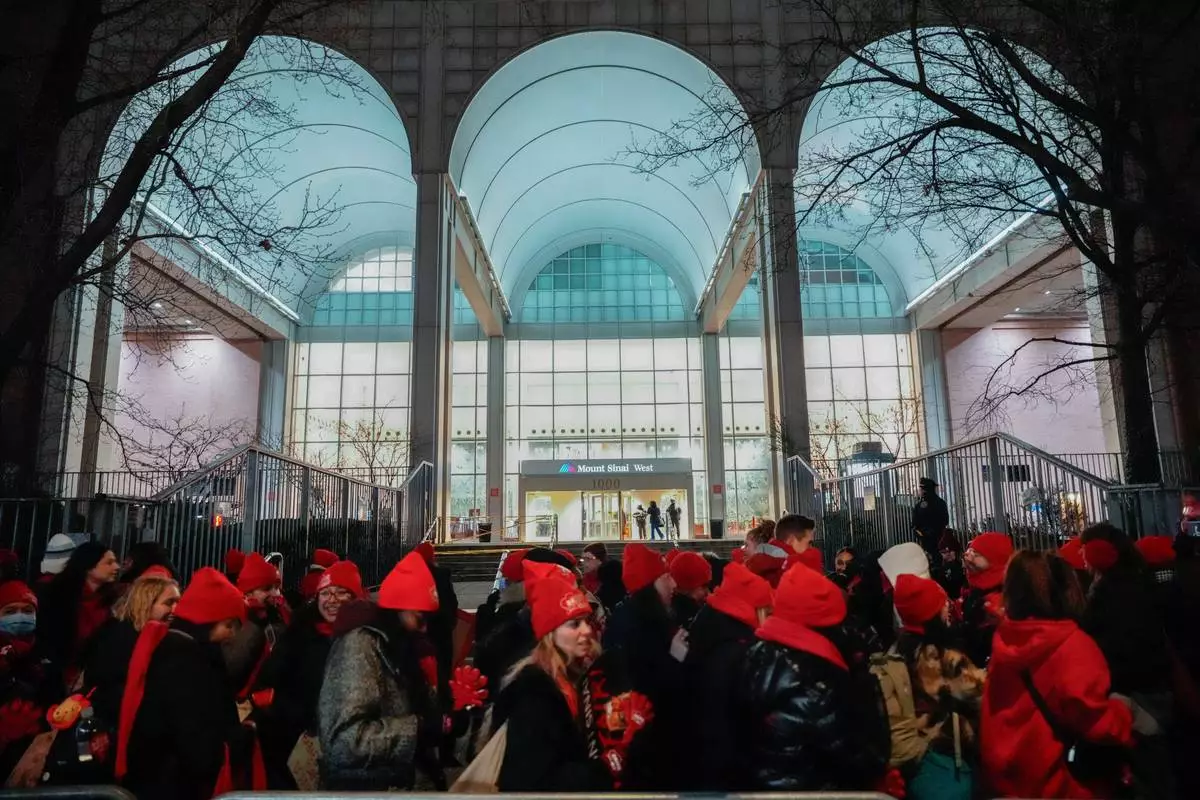
Nurses strike outside Mount Sinai West Hospital, Monday, Jan. 12, 2026, in New York. (AP Photo/Yuki Iwamura)

Nurses strike outside Mount Sinai West Hospital, Monday, Jan. 12, 2026, in New York. (AP Photo/Yuki Iwamura)

FILE - A medical worker transports a patient at Mount Sinai Hospital, April 1, 2020, in New York. (AP Photo/Mary Altaffer, File)