DAKAR, Senegal (AP) — A deal signed in Washington on Friday has been touted as a major step toward peace in Congo following decades of conflict that has killed millions, including thousands this year.
The U.S.-mediated agreement is between Rwanda and the Democratic Republic of Congo, which has been battered by fighting with more than 100 armed groups. The most potent is backed by neighboring Rwanda, and it is not clear if it will abide by the deal as the group wasn't part of the negotiations.
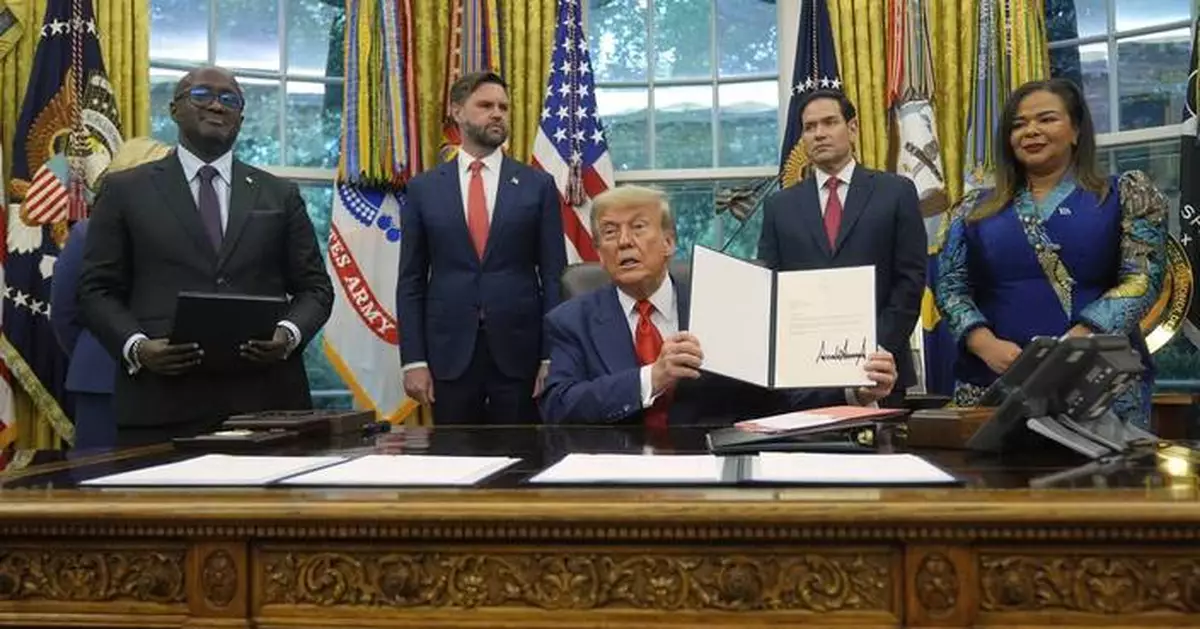
President Donald Trump says the deal gives the United States “a lot of the mineral rights” from Congo. His administration has pushed to gain access to minerals key to much of the world's technology and is seeking to counter China, a key player in the region where the U.S. presence and influence have eroded.
Both the Congolese and Rwandan presidents are expected in Washington in a few weeks to “finalize the complete protocol and agreement,” U.S. Secretary of State Marco Rubio said.
Here's a look at what we know about the agreement:
The agreement details general expectations but is short on how it will be implemented, particularly in getting the key actors of the conflict — the Rwanda-backed M23 rebels — to lay down their arms, according to a copy seen by The Associated Press.
The deal emphasizes the two neighboring countries' sovereignty, territorial integrity and peaceful coexistence, with a commitment to halt all hostilities and any support for armed groups.
Although it denies supporting the M23 rebels, Rwanda has said it is protecting its border and going after the ethnic Hutus, whom it accuses of participating in the 1994 Rwandan genocide and now working with Congolese forces after fleeing to the neighboring country.
Armed gangs involved in the conflict may be reintegrated into Congolese security forces only after individual vetting based on loyalty, fitness and human rights records, the deal says.
In what the U.N. has called “one of the most protracted, complex, serious humanitarian crises on Earth,” the deal includes a commitment to protect and facilitate humanitarian access for displaced people in Congo, estimated to be more than 7 million.
The two countries also commit to creating an economic framework “to expand foreign trade and investment derived from regional critical mineral supply chains,” including ones that “link both countries, in partnership, as appropriate, with the U.S. government and U.S. investors.”
Analysts say it is going to be difficult for the M23 rebels to withdraw from the cities they seized during their major advance this year and that such withdrawal may either take a long time or another round of fighting.
Rwanda is estimated to have thousands of troops supporting the M23 rebels in eastern Congo. Even if Rwanda ends its support for the rebels, the M23 has been consolidating its grip in the cities it has seized, setting up local administrative offices and enforcing a new governing structure.
A team of U.N. experts said in a report in December that Rwanda was benefitting from minerals “fraudulently” exported from areas in the region under the control of the M23. Rwanda has denied involvement.
The rebels were not directly involved in the U.S.-facilitated negotiations and have not spoken publicly about the deal. And Corneille Nangaa, leader of the Congo River Alliance, which includes the M23, told the AP in March that “anything regarding us which are done without us, it’s against us.”
Rwandan Foreign Minister Olivier Nduhungirehe pointed to separate talks happening in Qatar that are meant to get both Congo and the M23 rebels to agree among themselves how they will end the fighting. He also said Rwanda agreed to lift its "defensive measures.” It was not clear if he meant withdrawing the troops that Rwanda has said are defending its territorial interests.
Of five people that the AP spoke to in the conflict-battered region, none of them was convinced the deal would quickly end the fighting.
They called for caution in granting the U.S. access to the region’s minerals — resources that even late Pope Francis had reprimanded developed countries for exploiting to the detriment of the Congolese.
“We draw the attention of the Congolese government not to give in completely or to sell the Congo to the Americans just because the United States has supported us in restoring peace,” said Hangi Muhindo, a resident of Goma, the city at the center of the conflict.
“The commitments to the United States must not jeopardize the future of our people,” he added.
Some also felt the agreement is only a part of the solution and called for more dialogue and justice.
“We want peace now, but we don’t want the therapy to be worse than the disease," said Prince Epenge, spokesperson for the local opposition political coalition.
Justin Kabumba and Saleh Mwanamilongo in Congo contributed to this report.
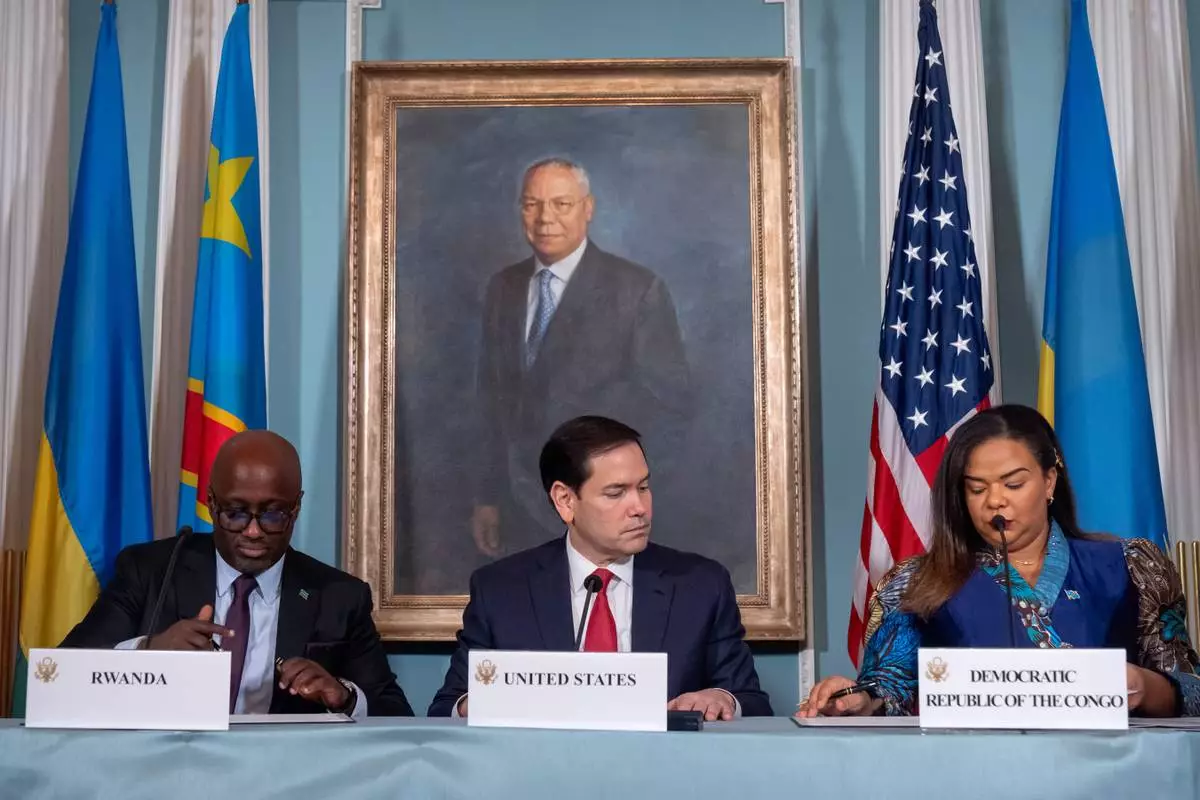
Secretary of State Marco Rubio, center, watches as Rwanda's Foreign Minister Olivier Nduhungirehe, left, and Democratic Republic of the Congo's Foreign Minister Therese Kayikwamba Wagner, right, sign a peace agreement at the State Department, Friday, June 27, 2025, in Washington. (AP Photo/Mark Schiefelbein).
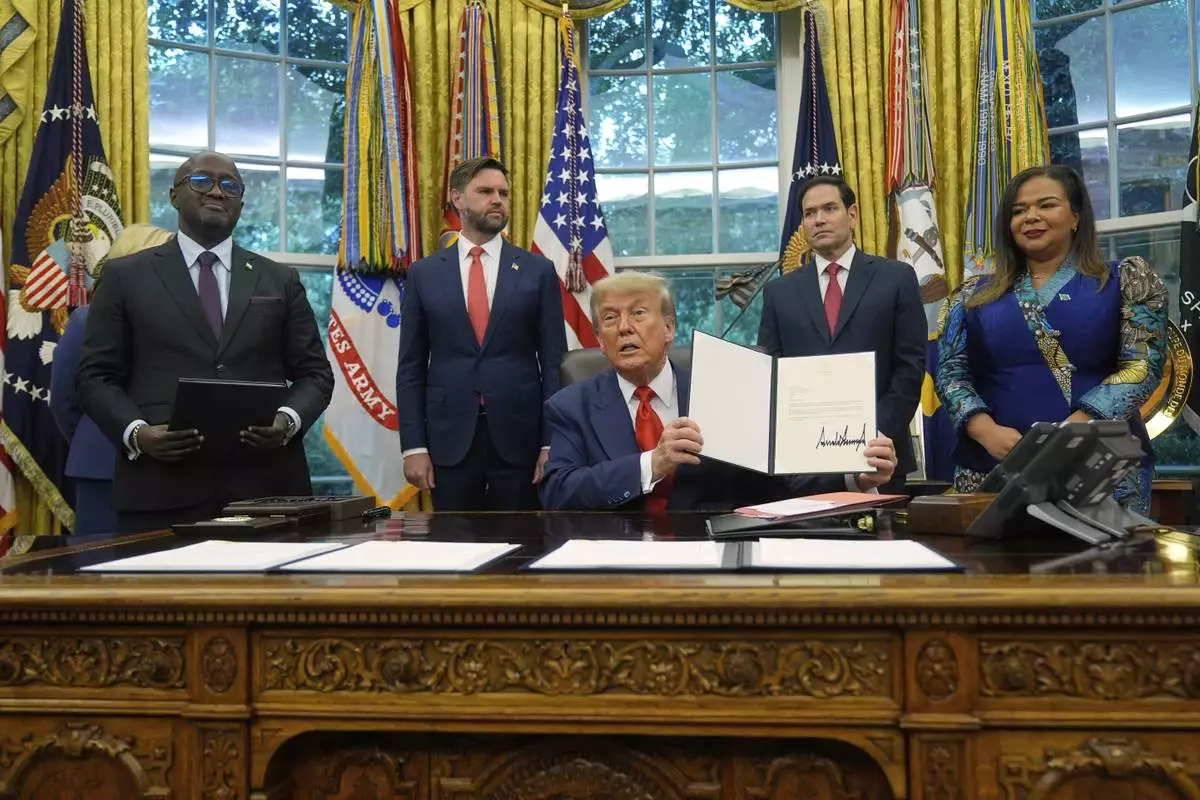
President Donald Trump holds up a signed document to present to Congo's Foreign Minister Therese Kayikwamba Wagner, right, as Rwanda's Foreign Minister Olivier Nduhungirehe, from left, Vice President JD Vance and Secretary of State Marco Rubio watch, Friday, June 27, 2025, in the Oval Office at the White House in Washington. (AP Photo/Manuel Balce Ceneta)
DUBAI, United Arab Emirates (AP) — U.S. President Donald Trump said Iran wants to negotiate with Washington after his threat to strike the Islamic Republic over its bloody crackdown on protesters, a move coming as activists said Monday the death toll in the nationwide demonstrations rose to at least 544.
Iran had no immediate reaction to the news, which came after the foreign minister of Oman — long an interlocutor between Washington and Tehran — traveled to Iran this weekend. It also remains unclear just what Iran could promise, particularly as Trump has set strict demands over its nuclear program and its ballistic missile arsenal, which Tehran insists is crucial for its national defense.
Meanwhile Monday, Iran called for pro-government demonstrators to head to the streets in support of the theocracy, a show of force after days of protests directly challenging the rule of 86-year-old Supreme Leader Ayatollah Ali Khamenei. Iranian state television aired chants from the crowd, who shouted “Death to America!” and “Death to Israel!”
Trump and his national security team have been weighing a range of potential responses against Iran including cyberattacks and direct strikes by the U.S. or Israel, according to two people familiar with internal White House discussions who were not authorized to comment publicly and spoke on condition of anonymity.
“The military is looking at it, and we’re looking at some very strong options,” Trump told reporters on Air Force One on Sunday night. Asked about Iran’s threats of retaliation, he said: “If they do that, we will hit them at levels that they’ve never been hit before.”
Trump said that his administration was in talks to set up a meeting with Tehran, but cautioned that he may have to act first as reports of the death toll in Iran mount and the government continues to arrest protesters.
“I think they’re tired of being beat up by the United States,” Trump said. “Iran wants to negotiate.”
He added: “The meeting is being set up, but we may have to act because of what’s happening before the meeting. But a meeting is being set up. Iran called, they want to negotiate.”
Iran through country's parliamentary speaker warned Sunday that the U.S. military and Israel would be “legitimate targets” if America uses force to protect demonstrators.
More than 10,600 people also have been detained over the two weeks of protests, said the U.S.-based Human Rights Activists News Agency, which has been accurate in previous unrest in recent years and gave the death toll. It relies on supporters in Iran crosschecking information. It said 496 of the dead were protesters and 48 were with security forces.
With the internet down in Iran and phone lines cut off, gauging the demonstrations from abroad has grown more difficult. The Associated Press has been unable to independently assess the toll. Iran’s government has not offered overall casualty figures.
Those abroad fear the information blackout is emboldening hard-liners within Iran’s security services to launch a bloody crackdown. Protesters flooded the streets in the country’s capital and its second-largest city on Saturday night into Sunday morning. Online videos purported to show more demonstrations Sunday night into Monday, with a Tehran official acknowledging them in state media.
In Tehran, a witness told the AP that the streets of the capital empty at the sunset call to prayers each night. By the Isha, or nighttime prayer, the streets are deserted.
Part of that stems from the fear of getting caught in the crackdown. Police sent the public a text message that warned: “Given the presence of terrorist groups and armed individuals in some gatherings last night and their plans to cause death, and the firm decision to not tolerate any appeasement and to deal decisively with the rioters, families are strongly advised to take care of their youth and teenagers.”
Another text, which claimed to come from the intelligence arm of the paramilitary Revolutionary Guard, also directly warned people not to take part in demonstrations.
“Dear parents, in view of the enemy’s plan to increase the level of naked violence and the decision to kill people, ... refrain from being on the streets and gathering in places involved in violence, and inform your children about the consequences of cooperating with terrorist mercenaries, which is an example of treason against the country,” the text warned.
The witness spoke to the AP on condition of anonymity due to the ongoing crackdown.
The demonstrations began Dec. 28 over the collapse of the Iranian rial currency, which trades at over 1.4 million to $1, as the country’s economy is squeezed by international sanctions in part levied over its nuclear program. The protests intensified and grew into calls directly challenging Iran’s theocracy.
Nikhinson reported from aboard Air Force One.
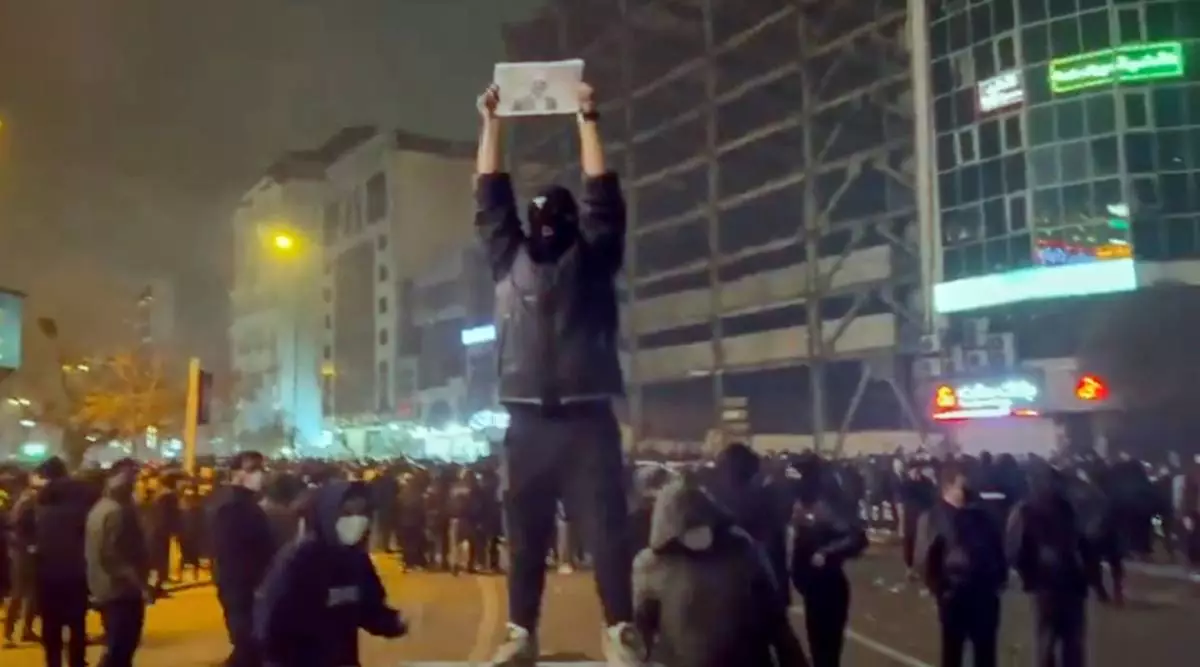
In this frame grab from video obtained by the AP outside Iran, a masked demonstrator holds a picture of Iran's Crown Prince Reza Pahlavi during a protest in Tehran, Iran, Friday, January. 9, 2026. (UGC via AP)
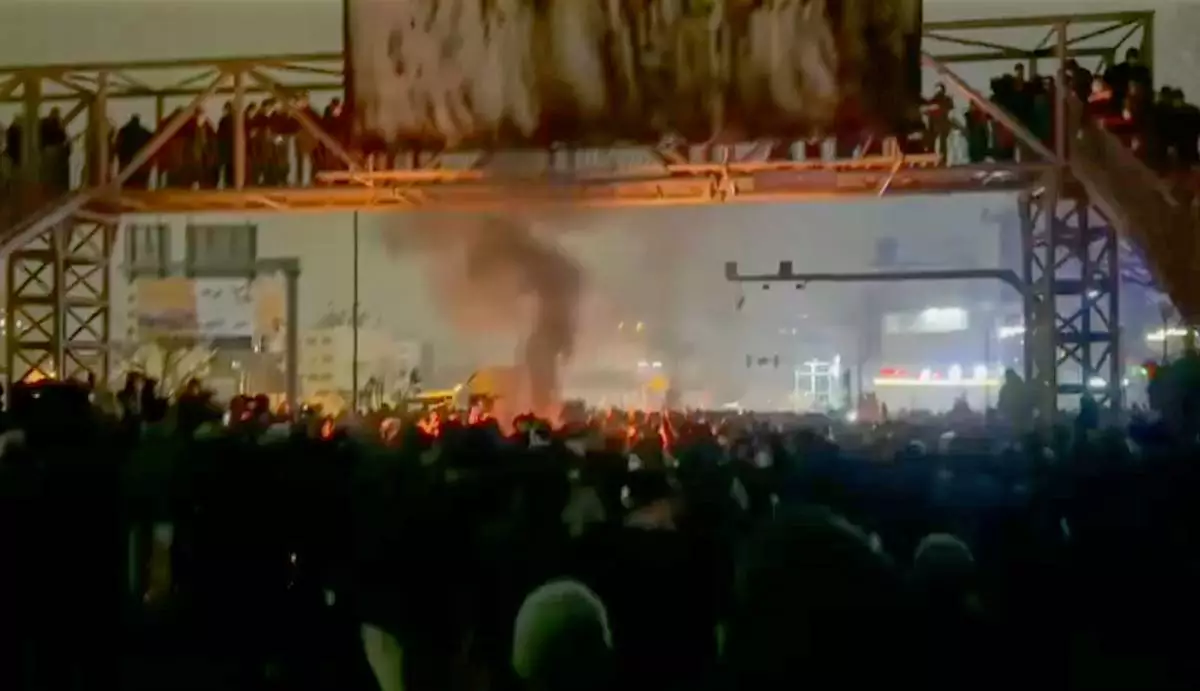
In this frame grab from footage circulating on social media from Iran shows protesters taking to the streets despite an intensifying crackdown as the Islamic Republic remains cut off from the rest of the world in Tehran, Iran, Friday, Jan. 9, 2026.(UGC via AP)
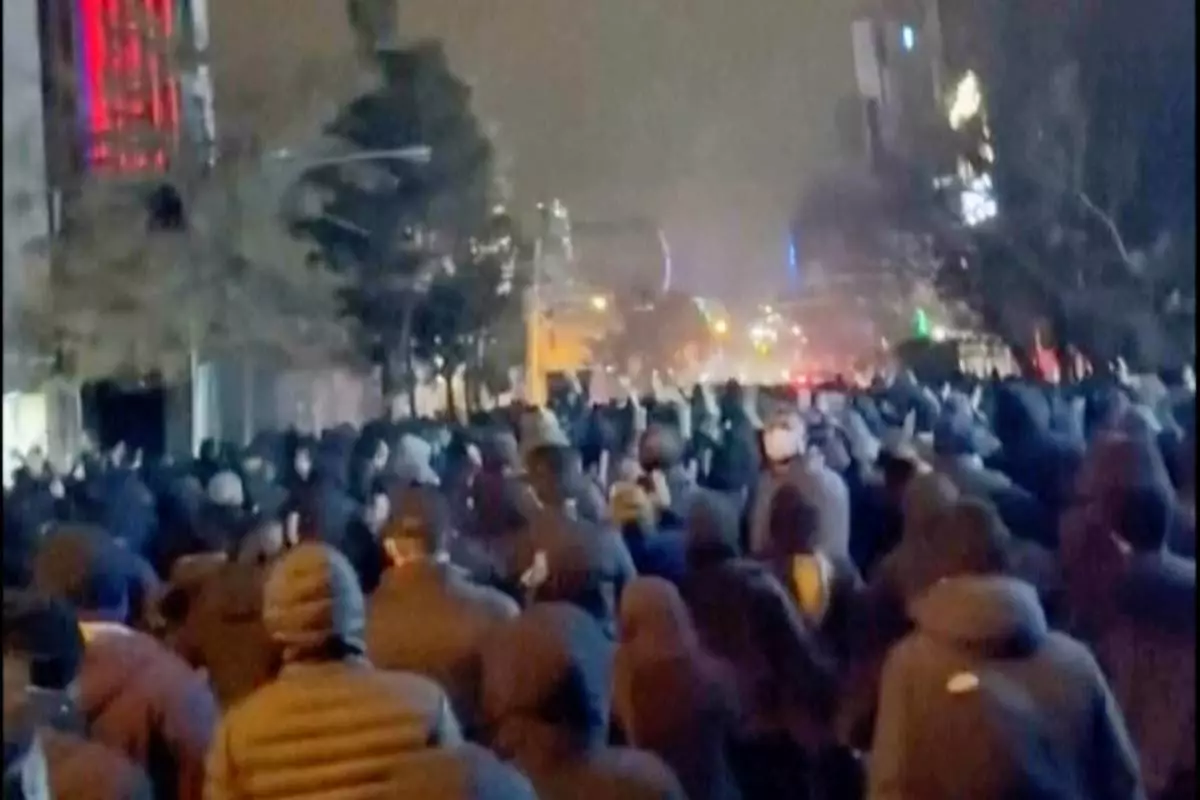
In this frame grab from footage circulating on social media from Iran showed protesters once again taking to the streets of Tehran despite an intensifying crackdown as the Islamic Republic remains cut off from the rest of the world in Tehran, Iran, Saturday Jan. 10, 2026. (UGC via AP)