WASHINGTON (AP) — Democratic efforts in the Senate to prevent President Donald Trump from further escalating with Iran fell short Friday, with Republicans blocking a resolution that marked Congress’ first attempt to reassert its war powers following U.S. strikes on Iranian nuclear sites.
The resolution, authored by Sen. Tim Kaine of Virginia, aimed to affirm that Trump should seek authorization from Congress before launching more military action against Iran. Asked Friday if he would bomb Iranian nuclear sites again if he deemed necessary, Trump said, “Sure, without question.”
The measure was defeated in a 53-47 vote in the Republican-held Senate. One Democrat, Sen. John Fetterman of Pennsylvania, joined Republicans in opposition, while Sen. Rand Paul of Kentucky was the only Republican to vote in favor.
Most Republicans have said Iran posed an imminent threat that required decisive action from Trump, and they backed his decision to bomb three Iranian nuclear sites last weekend without seeking congressional approval.
“Of course, we can debate the scope and strategy of our military engagements,” said Sen. Bill Hagerty, R-Tenn. “But we must not shackle our president in the middle of a crisis when lives are on the line.”
Democrats cast doubt on that justification, arguing the president should have come to Congress first. They also said the president did not update them adequately, with Congress' first briefings taking place Thursday.
“The idea is this: We shouldn’t send our sons and daughters into war unless there’s a political consensus that this is a good idea, this is a national interest,” Kaine said in a Thursday interview with The Associated Press. The resolution, Kaine said, wasn't aimed at restricting the president’s ability to defend against a threat, but that "if it’s offense, let’s really make sure we’re making the right decision.”
In a statement following Friday's vote, Kaine said he was “disappointed that many of my colleagues are not willing to stand up and say Congress" should be a part of a decision to go to war.
Democrats' argument for backing the resolution centered on the War Powers Resolution, passed in the early 1970s, which requires the president “in every possible instance” to “consult with Congress before introducing United States Armed Forces.”
Speaking on the Senate floor ahead of Friday's vote, Paul said he would back the resolution, saying that “despite the tactical success of our strikes, they may end up proving to be a strategic failure.”
“It is unclear if this intervention will fully curtail Iran's nuclear aspirations,” said Paul.
Trump is just the latest in a line of presidents to test the limits of the resolution — though he’s done so at a time when he’s often bristling at the nation's checks and balances.
Trump on Monday sent a letter to Congress — as required by the War Powers Resolution — that said strikes on Iran over the weekend were “limited in scope and purpose” and “designed to minimize casualties, deter future attacks and limit the risk of escalation.”
But following classified briefings with top White House officials this week, some lawmakers remain skeptical about how imminent the threat truly was.
“There was no imminent threat to the United States,” said Rep. Jim Himes, the top Democrat on the House Intelligence Committee, after Friday’s classified briefings.
“There’s always an Iranian threat to the world. But, I have not seen anything to suggest that the threat from the Iranians was radically different last Saturday than it was two Saturdays ago,” Himes said.
Despite Democratic skepticism, nearly all Republicans applauded Trump’s decision to strike Iran. And for GOP senators, supporting the resolution would have meant rebuking the president at the same time they’re working to pass his major legislative package.
Kaine proposed a similar resolution in 2020 aimed at limiting Trump’s authority to launch military operations against Iran. Among the eight Republicans who joined Democrats in approving the resolution was Indiana Sen. Todd Young.
After Thursday’s classified briefing for the Senate, Young said he was “confident that Iran was prepared to pose a significant threat” and that, given Trump’s stated goal of no further escalation, “I do not believe this resolution is necessary at this time.”
“Should the Administration’s posture change or events dictate the consideration of additional American military action, Congress should be consulted so we can best support those efforts and weigh in on behalf of our constituents,” Young said in a statement.
Trump has said that a ceasefire between Israel and Iran is now in place. But he and Ayatollah Ali Khamenei have verbally sparred in recent days, with the ayatollah warning the U.S. not to launch future strikes on Iran.
White House officials have said they expect to restart talks soon with Iran, though nothing has been scheduled.
Associated Press reporter Leah Askarinam contributed to this report.

President Donald Trump answers questions from reporters as he meets with Congo's Foreign Minister Therese Kayikwamba Wagner, and Rwanda's Foreign Minister Olivier Nduhungirehe, Friday, June 27, 2025, in the Oval Office at the White House in Washington. (AP Photo/Manuel Balce Ceneta)

Sen. Tim Kaine, D-Va., center, and Sen. Adam Schiff, D-Calif., right, arrive for a classified briefing on President Donald Trump's directed strikes on Iranian nuclear facilities last weekend, at the Capitol in Washington, Thursday, June 26, 2025. (AP Photo/Rod Lamkey, Jr.)
RHO, Italy (AP) — No ice is colder and harder than speedskating ice. The precision it takes has meant that Olympic speedskaters have never competed for gold on a temporary indoor rink – until the 2026 Milan Cortina Winter Games.
In the pursuit of maximum glide and minimum friction, Olympic officials brought on ice master Mark Messer, a veteran of six previous Olympic speedskating tracks and the ice technician in charge of the Olympic Oval in Calgary, Canada — one of the fastest tracks in the world with over 300 records.
Messer has been putting that experience to work one thin layer of ice at a time since the end of October at the new Speed Skating Stadium, built inside adjacent trade fair halls in the city of Rho just north of Milan.
“It’s one of the biggest challenges I’ve had in icemaking,’’ Messer said during an interview less than two weeks into the process.
If Goldilocks were a speedskater, hockey ice would be medium hard, for fast puck movement and sharp turns. Figure skating ice would be softer, allowing push off for jumps and so the ice doesn’t shatter on landing. Curling ice is the softest and warmest of all, for controlled sliding.
For speedskating ice to be just right, it must be hard, cold and clean. And very, very smooth.
“The blades are so sharp, that if there is some dirt, the blade will lose the edge,’’ Messer said, and the skater will lose speed.
Speedskater Enrico Fabris, who won two Olympic golds in Turin in 2006, has traded in his skates to be deputy sports manager at the speedskating venue in Rho. For him, perfect ice means the conditions are the same for all skaters — and then if it's fast ice, so much the better.
"It's more of a pleasure to skate on this ice,'' he said.
Messer’s first Olympics were in Calgary in 1988 — the first time speedskating was held indoors. “That gave us some advantages because we didn’t have to worry about the weather, wind blowing or rain,’’ he said. Now he is upping the challenge by becoming the first ice master to build a temporary rink for the Olympics.
Before Messer arrived in Italy, workers spent weeks setting up insulation to level the floor and then a network of pipes and rubber tubes that carry glycol — an antifreeze — that is brought down to minus 7 or minus 8 degrees Celsius (17.6 to 19.4 degrees Fahrenheit) to make the ice.
Water is run through a purification system — but it can’t be too pure, or the ice that forms will be too brittle. Just the right amount of impurities “holds the ice together,’’ Messer said.
The first layers of water are applied slowly, with a spray nozzle; after the ice reaches a few centimeters it is painted white — a full day’s work — and the stripes are added to make lanes.
“The first one takes about 45 minutes. And then as soon as it freezes, we go back and do it again, and again and again. So we do it hundreds of times,’’ Messer said.
As the ice gets thicker, and is more stable, workers apply subsequent layers of water with hoses. Messer attaches his hose to hockey sticks for easier spreading.
What must absolutely be avoided is dirt, dust or frost — all of which can cause friction for the skaters, slowing them down. The goal is that when the skaters push “they can go as far as possible with the least amount of effort,’’ Messer said.
The Zamboni ice resurfacing machine plays a key role in keeping the track clean, cutting off a layer and spraying water to make a new surface.
One challenge is gauging how quickly the water from the resurfacing machine freezes in the temporary rink.
Another is getting the ice to the right thickness so that the Zamboni, weighing in at six tons, doesn’t shift the insulation, rubber tubing or ice itself.
“When you drive that out, if there’s anything moving it will move. We don’t want that,’’ Messer said.
The rink got its first big test on Nov. 29-30 during a Junior World Cup event. In a permanent rink, test events are usually held a year before the Olympics, leaving more time for adjustments. “We have a very small window to learn,’’ Messer acknowledged.
Dutch speedskater Kayo Vos, who won the men’s neo-senior 1,000 meters, said the ice was a little soft — but Messer didn’t seem too concerned.
“We went very modest to start, now we can start to change the temperatures and try to make it faster and still maintain it as a safe ice,’’ he said.
Fine-tuning the air temperature and humidity and ice temperature must be done methodically — taking into account that there will be 6,000 spectators in the venue for each event. The next real test will be on Jan. 31, when the Olympians take to the ice for their first training session.
“Eighty percent of the work is done but the hardest part is the last 20 percent, where we have to try to find the values and the way of running the equipment so all the skaters get the same conditions and all the skaters get the best conditions,’’ Messer said.
AP Winter Olympics: https://apnews.com/hub/milan-cortina-2026-winter-olympics

Serpentines are set on the ice of the stadium where speed skating discipline of the Milan Cortina 2026 Winter Olympics will take place, in Rho, outskirt of Milan, Tuesday, Nov. 11, 2025. (AP Photo/Luca Bruno)

Ice Master Mark Messer poses in the stadium where speed skating discipline of the Milan Cortina 2026 Winter Olympics will take place, in Rho, outskirt of Milan, Tuesday, Nov. 11, 2025. (AP Photo/Luca Bruno)
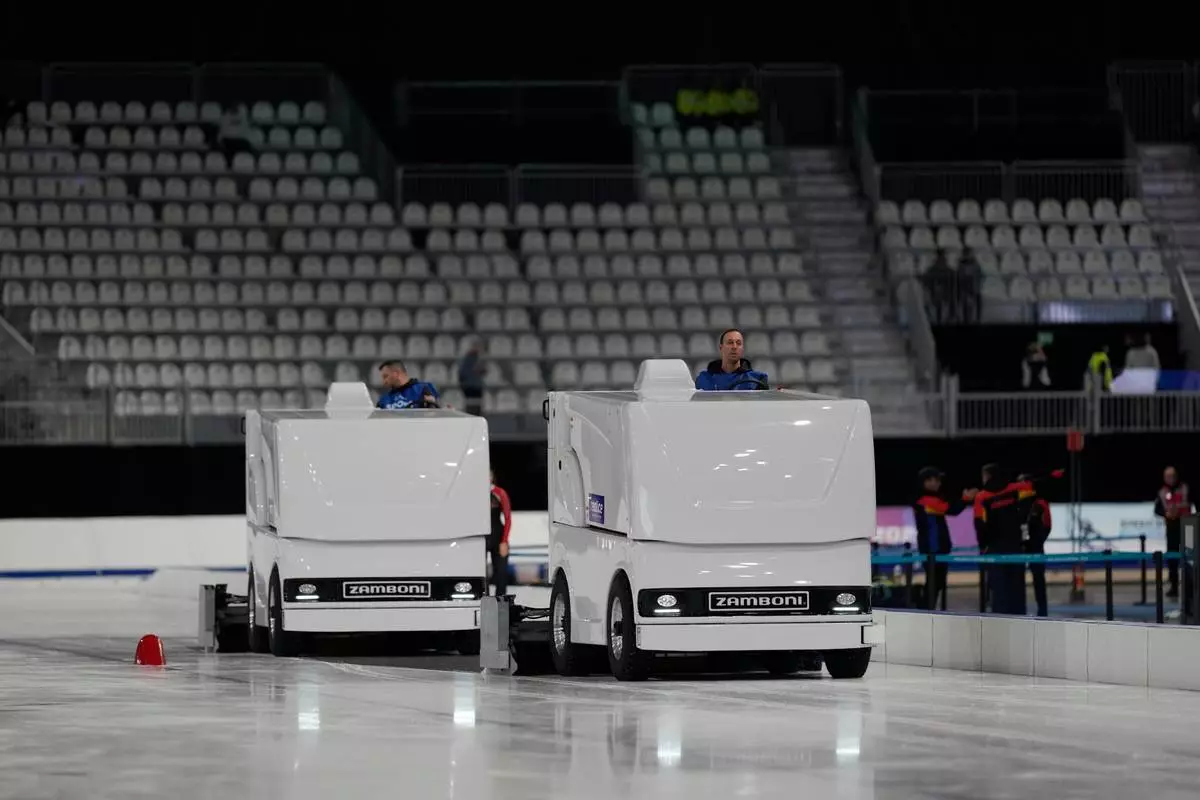
Workers clean the ice surface during a peed skating Junior World Cup and Olympic test event, in Rho, near Milan, Italy, Saturday, Nov. 29, 2025. (AP Photo/Luca Bruno)

Ice Master Mark Messer poses in the stadium where speed skating discipline of the Milan Cortina 2026 Winter Olympics will take place, in Rho, outskirt of Milan, Tuesday, Nov. 11, 2025. (AP Photo/Luca Bruno)

Ice Master Mark Messer poses in the stadium where speed skating discipline of the Milan Cortina 2026 Winter Olympics will take place, in Rho, outskirt of Milan, Tuesday, Nov. 11, 2025. (AP Photo/Luca Bruno)