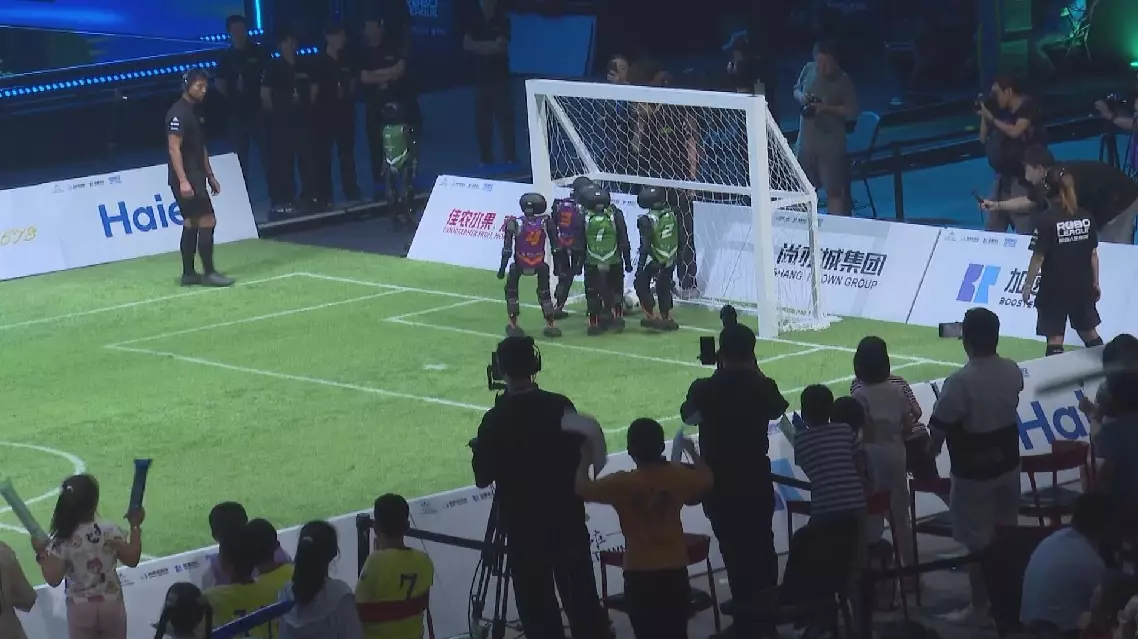
The final of the ROBO League robot football tournament concluded on Saturday in Beijing, with Tsinghua University's Power Intelligent Team beating the Mountain-Sea Team from China Agricultural University 5:3 to win the championship.
This event served as the first test match for the upcoming 2025 World Humanoid Robot Sports Games and marked China's first-ever fully autonomous 3v3 AI robot football competition.
The ROBO League football showdown was a remarkable display of advanced robotic technology. Unlike traditional remote-controlled competitions, these humanoid players relied solely on AI-driven strategies. They showcased real-time decision-making, coordinated teamwork and even the ability to self-recover after falling. The optimized penalty system minimized interruptions, allowing the 1.2-to-1.5-meter-tall robots to execute fluid movements and well-orchestrated attacks, mimicking human football tactics.
"This competition is not only a domestic first, but also a window to bring robots closer to the general public and real-life scenarios. We hope this new format can foster cross-disciplinary exchange and inspire more technological innovation and enthusiasm," said Dou Jing, executive director of the tournament organizing committee.
The robotic football event builds on the momentum of April's historic half-marathon. In that event, 20 humanoid robot teams completed a 21.0975-kilometer course in Beijing's Daxing District. This was a world first, revealing significant progress in robotic endurance and environmental adaptation.
The stage is set for the 2025 World Humanoid Robot Sports Games, scheduled from August 15 to 17 in Beijing, which will be the first global sporting event dedicated solely to humanoid robots.
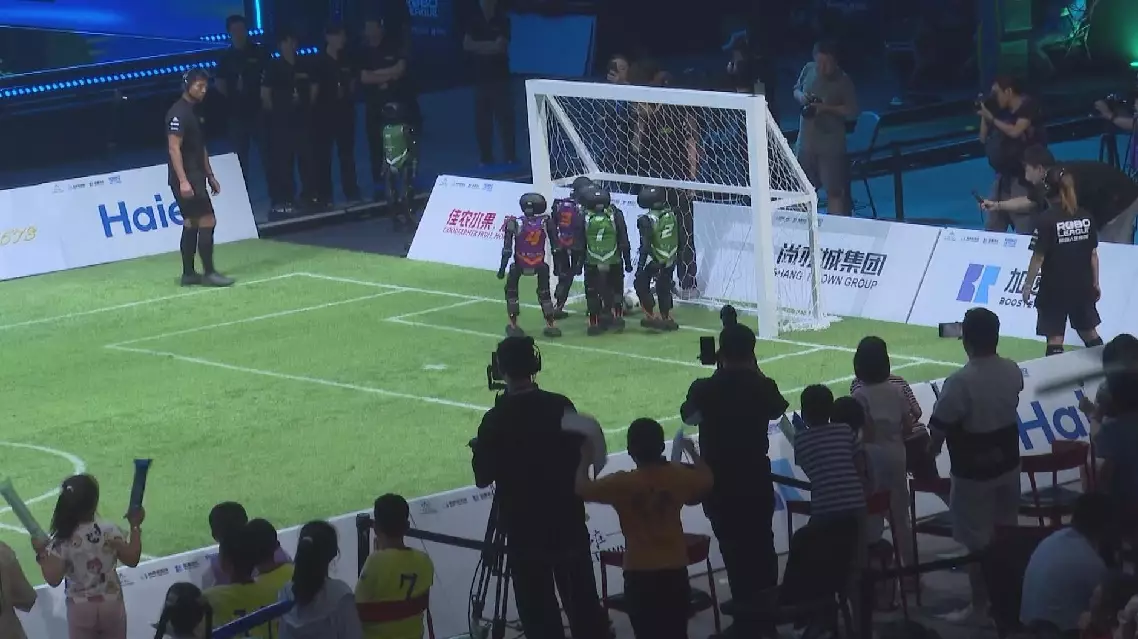
China’s first fully autonomous 3v3 AI robot football match ends
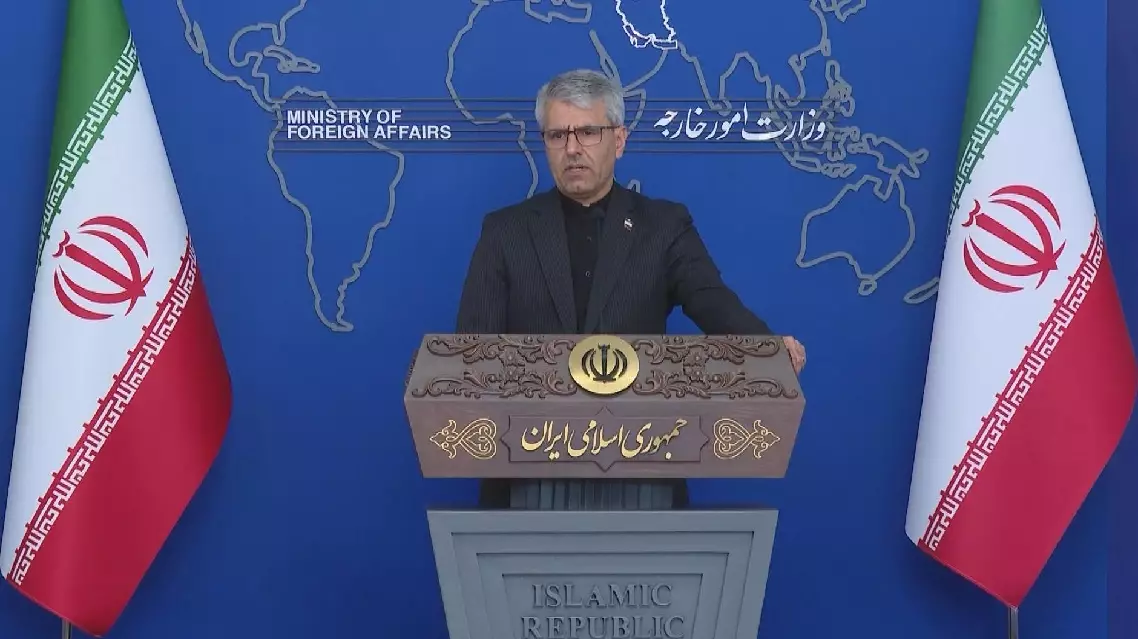
The European Commission's proposal to use frozen Russian assets as collateral to finance Ukraine "cannot deprive Russia of ownership of these assets", European Central Bank (ECB) President Christine Lagarde said on Wednesday.
Lagarde stated that this proposal is the closest one so far to complying with international law. She added that to address investor concerns, the European Union (EU) needs to explain that it is not "trying to seize Russian sovereign assets for its own benefit".
Lagarde has long expressed concerns about using frozen Russian assets. She said the ECB is keen to ensure that any outcome respects international law, otherwise the global reputation of the euro could be damaged.
In response, Russian Foreign Minister Sergey Lavrov said on Wednesday local time that Russia has no plans or intention to go to war with Europe, but Russia will respond to any deployment of European military forces in Ukraine as well as to attempts to seize Russian assets in Europe.
Following the outbreak of the Russia-Ukraine conflict in February 2022, Western countries froze approximately 300 billion U.S. dollars in Russian overseas assets. Among these, the EU froze about 200 billion euros (about 232 billion U.S. dollars) worth of assets belonging to the Russian central bank.
Approximately 90 percent of the frozen Russian assets within the EU are held by Euroclear Bank, based in Brussels, Belgium. Russia has repeatedly emphasized that, under international law, any seizure of its assets by Western governments constitutes "theft".
In September, European Commission President Ursula von der Leyen proposed establishing a "reparation loan" mechanism, intending to use frozen Russian assets as collateral to provide Ukraine with a total loan of about 140 billion euros (163 billion U.S. dollars).
However, Belgium and the ECB believe this plan carries significant risks in terms of international law and the financial stability of the eurozone.
ECB chief urges caution in using frozen Russian assets for Ukraine