HONG KONG (AP) — Hong Kong pro-democracy political party League of Social Democrats announced on Sunday it had disbanded due to immense political pressure, the latest casualty in a years-long crackdown that has already quieted much of the city’s once-vocal opposition.
Following massive anti-government protests in 2019, many leading activists were prosecuted or jailed under a 2020 national security law imposed by Beijing. Dozens of civil society groups dissolved. Media outlets critical of the government shuttered.
Click to Gallery
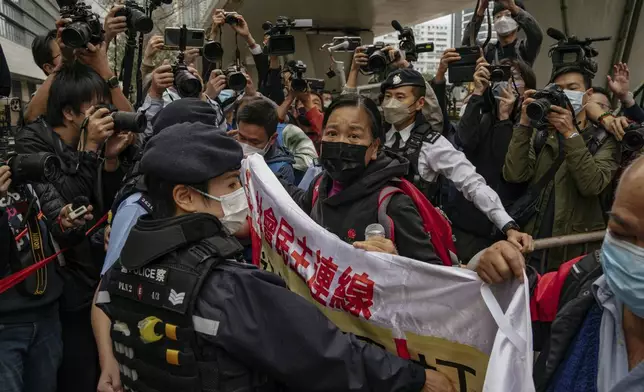
FILE - Photographers take picture of the members of League of Social Democrats scuffling with police outside the West Kowloon Magistrates' Courts ahead of the national security trail for the pro-democracy activists in Hong Kong, on Feb. 6, 2023. (AP Photo/Anthony Kwan, File)
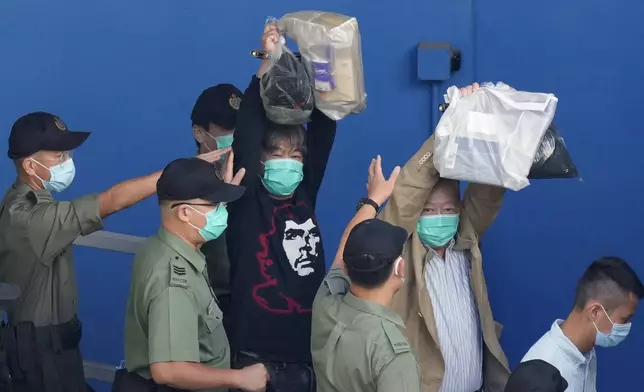
FILE - Pro-democracy activists Leung Kwok-hung, known as "Long Hair," left, and Lee Cheuk-yan raise their hands as they are escorted by Correctional Services officers to a prison van for a court in Hong Kong, on May 28, 2021. (AP Photo/Kin Cheung, File)
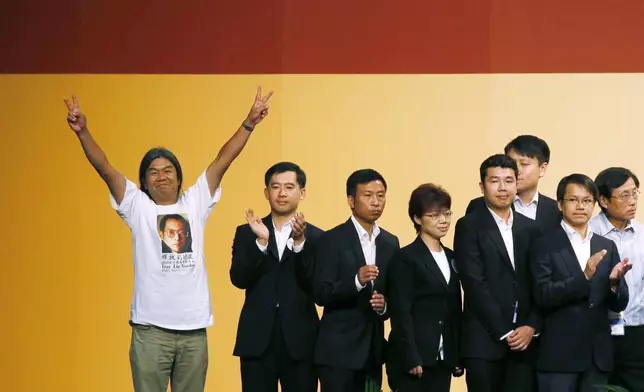
FILE - Leung Kwok-hung, also known as "Long Hair," left, of the pro-democracy League of Social Democrats celebrates after winning a seat on the Legislative Council next to Chan Hak-kan, second from right, of the pro-Beijing Democratic Alliance for the Betterment of Hong Kong Party in Hong Kong, on Sept. 10, 2012. (AP Photo/Kin Cheung, File)
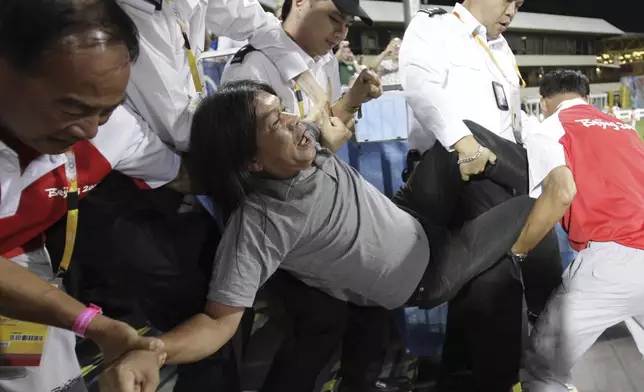
FILE - Security guards force to take away Pro-democracy protesters, Hong Kong legislator Leung Kwok-hung, also known as nickname "Long Hair", on the spectator stand during the first day of Beijing Olympics Equestrian game in Hong Kong on Aug. 9, 2008 while demanding for human rights and to stop one party ruling in China. (AP Photo/Kin Cheung, File)
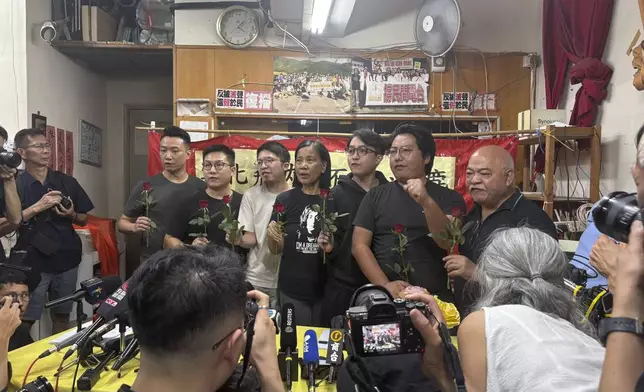
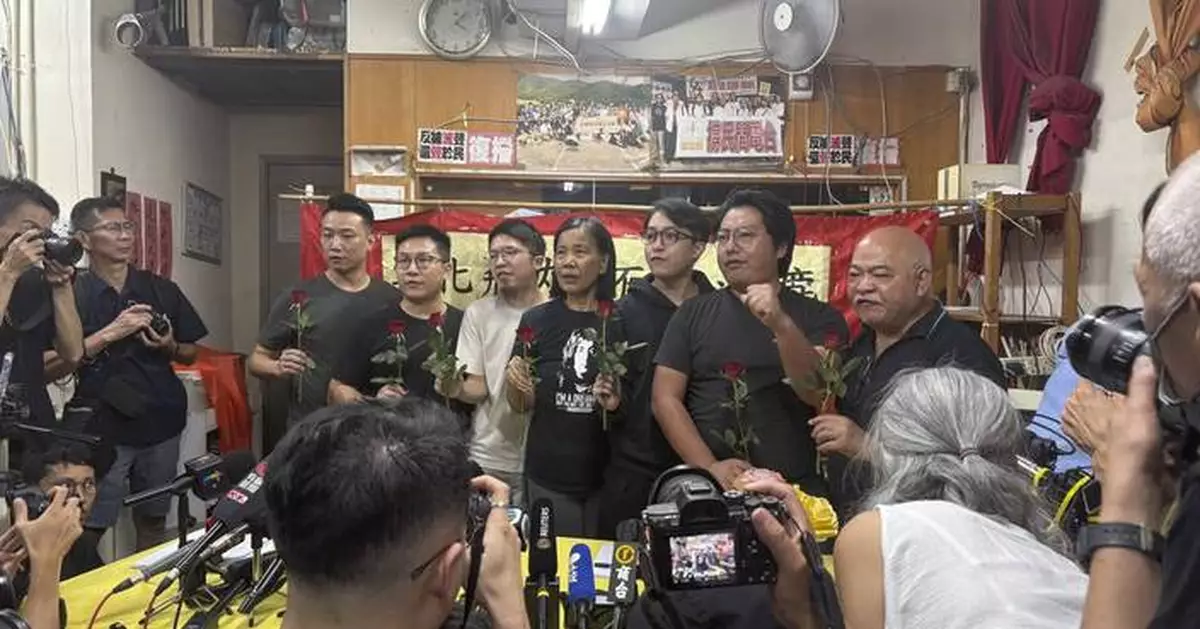
Current and former members of Hong Kong's pro-democracy political party, the League of Social Democrats, speak at a press conference, in Hong Kong, Sunday, June 29, 2025. (AP Photo/Kanis Leung)
The League of Social Democrats was the only pro-democracy party that still staged small street protests from time to time and held street booth activities to carry on its advocacy despite the risks.
Its chairperson, Chan Po-ying, said the disbandment decision was made after careful deliberation, especially taking into account the consequences to its members and comrades. Chan refused to elaborate on the pressure but said she was proud to say that the party had still contributed to the city's pro-democracy movement in these few years.
“We have stayed true to our original aspirations and haven't let down to the trust placed in us by those who went to prison," she said. “While we are now forced to disband and feel an ache in our conscience, we have no other choice,” she said.
Hong Kong, a former British colony, will mark the 28th anniversary of returning to Chinese rule on July 1. The city used to hold annual pro-democracy protests that day and other various demonstrations demanding better policies.
But those were ceased after most organizing groups were disbanded and the leading activists were jailed. Critics say the drastic political changes under the security law reflect that the freedoms Beijing promised to keep intact in 1997 are shrinking.
The Beijing and Hong Kong governments insist the law is necessary for the city's stability. A Chinese official overseeing Hong Kong affairs in 2023 said protests are not the only way for people to express their views, signaling Beijing's stance toward demonstrations in the city.
In April, Hong Kong’s biggest pro-democracy party, the Democratic Party, also voted to give its leadership the mandate to move toward a potential disbandment. Party veterans told The Associated Press that some members were warned of consequences if the party didn’t shut down. A final vote is expected at a later date.
Chan said she believed the “one country, two systems” principle, which Beijing uses to govern Hong Kong, has already ended, pointing to the Chinese government's imposition of the security law and introducing the idea of “soft resistance,” a term officials use to refer to underlying security risks.
“One country, two systems has already (become) one country, one system,” she said.
Founded in 2006, the League of Social Democrats was a left-wing political party that opposed what it called collusion between government and business, upheld the principle that people have a say and was firmly committed to the interests of underprivileged residents.
It was widely known for its more aggressive tactics when fighting for change. Its members have thrown bananas, eggs and luncheon meat at officials or pro-Beijing lawmakers as a protest gesture. Its party platform said the group advocated non-violent resistance but would not avoid physical confrontations — a stance that set it apart from older, traditional pro-democracy groups.
It once had three lawmakers in office. Its longest-serving lawmaker, Leung Kwok-hung — Chan's husband — was disqualified from the legislature due to his manner of taking his oath in office in 2017.
On the streets, the group's activism led to the arrests and jailing of its members from time to time.
Last year, Leung and prominent LGBTQ+ activist Jimmy Sham, a former party leader, were sentenced to nearly seven years and more than four years over their roles in an unofficial primary election under the sweeping security law. Sham was freed from prison last month.
In recent years, the party has had limited political influence, no longer holding any seats in the legislature or local district councils. Even a bank ceased to provide bank account services to the group.
But it continued to stage small protests from time to time, despite sometimes those activities leading to arrests. On June 12, Chan and other members were fined after being found guilty over their street booth activities.
Undeterred by their convictions, they kept pressing on and protested against the ruling outside the court.
Chan wiped away tears during Sunday's press conference and chanted slogans with other members at the end.
She said she doesn't believe that democracy will come in the near future.
“Moving forward is not at all easy,” she said. "I hope everyone can become like an ember, a flying spark — still carrying light, keeping that light alive, no matter how small it may be.”
FILE - Photographers take picture of the members of League of Social Democrats scuffling with police outside the West Kowloon Magistrates' Courts ahead of the national security trail for the pro-democracy activists in Hong Kong, on Feb. 6, 2023. (AP Photo/Anthony Kwan, File)
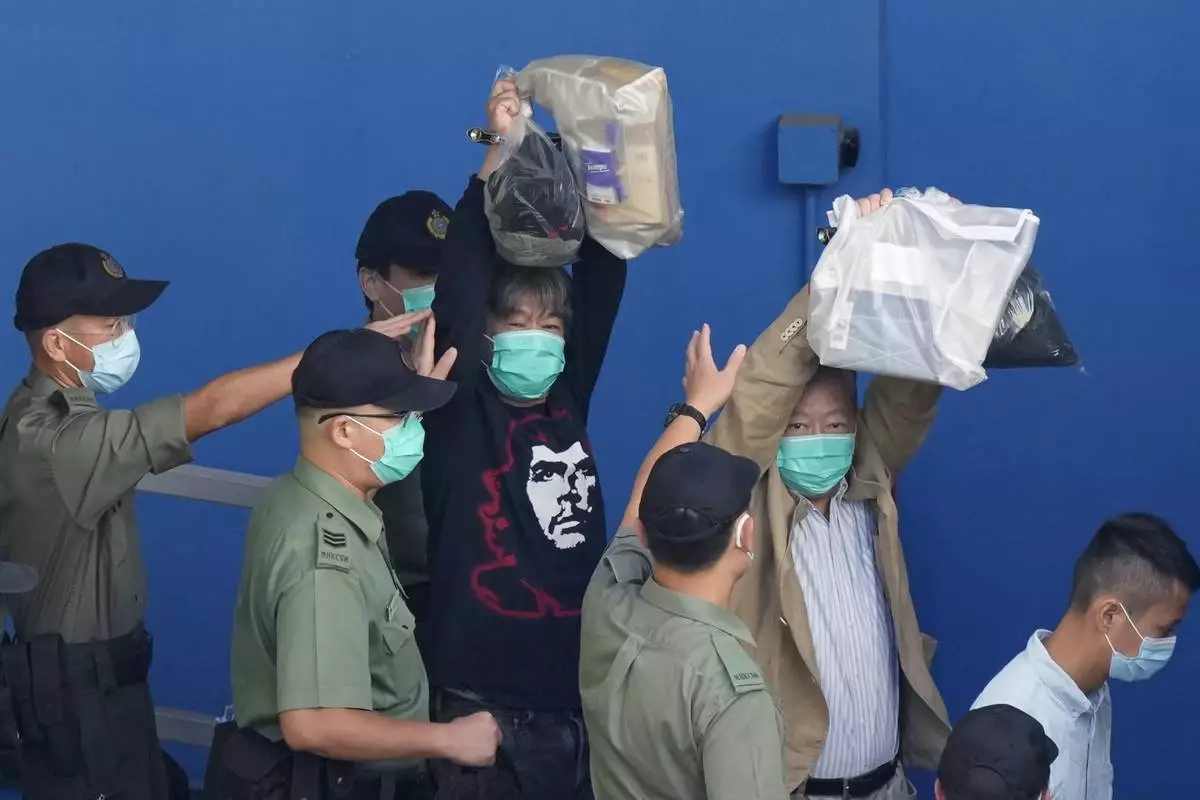
FILE - Pro-democracy activists Leung Kwok-hung, known as "Long Hair," left, and Lee Cheuk-yan raise their hands as they are escorted by Correctional Services officers to a prison van for a court in Hong Kong, on May 28, 2021. (AP Photo/Kin Cheung, File)
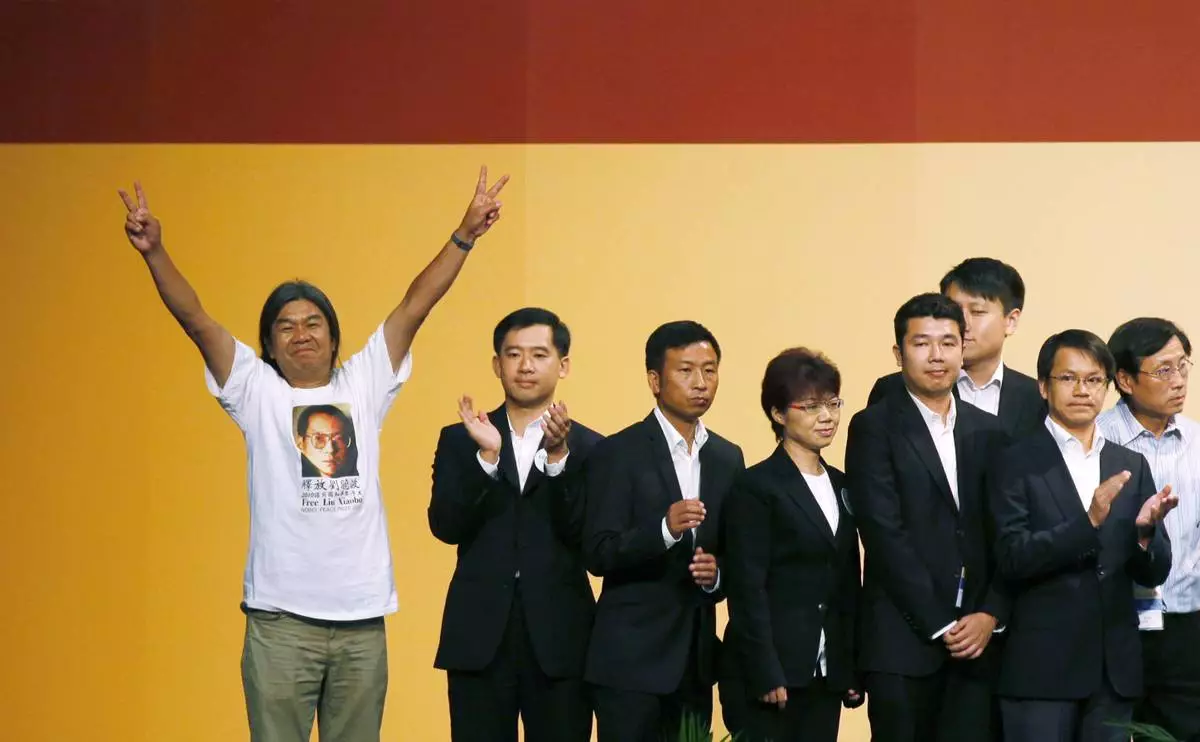
FILE - Leung Kwok-hung, also known as "Long Hair," left, of the pro-democracy League of Social Democrats celebrates after winning a seat on the Legislative Council next to Chan Hak-kan, second from right, of the pro-Beijing Democratic Alliance for the Betterment of Hong Kong Party in Hong Kong, on Sept. 10, 2012. (AP Photo/Kin Cheung, File)
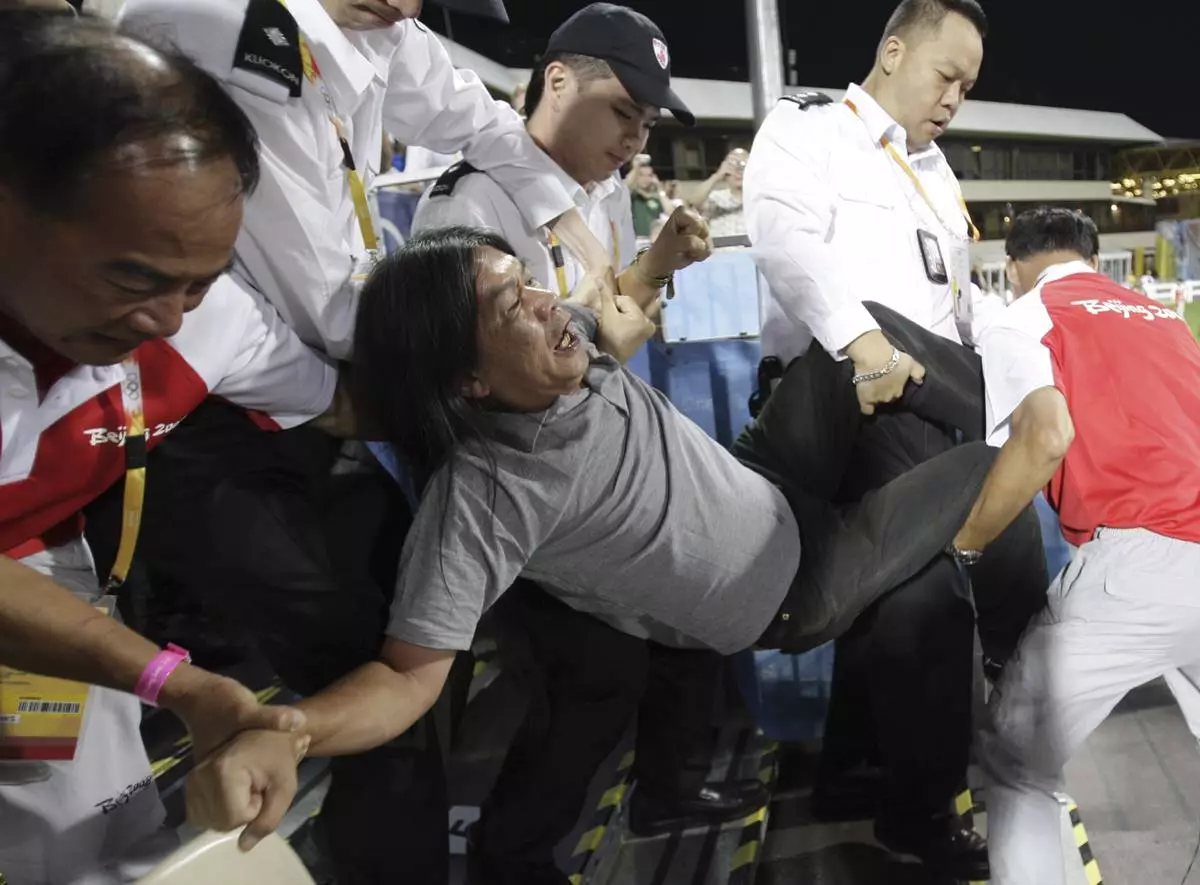
FILE - Security guards force to take away Pro-democracy protesters, Hong Kong legislator Leung Kwok-hung, also known as nickname "Long Hair", on the spectator stand during the first day of Beijing Olympics Equestrian game in Hong Kong on Aug. 9, 2008 while demanding for human rights and to stop one party ruling in China. (AP Photo/Kin Cheung, File)
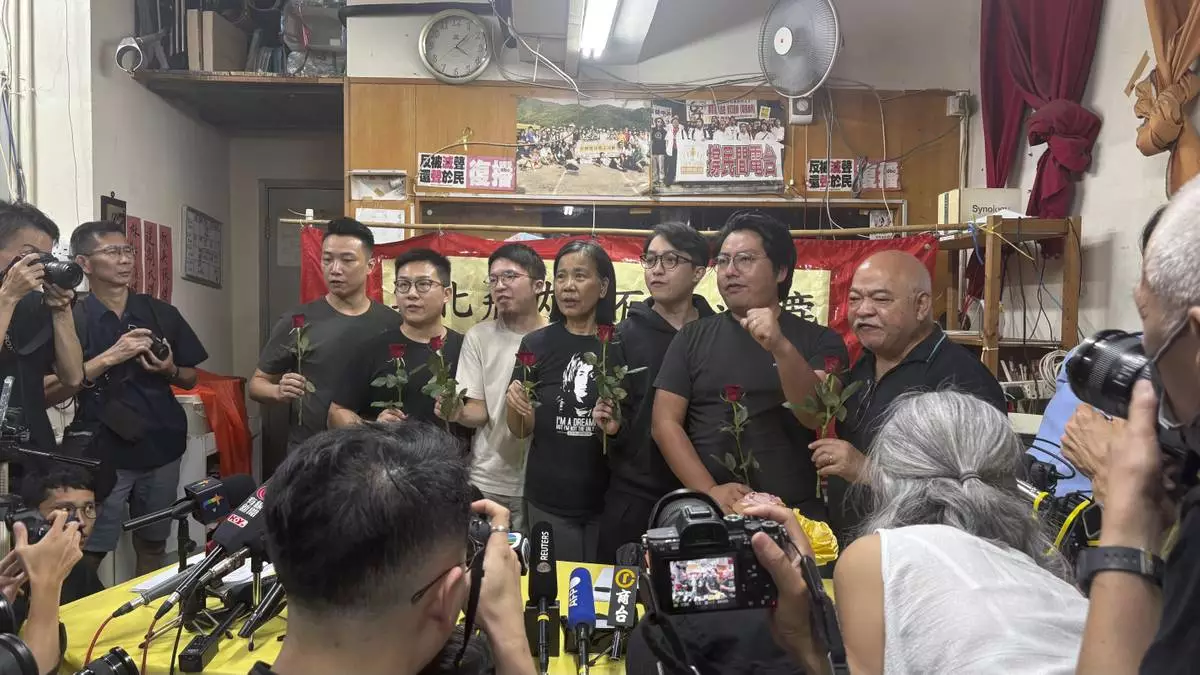
Current and former members of Hong Kong's pro-democracy political party, the League of Social Democrats, speak at a press conference, in Hong Kong, Sunday, June 29, 2025. (AP Photo/Kanis Leung)
A group of Buddhist monks and their rescue dog are striding single file down country roads and highways across the South, captivating Americans nationwide and inspiring droves of locals to greet them along their route.
In their flowing saffron and ocher robes, the men are walking for peace. It's a meditative tradition more common in South Asian countries, and it's resonating now in the U.S., seemingly as a welcome respite from the conflict, trauma and politics dividing the nation.
Their journey began Oct. 26, 2025, at a Vietnamese Buddhist temple in Texas, and is scheduled to end in mid-February in Washington, D.C., where they will ask Congress to recognize Buddha’s day of birth and enlightenment as a federal holiday. Beyond promoting peace, their highest priority is connecting with people along the way.
“My hope is, when this walk ends, the people we met will continue practicing mindfulness and find peace,” said the Venerable Bhikkhu Pannakara, the group’s soft-spoken leader who is making the trek barefoot. He teaches about mindfulness, forgiveness and healing at every stop.
Preferring to sleep each night in tents pitched outdoors, the monks have been surprised to see their message transcend ideologies, drawing huge crowds into churchyards, city halls and town squares across six states. Documenting their journey on social media, they — and their dog, Aloka — have racked up millions of followers online. On Saturday, thousands thronged in Columbia, South Carolina, where the monks chanted on the steps of the State House and received a proclamation from the city's mayor, Daniel Rickenmann.
At their stop Thursday in Saluda, South Carolina, Audrie Pearce joined the crowd lining Main Street. She had driven four hours from her village of Little River, and teared up as Pannakara handed her a flower.
“There’s something traumatic and heart-wrenching happening in our country every day,” said Pearce, who describes herself as spiritual, but not religious. “I looked into their eyes and I saw peace. They’re putting their bodies through such physical torture and yet they radiate peace.”
Hailing from Theravada Buddhist monasteries across the globe, the 19 monks began their 2,300 mile (3,700 kilometer) trek at the Huong Dao Vipassana Bhavana Center in Fort Worth.
Their journey has not been without peril. On Nov. 19, as the monks were walking along U.S. Highway 90 near Dayton, Texas, their escort vehicle was hit by a distracted truck driver, injuring two monks. One of them lost his leg, reducing the group to 18.
This is Pannakara's first trek in the U.S., but he's walked across several South Asian countries, including a 112-day journey across India in 2022 where he first encountered Aloka, an Indian Pariah dog whose name means divine light in Sanskrit.
Then a stray, the dog followed him and other monks from Kolkata in eastern India all the way to the Nepal border. At one point, he fell critically ill and Pannakara scooped him up in his arms and cared for him until he recovered. Now, Aloka inspires him to keep going when he feels like giving up.
“I named him light because I want him to find the light of wisdom,” Pannakara said.
The monk's feet are now heavily bandaged because he's stepped on rocks, nails and glass along the way. His practice of mindfulness keeps him joyful despite the pain from these injuries, he said.
Still, traversing the southeast United States has presented unique challenges, and pounding pavement day after day has been brutal.
“In India, we can do shortcuts through paddy fields and farms, but we can’t do that here because there are a lot of private properties,” Pannakara said. “But what’s made it beautiful is how people have welcomed and hosted us in spite of not knowing who we are and what we believe.”
In Opelika, Alabama, the Rev. Patrick Hitchman-Craig hosted the monks on Christmas night at his United Methodist congregation.
He expected to see a small crowd, but about 1,000 people showed up, creating the feel of a block party. The monks seemed like the Magi, he said, appearing on Christ’s birthday.
“Anyone who is working for peace in the world in a way that is public and sacrificial is standing close to the heart of Jesus, whether or not they share our tradition,” said Hitchman-Craig. “I was blown away by the number of people and the diversity of who showed up.”
After their night on the church lawn, the monks arrived the next afternoon at the Collins Farm in Cusseta, Alabama. Judy Collins Allen, whose father and brother run the farm, said about 200 people came to meet the monks — the biggest gathering she’s ever witnessed there.
“There was a calm, warmth and sense of community among people who had not met each other before and that was so special,” she said.
Long Si Dong, a spokesperson for the Fort Worth temple, said the monks, when they arrive in Washington, plan to seek recognition of Vesak, the day which marks the birth and enlightenment of the Buddha, as a national holiday.
“Doing so would acknowledge Vesak as a day of reflection, compassion and unity for all people regardless of faith,” he said.
But Pannakara emphasized that their main goal is to help people achieve peace in their lives. The trek is also a separate endeavor from a $200 million campaign to build towering monuments on the temple’s 14-acre property to house the Buddha’s teachings engraved in stone, according to Dong.
The monks practice and teach Vipassana meditation, an ancient Indian technique taught by the Buddha himself as core for attaining enlightenment. It focuses on the mind-body connection — observing breath and physical sensations to understand reality, impermanence and suffering. Some of the monks, including Pannakara, walk barefoot to feel the ground directly and be present in the moment.
Pannakara has told the gathered crowds that they don't aim to convert people to Buddhism.
Brooke Schedneck, professor of religion at Rhodes College in Memphis, Tennessee, said the tradition of a peace walk in Theravada Buddhism began in the 1990s when the Venerable Maha Ghosananda, a Cambodian monk, led marches across war-torn areas riddled with landmines to foster national healing after civil war and genocide in his country.
“These walks really inspire people and inspire faith,” Schedneck said. “The core intention is to have others watch and be inspired, not so much through words, but through how they are willing to make this sacrifice by walking and being visible.”
On Thursday, Becki Gable drove nearly 400 miles (about 640 kilometers) from Cullman, Alabama, to catch up with them in Saluda. Raised Methodist, Gable said she wanted some release from the pain of losing her daughter and parents.
“I just felt in my heart that this would help me have peace,” she said. “Maybe I could move a little bit forward in my life.”
Gable says she has already taken one of Pannakara’s teachings to heart. She’s promised herself that each morning, as soon as she awakes, she’d take a piece of paper and write five words on it, just as the monk prescribed.
“Today is my peaceful day.”
Freelance photojournalist Allison Joyce contributed to this report.
Associated Press religion coverage receives support through the AP’s collaboration with The Conversation US, with funding from Lilly Endowment Inc. The AP is solely responsible for this content.
Buddhist monks who are participating in the, "Walk For Peace," get lunch Thursday, Jan. 8, 2026, in Saluda, S.C. (AP Photo/Allison Joyce)
Aloka rests with Buddhist monks who are participating in the, "Walk For Peace," Thursday, Jan. 8, 2026, in Saluda, S.C. (AP Photo/Allison Joyce)
A sign is seen greeting the Buddhist monks who are participating in the, "Walk For Peace," Thursday, Jan. 8, 2026, in Saluda, S.C. (AP Photo/Allison Joyce)
Supporters pray with Buddhist monks who are participating in the, "Walk For Peace," Thursday, Jan. 8, 2026, in Saluda, S.C. (AP Photo/Allison Joyce)
Supporters watch Buddhist monks who are participating in the, "Walk For Peace," Thursday, Jan. 8, 2026, in Saluda, S.C. (AP Photo/Allison Joyce)
A Buddhist monk ties a prayer bracelet around the wrist of Josey Lee, 2-months-old, during the, "Walk For Peace," Thursday, Jan. 8, 2026, in Saluda, S.C. (AP Photo/Allison Joyce)
Bhikkhu Pannakara, a spiritual leader, speaks to supporters during the, "Walk For Peace," Thursday, Jan. 8, 2026, in Saluda, S.C. (AP Photo/Allison Joyce)
Buddhist monks participate in the, "Walk For Peace," Thursday, Jan. 8, 2026, in Saluda, S.C. (AP Photo/Allison Joyce)
Bhikkhu Pannakara leads other buddhist monks in the, "Walk For Peace," Thursday, Jan. 8, 2026, in Saluda, S.C. (AP Photo/Allison Joyce)
Audrie Pearce greets Buddhist monks who are participating in the, "Walk For Peace," Thursday, Jan. 8, 2026, in Saluda, S.C. (AP Photo/Allison Joyce)
Bhikkhu Pannakara, a spiritual leader, speaks to supporters during the, "Walk For Peace," Thursday, Jan. 8, 2026, in Saluda, S.C. (AP Photo/Allison Joyce)
Buddhist monks who are participating in the, "Walk For Peace," arrive in Saluda, Thursday, Jan. 8, 2026, in Saluda, S.C. (AP Photo/Allison Joyce)
Buddhist monks who are participating in the, "Walk For Peace," are seen with their dog, Aloka, Thursday, Jan. 8, 2026, in Saluda, S.C. (AP Photo/Allison Joyce)