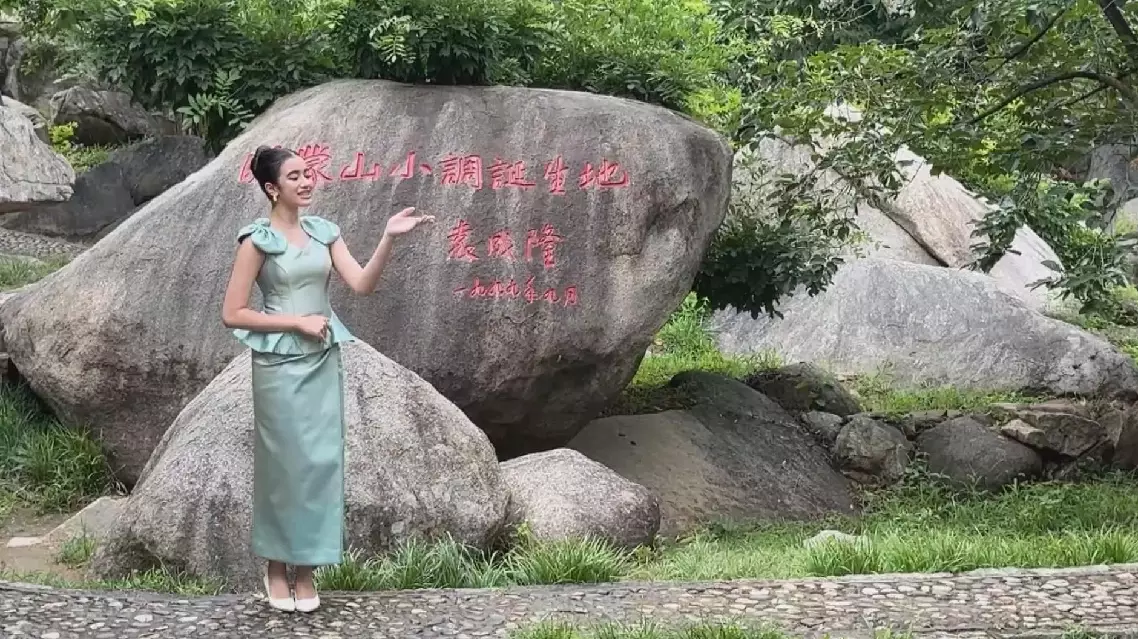
Princess Jenna Norodom, a member of the Cambodian Royal Family, has expressed her anticipation for enhanced cooperation between China and Cambodia, particularly in specialty trade and e-commerce, during her visit to Linyi City in east China's Shandong Province and her attendance at the 4th RCEP Regional (Shandong) Import Commodity Expo.
The visit to Linyi holds great significance for Princess Jenna Norodom. Having previously performed the Chinese folk song "Yimeng Mountain Minor" during a cultural exchange event in April, which was in celebration of the enduring friendship and cultural ties between China and Cambodia, she reprised the same song in Linyi, its place of origin.
The princess stated that she has been impressed by Linyi's business environment and its advanced logistics system. Within the RCEP framework, Linyi has significant potential to act as a key link between China and Southeast Asia.
"I hope to see more collaboration between our countries, especially in areas like specialty trade and e-commerce. It would be great to bring more Cambodian products here to Linyi, and at the same time, help Linyi's goods reach Cambodia through the Belt and Road," the princess said.
The three-day expo, which commenced in Linyi on Friday, features 11 exhibition areas with over 1,200 booths, drawing more than 300 international suppliers and over 5,000 domestic and foreign purchasers.
This year's event boasts 17 national pavilions and seven sister-city halls, bringing together 348 companies from across the globe, with over 50 percent representing enterprises from member countries of the RCEP (Regional Comprehensive Economic Partnership) -- the world's largest free trade deal.
Business associations from 20 countries such as South Korea and Malaysia have arranged delegations to exhibit featured products including cosmetics, household items, and specialty foods.
"It's our fourth time here. I've brought dozens of Korean companies showcasing mostly cosmetics. Through this platform we established a Korean product selection hub in Linyi last year with local partners. We're currently looking for a wider range of cooperation," said Kim Sang-woo, general manager of the Small and Medium Business Corporation, a South Korea-based government organization that provides financial and non-financial services to small and medium-sized enterprises.
"Our one-stop platform implements everything, from customs clearance, warehousing, to inspection and quarantine, cross-border logistics, overseas storage, even foreign exchange accounts settlement and tax rebates. We're building an ultimate bridge for seamless global trade," said Song Xiaopeng, vice president of ChinaMarket, official platform of Linyi Trade City -- a crucial logistics hub and wholesale trading center in Linyi.
Effective as of Jan. 1, 2022, the RCEP includes 10 ASEAN member states: Brunei, Cambodia, Indonesia, Laos, Malaysia, Myanmar, the Philippines, Singapore, Thailand, and Vietnam, along with their five free-trade partners -- China, Japan, South Korea, Australia, and New Zealand.
In recent years, Linyi has assumed a progressively active role in China's national strategy of opening up, capitalizing on its strategic location and robust industrial base to expedite international engagement. The RCEP Expo has emerged as a pivotal platform for fostering global exchange and collaboration.
Cambodian princess seeks stronger trade ties with China during Shandong visit