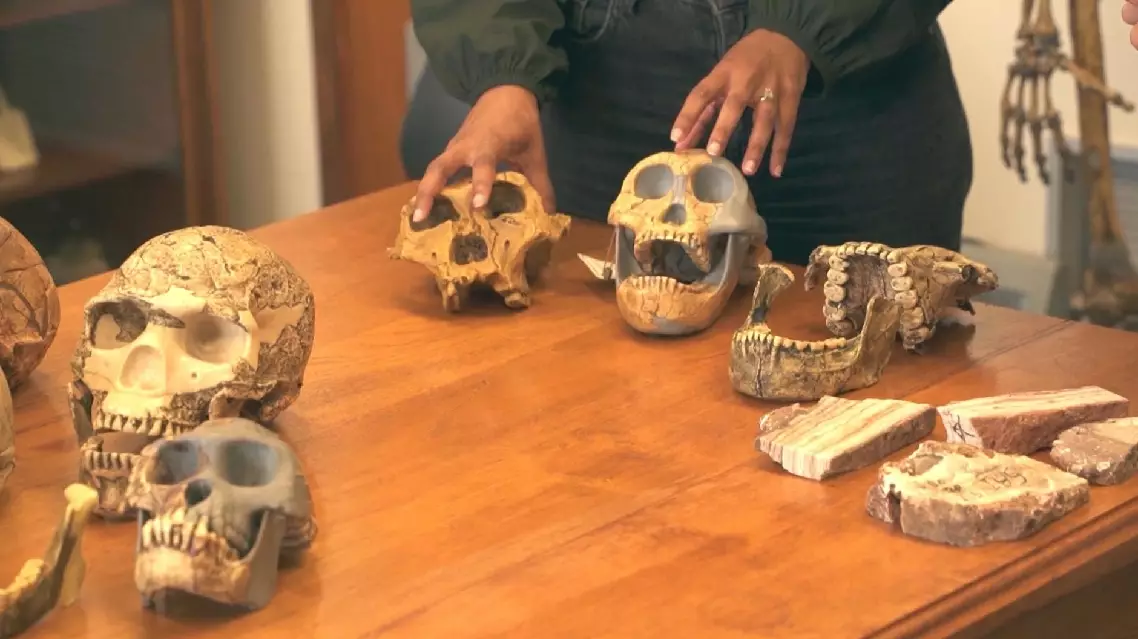
In a scientific first, a team led by African researchers has successfully extracted two-million-year-old enamel proteins from fossilized teeth discovered in South Africa, unlocking rare biological details about Paranthropus robustus, an extinct species that once coexisted with early humans.
The fossils were unearthed at the Cradle of Humankind, a UNESCO World Heritage Site near Johannesburg known as the richest source of hominin remains in the world.
Scientists applied a cutting-edge technique known as palaeoproteomics, which analyzes ancient proteins that outlast DNA, especially in warm climates like Africa's.
"The cradle of humankind is the single richest place in the whole world to find these, our early pre-human relatives, these hominin fossils. And the reason for this has to do with the geology. So our pre-human relatives would have lived all over the southern African landscape," said Dr. Robyn Pickering, associate professor of geological sciences at the University of Cape Town.
For the first time, researchers are using molecular traces from ancient teeth to reconstruct partial genetic profiles of extinct hominins. This enables scientists to delve deeper into our evolutionary biology than ever before.
"The study is so groundbreaking because we can understand a lot from the fossils themselves. These teeth are like these little time capsules that preserve the enamel proteins. And those proteins, of course, are made by DNA. So we get like, this little echo of the DNA from 2 million years ago," Pickering said.
That echo is especially important in Africa, where DNA rarely survives in ancient remains. The protein-based method offers a new way to peer into the deep past.
"We haven't had any genetic evidence for anything, really, within Africa older than 20,000 years ago. And that's why the proteins, the ancient proteins, are so important. The ancient DNA doesn't seem to, at least as far as we're aware, now survive into the deep past in an African context. But these proteins do. And so they can actually give us an insight into not even just 500,000 years ago. But in the case of this study, you know, 2 million years ago," said Rebecca Ackermann, professor of the Department of Archaeology at the University of Cape Town.
The team extracted proteins from four fossilized teeth found at the Swartkrans Cave site, identifying their biological sex and other traits.
"We found, that through these four teeth, some of them are male, some of them are female. So we were able to say something about sexual dimorphism. And so that is really something that we wouldn't be able to do without those proteins," said Dr. Lauren Schroeder, associate professor of biological anthropology at the University of Toronto.
The project also marks a shift in leadership in a field that Western researchers have long dominated. This time, scientists from the continent are at the forefront.
"This research is predominately done in Western labs where I truly hope that going forward, this type of research, especially when we are looking at palaeoproteomics, ancient biomolecules. It will include African scientists, South American scientists, essentially the global majority in this type of work," said Dr. Palesa Madupe, research associate at the University of Cape Town and postdoctoral fellow at the University of Copenhagen.
Living between 2.8 and 1.2 million years ago, Paranthropus robustus followed a separate evolutionary path from early humans. With this breakthrough, African scientists are not only decoding long-lost biological information but also reclaiming their role in telling the human story at its very origin.
African scientists decode ancient tooth proteins to unlock early human relatives' secrets