Skip to Content Facebook Feature Image

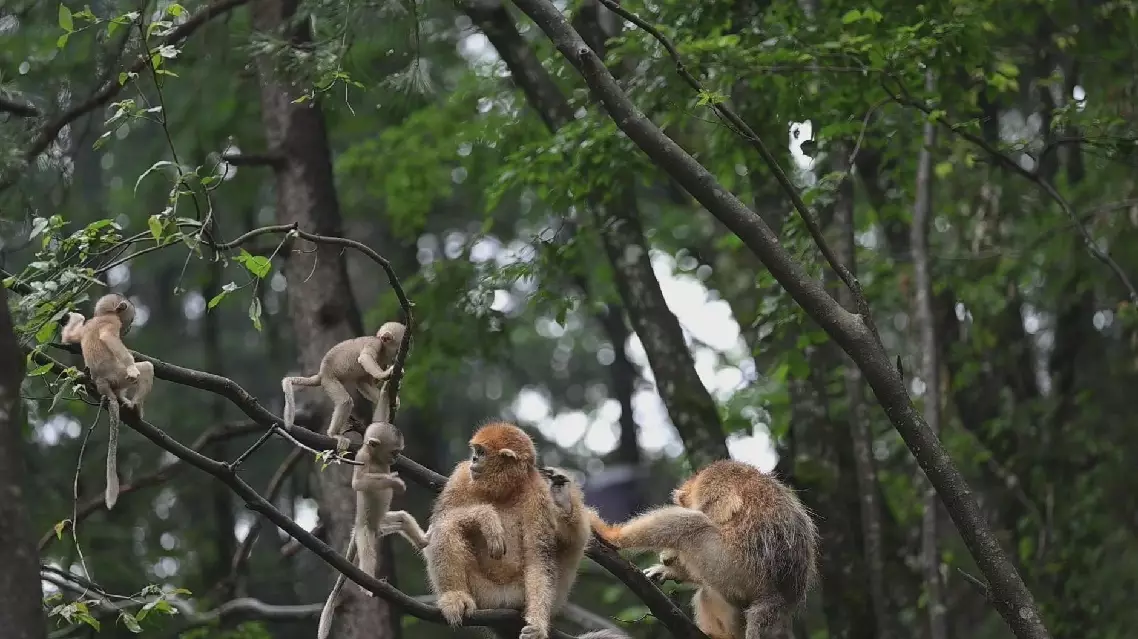
Northwest China reserve sees record baby boom of snub-nosed golden monkeys

China

China

China

Northwest China reserve sees record baby boom of snub-nosed golden monkeys

2025-07-01 08:54 Last Updated At:09:07

⁠⁠⁠⁠⁠⁠⁠The number of newborn snub-nosed golden monkeys living in the Qinling Mountains of northwest China's Shaanxi Province has reached a record high so far this year, according to newly collected data from multiple monitoring sites across the region.

The period of time from March to May each year marks the peak birthing season for the snub-nosed golden monkey, a species often described as "the world's most beautiful monkey."

Experts say the snub-nosed golden monkey in Qinling is mainly found in forested areas across the mountains' central stretch.

At the No. 6 observation site of the Qinling National Field Research Station for Giant Panda and Snub-nosed Golden Monkey Biodiversity, located on the southern slopes of the Qinling Mountains in Foping County, eight family groups with around 100 monkeys have been closely tracked and monitored.

Guo Songtao, professor with the School of Life Sciences under the Northwest University, said as many as nearly 20 newborns have been spotted at the site since the beginning of this year, which is a considerable number.

Further north, deep into the Qinling range, the Shuangzimiao observation station in the Zhouzhi National Nature Reserve has also recorded a surge in monkey births so far this year.

"We have tracked and monitored this year's newborn golden monkeys, and the total has reached 45," said Tian Wenyong, director of the reserve.

Latest figures show that the snub-nosed golden monkey group at Shuangzimiao now exceeds 340 individuals, making it the largest known group of snub-nosed golden monkeys in the Qinling Mountains and even across the country.

Northwest University, which leads long-term monitoring efforts, has set up two main observation stations and 20 sub-sites across the region.

"Thanks to over a decade of sustained efforts, the Sichuan golden monkey population has grown from just over 4,000 to more than 6,000," said Li Baoguo, founding chairman of the Primatology Branch of the Chinese Zoological Society and professor with the university.

The snub-nosed golden monkey is an endangered species under first-class national protection in China. The steady rise in its population reflects the country's progress in wildlife conservation and habitat restoration in recent years.
Northwest China reserve sees record baby boom of snub-nosed golden monkeys


Northwest China reserve sees record baby boom of snub-nosed golden monkeys

Voting for the second phase of Myanmar's multi-party democratic general election concluded on Sunday afternoon.

Voting began at 06:00 local time on Sunday. At 16:00, an election official at a polling station in Yangon's Latha township announced the closure of the polling station.

Following the closure, election staff at the polling station, in the presence of domestic and international media, candidates, and observers, counted the votes, including advance votes, for seats in the Pyithu Hluttaw (Lower House), Amyotha Hluttaw (Upper House), and State and Region Hluttaws (State and Region Parliaments).

The second phase of the election was held in 100 townships across 12 of the 14 regions and states. In the Yangon region, it was held in 16 townships, including the townships of Latha, Bahan, Kyimyindaing and Kawhmu.

"We welcome the election, which is expected to bring new changes to the country," said a Yangon resident.

"I hope the parties can lead us and make it a better country, which is why I support the election," said another voter.

Myanmar's multi-party democratic general election is being held in three phases, with the first phase held in 102 townships on Dec 28 last year, and the third phase scheduled for Jan 25 this year in 63 townships.

"The parliament is scheduled to convene in March. Following the conclusion of the session, the new government will officially take office in April. We hope that more foreign investment will flow into Myanmar, enabling the public to enjoy the opportunities generated by the country's economic development more fully," said Zaw Min Tun, leader of the Information Team of Myanmar's National Defense and Security Council.

The Union Election Commission (UEC) said that about 5,000 candidates from 57 political parties are competing in the three phases of the election, adding that it plans to set up over 21,000 polling stations across the country for all three phases of the general election.

The election will produce the elected members of the Union Parliament (Pyithu Hluttaw and Amyotha Hluttaw) and State and Region Parliaments; the new Union Parliament will then elect a new president, who will form a new Union Government.

Voting for 2nd phase of Myanmar's general election concludes

Voting for 2nd phase of Myanmar's general election concludes

Recommended Articles