
Skip to Content Facebook Feature Image

Lyten Acquires Europe’s Largest Battery Energy Storage Systems Manufacturing Operation from Northvolt

News

Lyten Acquires Europe’s Largest Battery Energy Storage Systems Manufacturing Operation from Northvolt
News

News

Lyten Acquires Europe’s Largest Battery Energy Storage Systems Manufacturing Operation from Northvolt

2025-07-01 15:00 Last Updated At:15:21

SAN JOSE, Calif. & LUXEMBOURG--(BUSINESS WIRE)--Jul 1, 2025--

Lyten, the supermaterial applications company and global leader in lithium-sulfur batteries, announced today the acquisition of Northvolt’s Dwa ESS operations in Gdansk, Poland, a 25,000 square meter (270,000 sq ft) battery energy storage systems (BESS) manufacturing and R&D facility. Northvolt Dwa ESS is the largest BESS manufacturing facility in Europe and was part of Northvolt Systems. The financial terms of the acquisition are not being released by either party.

This press release features multimedia. View the full release here: https://www.businesswire.com/news/home/20250701098618/en/

The Northvolt acquisition accelerates expansion of Lyten’s lithium-sulfur batteries into Europe and provides Lyten with production capacity to meet demand in the growing BESS market. Lyten has previously announced its lithium-sulfur batteries are shipping commercially for drones, launching onto the International Space Station, and selected by Chrysler, a Stellantis company, for its Halcyon Concept Electric Vehicle.

Lyten Lithium-Sulfur batteries have unique characteristics that make them ideally suited to meet rapidly growing demand for BESS: a broader operating temperature range especially in hot conditions, improved safety, and the ability to be made from abundantly available, low-cost materials found throughout the US and Europe. Lithium-Sulfur is also a high energy density, ultra-lightweight battery.

“Northvolt’s BESS manufacturing operations are truly world class and are a seamless strategic fit for Lyten as we launch an exciting new chapter for our company. We plan to immediately restart operations in Poland and deliver on existing and new customer orders,” said Dan Cook, Lyten CEO & Co-Founder. “The Port of Gdansk, local and federal officials have all been fully supportive as we combine Silicon Valley technology with Polish engineering and operations talent to export next generation energy storage technology to customers worldwide.”

The Dwa ESS facility came online in 2023. The facility includes equipment to ramp up to 6 GWh of energy storage manufacturing capacity and the footprint to expand to 10+ GWh in the future. The facility is supplied by renewable power and has contracted orders extending into 2026.

“The message we are hearing clearly from European customers is that they want energy storage systems manufactured in Europe using locally sourced supply chains free of geopolitical risk. Gdansk, Poland is the perfect location to meet this need for Europe,” added Lars Herlitz, Lyten Chairman and Co-Founder.

BESS is the fastest growing segment of the battery market, as the technology is critical to meet AI data center power demand, provide resiliency to the electricity grid in Europe and North America, and meet surging power demand in emerging markets. In December, Lyten announced a $650M LOI from the Export Import Bank of the US (EXIM) to expand battery manufacturing and commence delivery of BESS to Emerging Market nations.

Robert Chryc-Gawrychowski, CEO of Northvolt Poland, stated, “Northvolt set out to lead the sustainable development of Europe’s battery industry. Lyten is carrying that mission forward with BESS manufacturing and the introduction of lithium-sulfur batteries in Europe, which replaces minerals like nickel, cobalt, manganese, and graphite, with locally abundant battery materials. Moreover, it is important and exciting that the factory in Gdansk, built for the production of energy storage systems, will continue its operations.”

Aleksandra Dulkiewicz, President of Gdansk, stated, "The planned investment is a confirmation of the growing competitiveness of Poland and specifically Gdansk on the global economic map. For Gdansk, Lyten’s activities constitute an opportunity to cooperate in the field of energy storage, create energy innovation centres and advance R&D partnerships with local universities.”

In late 2024 Northvolt announced the intended sale of its Northvolt Systems business unit as part of its strategic review and bankruptcy procedures. Scania, a Swedish commercial vehicle manufacturer, announced the purchase of the Industrial subset of the Northvolt Systems division in April 2025.

Lyten and Northvolt intend to close the transaction in 3Q 2025.

About Lyten

Lyten, founded in 2015, is a supermaterial applications company that has received more than $425 million in equity investment and secured LOIs for $650M in financing from the Export Import Bank of the US. Lyten has built a proprietary materials platform, called Lyten 3D Graphene, that it uses to build better performing, lower cost, and decarbonizing products, including its next generation lithium-sulfur battery. Lyten corporate headquarters is in San Jose, CA and European headquarters is in Luxembourg.

The company lists more than 520 patents granted or pending and is currently manufacturing in San Jose, CA. Lyten recently announced the acquisition of Northvolt’s battery manufacturing plant in San Leandro, California to quickly scale production to meet the demand for American made batteries. In 2024, Lyten announced its integration into Chrysler’s Halcyon Concept electric vehicle, plans to integrate lithium-sulfur into AEVEX Aerospace’s unmanned aerial vehicles, and the selection of Lyten Lithium-Sulfur for demonstration on-orbit aboard the International Space Station (ISS), scheduled for launch later in 2025.

Lyten was named Fast Company’s #8 Most Innovative Energy Company and named one of America’s Top Green Technology Companies by Time in 2024 and one of the World’s Top Green Technology Companies by Time in 2025.
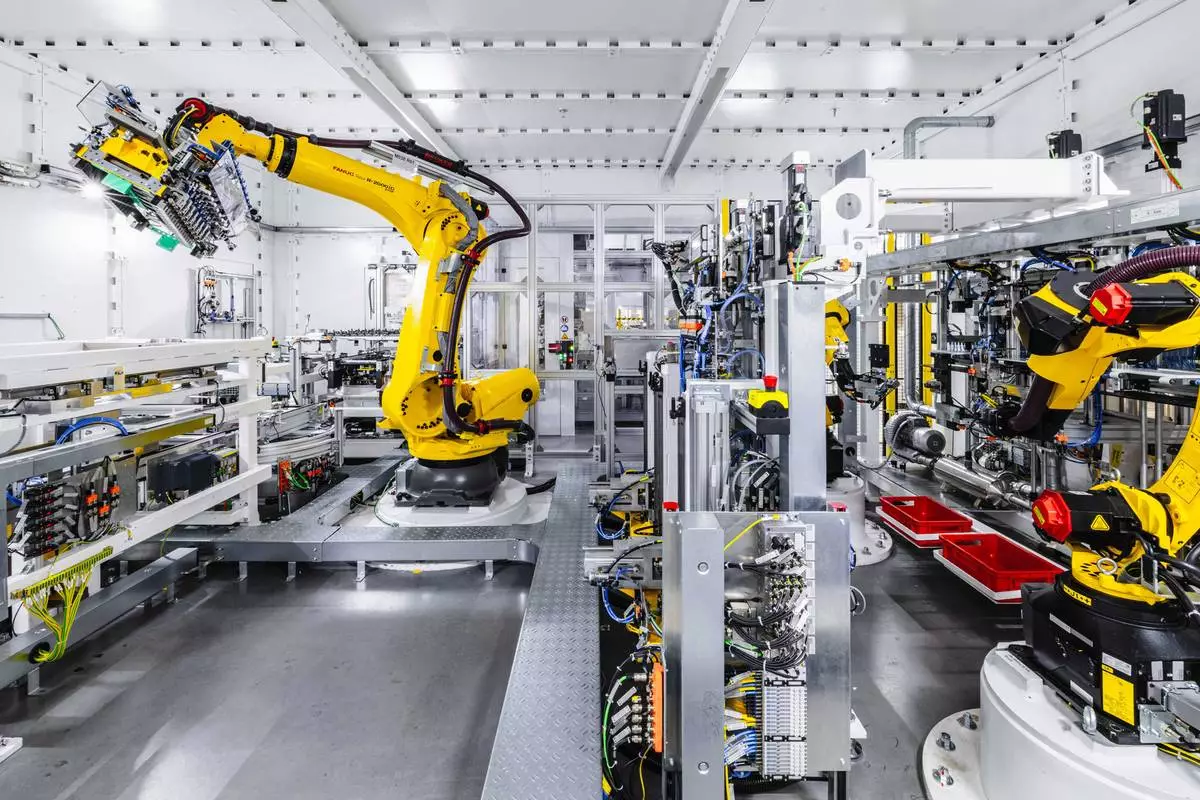
Lyten’s newly acquired battery energy storage systems manufacturing facility features state-of-the-art robotics and automation. Lyten acquired the facility, in Gdansk, Poland, from Northvolt. It is Europe’s largest energy storage systems manufacturing facility.

Lyten’s newly acquired battery energy storage systems manufacturing facility features state-of-the-art robotics and automation. Lyten acquired the facility, in Gdansk, Poland, from Northvolt. It is Europe’s largest energy storage systems manufacturing facility.

Aerial view of the 25,000-square meter battery energy storage systems manufacturing facility, in Gdansk, Poland, acquired by Lyten from Northvolt. The facility, previously known as Northvolt Dwa ESS, is Europe’s largest energy storage systems manufacturing operation.


Aerial view of the 25,000-square meter battery energy storage systems manufacturing facility, in Gdansk, Poland, acquired by Lyten from Northvolt. The facility, previously known as Northvolt Dwa ESS, is Europe’s largest energy storage systems manufacturing operation.

LAS VEGAS (AP) — The Las Vegas Review-Journal announced Friday that it will no longer print its rival the Las Vegas Sun for the first time in decades, sharpening a legal dispute over the nation’s last joint operating agreement stemming from a 1970 law designed to preserve newspapers.

Readers “will not find a printed Las Vegas Sun insert inside,” the Review-Journal said in an editorial, noting the Sun maintains a website, has a few hundred thousand followers across social media platforms, and is free to produce its own newspaper.

“We encourage them to do so. The Review-Journal competes with countless sources of news and entertainment, but we would welcome one more. We just don’t want to foot the bill. It is time the Sun stood up on its own two feet,” the editorial said, without specifying the cost.

The two publications will be in court Friday and the Sun hopes a judge will order printing to immediately resume, attorney Leif Reid said in an email. It will be the first day in 76 years that the Sun hasn’t been printed, he said.

“This does irreparable harm to our community, as no one benefits when a local newspaper is prevented from being published,” he said.

The now-rare joint operating agreement required the Sun to be printed as a daily insert in the Review-Journal, while both companies remained editorially independent with separate newsrooms and websites.

A lower court had found the agreement was unenforceable because a 2005 update was never signed by the U.S. attorney general, and in February the U.S. Supreme Court declined to hear an appeal by the Sun.

The Review-Journal editorial called the Supreme Court decision a decisive victory, saying that halting publication of the Sun on Friday was “a result of 6½ years of litigation between the newspapers, precipitated by the Sun.”

Such agreements between rival publications have dwindled as part of a "long, slow goodbye of newspapers as we knew them,” said Ken Doctor, a news business analyst. The Detroit Free Press and the Detroit News ended a 40-year agreement last year. USA Today Co., which owns the Detroit Free Press, recently announced its plans to purchase the Detroit News.

In 1950, the Sun was founded in response to the Review-Journal’s refusal to negotiate with typesetters from the International Typographical Union. The union started its own newspaper and reached out to businessman Hank Greenspun for financial backing. The Greenspuns still own the paper.

The Review-Journal has been publishing since 1909, first as the Clark County Review. It is owned by the Adelson family, casino magnates and mega GOP donors, and remains the state’s largest newspaper.

The Review-Journal’s editorials lean more conservative, while the Sun’s lean liberal. The 1970 law signed by then President Richard Nixon, called the Newspaper Preservation Act, was designed to save newspapers costs while maintaining competition and editorial variety in cities as newspapers began to financially struggle.

The papers first entered into a joint operating agreement in 1989 when the Sun was struggling to stay afloat financially. The agreement made the Sun an afternoon newspaper during weekdays and a section within the Review-Journal on weekend mornings, while the Review-Journal handled production, distribution and advertising. The Review-Journal also collected all revenue and was required to pay the Sun monthly to cover the Sun’s news and editorial expenses.

In 2005 the agreement was amended to make the Sun an insert in the Review-Journal every morning.

Review-Journal owners sought to end the agreement in 2019, and in response the Sun’s owners filed a lawsuit alleging that ending the agreement violated anti-trust laws.

The 1970 law allowing such agreements was signed at a time when news options weren't as prevalent and there was more concern over news monopolies.

Las Vegas — and Nevada as a whole — today have more strong, independent news organizations compared to other places, said Stephen Bates, a journalism and media professor at the University of Nevada, Las Vegas.

The Sun also publishes online. But it has argued in court that losing its print product could make it harder to recruit staff, cause a loss in readers, and even force it to close.

Genelle Belmas, a journalism professor at the University of Kansas who specializes in media law, said it would be disappointing if the last joint operating agreement in the country ends. During visits to Vegas, she's enjoyed being able to pick up the Review-Journal and see the Sun folded inside, offering two differing points of view in one place. Online news outlets make it easier for consumers to stay in their echo chambers, she said.

“Every local news outlet we lose — and that includes big towns, small towns, whatever — is a loss of perspective and a loss of a potential alternative view,” Belmas said.

The exterior of the Las Vegas Review-Journal is shown Friday, April 3, 2026, in Las Vegas (AP Photo/Ty Oneil)

The exterior of the Las Vegas Review-Journal is shown Friday, April 3, 2026, in Las Vegas (AP Photo/Ty Oneil)

The front page of the Las Vegas Review-Journal is shown Friday, April 3, 2026, in Las Vegas (AP Photo/Ty Oneil)

The front page of the Las Vegas Review-Journal is shown Friday, April 3, 2026, in Las Vegas (AP Photo/Ty Oneil)

FILE - This Dec. 17, 2015 file photo shows a sign outside the building housing the Las Vegas Review-Journal in Las Vegas. AP Photo/John Locher, File)

FILE - This Dec. 17, 2015 file photo shows a sign outside the building housing the Las Vegas Review-Journal in Las Vegas. AP Photo/John Locher, File)

Recommended Articles