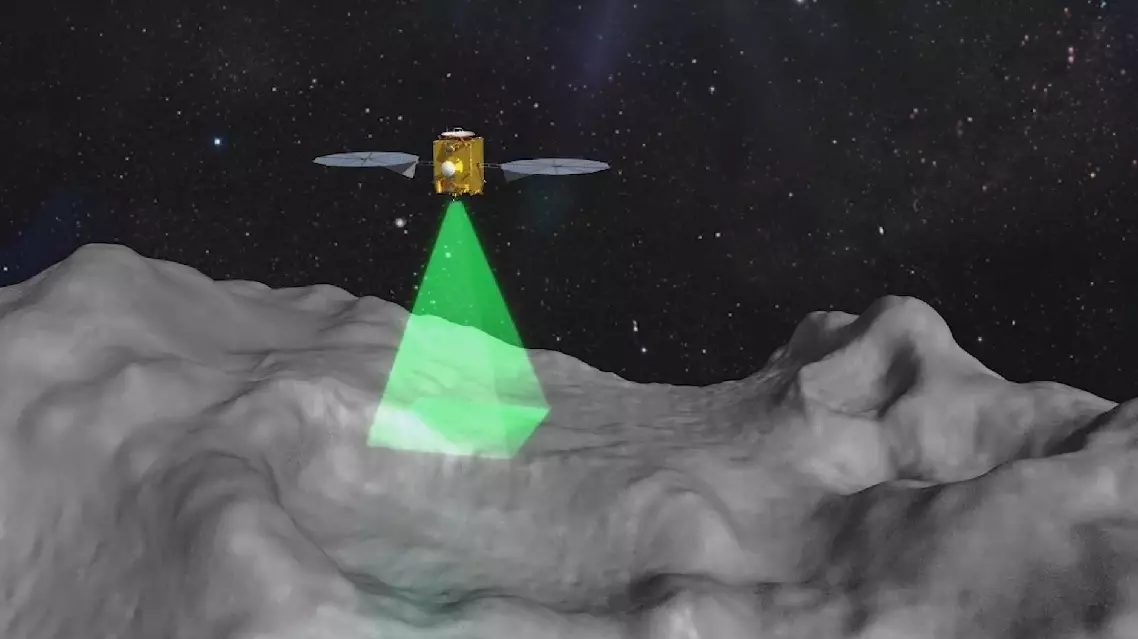
The Tianwen-2 probe is preparing to explore two target asteroids, near-Earth asteroid 2016HO3 and main-belt comet 311P, which are of high scientific research value and accessibility, according to Chinese scientists.
China launched its first asteroid sample-return mission, Tianwen-2, on May 29, an endeavor to shed light on the formation and evolution of asteroids and the early solar system.
The mission aims to achieve multiple goals over a decade-long expedition: collecting samples from 2016HO3 and exploring 311P, which is farther from Earth than Mars.
Known as a quasi-satellite of Earth, asteroid 2016HO3 orbits the Sun and appears to circle around Earth as well, remaining a constant companion to our planet.
Dubbed as "cosmic fossils," asteroids preserve critical information about the solar system's infancy, scientists say.
"[This asteroid] is very likely to hold the original information of the solar system at its birth, which is of great scientific research value for our understanding of the material composition of the early solar system, including its formation process and evolutionary history," said Han Siyuan, deputy director of the Lunar Exploration and Space Engineering Center.
The asteroid 2016HO3 also has a relatively stable orbit, requiring lower energy consumption for spacecraft to reach it, while enabling a viable scenario for subsequent exploration of the main-belt comet 311P, according to Han.
The second target, 311P, a celestial anomaly discovered in the main asteroid belt between Mars and Jupiter, occasionally spews out materials and resembles a comet with tails.
Its discovery challenges astronomers' conventional understanding about a comet, as the region is too close to the Sun for a comet to retain its volatile materials like water ice.
As scientists are still uncertain whether main-belt comets originated in the asteroid belt or from the edge of the solar system, these special small celestial bodies hold significant scientific research value.
The entire mission process for Tianwen-2 is complex. After launch, it will journey for about one year to reach its first target, during which it will perform deep-space maneuvers and mid-course corrections until it is about 30,000 km away from 2016HO3.
The probe will gradually approach the target, carrying out close exploration by circling and hovering over the asteroid to determine the sampling area, with a strategy of flying and probing simultaneously.
After completing the sampling, the spacecraft will fly back to the vicinity of Earth. A return capsule will separate from the main probe and is expected to deliver the samples to Earth by the end of 2027.
The main probe will then continue its voyage to rendezvous with the more distant target, the main-belt comet 311P, to carry out subsequent exploration tasks.
Asteroid 2016HO3 is located between 18 million km and 46 million km from Earth, while the main-belt comet 311P lies approximately 150 million km to 500 million km away.
Tianwen-2 probe to explore two target asteroids of high scientific research value: scientist