HAVANA, Cuba (AP) — The Cuban women’s national volleyball team was denied a chance to play in a tournament in Puerto Rico following the new visa restrictions imposed by U.S. President Donald Trump.
The Cuban Volleyball Federation said last week that the team, comprising 12 athletes, a referee and several coaches, had their visa request denied and will be unable to attend the tournament later this month.
“The disappointment is huge because I train every day, every hour of training is leading up to this and dedicate myself to it,” national team player Laura Suarez told The Associated Press. “It’s really disappointing not to be able to participate in the competition, which is what I’ve been preparing myself for.(asterisk)
Cuba was scheduled to play in the NORCECA Women’s Final Four tournament in Manatí, Puerto Rico. The tournament includes Puerto Rico, Mexico and Costa Rica and it awards ranking points toward qualification for the Volleyball Nations League.
“We were focused on the competition because it’s right there," said Dayana Martínez, another player. "Arriving at the embassy and being denied the visa affects us a lot because that competition gives us points to improve our ranking,”
The Cuban team's coach, Wilfredo Robinson, said the decision means his team is likely to miss out on the Nations League.
“The competition grants points for each match and at the end it all adds up," Robinson said. “In September, we have another tournament and if we get there needing to achieve 80 or 100 points we are not going to be able to do it.”
The United States added Cuba to a list of 12 countries with restrictions for entering the U.S. or its territories, effective from early June. It includes nationals from Afghanistan, the Republic of Congo, Iran, Venezuela and other nations.
“Denial of visas is part of a racist and xenophobic list of visa restrictions,” Cuban foreign minister Bruno Rodriguez wrote on his X account.
In a message sent to The Associated Press, the U.S. Embassy in Cuba stated that, according to its privacy policies, it could not comment on specific cases but that directives were being implemented to secure the borders and protect U.S. communities and citizens.
The Cuban women's national team won back-to-back world championships in 1994 and 1998. It also won three Olympic golds in a row in Barcelona 1992, Atlanta 1996 and Sydney 2000.
The U.S. measures are likely to impact many more Cuban athletes who depend on international competitions, including some on American soil to qualify for major championships and the next Olympics scheduled to be played in Los Angeles in 2028.
AP Volleyball: https://apnews.com/hub/volleyball
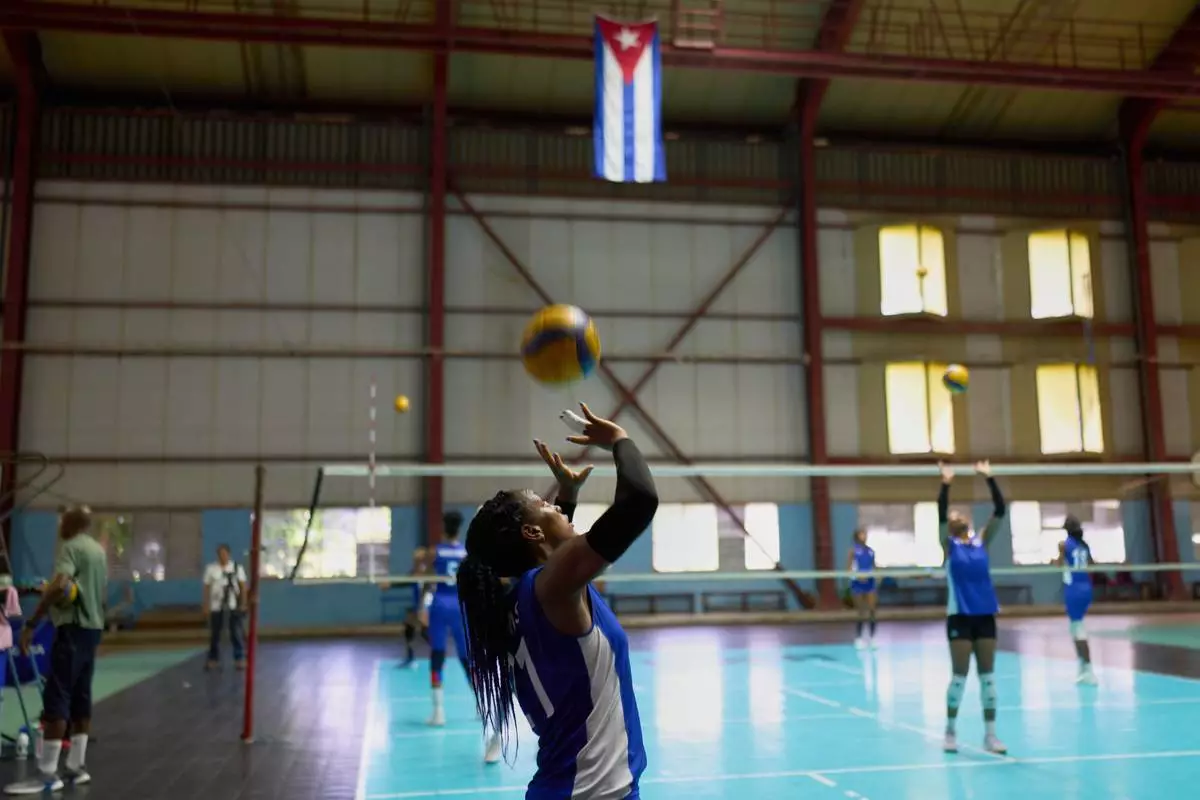
The Cuban women's national volleyball team trains in Havana, Cuba, Monday, June 30, 2025. (AP Photo/Ramon Espinosa)
When he talks about the role of religion in the founding of the United States, historian Gregg Frazer does not attract eager audiences.
“Neither side really wants to hear what I say,” says Frazer, a professor of history and political studies at The Master’s University, a Christian school in Santa Clarita, California.
The founders, Frazer says, did not create a Christian republic. Several key founders either rejected core Christian doctrines or were vague enough to keep historians debating. For Frazer, that often disappoints audiences of his fellow Christians.
But, he says, nor were the founders a cluster of rationalist deists — believers in a God who set the universe in motion like a clockmaker and then left it alone — and anti-religious skeptics, as they are sometimes portrayed. That disappoints audiences who favor a high firewall between church and state. Most of the founders were religious in one form or another.
The long-running debate over the founders’ intentions about religion has been turbocharged with the approaching 250th anniversary of the Declaration of Independence on July 4. Amid the America 250 celebrations, some Christian activists and authors are redoubling claims that the U.S. had a Christian founding.
They have an ally in the White House. President Donald Trump is promoting “America Prays,” culminating in a May 17 gathering on the National Mall in Washington. Cabinet officials are issuing Christian messages in their official capacity. Defense Secretary Pete Hegseth proclaimed that “America was founded as a Christian nation … in our DNA.”
Critics and advocacy groups are pushing back.
“Most — nearly all — serious historians agree that America was not founded as a Christian nation in any meaningful legal, philosophical, or constitutional sense,” says the group Americans United for Separation of Church and State.
Six in 10 U.S. adults surveyed said they believed the founders originally intended America to be a Christian nation, according to a 2022 Pew Research Center report.
Why do the founders’ beliefs and intentions matter?
“Everyone’s looking for what we historians call a usable past,” says John Fea, author of “Was America Founded as a Christian Nation?”
“We go into the past looking for what we want in order to advance a particular political or cultural agenda,” says Fea, a fellow at the Lumen Center, a Christian research institute and study center in Madison, Wisconsin.
Public officials and others did indeed offer prayers on behalf of the new republic at important historical moments. But he said other issues — such as taxation and representation — were more central to the Revolution.
Historian Mark David Hall argues that Christianity did strongly impact the founding. While core founders did not hold traditional Christian beliefs, he contends that many other founders did, and this shaped their thinking about how to form the new republic.
“There’s plenty of evidence Christianity had an influence,” says Hall, author of “Did America Have a Christian Founding?”
He says founders’ attention to human dignity harmonizes with the Bible’s teaching of humanity created in God’s image. The system of checks and balances — to prevent the concentration of power — reflects teachings about human sin that would have permeated a largely Protestant culture, he says.
He also notes that some early presidents and Congresses issued proclamations for prayer and thanksgiving, though some drew opposition and controversy. Some states sponsored churches for decades after the Constitution was ratified, indicating that the founders didn’t believe religion should be absent from public life.
The believed that faith was important in forming moral, responsible citizens of the new republic. They promoted “toleration without eliminating the importance of real religious commitment on the part of differing adherents,” Frazer wrote in his book, “The Religious Beliefs of America’s Founders.”
There’s no reference to any specific religion in the Constitution beyond the date — “in the year of our Lord” 1787. It forbids religious tests for officeholders. The First Amendment guarantees religious freedom and forbids “establishment” of a national religion.
Twentieth-century Supreme Court rulings applied the First Amendment to the states on the basis of the Fourteenth Amendment, which prohibits states from denying citizens’ rights.
Frazer argues that the Bible is not cited as a source for any governing principles in the documented proceedings of the Constitutional Convention or in the influential Federalist Papers. He says the founders drew on influences such as Enlightenment thinking for such concepts as human equality, accountable government and freedom of religion. Early critics faulted the Constitution's lack of religious content.
The Declaration of Independence does have religious language, declaring that rights come from the “Creator.” It appeals to the “Laws of Nature and of Nature’s God.”
Thomas Jefferson and other founders — adroitly, Frazer says — used terms acceptable to Christians as well as followers of other religious and philosophical movements.
At the time of the Revolution, most colonists were Protestant, though church participation had been in decline.
Rationalistic approaches to religion strongly influenced many college-educated and propertied elite men, such as those who produced the Declaration of Independence and Constitution, Frazer wrote. So did Freemasonry, a fraternal order based on beliefs in a universal God and morals.
Some founders were devout Christians such as John Jay, Samuel Adams and Patrick Henry. Others believed in God but not in Jesus’ divinity, including key founders like Jefferson, John Adams and Benjamin Franklin. The enigmatic Washington kept active in his Episcopal church but avoided sacraments and also was an active Freemason.
But contrary to popular belief, most founders were not deists.
Frazer instead describes many founders as “theistic rationalists.” George Washington believed that divine “Providence” saved his life in battle and intervened on America’s behalf. He was far from alone.
“They did believe in an active God,” Frazer says.
Even the skeptics thought religion was important in forming virtuous citizens. Many scholars believe the First Amendment created a sort of religious free market in which Christianity and other faiths have flourished to this day.
Associated Press religion coverage receives support through the AP’s collaboration with The Conversation US, with funding from Lilly Endowment Inc. The AP is solely responsible for this content.
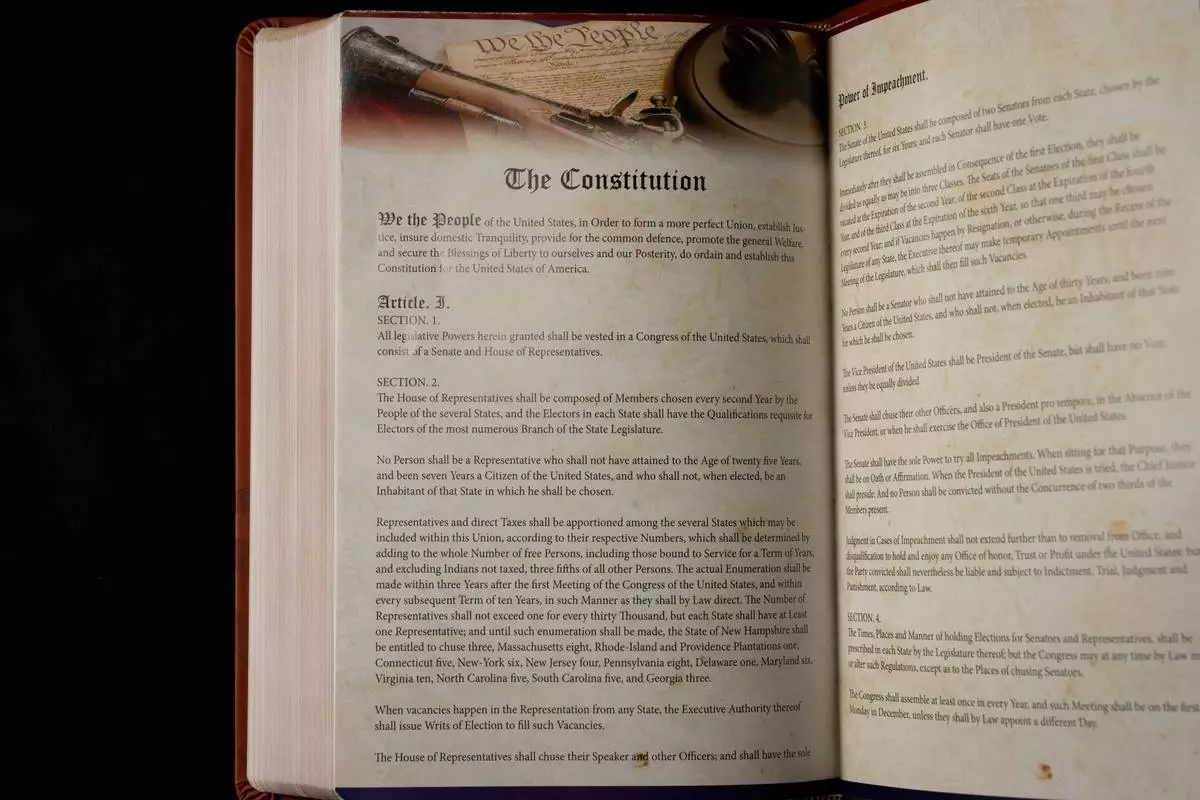
FILE - The Constitution of the United States is printed in Republican presidential nominee former President Donald Trump's "God Bless the USA" Bible in Washington, Oct. 8, 2024. (AP Photo/Ben Curtis, File)
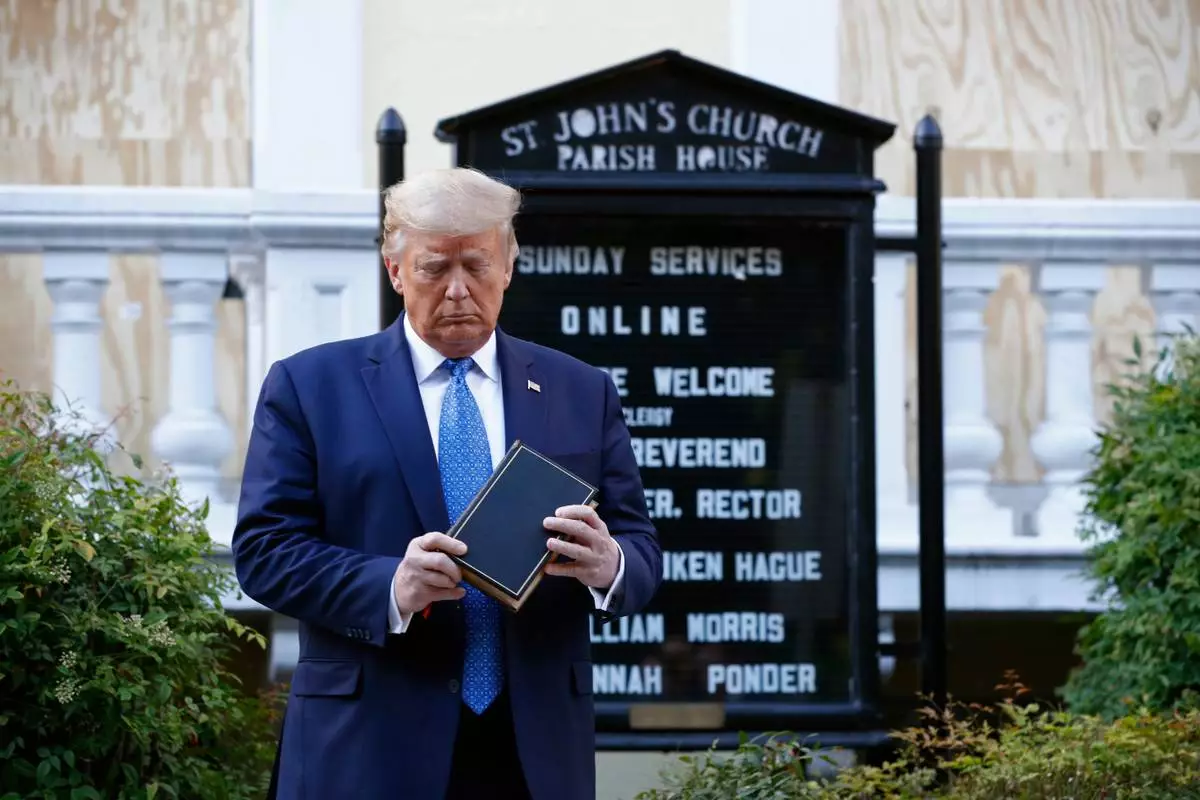
FILE - President Donald Trump holds a Bible as he stands outside St. John's Church, across Lafayette Park from the White House, on June 1, 2020, in Washington. (AP Photo/Patrick Semansky, File)
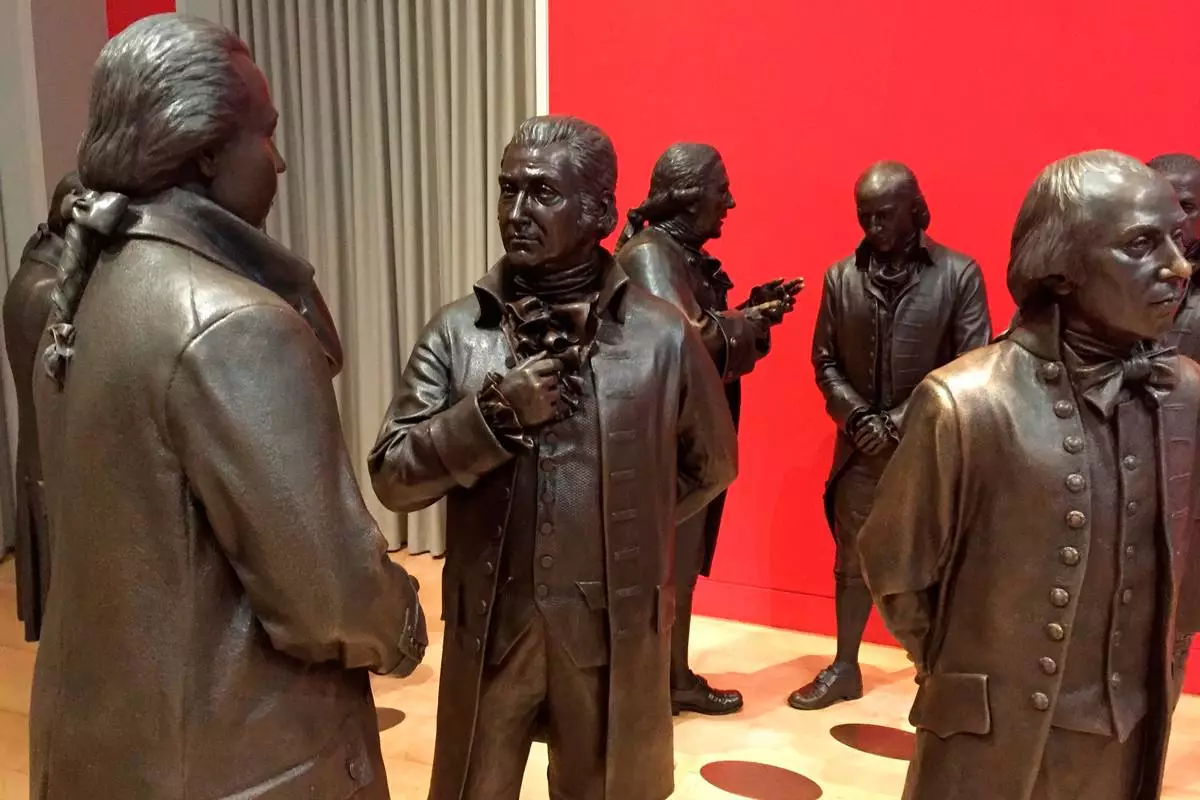
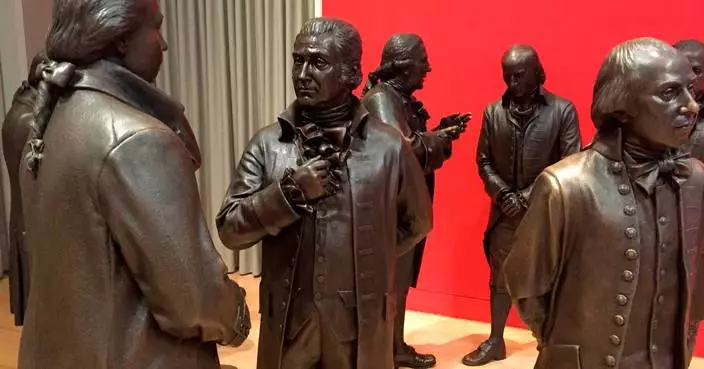
FILE - Life-size bronze sculptures of the signers of the U.S. Constitution stand in the Signers' Hall on July 7, 2016, at the National Constitution Center in Philadelphia. (AP Photo/Beth J. Harpaz, File)
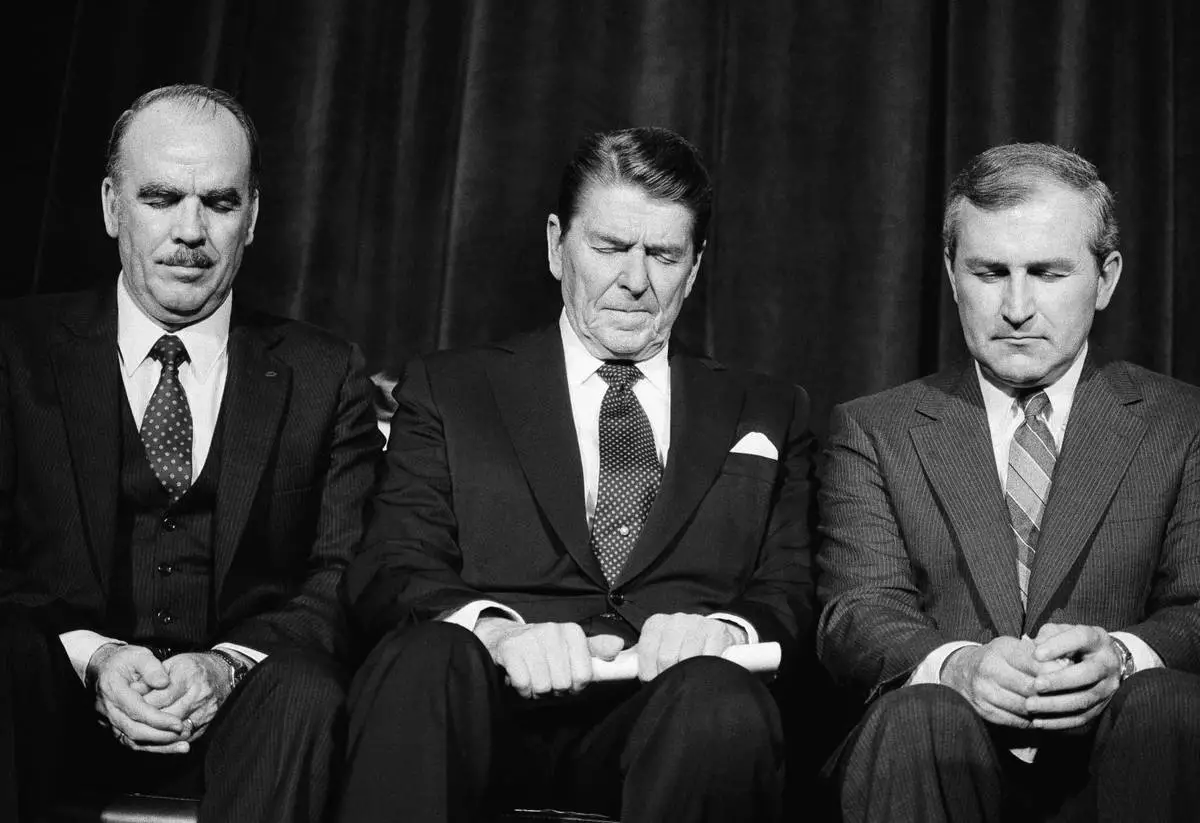
FILE - President Ronald Reagan prays with National Association of Evangelicals President Arthur Gay, left, following his address to the organization's convention asking for help in winning approval of a constitutional amendment permitting prayer in school in Columbus, Ohio, March 7, 1984. (AP Photo/Barry Thumma, File)