Social media users are falsely claiming that President Donald Trump's sprawling tax bill, which passed the Senate Tuesday after a turbulent overnight session, will give Trump undue influence over U.S. elections.
“The reason the GOP isn’t concerned about the midterms and why they are pushing this bill is because it gives Trump power to cancel elections,” reads one X post. “If this bill passes — it’s the end of the country. Democracy is over.”
The bill contains no such provision. Here's a closer look at the facts.
CLAIM: President Donald Trump's tax bill will allow him to delay or cancel elections.
THE FACTS: That's false. There is nothing in the legislation that would allow Trump, or any future president, to stop an election from going forward. According to legal experts, a constitutional amendment would have to pass for anyone to have the ability to cancel a federal election. The timing of elections for federal offices is stipulated in federal law and it is highly unlikely that Congress would pass a bill allowing the president to change that timing, experts said.
“Although President Trump might like to cancel or postpone an upcoming election if he thought his party was going to fare poorly, the One Big Beautiful Bill does not actually grant him that power,” said Barry Burden, director of the University of Wisconsin-Madison's Elections Research Center and a political science professor.
White House spokeswoman Abigail Jackson called the false claims “obviously fake news.”
Burden and other experts agree that these allegations may stem from a misunderstanding of a section of the bill on judicial enforcement that was included in the version passed by the House. That section was removed from the bill after Senate Parliamentarian Elizabeth MacDonough ruled that it violates the so-called Byrd Rule, which essentially bars policy matters in budget reconciliation bills.
Section 70302 could have made it easier for Trump to disregard federal court rulings, requiring parties seeking preliminary injunctions or temporary restraining orders to put down a “security,” such as a cash bond, before the court could issue contempt penalties.
Regardless, such a provision would not allow Trump to delay or cancel elections, even if he tried.
“If Trump announced, I'm canceling the elections, that has as much power as my announcing I'm canceling the elections,” said Justin Levitt, a professor at Loyola Marymount University who specializes in constitutional law and the law of democracy.
Asked whether section 70302 would have given Trump power over whether elections occur, Richard Pildes, a professor of constitutional law at New York University, replied, “Obviously not.”
The U.S. Constitution gives state legislatures the power to set the time of elections, subject to any laws Congress enacts that “make or alter such Regulations.”
Congress set standard federal election dates with a series of laws, starting in 1845. That year, it was determined that states would choose presidential electors “the Tuesday next after the first Monday in the month of November.” Presidential elections have been held every four years on this day since 1848, including through the Civil War, World War I and World War II. Congress aligned House elections with presidential races in 1872 and in 1914 aligned the election of Senators with biennial House elections.
The Constitution states that the term for president and vice president is four years, the term for senators is six years and the term for representatives is two years. Unless they are reelected, there is no mechanism for any of these officials to remain in office after their term ends. Only a constitutional amendment could change this.
Some states have a provision that allows voting in federal races to continue after Election Day in “extraordinary and catastrophic” circumstances, such as a natural disaster. There is no other way to delay a federal election.
Find AP Fact Checks here: https://apnews.com/APFactCheck.
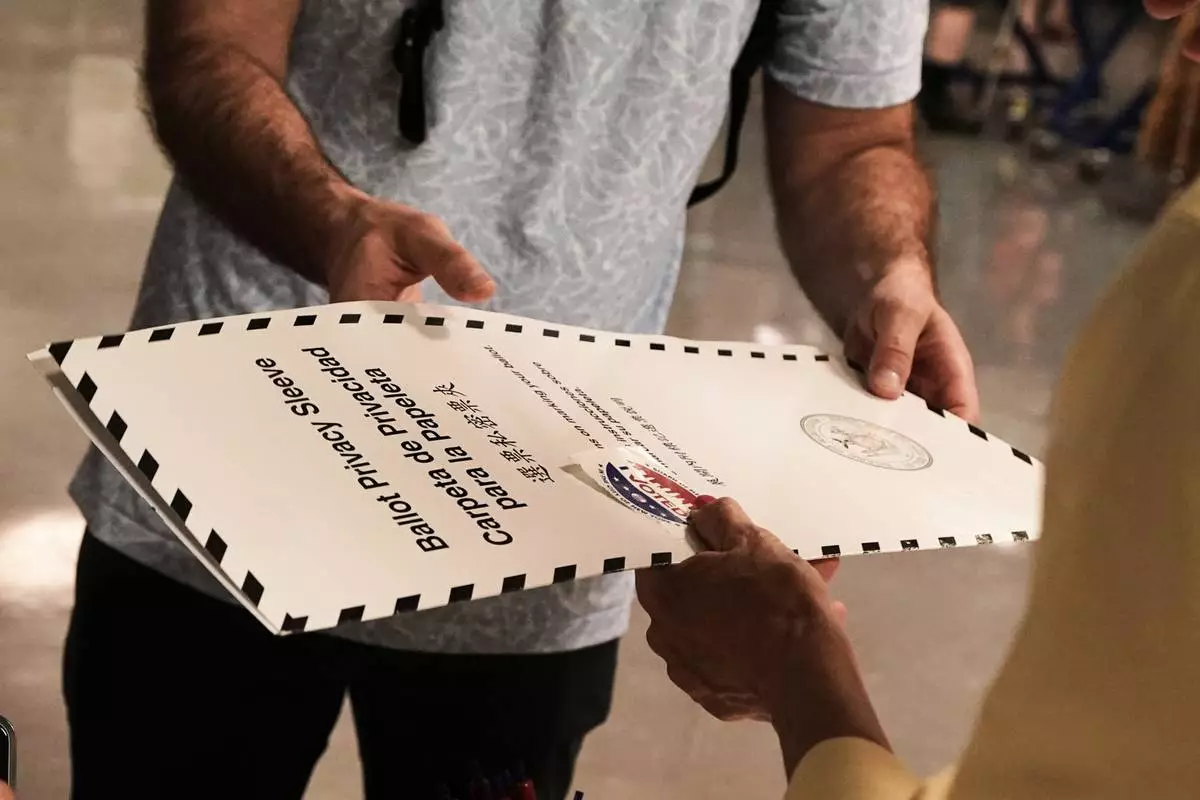
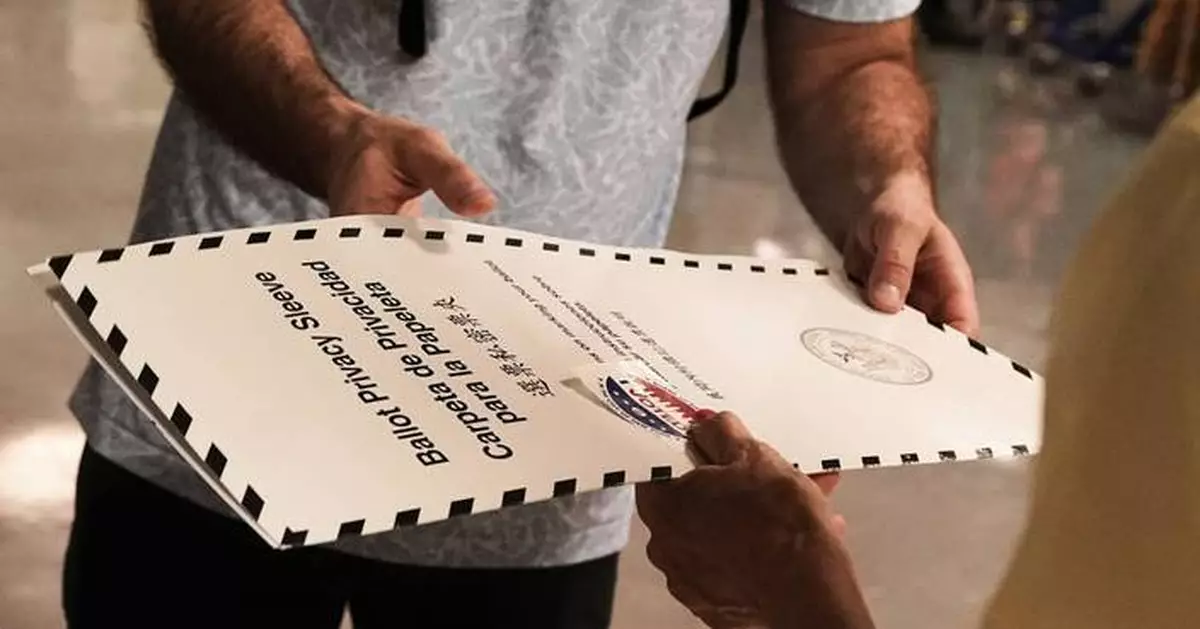
A voter receives his ballot at PS811, The Mickey Mantle School, in the mayoral primary election in New York, Tuesday, June 24, 2025. (AP Photo/Richard Drew)
U.S. forces have boarded another oil tanker in the Caribbean Sea. The announcement was made Friday by the U.S. military. The Trump administration has been targeting sanctioned tankers traveling to and from Venezuela.
The pre-dawn action was carried out by U.S. Marines and Navy, taking part in the monthslong buildup of forces in the Caribbean, according to U.S. Southern Command, which declared “there is no safe haven for criminals” as it announced the seizure of the vessel called the Olina.
Navy officials couldn’t immediately provide details about whether the Coast Guard was part of the force that took control of the vessel as has been the case in the previous seizures. A spokesperson for the U.S. Coast Guard said there was no immediate comment on the seizure.
The Olina is the fifth tanker that has been seized by U.S. forces as part of a broader effort by Trump’s administration to control the distribution of Venezuela’s oil products globally following the U.S. ouster of President Nicolás Maduro in a surprise nighttime raid.
The latest:
Richard Grenell, president of the Kennedy Center, says a documentary film about first lady Melania Trump will make its premiere later this month, posting a trailer on X.
As the Trumps prepared to return to the White House last year, Amazon Prime Video announced a year ago that it had obtained exclusive licensing rights for a streaming and theatrical release directed by Brett Ratner.
Melania Trump also released a self-titled memoir in late 2024.
Some artists have canceled scheduled Kennedy Center performances after a newly installed board voted to add President Donald Trump’s to the facility, prompting Grenell to accuse the performers of making their decisions because of politics.
Mexico President Claudia Sheinbaum says that she has asked her foreign affairs secretary to reach out directly to U.S. Secretary of State Marco Rubio or Trump regarding comments by the American leader that the U.S. cold begin ground attacks against drug cartels.
In a wide-ranging interview with Fox News aired Thursday night, Trump said, “We’ve knocked out 97% of the drugs coming in by water and we are going to start now hitting land, with regard to the cartels. The cartels are running Mexico. It’s very sad to watch.”
As she has on previous occasions, Sheinbaum downplayed the remarks, saying “it is part of his way of communicating.” She said she asked her Foreign Affairs Secretary Juan Ramón de la Fuente to strengthen coordination with the U.S.
Sheinbaum has repeatedly rebuffed Trump’s offer to send U.S. troops after Mexican drug cartels. She emphasizes that there will be no violation of Mexico’s sovereignty, but the two governments will continue to collaborate closely.
Analysts do not see a U.S. incursion in Mexico as a real possibility, in part because Sheinbaum’s administration has been doing nearly everything Trump has asked and Mexico is a critical trade partner.
Trump says he wants to secure $100 billion to remake Venezuela’s oil infrastructure, a lofty goal going into a 2:30 meeting on Friday with executives from leading oil companies. His plan rides on oil producers being comfortable in making commitments in a country plagued by instability, inflation and uncertainty.
The president has said that the U.S. will control distribution worldwide of Venezuela’s oil and will share some of the proceeds with the country’s population from accounts that it controls.
“At least 100 Billion Dollars will be invested by BIG OIL, all of whom I will be meeting with today at The White House,” Trump said Friday in a pre-dawn social media post.
Trump is banking on the idea that he can tap more of Venezuela’s petroleum reserves to keep oil prices and gasoline costs low.
At a time when many Americans are concerned about affordability, the incursion in Venezuela melds Trump’s assertive use of presidential powers with an optical spectacle meant to convince Americans that he can bring down energy prices.
Trump is expected to meet with oil executives at the White House on Friday.
He hopes to secure $100 billion in investments to revive Venezuela’s oil industry. The goal rides on the executives’ comfort with investing in a country facing instability and inflation.
Since a U.S. military raid captured former Venezuelan leader Nicolás Maduro on Saturday, Trump has said there’s a new opportunity to use the country’s oil to keep gasoline prices low.
The full list of executives invited to the meeting has not been disclosed, but Chevron, ExxonMobil and ConocoPhillips are expected to attend.
Attorneys general in five Democratic-led states have filed a lawsuit against President Donald Trump’s administration after it said it would freeze money for several public benefit programs.
The Trump administration has cited concerns about fraud in the programs designed to help low-income families and their children. California, Colorado, Minnesota, Illinois and New York states filed the lawsuit Thursday in the U.S. District Court for the Southern District of New York.
The lawsuit asks the courts to order the administration to release the funds. The attorneys general have called the funding freeze an unconstitutional abuse of power.
Iran’s judiciary chief has vowed decisive punishment for protesters, signaling a coming crackdown against demonstrations.
Iranian state television reported the comments from Gholamhossein Mohseni-Ejei on Friday. They came after Supreme Leader Ayatollah Ali Khamenei criticized Trump’s support for the protesters, calling Trump’s hands “stained with the blood of Iranians.”
The government has shut down the internet and is blocking international calls. State media has labeled the demonstrators as “terrorists.”
The protests began over Iran’s struggling economy and have become a significant challenge to the government. Violence has killed at least 50 people, and more than 2,270 have been detained.
Trump questions why a president’s party often loses in midterm elections and suggests voters “want, maybe a check or something”
Trump suggested voters want to check a president’s power and that’s why they often deliver wins for an opposing party in midterm elections, which he’s facing this year.
“There’s something down, deep psychologically with the voters that they want, maybe a check or something. I don’t know what it is, exactly,” he said.
He said that one would expect that after winning an election and having “a great, successful presidency, it would be an automatic win, but it’s never been a win.”
Hiring likely remained subdued last month as many companies have sought to avoid expanding their workforces, though the job gains may be enough to bring down the unemployment rate.
December’s jobs report, to be released Friday, is likely to show that employers added a modest 55,000 jobs, economists forecast. That figure would be below November’s 64,000 but an improvement after the economy lost jobs in October. The unemployment rate is expected to slip to 4.5%, according to data provider FactSet, from a four-year high of 4.6% in November.
The figures will be closely watched on Wall Street and in Washington because they will be the first clean readings on the labor market in three months. The government didn’t issue a report in October because of the six-week government shutdown, and November’s data was distorted by the closure, which lasted until Nov. 12.

FILE - President Donald Trump dances as he walks off stage after speaking to House Republican lawmakers during their annual policy retreat, Tuesday, Jan. 6, 2026, in Washington. (AP Photo/Evan Vucci, File)