Skip to Content Facebook Feature Image

Wisconsin Supreme Court’s liberal majority strikes down 176-year-old abortion ban

News

Wisconsin Supreme Court’s liberal majority strikes down 176-year-old abortion ban
News

News

Wisconsin Supreme Court’s liberal majority strikes down 176-year-old abortion ban

2025-07-03 02:34 Last Updated At:02:41

MADISON, Wis. (AP) — The Wisconsin Supreme Court’s liberal majority struck down the state’s 176-year-old abortion ban on Wednesday, ruling 4-3 that it was superseded by newer state laws regulating the procedure, including statutes that criminalize abortions only after a fetus can survive outside the womb.

The ruling came as no surprise given that liberal justices control the court. One of them went so far as to promise to uphold abortion rights during her campaign two years ago, and they blasted the ban during oral arguments in November.

The statute Wisconsin legislators adopted in 1849, widely interpreted as a near-total ban on abortions, made it a felony for anyone other than the mother or a doctor in a medical emergency to destroy “an unborn child.”

The ban was in effect until 1973, when the U.S. Supreme Court’s landmark Roe v. Wade decision legalizing abortion nationwide nullified it. Legislators never officially repealed it, however, and conservatives argued that the U.S. Supreme Court’s 2022 decision to overturn Roe reactivated it.

Wisconsin Attorney General Josh Kaul, a Democrat, filed a lawsuit that year arguing that abortion restrictions enacted by Republican legislators during the nearly half-century that Roe was in effect trumped the ban. Kaul specifically cited a 1985 law that essentially permits abortions until viability. Some babies can survive with medical help after 21 weeks of gestation.

Lawmakers also enacted abortion restrictions under Roe requiring women to undergo ultrasounds, wait 24 hours before having the procedure and provide written consent, and receive abortion-inducing drugs only from doctors during an in-person visit.

“That comprehensive legislation so thoroughly covers the entire subject of abortion that it was clearly meant as a substitute for the 19th century near-total ban on abortion,” Justice Rebeca Dallet wrote for the majority.

Sheboygan County District Attorney Joel Urmanski, a Republican, defended the ban in court, arguing that it can coexist with the newer abortion restrictions.

Dane County Circuit Judge Diane Schlipper ruled in 2023 that the 1849 ban outlaws feticide — which she defined as the killing of a fetus without the mother’s consent — but not consensual abortions. Abortions have been available in the state since that ruling, but the state Supreme Court decision gives providers and patients more certainty that abortions will remain legal in Wisconsin.

Urmanski had asked the state Supreme Court to overturn Schlipper’s ruling without waiting for a decision from a lower appellate court.

The liberal justices all but telegraphed how they would rule. Justice Janet Protasiewicz stated on the campaign trail that she supports abortion rights. During oral arguments, Dallet declared that the ban was authored by white men who held all the power in the 19th century. Justice Jill Karofsky likened the ban to a “death warrant” for women and children who need medical care.

A solid majority of Wisconsin voters in the 2024 election, 62%, said abortion should be legal in all or most cases, according to AP VoteCast. About one-third said abortion should be illegal in most cases and only 5% said it should be illegal in all cases.

In a dissent, Justice Annette Ziegler called the ruling “a jaw-dropping exercise of judicial will.” She said the liberal justices caved in to their Democratic constituencies.

“Put bluntly, our court has no business usurping the role of the legislature, inventing legal theories on the fly in order to make four justices’ personal preference the law,” Ziegler said.

Urmanski's attorney, Andrew Phillips, didn't respond to an email. Kaul told reporters during a news conference that the ruling is a “major victory” for reproductive rights.

Heather Weininger, executive director of Wisconsin Right to Life, called the ruling “deeply disappointing.” She said that the liberals failed to point to any statute that explicitly repealed the 1849 ban.

“To assert that a repeal is implied is to legislate from the bench,” she said.

Planned Parenthood of Wisconsin asked the Supreme Court in February 2024 to decide whether the ban was constitutional. The court dismissed that case with no explanation Wednesday.

Michelle Velasquez, chief strategy officer for Planned Parenthood of Wisconsin, said Wednesday's ruling creates stability for abortion providers and patients, but she was disappointed the justices dismissed the constitutional challenge. She hinted that the organization might look next to challenge the state's remaining abortion restrictions.

Kaul said he has no plans to challenge the remaining restrictions, saying the Legislature should instead revisit abortion policy.

Democratic-backed Susan Crawford defeated conservative Brad Schimel for an open seat on the court in April, ensuring liberals will maintain their 4-3 edge until at least 2028. Crawford has not been sworn in yet and was not part of Wednesday’s ruling.

Abortion figures to be a key issue again next spring in another race for a state Supreme Court seat. Chris Taylor, a state appellate judge who served as Planned Parenthood of Wisconsin's policy director before a stint as a Democratic legislator, is challenging conservative Justice Rebecca Bradley.

Taylor's campaign sent out an email Wednesday calling the ruling a “huge victory” and asking for donations. She issued a statement calling the decision the correct one and blasting Bradley's dissent as “an unhinged political rant.”

Bradley wrote that the four liberal justices fancy themselves “super legislators” and committed "an affront to democracy."
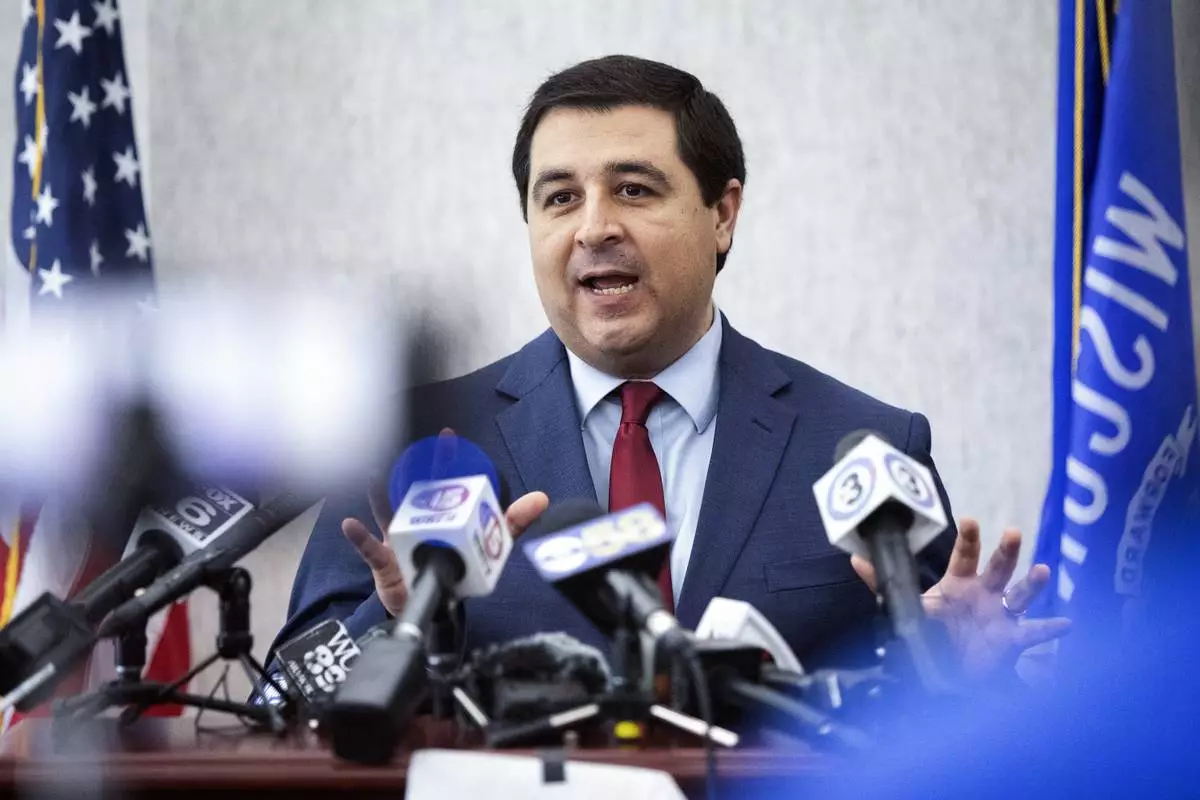
FILE - Wisconsin Attorney General Josh Kaul delivers remarks following hearing before Dane County Wis. judge Diane Schlipper which challenges a 174-year-old feticide law in Madison, Wis., May 4, 2023. (John Hart/Wisconsin State Journal via AP, File)

FILE - Wisconsin Attorney General Josh Kaul delivers remarks following hearing before Dane County Wis. judge Diane Schlipper which challenges a 174-year-old feticide law in Madison, Wis., May 4, 2023. (John Hart/Wisconsin State Journal via AP, File)

SAN FRANCISCO & JACKSONVILLE, Fla.--(BUSINESS WIRE)--Jan 12, 2026--

Abridge, the leading enterprise-grade AI for clinical conversations, is collaborating with Availity, the nation’s largest real-time health information network, to launch a first-of-its kind prior authorization experience. The engagement uses cutting-edge technology grounded in the clinician-patient conversation to facilitate a more efficient process between clinicians and health plans in medical necessity review.

This press release features multimedia. View the full release here: https://www.businesswire.com/news/home/20260112960386/en/

Rather than creating parallel AI systems across healthcare stakeholders, Abridge and Availity are working together to ensure shared clinical context at the point of conversation powers administrative processes, such as prior authorization review and submission, improving outcomes for patients and the teams delivering care.

This collaboration unites two trusted and scaled organizations: combining Abridge’s enterprise-grade AI platform, serving over 200 health systems and projected to support over 80 million patient-clinician conversations in 2026, with Availity’s next-generation, FHIR-native Intelligent Utilization Management solution, which helps payers and providers digitize and operationalize coverage requirements within administrative workflows.

Availity’s FHIR-native APIs enable fast, scalable, and secure connectivity of payer information across the entire healthcare ecosystem. With Abridge’s Contextual Reasoning Engine technology, clinicians can gain visibility into relevant clinical information during the conversation to support documentation aligned with prior authorization requirements.

“At Availity, we’ve invested in building AI-powered, FHIR-native APIs designed to bring clinical policy logic directly into provider workflows,” said Russ Thomas, CEO of Availity. “By embedding our technology at the point of conversation, we’re enabling faster, more transparent utilization management decisions rooted in clinical context. We’re excited to collaborate with Abridge and to demonstrate what’s possible when payer intelligence meets real-time provider workflows.”

The development of real-time prior authorization is just a component of a broader revenue cycle collaboration that is focused on applying real-time conversational intelligence across the patient, provider, and payer experiences. The companies intend to support integration by collaborating on workflow alignment between their respective platforms in the following areas:

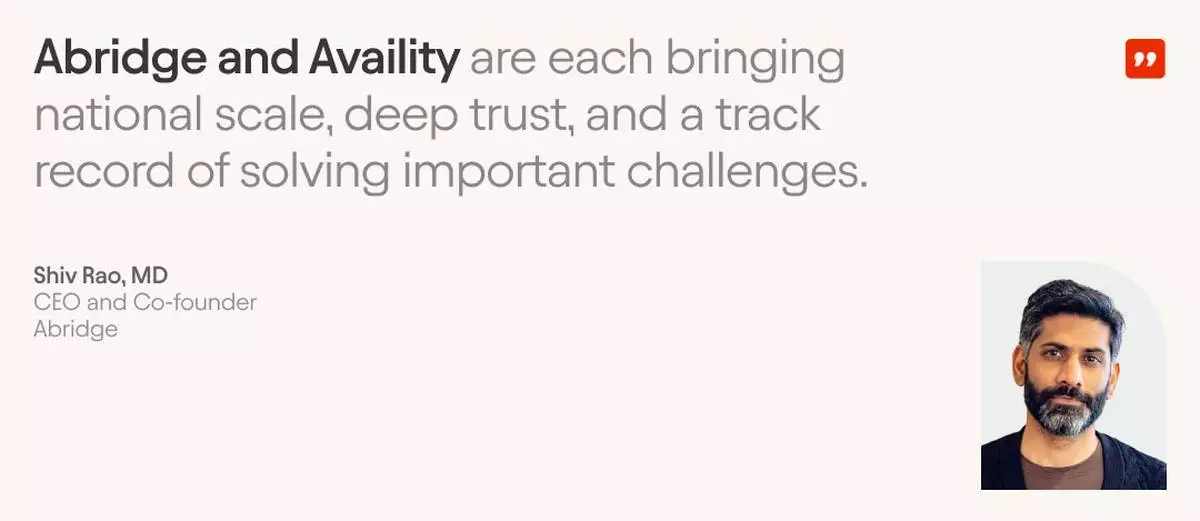
“Abridge and Availity are each bringing national scale, deep trust, and a track record of solving important challenges across the care and claims experience to this partnership,” said Dr. Shiv Rao, CEO and Co-Founder of Abridge. “We’re building real-time bridges between patients, providers, and payers, unlocking shared understanding, focused at the point of conversation.”

About Availity

Availity empowers payers and providers to deliver transformative patient experiences by enabling the seamless exchange of clinical, administrative, and financial information. As the nation's largest real-time health information network, Availity develops intelligent, automated, and interoperable solutions that foster collaboration and shared value across the healthcare ecosystem. With connections to over 95% of payers, more than 3 million providers, and over 2,000 trading partners, Availity provides mission-critical connectivity to drive the future of healthcare innovation. For more information, including an online demonstration, please visit www.availity.com or call 1.800.AVAILITY (282.4548). Follow us on LinkedIn.

About Abridge

Abridge was founded in 2018 to power deeper understanding in healthcare. Abridge is now trusted by more than 200 of the largest and most complex health systems in the U.S. The enterprise-grade AI platform transforms medical conversations into clinically useful and billable documentation at the point of care, reducing administrative burden and clinician burnout while improving patient experience. With deep EHR integration, support for 28+ languages, and 50+ specialties, Abridge is used across a wide range of care settings, including outpatient, emergency department, and inpatient.

Abridge’s enterprise-grade AI platform is purpose-built for healthcare. Supported by Linked Evidence, Abridge is the only solution that maps AI-generated summaries to source data, helping clinicians quickly trust and verify the output. As a pioneer in generative AI for healthcare, Abridge is setting the industry standard for the responsible deployment of AI across health systems.

Abridge was awarded Best in KLAS 2025 for Ambient AI in addition to other accolades, including Forbes 2025 AI 50 List, TIME Best Inventions of 2024, and Fortune’s 2024 AI 50 Innovators.

Abridge and Availity Collaborate to Redefine Payer-Provider Synergy at the Point of Conversation

Abridge and Availity Collaborate to Redefine Payer-Provider Synergy at the Point of Conversation

Abridge and Availity Collaborate to Redefine Payer-Provider Synergy at the Point of Conversation

Abridge and Availity Collaborate to Redefine Payer-Provider Synergy at the Point of Conversation

Recommended Articles