WASHINGTON (AP) — When the United States revokes someone's visa, it is typically confidential, with few exceptions. But with British punk-rap duo Bob Vylan and others, the Trump administration appears to have eased privacy restrictions to make a public point when it deems a case particularly egregious.
The State Department’s number two diplomat made headlines when he posted a social media message this week saying visas for the band for an upcoming U.S. tour had been revoked. British police are investigating whether a crime was committed when the duo's frontman led the audience in chants of “Death to the IDF” — the Israel Defense Forces — at a music festival in the U.K.
Deputy Secretary of State Christopher Landau posted that their visas had been revoked “in light of their hateful tirade at Glastonbury, including leading the crowd in death chants.”
The band rejected claims of antisemitism and said in a statement that it was being “targeted for speaking up” about the war in Gaza.
Under the Immigration and Nationality Act and certain statutes related to the privacy of government documents, the State Department has for years resisted or refused to discuss specific cases in which visas may have been denied or revoked. Certain exemptions apply, such as when foreign officials and their immediate family members are found to ineligible for entry into the United States for violating anti-corruption or human rights regulations.
However, as the Trump administration pursues a nationwide crackdown targeted at visa holders it believes have engaged in antisemitic or pro-militant behavior, the standard for releasing once-privileged information seems to have been relaxed.
“Foreigners who glorify violence and hatred are not welcome visitors to our country,” State Department spokeswoman Tammy Bruce said when asked about the public announcement.
She said one reason for announcing the revocations was to make clear that the administration is serious about the standards it will apply to visa holders and applicants.
“We’ve been public about that standard, and this was a very public event that violated that very basic standard about the nature of who we want to let into the country,” Bruce said.
Other recent cases have been less clear-cut, although some have ended up in public court cases.
Earlier this year, as part of an initiative to expel foreign students who are accused by the Trump administration of engaging in pro-Hamas, anti-Israel or antisemitic activity, Secretary of State Marco Rubio said he had rescinded at least 300 visas and expected that number to rise.
Many of those cases were not publicized individually.
One that was: Rumeysa Ozturk, who was detained by immigration authorities in Massachusetts for authoring an opinion piece criticizing Tufts University for not taking a tougher line on alleged Israeli atrocities in Gaza.
U.S. officials said at the time that her visa had been revoked because of adverse foreign policy consequences if she remained in the United States.
Other high-profile and public cases of visa revocations for political reasons date back decades, including actor Charlie Chaplin in 1952 during the Truman administration and an ultimately unsuccessful deportation attempt against Beatles singer John Lennon in the 1970s.
“The practice of ideological exclusion has a long history in the United States, having been used for decades as a political tool to keep U.S. audiences from being exposed to dissident viewpoints,” the human rights group Amnesty International said in a 2020 report.
“During the Cold War, in particular, the U.S. government denied visas to some of the world’s leading intellectuals, writers and artists who, the government thought, might promote Communism or other 'subversive' views,” it said.
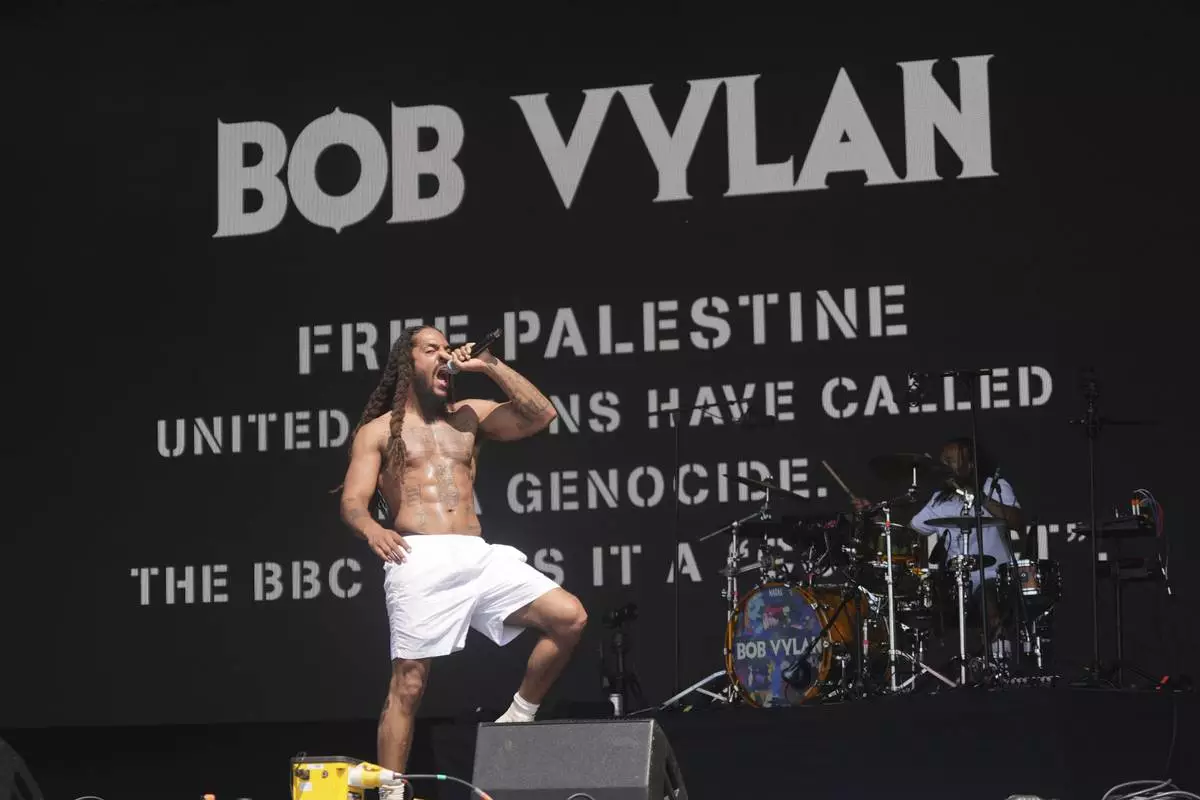
Bob Vylan perform on the West Holts Stage, during the Glastonbury Festival at Worthy Farm in Somerset. England, Saturday, June 28, 2025. (Yui Mok/PA via AP)
MELBOURNE, Australia (AP) — A mass shooting in which 15 people were killed during a Hanukkah celebration at Sydney’s Bondi Beach was “a terrorist attack inspired by Islamic State,” Australia’s federal police commissioner Krissy Barrett said Tuesday.
The suspects were a father and son, aged 50 and 24, authorities have said. The older man, whom state officials named as Sajid Akram, was shot dead. His son was being treated at a hospital.
A news conference by political and law enforcement leaders on Tuesday was the first time officials confirmed their beliefs about the suspects' ideologies. Prime Minister Anthony Albanese said the remarks were based on evidence obtained, including “the presence of Islamic State flags in the vehicle that has been seized.”
There are 25 people still being treated in hospitals after Sunday’s massacre, 10 of them in critical condition. Three of them are patients in a children's hospital.
Also among them is Ahmed al Ahmed, who was captured on video tackling and disarming one assailant, before pointing the man’s weapon at him and then setting it on the ground.
Those killed ranged in age from 10 to 87 years old. They were attending a Hanukkah event at Australia's most famous beach Sunday when the gunshots rang out.
Albanese and the leaders of some of Australia's states have pledged to tighten the country's already strict gun laws in what would be the most sweeping reforms since a shooter killed 35 people in Port Arthur, Tasmania, in 1996. Mass shootings in Australia have since been rare.
Officials divulged more information as public questions and anger grew on the third day following the attack about how the suspects were able to plan and enact it and whether Australian Jews had been sufficiently protected from rising antisemitism.
Albanese announced plans to further restrict access to guns, in part because it emerged the older suspect had amassed his cache of six weapons legally.
“The suspected murderers, callous in how they allegedly coordinated their attack, appeared to have no regard for the age or ableness of their victims,” said Barrett. “It appears the alleged killers were interested only in a quest for a death tally.”
The suspects traveled to the Philippines last month, said Mal Lanyon, the Police Commissioner for New South Wales state. Their reasons for the trip and where in the Philippines they went would be probed by investigators, Lanyon said.
He also confirmed that a vehicle removed from the scene, registered to the younger suspect, contained improvised explosive devices.
“I also confirm that it contained two homemade ISIS flags,” Lanyon said.
The Philippines Bureau of Immigration confirmed Tuesday that Sajid Akram traveled to the country from Nov. 1 to Nov. 28 along with Naveed Akram, 24, giving the city of Davao as their final destination. Australian authorities have not named the younger suspect.
Groups of Muslim separatist militants, including Abu Sayyaf in the southern Philippines, once expressed support for the Islamic State group and have hosted small numbers of foreign militant combatants from Asia, the Middle East and Europe in the past.
Decades of military offensives, however, have considerably weakened Abu Sayyaf and other such armed groups, and Philippine military and police officials say there has been no recent indication of any foreign militants in the country’s south.
Earlier, Albanese visited al Ahmed in a hospital. Albanese said the 42-year-old Syrian-born fruit shop owner had further surgery scheduled on Wednesday for shotgun wounds to his left shoulder and upper body.
“It was a great honor to met Ahmed al Ahmed. He is a true Australian hero,” Albanese told reporters after a 30-minute meeting with him and his parents.
“We are a brave country. Ahmed al Ahmed represents the best of our country. We will not allow this country to be divided. That is what the terrorists seek. We will unite. We will embrace each other, and we’ll get through this,” Albanese added.
The famous blue-shirted lifeguards of Bondi Beach attracted praise as more stories of their actions during the shooting emerged.
One duty lifeguard, identified by the organization’s Instagram account as Rory Davey, performed an ocean rescue during the shooting after people fled, fully clothed, into the sea.
Another lifeguard, Jackson Doolan, posted to his social media a photo taken as he sprinted, barefoot and clutching a first aid kit, from Tamarama beach a mile away toward Bondi as the massacre continued.
“These guys are community members and it’s not about the surf,” Anthony Caroll, one of the stars of a popular reality television show called “Bondi Rescue,” told Sky News on Tuesday. “They heard the gunshots and they left the beach and came right up the back here into the scene of the crime, into harm’s way while those bullets were being shot.”
Israeli Ambassador to Australia Amir Maimon visited the scene of the carnage on Tuesday and was welcomed by Jewish leaders.
“I’m not sure that my vocabulary is rich enough to express how I feel. My heart is torn apart because the Jewish community, the Australians of Jewish faith, the Jewish community is also my community,” Maimon said.
Thousands have visited Bondi from all walks of life since the tragedy to pay their respects and lay flowers on a mounting pile at an impromptu memorial site.
One of the visitors on Tuesday was former Prime Minister John Howard, who was responsible the the 1996 overhaul of gun laws and an associated buyback of newly outlawed weapons.
In the aftermath of Sunday's shooting, a record number of Australians signed up to donate blood. On Monday alone close to 50,000 appointments were booked, more than double the previous record, the national donation organization Lifeblood told The Associated Press.
Almost 1,300 people signed up to donate for the first time. Such was the enthusiasm at Lifeblood’s Bondi location that appointments to give blood were unavailable before Dec. 31, according to the organization’s website.
A total of 7,810 donations of blood, plasma and platelets were made across the country on Monday, spokesperson Cath Stone said. Australian news outlets reported queues of up to four hours at some Sydney donation sites.
Graham-McLay reported from Wellington, New Zealand.
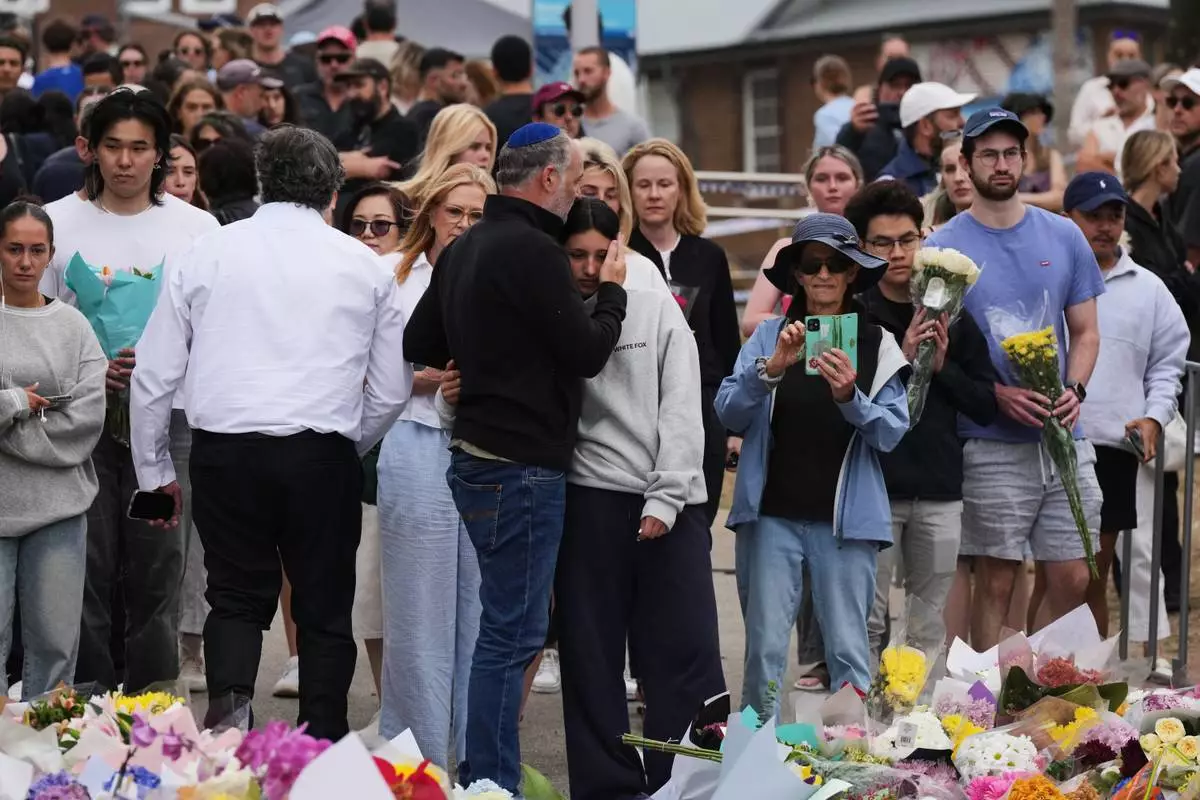
People offer flowers and hugs at a floral memorial during a tribute for victims of Sunday's shooting at the Bondi Pavilion at Bondi Beach on Tuesday, Dec. 16, 2025, in Sydney, Australia. (AP Photo/Mark Baker)
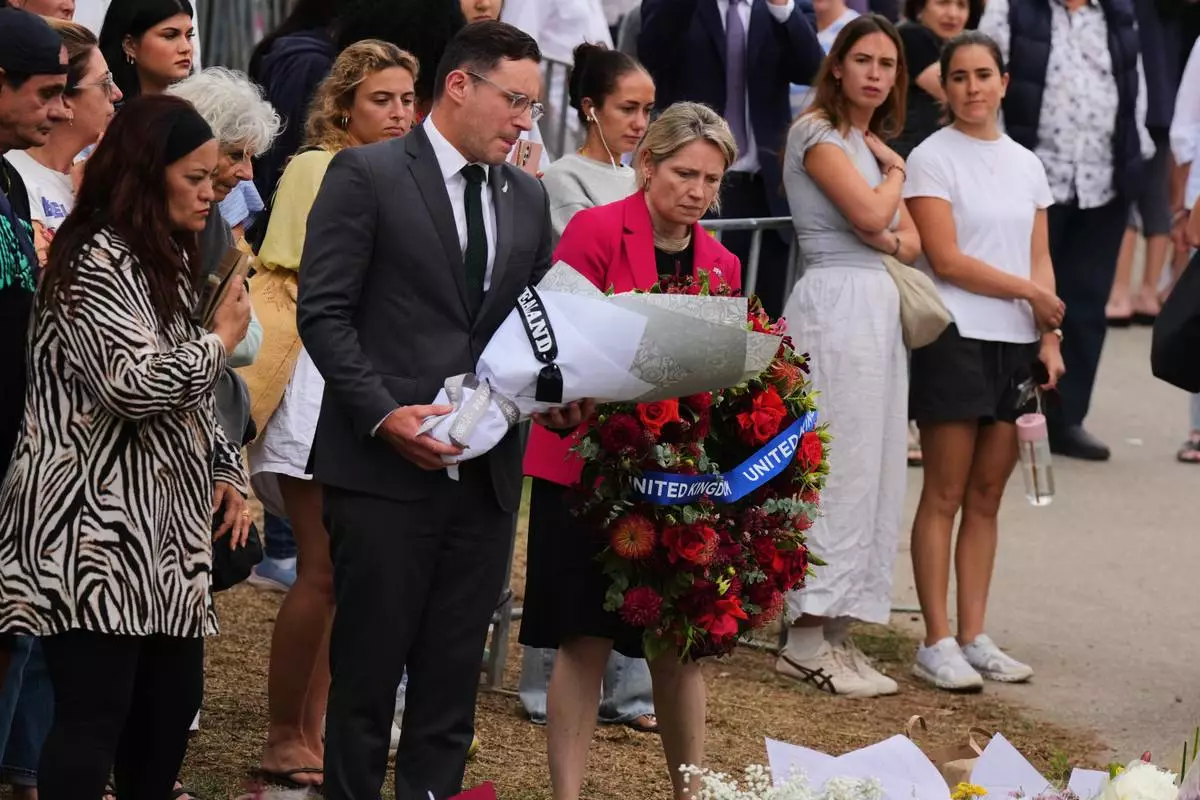
British Consul General Louise Cantillon, arrives at a memorial with flowers and a wreath during a tribute for victims of Sunday's shooting at the Bondi Pavilion at Bondi Beach on Tuesday, Dec. 16, 2025, in Sydney, Australia. (AP Photo/Mark Baker)
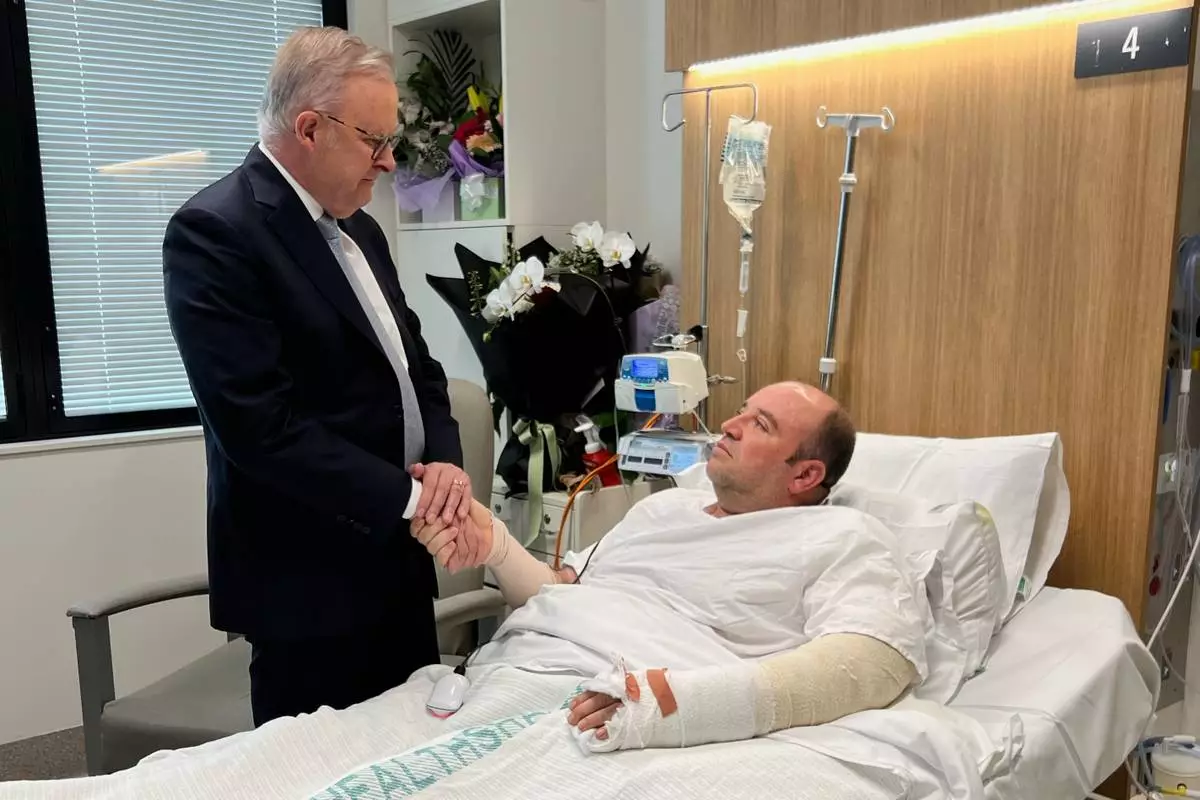
In this photo released by the Prime Minister office, Australian Prime Minister Anthony Albanese meets Ahmed al Ahmed at St George Hospital in Sydney, Tuesday, Dec. 16, 2025. (Australian Prime Minister Office via AP)
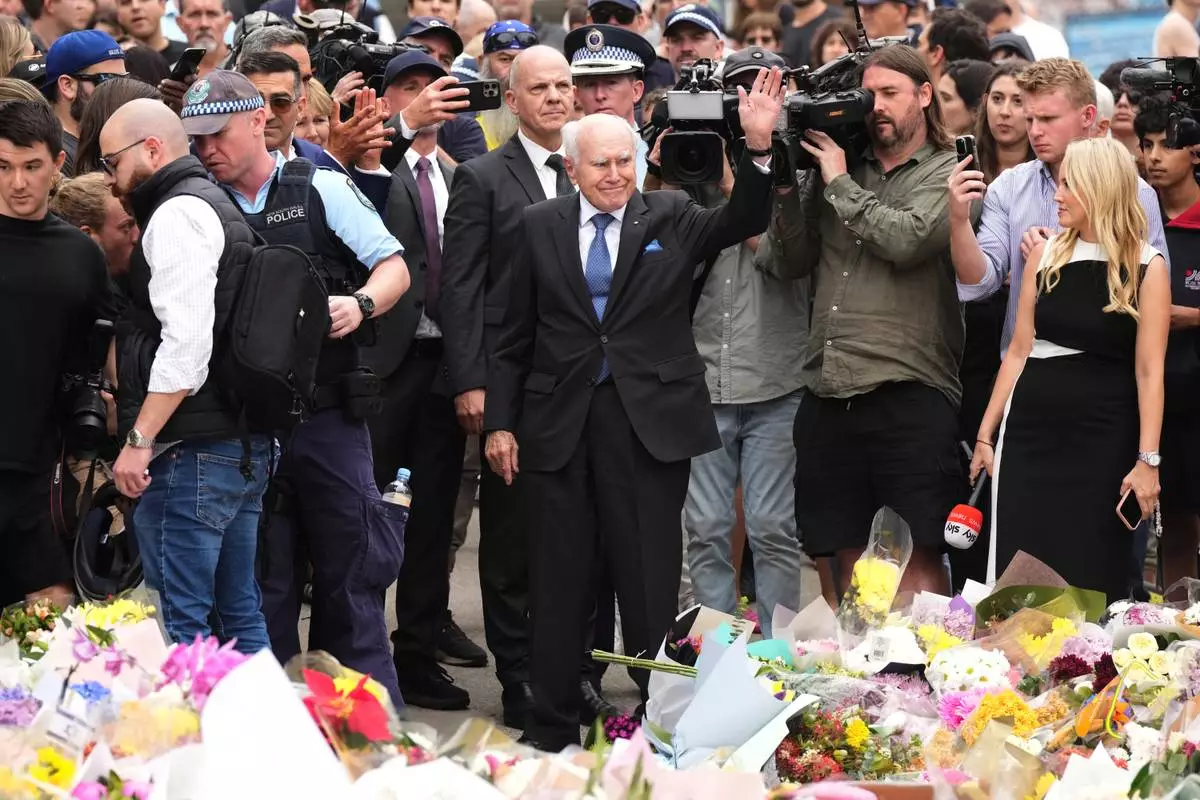
Former PM John Howard waves during a flower memorial for victims of Sunday's shooting at the Bondi Pavilion at Bondi Beach on Tuesday, Dec. 16, 2025, in Sydney, Australia. (AP Photo/Mark Baker)
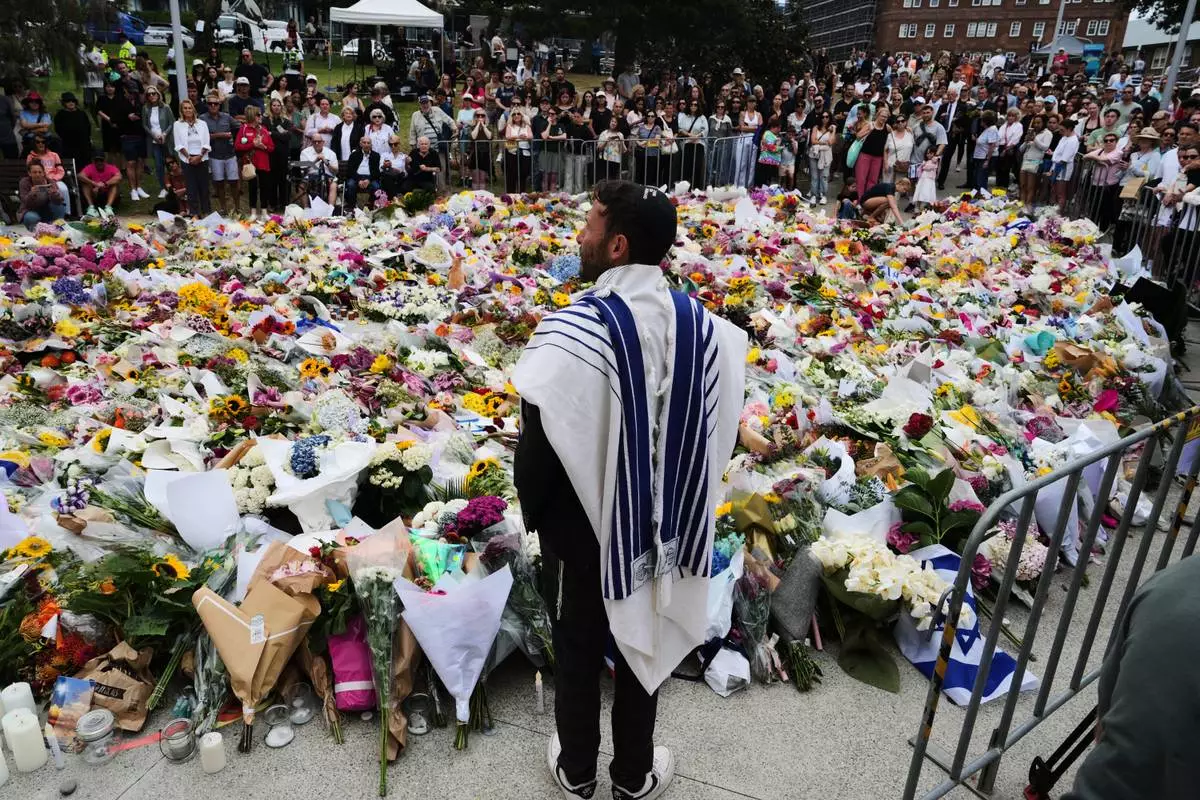
Rabbi Yossi Friedman speaks to people gathering at a flower memorial by the Bondi Pavilion at Bondi Beach on Tuesday, Dec. 16, 2025, following Sunday's shooting in Sydney, Australia. (AP Photo/Mark Baker)