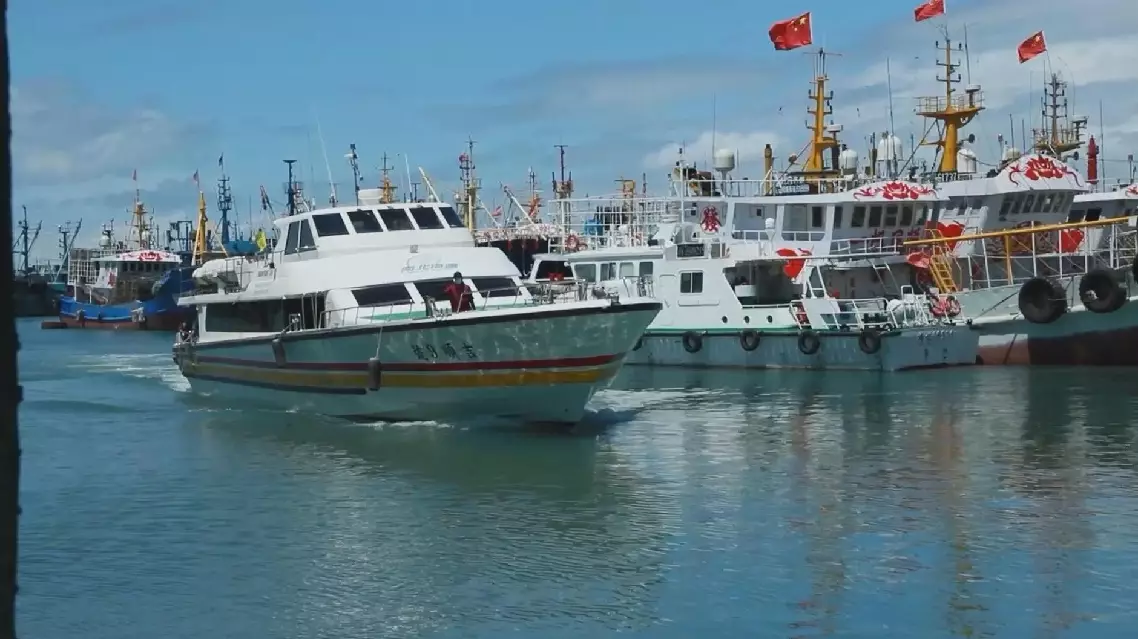
The "mini three links" passenger ferry routes between Fuzhou City of east China's Fujian Province and the island of Matsu in China's Taiwan region handled more than 44,000 trips in the first half of this year, marking a 52 percent year-on-year increase, the Fuzhou Entry and Exit Border Inspection Station said on Tuesday.
The "mini three links" refers to small-scale trade, shipping and postal services between Fujian Province, and the islands of Kinmen and Matsu in the Taiwan region.
At about 11:00 on Wednesday, a passenger ferry docked at Fuzhou's Huangqi ferry terminal, carrying 145 passengers from Matsu's Baisha Harbor.
The majority of the passengers were Taiwan compatriots, who visit the mainland for family reunions, tourism and shopping.
"Since summer vacation has just started, we brought the kids from Matsu to spend the holiday on the mainland. It's very convenient, just a 25-minute ferry ride away," said a Taiwan compatriot.
Currently, there are two "mini three links" passenger ferry routes operating between Fuzhou and Matsu: the Huangqi-Matsu route and the Mawei-Matsu route, with a total of eight daily round sailings connecting both sides of the Taiwan Strait.
According to the Fuzhou Entry and Exit Border Inspection Station, passenger traffic on the Fuzhou-Matsu routes has shown a month-by-month increasing trend in the first half of this year.
Notably, the Huangqi-Matsu route alone handled 28,751 passenger trips during the period, surging 99.1 percent compared to the same period last year.
"We have opened more inspection channels, and provided services both in Fuzhou dialect and southern Fujian dialect to ensure smooth passenger clearance. Given that most passengers at the port are family groups, elderly travelers and young children, we have established special lanes. These measures can help create the Fuzhou-Matsu living circle," said Lin Yanxia, police officer with the Fuzhou Entry and Exit Border Inspection Station.
Fuzhou-Matsu 'Mini three links' routes see surge in passenger traffic in H1