MEXICO CITY (AP) — El Salvador President Nayib Bukele cast aside allegations that Kilmar Abrego Garcia was beaten and subject to psychological torture in a Salvadoran prison on Thursday.
In a post on the social media platform X, Bukele wrote that Abrego Garcia “wasn’t tortured, nor did he lose weight.” In the post, Bukele included pictures and video of Abrego Garcia in a detention cell.
“If he’d been tortured, sleep-deprived, and starved, why does he look so well in every picture?” Bukele wrote.
It comes after Abrego Garcia said he suffered severe beatings, severe sleep deprivation and psychological torture in the notorious El Salvador prison the Trump administration had mistakenly deported him to in March, according to court documents filed on Wednesday.
He said he was kicked and hit so often after arrival that by the following day, he had visible bruises and lumps all over his body. He said he and 20 others were forced to kneel all night long and guards hit anyone who fell.
In the new court documents, Abrego Garcia said detainees at CECOT “were confined to metal bunks with no mattresses in an overcrowded cell with no windows, bright lights that remained on 24 hours a day, and minimal access to sanitation.”
Abrego Garcia’s description falls in line with accounts from other Salvadorans who were detained under Bukele's state of emergency, where the government has detained more than 1% of the Central American nation’s population in its war on the country's gangs.
Hundreds of people people have died in the prisons, according to human rights groups, which have also documented cases of torture and deteriorated conditions.
Abrego Garcia was living in Maryland when he was mistakenly deported and became a flashpoint in U.S. President Donald Trump’s immigration crackdown. The new details of Abrego Garcia’s incarceration in El Salvador were added to a lawsuit against the Trump administration that Abrego Garcia’s wife filed in Maryland federal court after he was deported.
The Trump administration has asked a federal judge in Maryland to dismiss the lawsuit, arguing that it is now moot because the government returned him to the United States as ordered by the court.
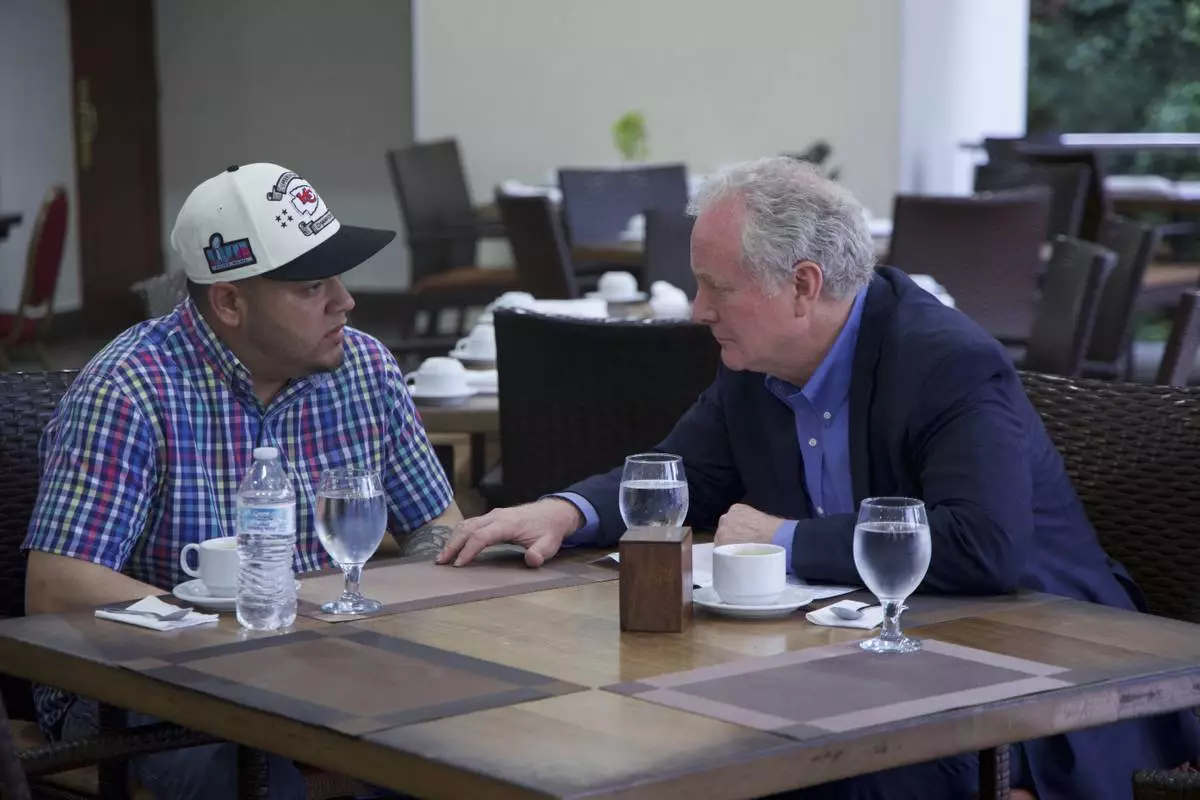
FILE - In this photo released by Senator Van Hollen's press office, Hollen, right, speaks with Kilmar Abrego Garcia, a Salvadoran citizen who was living in Maryland and deported to El Salvador by the Trump administration, in a hotel restaurant in San Salvador, El Salvador, April 17, 2025. (Press Office Senator Van Hollen, via AP, File)
MEXICO CITY (AP) — Nicaragua’s Interior Ministry said Saturday the country would release dozens of prisoners, as the United States ramped up pressure on leftist President Daniel Ortegaa week after it ousted former Venezuelan leader Nicolás Maduro.
On Friday, the U.S. Embassy in Nicaragua said Venezuela had taken an important step toward peace by releasing what it described as “political prisoners.” But it lamented that in Nicaragua, “more than 60 people remain unjustly detained or disappeared, including pastors, religious workers, the sick, and the elderly.”
On Saturday, the Interior Ministry said in a statement that “dozens of people who were in the National Penitentiary System are returning to their homes and families.”
It wasn’t immediately clear who was freed and under what conditions. Nicaragua’s government did not immediately respond to a request for comment.
The government has been carrying out an ongoing crackdown since mass social protests in 2018, that were violently repressed.
Nicaragua’s government has imprisoned adversaries, religious leaders, journalists and more, then exiled them, stripping hundreds of their Nicaraguan citizenship and possessions. Since 2018, it has shuttered more than 5,000 organizations, largely religious, and forced thousands to flee the country. Nicaragua’s government often accused critics and opponents of plotting against the government.
In recent years, the government has released hundreds of imprisoned political opponents, critics and activists. It stripped them of Nicaraguan citizenship and sent them to other countries like the U.S. and Guatemala. Observers have called it an effort to wash its hands of its opposition and offset international human rights criticism. Many of those Nicaraguans were forced into a situation of "statelessness."
Saturday on X, the U.S. State Department’s Bureau of Western Hemisphere Affairs again slammed Nicaragua’s government. “Nicaraguans voted for a president in 2006, not for an illegitimate lifelong dynasty,” it said. “Rewriting the Constitution and crushing dissent will not erase the Nicaraguans’ aspirations to live free from tyranny.”
Danny Ramírez-Ayérdiz, executive-secretary of the Nicaraguan human rights organization CADILH, said he had mixed feelings about the releases announced Saturday.
“On the one hand, I’m glad. All political prisoners suffer some form of torture. But on the other hand, I know these people will continue to be harassed, surveilled and monitored by the police, and so will their families.”
Ramírez-Ayérdiz said the liberation of the prisoners is a response to pressure exerted by the United States. “There is surely a great deal of fear within the regime that the U.S. might completely dismantle it,” he said.
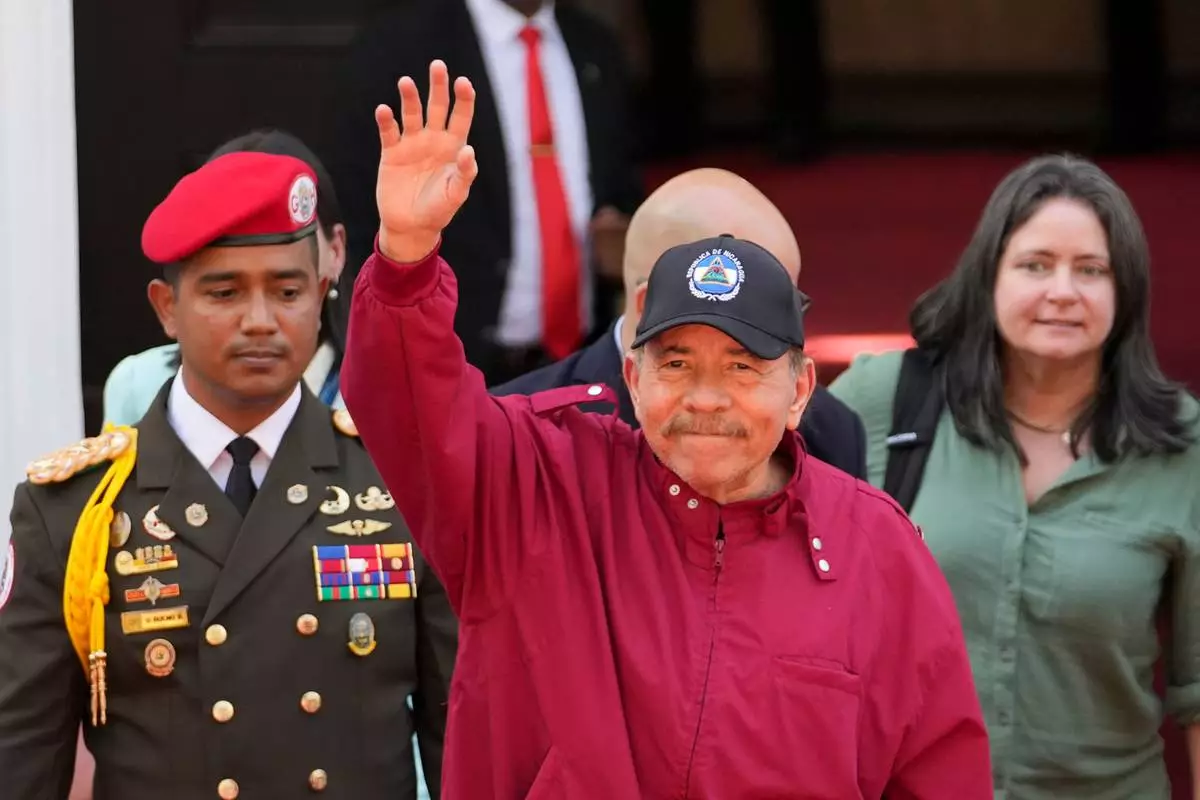
FILE - Nicaragua's President Daniel Ortega waves after attending the swearing-in ceremony of Venezuela's President Nicolas Maduro for a third term at the National Assembly in Caracas, Friday, Jan. 10, 2025. (AP Photo/Matias Delacroix, File)