Skip to Content Facebook Feature Image

UN experts say Rwanda supported rebels in Congo and smuggled minerals at ‘unprecedented levels’

News

UN experts say Rwanda supported rebels in Congo and smuggled minerals at ‘unprecedented levels’
News

News

UN experts say Rwanda supported rebels in Congo and smuggled minerals at ‘unprecedented levels’

2025-07-04 23:59 Last Updated At:07-05 00:21

DAKAR, Senegal (AP) — Rwanda provided “critical” support to the M23 rebels' recent offensive in eastern Congo, which helped secure Kigali's access to minerals and fertile ground, according to a confidential United Nations report seen by The Associated Press.

The Rwanda-backed M23 rebel group is the most prominent armed group in the conflict in Eastern Congo, which has been in and out of crises for decades. The rebels earlier this year advanced and seized the strategic city of Goma and Bukavu in a major escalation of the conflict.

Rwanda has denied any involvement. But U.N. experts say Kigali provided backing to the rebels with an aim to “control the territory of the DRC and its natural resources," using “advanced military equipment, including jamming systems, short-range air defense system and armed drones.”

Rwanda has been accused of exploiting eastern Congo’s minerals, used in smartphones, advanced fighter jets and much more, which Kigali denies. The report said that smuggling of coltan, considered a critical mineral, from M23-controlled territories in recent months reached “unprecedented levels."

“Evidence indicated increasing risk of cross-border fraud as minerals from North Kivu, particularly coltan from the AFC-controlled Rubaya mine, continued to be smuggled to Rwanda.” the report said. “These minerals were then mixed with production of Rwandan origin and exported downstream.”

AFC, or Congo River Alliance, is an umbrella groups which includes M23.

The M23-controlled Rubaya mines produce coltan — short for columbite-tantalite — an ore from which the metals tantalum and niobium are extracted. Both are considered critical raw materials by the United States, the European Union, China and Japan.

Tantalum is used in mobile phones, computers and automotive electronics, as well as in aircraft engines, missile components and GPS systems. Niobium is used in pipelines, rockets and jet engines.

Congo produced about 40% of the world’s coltan in 2023, according to the U.S. Geological Survey, with Australia, Canada and Brazil being other major suppliers.

Part of the minerals smuggled to Rwanda were purchased by Boss Mining Solution Limited, a Rwandan company. To justify the plausibility of domestic origins of tantalum, tin and tungsten, the Rwandan Development Board declared annual domestic production of 8,000 to 9,000 tons of these minerals, the report said. The figure was contradicted by the National Institute of Statistics, independent geological studies and ITSCI.

Late last month, Rwanda and Congo signed a peace deal facilitated by the U.S. while helping the U.S. government and American companies gain access to critical minerals in the region. But experts said they don’t believe it will quickly end the fighting because the most prominent armed group says it does not apply to it.

Rwanda denied the allegations from the U.N. report.

Alluding to the U.N. report, Rwanda's president Paul Kagame told reporters on Friday:“The expertise they provide, the reports they write actually do not have anything to do with the situation itself. These reports were written long ago — long ago when they were given the mission.”

A spokesperson for Rwanda’s government, Yolande Makolo, wrote on X that “⁠Following the signing of the US-brokered Peace Agreement last Friday, Rwanda is fully committed to its implementation.”

The report, which was first reported by Reuters, was submitted to the U.N. Security Council sanctions committee for Congo earlier this week, and will be published shortly, said a U.N. official who was not authorized to speak on the matter publicly.

Despite Congo's exceptional mineral wealth, over 70% of Congolese live on less than $2.15 a day. The conflict in the country's east has created one of the world’s largest humanitarian crises with more than 7 million people displaced, including 100,000 who fled homes this year.

The U.N. report also accused all sides in the conflict of human rights violations, including reprisal killings on suspicion of collaboration of the opposing sides.

Rwanda and M23 are responsible for “systematic campaign of repression in occupied areas, including extrajudicial killings, arbitrary arrest, torture, enforced disappearance and raids in hospitals," it said. Retreating Congolese soldiers and members of the pro-government militia “committed looting, sexual violence and killings.”

Associated Press writers Wilson McMakin in Dakar, Senegal and Rodney Muhumuza in Kampala, Uganda, contributed to this report.
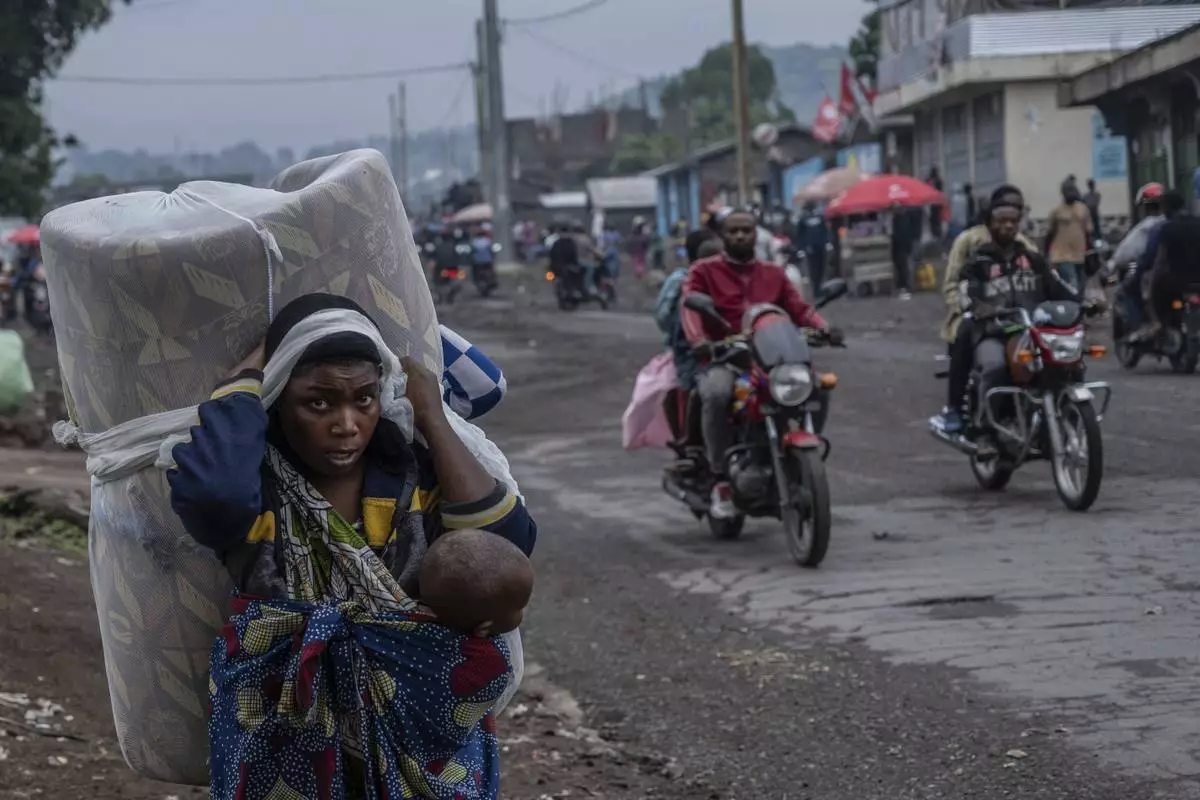
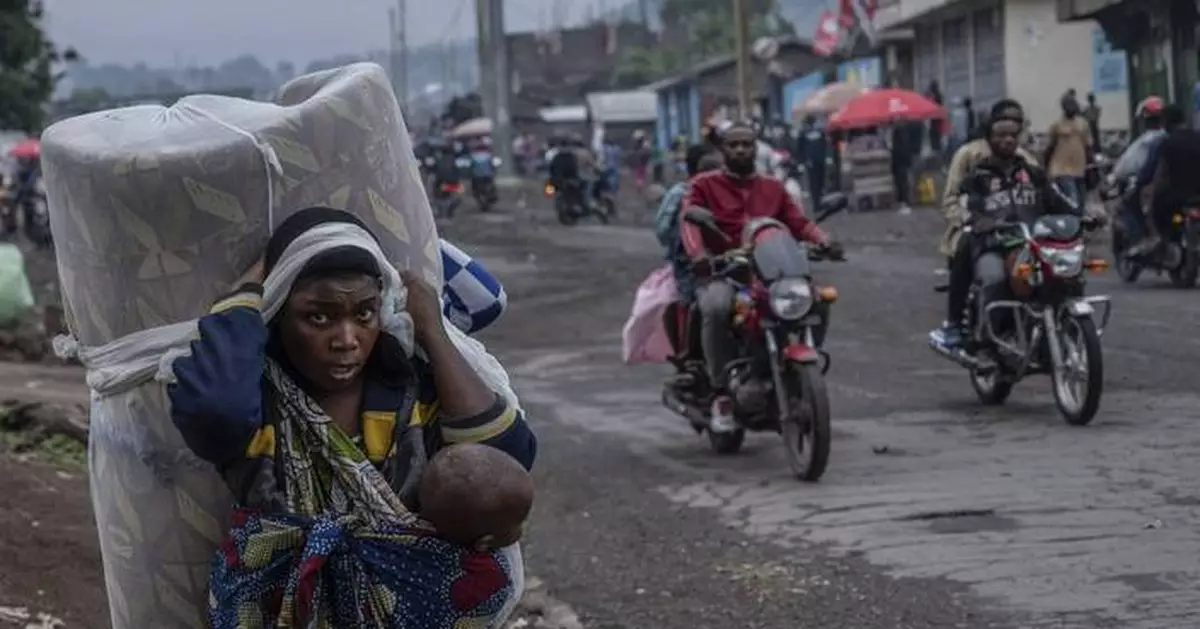
FILE - People displaced by the fighting with M23 rebels make their way to the center of Goma, Democratic Republic of the Congo, Sunday, Jan. 26, 2025. (AP Photo/Moses Sawasawa, File)
FILE - People displaced by the fighting with M23 rebels make their way to the center of Goma, Democratic Republic of the Congo, Sunday, Jan. 26, 2025. (AP Photo/Moses Sawasawa, File)
ADEN, Yemen (AP) — Saudi warplanes have reportedly struck on Friday forces in southern Yemen backed by the United Arab Emirates, a separatist leader says.

This comes as a Saudi-led operation attempts to take over camps of the Southern Transitional Council, or STC, in the governorate of Haramout that borders Saudi Arabia.

Tensions between Saudi Arabia and the UAE rose after the STC moved last month into Yemen’s governorates of Hadramout and Mahra and seized an oil-rich region. The move pushed out forces affiliated with the Saudi-backed National Shield Forces, a group aligned with the coalition in fighting the Iran-backed Houthis in Yemen.

Meanwhile, the Saudi ambassador to Yemen accused the head of the STC of blocking a Saudi mediation delegation from landing in the southern city of Aden.

The STC deputy and former Hamdrmout governor, Ahmed bin Breik, said in a statement that the Saudi-backed National Shield Forces advanced toward the camps, but the separatists refused to withdraw, apparently leading to the airstrikes.

Mohamed al-Nakib, spokesperson for the STC-backed Southern Shield Forces, also known as Dera Al-Janoub, said Saudi airstrikes caused fatalities, without providing details. The Associated Press couldn’t independently verify that claim.

Al-Nakib also accused Saudi Arabia in a video on X of using “Muslim Brotherhood and al-Qaeda militias” in a "large-scale attack " early Friday that he claimed sepratists were able to repel.

He likened the latest developments to Yemen’s 1994 civil war, “except that this time it is under the cover of Saudi aviation operations.”

Salem al-Khanbashi, the governor of Hadramout who was chosen Friday by Yemen's internationally recognized government to command the Saudi-led forces in the governorate, refuted STC claims, calling them “ridiculous” and showing intentions of escalation instead of a peaceful handover, according Okaz newspaper, which is aligned with the Saudi government.

Earlier on Friday, al-khanbashi called the current operation of retrieving seized areas “peaceful.”

“This operation is not a declaration of war and does not seek escalation,” al-Khanbashi said in a speech aired on state media. “This is a responsible pre-emptive measure to remove weapons and prevent chaos and the camps from being used to undermine the security in Hadramout,” he added.

The Saudi-led coalition in Yemen demands the withdrawal of STC forces from the two governorates as part of de-escalation efforts. The STC has so far refused to hand over its weapons and camps.

The coalition's spokesperson Brig. Gen. Turki al-Maliki said Friday on X that Saudi-backed naval forces were deployed across the Arabian Sea to carry out inspections and combat smuggling.

In his post on X, the Saudi ambassador to Yemen, Mohammed al-Jaber, said the kingdom had tried “all efforts with STC” for weeks "to stop the escalation" and to urge the separatists to leave Hadramout and Mahra, only to be faced with “continued intransigence and rejection from Aidarous al-Zubaidi," the STC head.

Al-Jaber said the latest development was not permitting the Saudi delegation's jet to land in Aden, despite having agreed on its arrival with some STC leaders to find a solution that serves “everyone and the public interest.”

Yemen’s transport ministry, aligned with STC, said Saudi Arabia imposed on Thursday requirements mandating that flights to and from Aden International Airport undergo inspection in Jeddah. The ministry expressed “shock” and denounced the decision. There was no confirmation from Saudi authorities.

ِA spokesperson with the transport ministry told the AP late Thursday that all flights from and to the UAE were suspended until Saudi Arabia reverses these reported measures.

Yemen has been engulfed in a civil war for more than a decade, with the Houthis controlling much of the northern regions, while a Saudi-UAE-backed coalition supports the internationally recognized government in the south. However, the UAE also helps the southern separatists who call for South Yemen to secede once again from Yemen. Those aligned with the council have increasingly flown the flag of South Yemen, which was a separate country from 1967-1990.

Associated Press writers Bassem Mroue in Beirut and Fatma Khaled in Cairo contributed to this report.

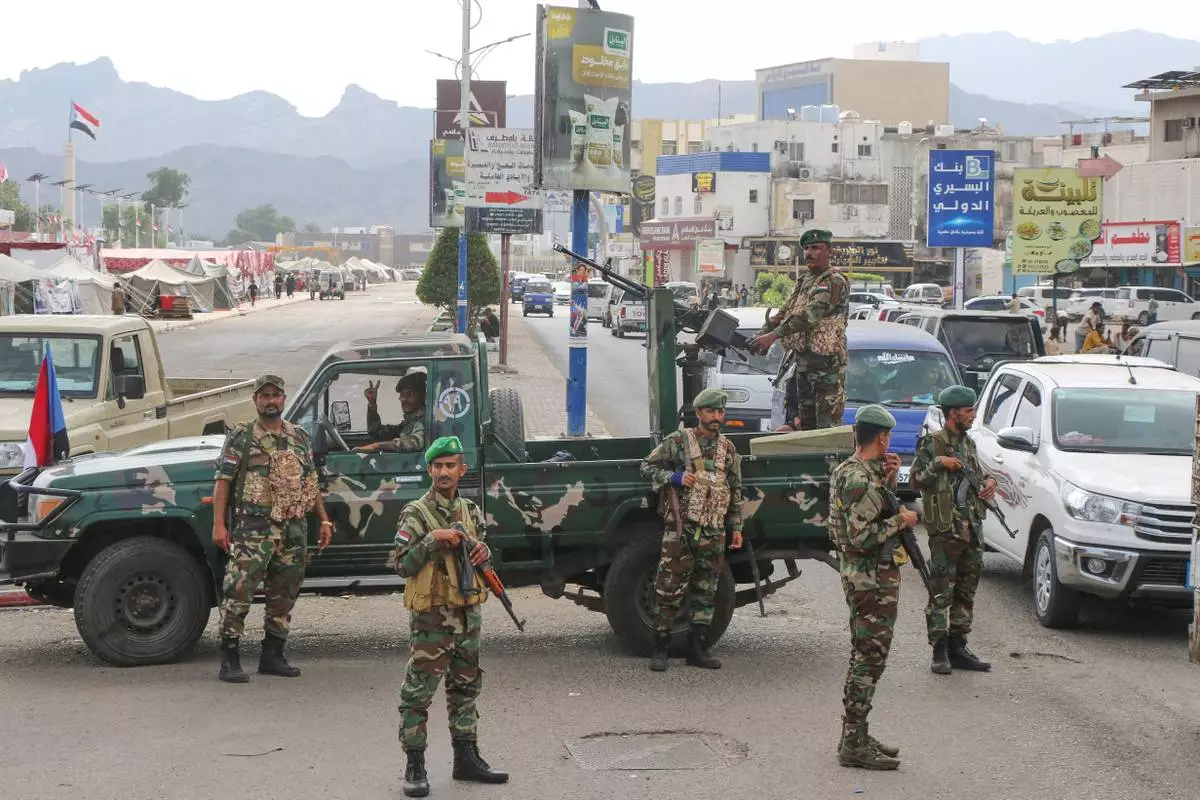
Southern Yemen soldiers of Southern Transitional Council (STC) at a check point, in Aden, Yemen, Wednesday, Dec. 31, 2025. (AP Photo)

Southern Yemen soldiers of Southern Transitional Council (STC) at a check point, in Aden, Yemen, Wednesday, Dec. 31, 2025. (AP Photo)

Recommended Articles