MELBOURNE, Australia (AP) — Australian woman Erin Patterson was found guilty Monday of murdering three of her estranged husband’s relatives by deliberately serving them poisonous mushrooms for lunch.
The jury in the Supreme Court trial in Victoria state returned a verdict after six days of deliberations, following a nine-week trial that gripped Australia. Patterson faces life in prison and will be sentenced later, but a date for the hearing hasn't yet been scheduled.
Patterson, who sat in the dock between two prison officers, showed no emotion but blinked rapidly as the verdicts were read.
Three of Patterson’s four lunch guests — her parents-in-law Don and Gail Patterson, and Gail’s sister Heather Wilkinson — died in the hospital after the 2023 meal at her home in Leongatha, at which she served individual beef Wellington pastries containing death cap mushrooms.
She was also found guilty of attempting to murder Ian Wilkinson, Heather’s husband, who survived the meal.
It wasn’t disputed that Patterson served the mushrooms or that the pastries killed her guests. The jury was required to decide whether she knew the lunch contained death caps, and if she intended for them to die.
The guilty verdicts, which were required to be unanimous, indicated that jurors rejected Patterson’s defense that the presence of the poisonous fungi in the meal was a terrible accident, caused by the mistaken inclusion of foraged mushrooms that she didn’t know were death caps. Prosecutors didn’t offer a motive for the killings, but during the trial highlighted strained relations between Patterson and her estranged husband and frustration that she had felt about his parents in the past.
The case turned on the question of whether Patterson meticulously planned a triple murder or accidentally killed three people she loved, including her children’s only surviving grandparents. Her lawyers said she had no reason to do so — she had recently moved to a beautiful new home, was financially comfortable, had sole custody of her children and was due to begin studying for a degree in nursing and midwifery.
But prosecutors suggested Patterson had two faces — the woman who publicly appeared to have a good relationship with her parents-in-law, while her private feelings about them were kept hidden. Her relationship with her estranged husband, Simon Patterson, who was invited to the fatal lunch but didn’t go, deteriorated in the year before the deaths, the prosecution said.
The simplest facts of what happened that day and immediately afterward were hardly disputed. But Patterson’s motivations for what she did and why were pored over in detail during the lengthy trial, at which more than 50 witnesses were called.
The individual beef Wellington pastries Patterson served her guests were one point of friction because the recipe she used contained directions for a single, family-sized portion. Prosecutors said that she reverted to individual servings, so she could lace the other diners’ portions, but not her own, with the fatal fungi — but Patterson said that she was unable to find the correct ingredients to make the recipe as directed.
Nearly every other detail of the fateful day was scrutinized at length, including why Patterson sent her children out to a film before her guests arrived, why she added additional dried mushrooms to the recipe from her pantry, why she didn’t become ill when the other diners did, and why she disposed of a food dehydrator after the deaths and told investigators that she didn’t own one.
Patterson acknowledged some lies during her evidence — including that she’d never foraged mushrooms or owned a dehydrator. But she said that those claims were made in panic as she realized her meal had killed people.
She said she didn’t become as ill as the other diners since she vomited after the meal because of an eating disorder. She denied that she told her guests she had cancer as a ruse to explain why she invited them to her home that day.
The bizarre and tragic case has lingered in the minds of Australians and has provoked fervor among the public and media. During the trial, five separate podcasts analyzed each day of the proceedings and several news outlets ran live blogs giving moment-by-moment accounts of more than two months of evidence.
At least one television drama and a documentary about the case are slated for production. Prominent Australian crime writers were seen in court throughout the trial.
As it emerged half an hour before the verdict that the court was reconvening, about 40 members of the public queued outside the courthouse in the rural town of Morwell in the hope of watching the outcome in person. News outlets reported that family members of the victims were not among those present.
Before the verdict, newspapers published photos of black privacy screens erected at the entrance to Erin Patterson’s home. Dozens of reporters from throughout Australia and from news outlets abroad crowded around friends of Patterson's as they left the courthouse Monday.
“I'm saddened, but it is what it is,” said one friend, Ali Rose Prior, who wore sunglasses and fought back tears. Asked what she thought Patterson felt as the verdicts were read, Prior said, “I don't know.”
Prior, who attended every day of the trial, confirmed Patterson had told her: “See you soon.” Prior said she would visit her friend in prison.
Graham-McLay reported from Wellington, New Zealand.
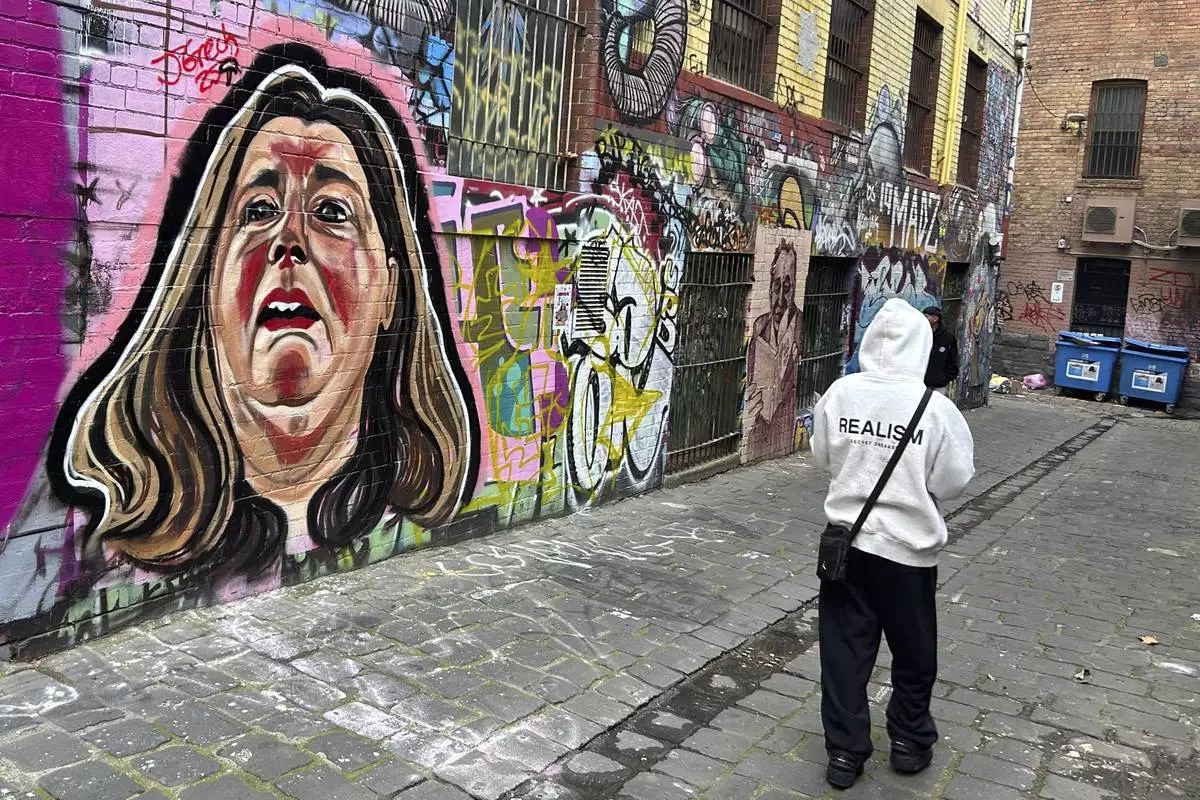
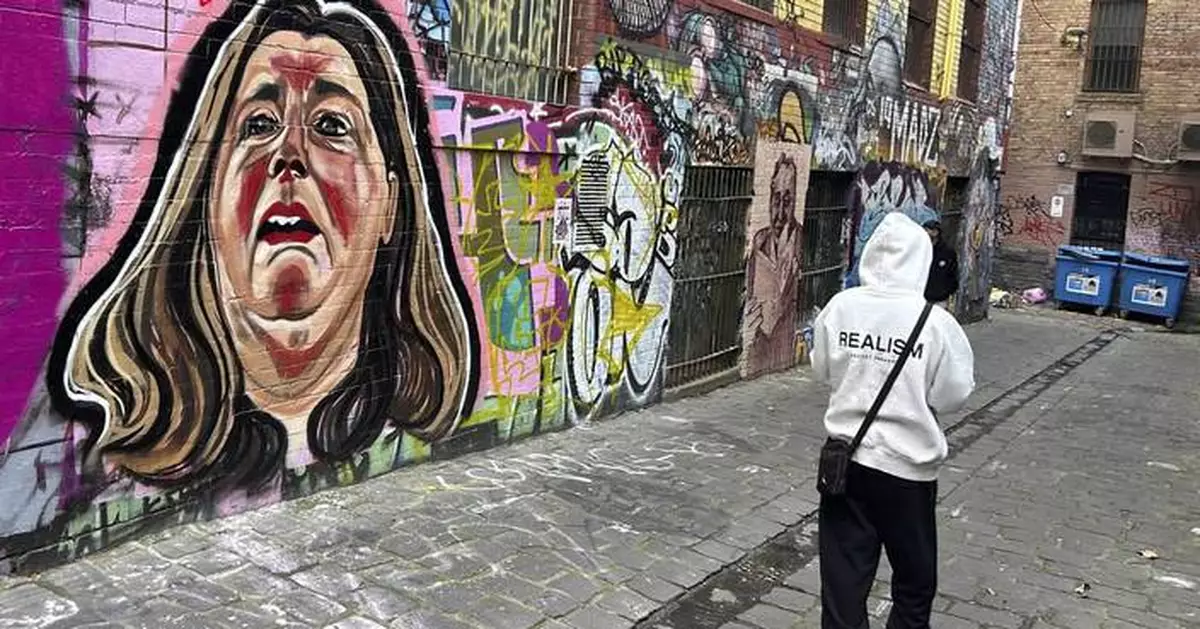
A likeness of Erin Patterson is painted on a wall in Melbourne, Australia, on June 28, 2025. (AP Photo/Rod McGuirk)
RHO, Italy (AP) — No ice is colder and harder than speedskating ice. The precision it takes has meant that Olympic speedskaters have never competed for gold on a temporary indoor rink – until the 2026 Milan Cortina Winter Games.
In the pursuit of maximum glide and minimum friction, Olympic officials brought on ice master Mark Messer, a veteran of six previous Olympic speedskating tracks and the ice technician in charge of the Olympic Oval in Calgary, Canada — one of the fastest tracks in the world with over 300 records.
Messer has been putting that experience to work one thin layer of ice at a time since the end of October at the new Speed Skating Stadium, built inside adjacent trade fair halls in the city of Rho just north of Milan.
“It’s one of the biggest challenges I’ve had in icemaking,’’ Messer said during an interview less than two weeks into the process.
If Goldilocks were a speedskater, hockey ice would be medium hard, for fast puck movement and sharp turns. Figure skating ice would be softer, allowing push off for jumps and so the ice doesn’t shatter on landing. Curling ice is the softest and warmest of all, for controlled sliding.
For speedskating ice to be just right, it must be hard, cold and clean. And very, very smooth.
“The blades are so sharp, that if there is some dirt, the blade will lose the edge,’’ Messer said, and the skater will lose speed.
Speedskater Enrico Fabris, who won two Olympic golds in Turin in 2006, has traded in his skates to be deputy sports manager at the speedskating venue in Rho. For him, perfect ice means the conditions are the same for all skaters — and then if it's fast ice, so much the better.
"It's more of a pleasure to skate on this ice,'' he said.
Messer’s first Olympics were in Calgary in 1988 — the first time speedskating was held indoors. “That gave us some advantages because we didn’t have to worry about the weather, wind blowing or rain,’’ he said. Now he is upping the challenge by becoming the first ice master to build a temporary rink for the Olympics.
Before Messer arrived in Italy, workers spent weeks setting up insulation to level the floor and then a network of pipes and rubber tubes that carry glycol — an antifreeze — that is brought down to minus 7 or minus 8 degrees Celsius (17.6 to 19.4 degrees Fahrenheit) to make the ice.
Water is run through a purification system — but it can’t be too pure, or the ice that forms will be too brittle. Just the right amount of impurities “holds the ice together,’’ Messer said.
The first layers of water are applied slowly, with a spray nozzle; after the ice reaches a few centimeters it is painted white — a full day’s work — and the stripes are added to make lanes.
“The first one takes about 45 minutes. And then as soon as it freezes, we go back and do it again, and again and again. So we do it hundreds of times,’’ Messer said.
As the ice gets thicker, and is more stable, workers apply subsequent layers of water with hoses. Messer attaches his hose to hockey sticks for easier spreading.
What must absolutely be avoided is dirt, dust or frost — all of which can cause friction for the skaters, slowing them down. The goal is that when the skaters push “they can go as far as possible with the least amount of effort,’’ Messer said.
The Zamboni ice resurfacing machine plays a key role in keeping the track clean, cutting off a layer and spraying water to make a new surface.
One challenge is gauging how quickly the water from the resurfacing machine freezes in the temporary rink.
Another is getting the ice to the right thickness so that the Zamboni, weighing in at six tons, doesn’t shift the insulation, rubber tubing or ice itself.
“When you drive that out, if there’s anything moving it will move. We don’t want that,’’ Messer said.
The rink got its first big test on Nov. 29-30 during a Junior World Cup event. In a permanent rink, test events are usually held a year before the Olympics, leaving more time for adjustments. “We have a very small window to learn,’’ Messer acknowledged.
Dutch speedskater Kayo Vos, who won the men’s neo-senior 1,000 meters, said the ice was a little soft — but Messer didn’t seem too concerned.
“We went very modest to start, now we can start to change the temperatures and try to make it faster and still maintain it as a safe ice,’’ he said.
Fine-tuning the air temperature and humidity and ice temperature must be done methodically — taking into account that there will be 6,000 spectators in the venue for each event. The next real test will be on Jan. 31, when the Olympians take to the ice for their first training session.
“Eighty percent of the work is done but the hardest part is the last 20 percent, where we have to try to find the values and the way of running the equipment so all the skaters get the same conditions and all the skaters get the best conditions,’’ Messer said.
AP Winter Olympics: https://apnews.com/hub/milan-cortina-2026-winter-olympics

Serpentines are set on the ice of the stadium where speed skating discipline of the Milan Cortina 2026 Winter Olympics will take place, in Rho, outskirt of Milan, Tuesday, Nov. 11, 2025. (AP Photo/Luca Bruno)

Ice Master Mark Messer poses in the stadium where speed skating discipline of the Milan Cortina 2026 Winter Olympics will take place, in Rho, outskirt of Milan, Tuesday, Nov. 11, 2025. (AP Photo/Luca Bruno)
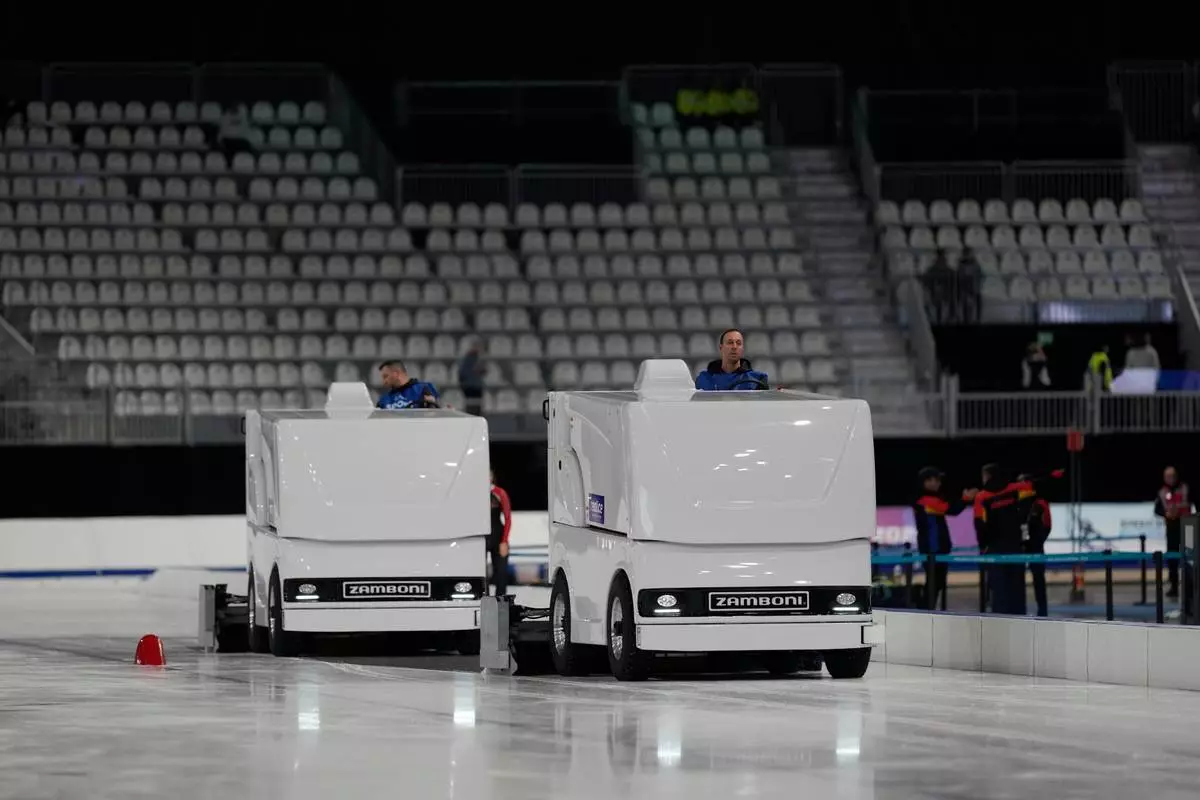
Workers clean the ice surface during a peed skating Junior World Cup and Olympic test event, in Rho, near Milan, Italy, Saturday, Nov. 29, 2025. (AP Photo/Luca Bruno)

Ice Master Mark Messer poses in the stadium where speed skating discipline of the Milan Cortina 2026 Winter Olympics will take place, in Rho, outskirt of Milan, Tuesday, Nov. 11, 2025. (AP Photo/Luca Bruno)

Ice Master Mark Messer poses in the stadium where speed skating discipline of the Milan Cortina 2026 Winter Olympics will take place, in Rho, outskirt of Milan, Tuesday, Nov. 11, 2025. (AP Photo/Luca Bruno)