BRUSSELS (AP) — European Commission President Ursula von der Leyen accused her political adversaries of peddling conspiracies about her and the COVID-19 pandemic as she defended herself on Monday ahead of a rare no-confidence vote.
Von der Leyen said a group of hard-right lawmakers that has tabled censure motion against the European Union’s executive branch is trying to drive a wedge between pro-European political groups in the European Parliament.
“We can never let extremists rewrite history,” she said during a plenary session in Strasbourg, France.
The censure motion contained a mix of allegations against von der Leyen including text messaging privately with the boss of vaccine maker Pfizer, misuse of EU funds and interference in elections in Germany and Romania. Von der Leyen led the effort to find vaccines for around 450 million European citizens during the pandemic.
EU lawmakers will vote on the motion on Thursday, with a two-thirds majority required to pass. The commission proposes EU laws and supervises whether those that enter force are respected.
Von der Leyen is almost certain to win the vote comfortably. She could be forced to resign if she loses.
Romanian lawmaker Gheorghe Piperea, who championed the motion and hails from the right-wing populist Alliance for the Union of Romanians, accused von der Leyen of distorting facts and trying to bypass the European Parliament.
“The decision-making process has become opaque and discretionary and raises fears of abuse and corruption,” he said.
Von der Leyen said Piperea’s speech “was taken from the oldest playbook of extremists.”
She said it was aimed at “polarizing society, eroding trust in democracy, with false claims about election meddling, attempting to rewrite the history (of) how a successful Europe overcame the pandemic together."
The censure motion is another sign of discontent with the former German defense minister and her backers.
Von der Leyen hails from the European People's Party (EPP), a political family uniting conservative parties across the 27-nation bloc and the biggest group in the assembly.
Other pro-European centrist groups took aim at the EPP for working with hard-right parties to seal deals.
The second biggest political group, the Socialists and Democrats (S&D), said the censure motion is a result “of the EPP’s irresponsibility and the double games.”
Looking to the EPP, S&D leader Iratxe García Pérez said: “Who do you want to govern with? Do you want to govern with those that want to destroy Europe, or those of us who fight every day to build it?” She said, however, that her group would not vote against von der Leyen.
The EPP has notably worked with the hard right to fix the agenda for hearing von der Leyen's new commissioners when they were questioned for their suitability for their posts last year, and to reject an ethics body that was meant to be set up after a corruption scandal in 2022 linked to Qatar.
Referring to the hard right, Dutch senior Greens lawmaker Bas Eickhout said to the EPP: “You are feeding that beast, and at a certain moment the beast will eat you.”
The threat of a parliamentary censure motion in 1999 forced the European Commission — led at the time by Jacques Santer from Luxembourg — to resign over fraud, mismanagement and nepotism allegations.

EU Commission President Ursula von der Leyen walks in the Town Hall Garden at Aarhus Town Hall, Aarhus, Denmark, Thursday, July 3, 2025. (Ida Marie Odgaard/Ritzau Scanpix via AP)
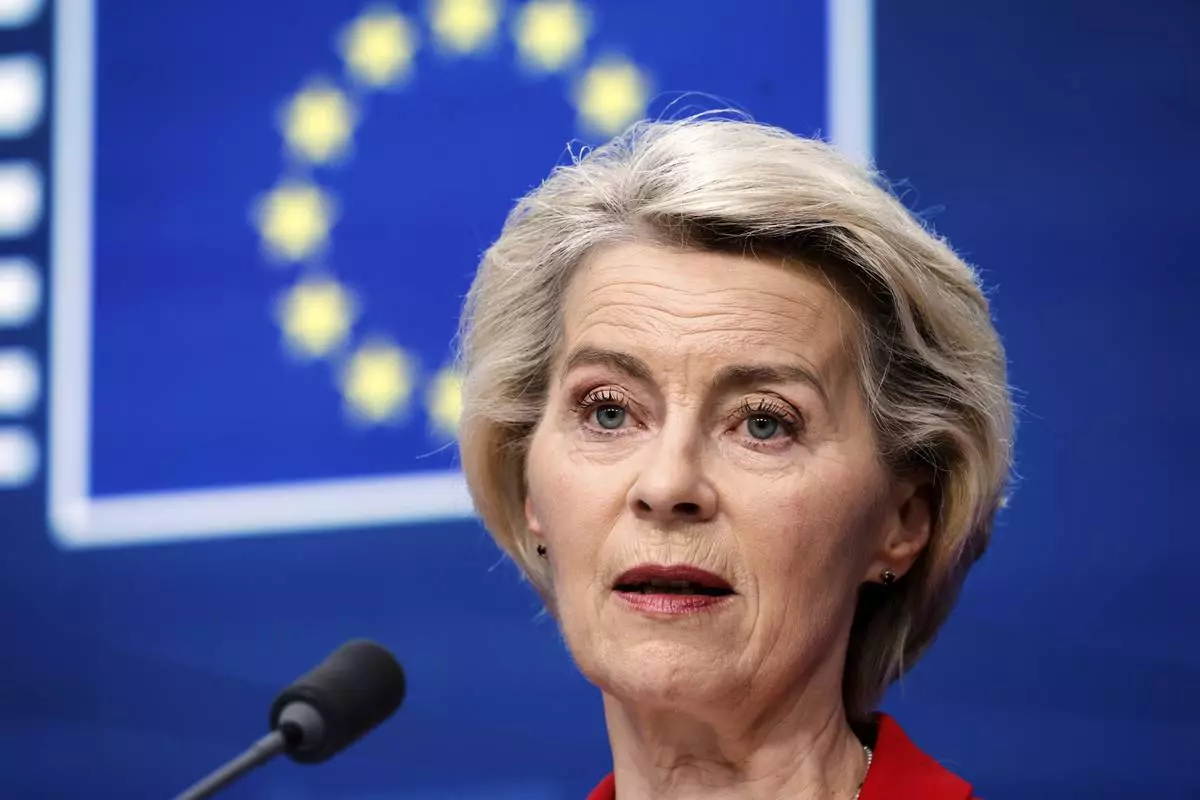
European Commission President Ursula von der Leyen addresses a media conference at an EU summit in Brussels, Thursday, June 26, 2025. (AP Photo/Omar Havana)