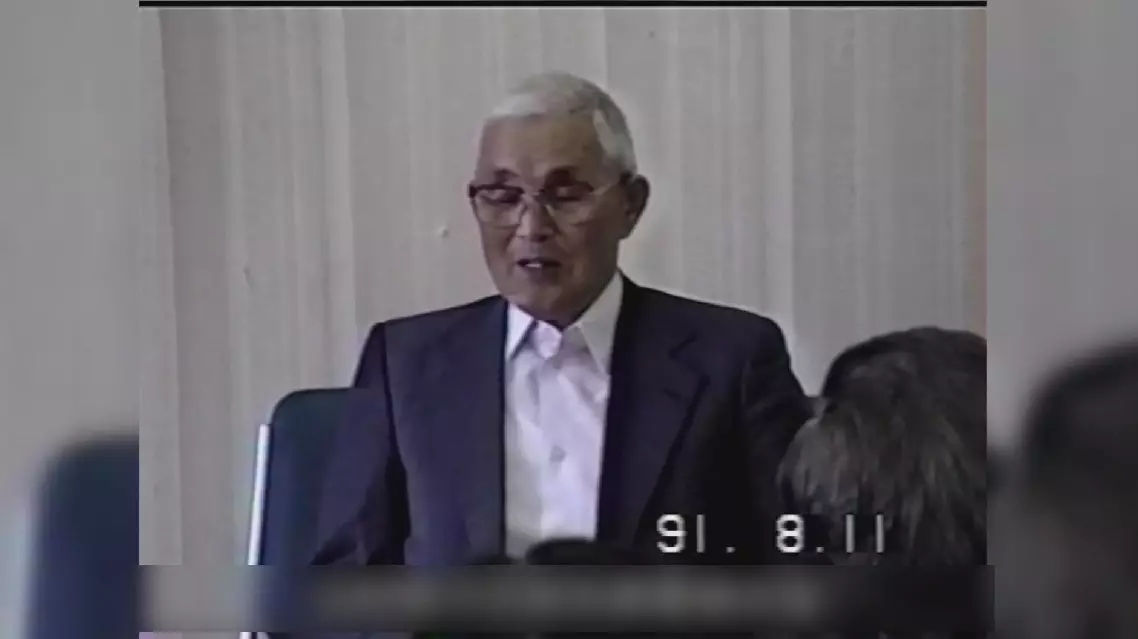
The Exhibition Hall of Evidence of Crime Committed by Unit 731 of Japanese Imperial Army on Monday released for the first time the testimony of Masakuni Kurumizawa, a former member of the notorious Unit 731, revealing how the Japanese invaders hide their atrocities with strict secrecy protocols.
The 83-minute testimony, recorded in August 1991 during a peace exhibition in Iida City, Japan, was released on the occasion of the 88th anniversary of July 7 Incident, which marked the start of Japan's full-scale invasion of China and China's whole-nation resistance against the Japanese invaders.
Unit 731 is a secret Japanese germ warfare unit during the World War II, infamous for its atrocious human dissections, live experiments, and biological warfare targeting civilians and prisoners. According to Kurumizawa's recollection, while in China, the Japanese invaders enforced strict secrecy rules, requiring all Unit 731 members to keep silent.
"I never told anyone. It was an absolute secret. Even my wife knew nothing. Before going home each time, I had to change clothes. She had no idea I was involved in dissections," Kurumizawa said in the footage.
"Unit 731 was a confidential unit. It had a confidentiality mechanism that forbade members from telling even their families about the crimes they committed there. That is one of the main reasons why Unit 731's crimes were not exposed to the world quickly after World War II," said Jin Shicheng, deputy secretary general of the Harbin Research Institute on History of Bacterial and Gas War of Japanese Invasion in China.
In addition, before its defeat and retreat in 1945, the Japanese invaders blew up major buildings of the Unit 731 headquarters to destroy evidence. During the withdrawal, the unit's commander, Shiro Ishii, issued a secrecy order of "three nots" within the unit, allowing its crimes to remain concealed for decades.
"No. I absolutely could not become a civil servant. I was forbidden to take public office or leak secrets. That was the unit's regulation," Kurumizawa said in the footage, in response to questions about his career after returning to Japan.
"First, after returning to Japan, they were not allowed to contact each other. Second, they were not allowed to work in the medical field. Third, they were not allowed to work as civil servants. But after the 1947 deal between the U.S. and Japan, in which the U.S. granted them immunity in exchange for Unit 731's data, many of these members ended up working in government agencies, hospitals, and universities in Japan. They were actually holding important positions in Japanese postwar society. That is why Japan's medical community has never completely reflected and repented after the war," said Jin.
In the "Roster of Epidemic Prevention and Water Purification Department of Kwantung Army" on display at the Exhibition Hall, 3,497 personnel are registered, the vast majority of whom have passed away.
"Over all these years, only a few former Unit 731 members have voluntarily stood out. Most have remained hidden and stayed silent. Exposing Unit 731's crimes should be a joint mission of all peace-lovers worldwide. Our purpose is to uncover the evidence of Unit 731's atrocities, learn the lessons of history, and look ahead to the future," said Jin.
former member reveals how Unit 731 secrecy protocols bury atrocities