The health of U.S. children has deteriorated over the past 17 years, with kids today more likely to have obesity, chronic diseases and mental health problems like depression, a new study says.
Much of what researchers found was already known, but the study paints a comprehensive picture by examining various aspects of children’s physical and mental health at the same time.
“The surprising part of the study wasn’t any with any single statistic; it was that there’s 170 indicators, eight data sources, all showing the same thing: a generalized decline in kids’ health,” said Dr. Christopher Forrest, one of the authors of the study published Monday in the Journal of the American Medical Association.
Health Secretary Robert F. Kennedy Jr. has brought children's health to the forefront of the national policy conversation, unveiling in May a much-anticipated “Make America Healthy Again” report that described kids as undernourished and overmedicated, and raised concerns about their lack of physical activity. But the Trump administration's actions — including cuts to federal health agencies, Medicaid and scientific research — are not likely to reverse the trend, according to outside experts who reviewed Monday’s study.
“The health of kids in America is not as good as it should be, not as good as the other countries, and the current policies of this administration are definitely going to make it worse,” said Dr. Frederick Rivara, a pediatrician and researcher at the Seattle Children's Hospital and UW Medicine in Seattle. He co-authored an editorial accompanying the new study.
Forrest and his colleagues analyzed surveys, electronic health records from 10 pediatric health systems and international mortality statistics. Among their findings:
— Obesity rates for U.S. children 2-19 years old rose from 17% in 2007-2008 to about 21% in 2021-2023.
— A U.S. child in 2023 was 15% to 20% more likely than a U.S. child in 2011 to have a chronic condition such as anxiety, depression or sleep apnea, according to data reported by parents and doctors.
— Annual prevalence rates for 97 chronic conditions recorded by doctors rose from about 40% in 2011 to about 46% in 2023.
— Early onset of menstruation, trouble sleeping, limitations in activity, physical symptoms, depressive symptoms and loneliness also increased among American kids during the study period.
— American children were around 1.8 times more likely to die than kids in other high-income countries from 2007-2022. Being born premature and sudden unexpected death were much higher among U.S. infants, and firearm-related incidents and motor vehicle crashes were much more common among 1-19-year-old American kids than among those the same age in other countries examined.
The research points to bigger problems with America’s health, said Forrest, who is a pediatrician at the Children’s Hospital of Philadelphia.
“Kids are the canaries in the coal mine,” he said. “ When kids’ health changes, it’s because they’re at increased vulnerability, and it reflects what’s happening in society at large.”
The timing of the study, he said, is “completely fortuitous." Well before the 2024 presidential election, Forrest was working on a book about thriving over the life span and couldn’t find this sort of comprehensive data on children’s health.
The datasets analyzed have some limitations and may not be applicable to the full U.S. population, noted Dr. James Perrin, a pediatrician and spokesman for the American Academy of Pediatrics, who wasn't involved in the study.
“The basic finding is true,” he said.
The editorial published alongside the study said while the administration's MAHA movement is bringing welcome attention to chronic diseases, "it is pursuing other policies that will work against the interests of children.” Those include eliminating injury prevention and maternal health programs, canceling investments in a campaign addressing sudden infant death and “fueling vaccine hesitancy among parents that may lead to a resurgence of deadly vaccine-preventable diseases," authors wrote.
Officials from the U.S. Health and Human Services Department did not respond to a request for comment.
Forrest said risks highlighted by the MAHA report, such as eating too much ultra-processed food, are real but miss the complex reality driving trends in children's health.
“We have to step back and take some lessons from the ecological sustainability community and say: Let’s look at the ecosystem that kids are growing up in. And let’s start on a kind of neighborhood-by-neighborhood, city-by-city basis, examining it,” he said.
The Associated Press Health and Science Department receives support from the Howard Hughes Medical Institute’s Department of Science Education and the Robert Wood Johnson Foundation. The AP is solely responsible for all content.

FILE - Children run on the lawn at the Liberty Memorial in Kansas City, Mo., on April 28, 2020. (AP Photo/Charlie Riedel, File)
ST. LOUIS (AP) — World champions Ilia Malinin and the ice dance duo of Madison Chock and Evan Bates will anchor one of the strongest U.S. Figure Skating teams in history when they head to Italy for the Milan Cortina Olympics in less than a month.
Malinin, fresh off his fourth straight national title, will be the prohibitive favorite to follow in the footsteps of Nathan Chen by delivering another men's gold medal for the American squad when he steps on the ice at the Milano Ice Skating Arena.
Chock and Bates, who won their record-setting seventh U.S. title Saturday night, also will be among the Olympic favorites, as will world champion Alysa Liu and women's teammate Amber Glenn, fresh off her third consecutive national title.
U.S. Figure Skating announced its full squad of 16 athletes for the Winter Games during a made-for-TV celebration Sunday.
"I'm just so excited for the Olympic spirit, the Olympic environment," Malinin said. “Hopefully go for that Olympic gold.”
Malinin will be joined on the men's side by Andrew Torgashev, the all-or-nothing 24-year-old from Coral Springs, Florida, and Maxim Naumov, the 24-year-old from Simsbury, Connecticut, who fulfilled the hopes of his late parents by making the Olympic team.
Vadim Naumov and Evgenia Shishkova were returning from a talent camp in Kansas when their American Airlines flight collided with a military helicopter and crashed into the icy Potomac River in January 2025. One of the last conversations they had with their son was about what it would take for him to follow in their footsteps by becoming an Olympian.
“We absolutely did it,” Naumov said. “Every day, year after year, we talked about the Olympics. It means so much in our family. It's what I've been thinking about since I was 5 years old, before I even know what to think. I can't put this into words.”
Chock and Bates helped the Americans win team gold at the Beijing Games four years ago, but they finished fourth — one spot out of the medals — in the ice dance competition. They have hardly finished anywhere but first in the years since, winning three consecutive world championships and the gold medal at three straight Grand Prix Finals.
U.S. silver medalists Emilea Zingas and Vadym Kolesnik also made the dance team, as did the Canadian-born Christina Carreira, who became eligible for the Olympics in November when her American citizenship came through, and Anthony Ponomarenko.
Liu was picked for her second Olympic team after briefly retiring following the Beijing Games. She had been burned out by years of practice and competing, but stepping away seemed to rejuvenate the 20-year-old from Clovis, California, and she returned to win the first world title by an American since Kimmie Meissner stood atop the podium two decades ago.
Now, the avant-garde Liu will be trying to help the U.S. win its first women's medal since Sasha Cohen in Turin in 2006, and perhaps the first gold medal since Sarah Hughes triumphed four years earlier at the Salt Lake City Games.
Her biggest competition, besides a powerful Japanese contingent, could come from her own teammates: Glenn, a first-time Olympian, has been nearly unbeatable the past two years, while 18-year-old Isabeau Levito is a former world silver medalist.
"This was my goal and my dream and it just feels so special that it came true,” said Levito, whose mother is originally from Milan.
The two pairs spots went to Ellie Kam and Danny O'Shea, the U.S. silver medalists, and the team of Emily Chan and Spencer Howe.
The top American pairs team, two-time reigning U.S. champions Alisa Efimova and Misha Mitrofanov, were hoping that the Finnish-born Efimova would get her citizenship approved in time to compete in Italy. But despite efforts by the Skating Club of Boston, where they train, and the help of their U.S. senators, she did not receive her passport by the selection deadline.
“The importance and magnitude of selecting an Olympic team is one of the most important milestones in an athlete's life,” U.S. Figure Skating CEO Matt Farrell said, "and it has such an impact, and while there are sometimes rules, there is also a human element to this that we really have to take into account as we make decisions and what's best going forward from a selection process.
“Sometimes these aren't easy," Farrell said, “and this is not the fun part.”
The fun is just beginning, though, for the 16 athletes picked for the powerful American team.
AP Olympics: https://apnews.com/hub/milan-cortina-2026-winter-olympics
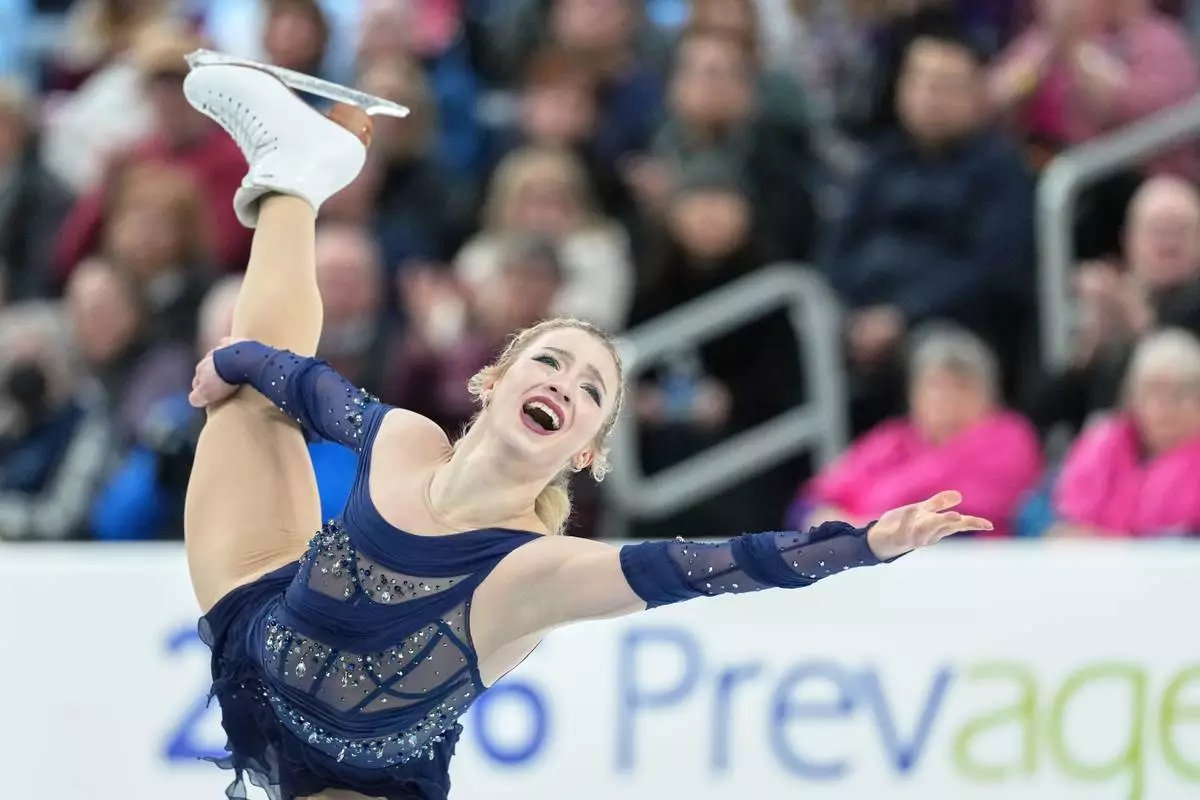
Amber Glenn competes during the women's free skating competition at the U.S. Figure Skating Championships, Friday, Jan. 9, 2026, in St. Louis. (AP Photo/Stephanie Scarbrough)

Alysa Liu skates during the "Making Team USA" performance at the U.S. Figure Skating Championships, Sunday, Jan. 11, 2026, in St. Louis. (AP Photo/Stephanie Scarbrough)

Maxim Naumov skates during the "Making Team USA" performance at the U.S. Figure Skating Championships, Sunday, Jan. 11, 2026, in St. Louis. (AP Photo/Stephanie Scarbrough)

Madison Chock and Evan Bates skate during the "Making the Team" performance at the U.S. Figure Skating Championships, Sunday, Jan. 11, 2026, in St. Louis. (AP Photo/Stephanie Scarbrough)

Gold medalist Ilia Malinin arrives for the metal ceremony after the men's free skate competition at the U.S. Figure Skating Championships, Saturday, Jan. 10, 2026, in St. Louis. (AP Photo/Jeff Roberson)