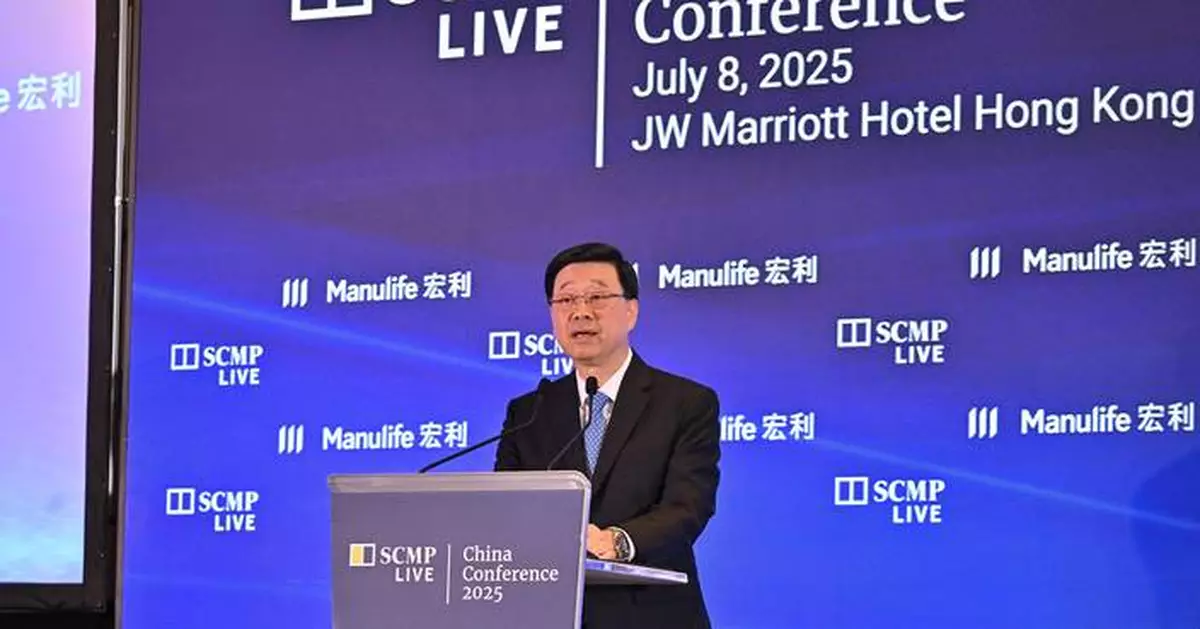
Speech by CE at South China Morning Post China Conference 2025 (with photos/video)
Following is the speech by the Chief Executive, Mr John Lee, at the South China Morning Post China Conference 2025 today (July 8):
Ms Catherine So (Chief Executive Officer of the South China Morning Post), Ms Tammy Tam (Editor-in-Chief of the South China Morning Post), Mr Steve Finch (President and Chief Executive Officer of Manulife Asia), distinguished guests, ladies and gentlemen,
Good morning. It's a pleasure to join you here, once again, at the South China Morning Post's annual China Conference - the 11th edition.
More than 700 of you are here for this year's gathering. Some 300s are joining us, virtually, at this forum for business, trade, finance, investment and technology. All of you keen on getting the latest intelligence and insights, developments and business opportunities - in Hong Kong, throughout China and beyond.
The theme of this China Conference is "Where Capital Meets Innovation" - an apt description of the strengths of China, our country, and how Hong Kong contributes to its rise. That provides the world with much-needed certainty, especially in this difficult time.
This year's international trade uncertainties, and chaos, may well continue amidst the rise of protectionism and unilateralism. The global economy is grappling with profound instability, escalating geopolitical risks and the wholesale reshaping of long-existing trading systems.
In spite of a damaged global trade order, the expanding trade and capital flows of China, our country, help buoy the economy of the region and the world.
The Mainland economy has sound fundamentals, a vast domestic market and the robust policies in place to withstand external challenges. In the first quarter of this year, the country's GDP (Gross Domestic Product) grew by 5.4 per cent, and key economic indicators have kept improving since the beginning of the second quarter - simply said, China, our country, is well on its way to achieving the official growth target of around 5 per cent for 2025.
As for Hong Kong, our economy expanded solidly by 3.1 per cent in the first quarter of 2025, supported by visible increases in exports and the resumption of moderate growth in overall investment expenditure. We forecast real GDP growth of 2 per cent to 3 per cent in this year.
Last week, we celebrated the 28th anniversary of the Hong Kong Special Administrative Region's establishment. That happy occasion was a welcome opportunity to thank our country for championing Hong Kong through the "one country, two systems" principle, as well as the national strategies and made-for-Hong Kong initiatives it supports us with.
Last month, the World Competitiveness Yearbook ranked Hong Kong third in the world in global competitiveness, up two places from the previous year, and up four places from 2023.
It marks Hong Kong's return to the global top three for the first time since 2019, reflecting our commitment to change in face of today's rising challenges.
There's a lot more to be grateful for. In April and May, Hong Kong's merchandise exports showed double-digit, year-on-year growth, while visitor arrivals also brought double-digit, year-on-year increases in the second quarter.
And Hong Kong, in the first half of this year, has been the world's largest IPO (initial public offering) fundraising market, raising over US$13 billion. That's up a whopping 22 per cent, compared with the full-year figure last year.
It speaks of Hong Kong's long-standing appeal as a safe haven for Chinese and international capital and a bridge for global investors.
Hong Kong is, after all, the most internationalised city in the country. We offer the world a market-friendly business environment underpinned by the rule of law. We are the only common law jurisdiction in our country, with a legal system and regulatory regime similar to most global financial hubs. And we present business and investment advantages unmatched by any other city in the world.
Last year, the total number of local registered companies reached its record high, surpassing 1.46 million. And the total number of non-local companies registered here also reached a record high, and was over 15 000. Both figures continue to show encouraging growth this year.
Since January 2023, Invest Hong Kong, our dedicated investment promotion agency, has assisted more than 1 300 Mainland and overseas companies in setting up or expanding their business in Hong Kong. These companies bring in foreign direct investment of over US$21 billion to our economy, creating over 19 000 jobs.
When I assumed office as Chief Executive three years ago, I established the Office for Attracting Strategic Enterprises. My aim is to offer, through this Office, one-stop facilitation services and tailor-made incentives to attract strategic enterprises to our city and foster innovation and economic growth.
The Office has brought in 84 strategic companies, from such high-tech industries as advanced manufacturing and new energy technology, AI and data science, fintech and life and health technology. The strategic companies will invest about US$6.4 billion in the next few years, creating over 20 000 jobs.
We also launched a new scheme in May this year to create a company re-domiciliation regime to attract companies to Hong Kong. It provides a convenient, safe and secure pathway for companies to re-domicile to Hong Kong. Different companies have already expressed their interest to the regime and two international insurance giants - as Mr Finch is surely aware - have announced they will officially re-domicile to Hong Kong. Good business always makes right decisions.
These companies all gave their strong vote of confidence in the development of Hong Kong and the country, and will help attract a wealth of partners and related companies to this part of the globe.
Another strong advantage Hong Kong offers to overseas companies here, old or new, is our easy access to the Mainland market. We are certainly a front runner in this regard.
That's in no small part thanks to the Mainland and Hong Kong Closer Economic Partnership Arrangement, or CEPA, our de facto free trade agreement with the Mainland that provides preferential treatment to Hong Kong companies, facilitating smoother access to the Mainland's vast market.
A new amendment agreement under the CEPA Agreement on Trade in Services entered into force this March. It includes the removal of the qualifying period requirement on Hong Kong service suppliers in most sectors, meaning our many new companies can also benefit from the arrangement's facilitation measures in accessing the Mainland market.
Together with new initiatives that allow Hong Kong-invested enterprises to adopt Hong Kong law and choose Hong Kong as the seat for arbitration in their operation in a range of Mainland cities, CEPA provides a wide range of innovative enhancements that help a world of investors better capitalise on China's growth opportunities, with the help of Hong Kong's world-class professional services.
Then there's technological innovation, including artificial intelligence. AI advancements are transforming production, business and consumption patterns. They are redefining the core competitiveness of economies.
These trends create new opportunities for Hong Kong, particularly in our deepening integration with the Guangdong-Hong Kong-Macao Greater Bay Area, a cluster city development that brings together Hong Kong, Macao, and nine southern cities on the Mainland.
With a population exceeding 87 million and a GDP of more than US$2 trillion last year, similar to the size of the 10th largest economy in the world, the Greater Bay Area is among the most open and economically vibrant regions in the country.
The Shenzhen-Hong Kong-Guangzhou science and technology cluster, which includes three of the Greater Bay Area's core cities, has been ranked second, globally, for five consecutive years in the Global Innovation Index, published by the World Intellectual Property Organization.
Drawing together Hong Kong's research capabilities and business competitiveness, as well as the Mainland's innovation and advanced manufacturing prowess, the Greater Bay Area endeavours to become a world-leading I&T (innovation and technology) hub.
One spectacular example is the Hetao Shenzhen-Hong Kong Science and Technology Innovation Co-operation Zone, an area that straddles our boundary with Shenzhen. It will develop into a cutting-edge advanced technology centre that converges the strengths of Hong Kong and Shenzhen. Last November, the HKSAR (Hong Kong Special Administrative Region) Government published the Development Outline for the Hong Kong Park in the co-operation zone.
The Park's first three buildings have been completed, and the Greater Bay Area International Clinical Trial Institute opened last November at Hong Kong Park.
That’s just the beginning. Artificial intelligence, new energy vehicles, the low-altitude economy, fintech, and more, are thriving in the Greater Bay Area. And as the Park enters into the operational phase this year, more of these companies will be joining us.
Beyond I&T, we have seen the successful introduction of a wide variety of policy initiatives with the Greater Bay Area, including measures for the two-way flow of talent, schemes for supporting youth innovation, entrepreneurship and employment, and policies to facilitate mutual travel.
And the promise of further co-operation between Hong Kong and the rest of the Greater Bay Area and the Mainland is boundless.
Ladies and gentlemen, when we talk of China's might, many of us immediately look to the maiden visit to Hong Kong over the past weekend of the first domestically built aircraft carrier of China, our country, the Shandong. Although the fleet has just bid us farewell yesterday, the awe and pride it drew among the people of Hong Kong over its five-day visit will be long-lasting.
More than a display of maritime strength, the fleet showcases our country's commitment to peacekeeping and regional stability. And much like how the Shandong docked in our safe harbour, Hong Kong is where the country anchors its trust.
In this era of fogged horizons, China does not just project power - it radiates investible stability. And Hong Kong is the "super connector" and "super value-adder" that links the world with opportunities from China's growth and certainties. A link you can always bank on.
Amid an ever changing geopolitical landscape and constantly escalating uncertainties, Hong Kong is the place that promises security and development. This certainty of security and development is precisely what a world of investors need and thirst for.
Together, we will fully seize development opportunities, keep boosting our competitiveness, undertake reforms for progress, and foster innovation. The wisdom and wealth of experience of the people of Hong Kong will help the Pearl of the Orient shine brighter than ever on the world stage.
My thanks to the South China Morning Post for organising this essential, always eventful, annual gathering.
I wish you all a rewarding conference. And the best of business in the second half of 2025, a year that will surely be full of opportunities and rewards. Thank you.
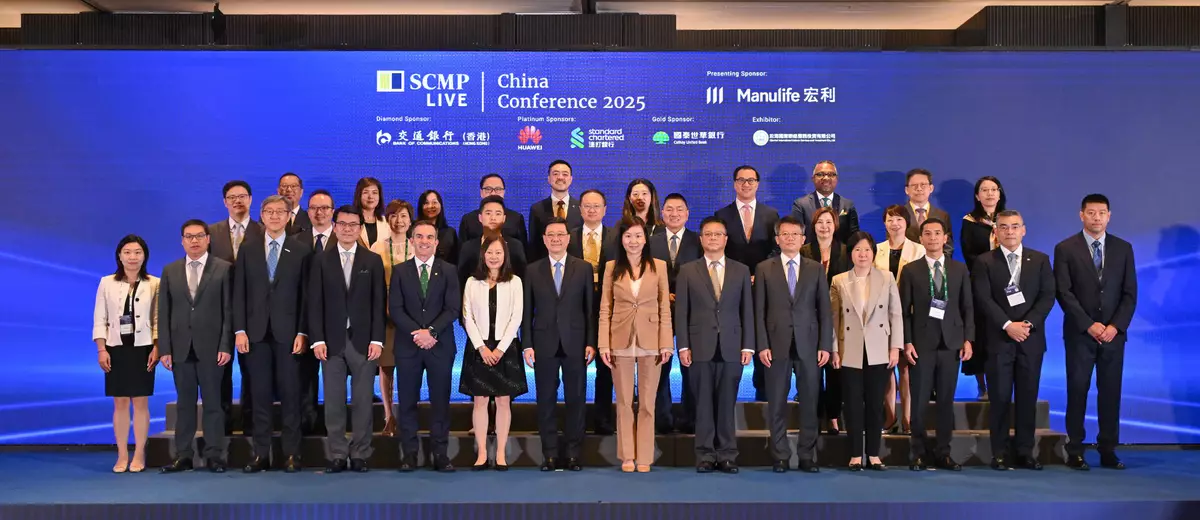
Speech by CE at South China Morning Post China Conference 2025 (with photos/video) Source: HKSAR Government Press Releases
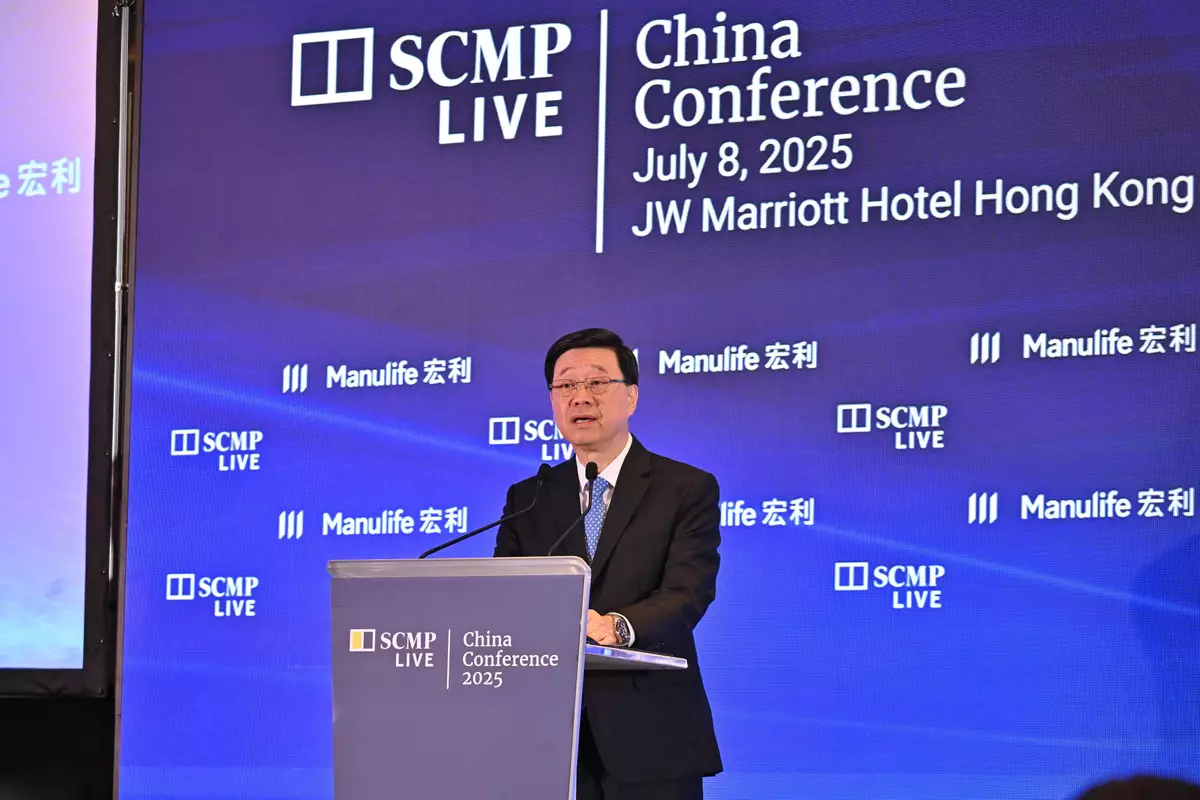
Speech by CE at South China Morning Post China Conference 2025 (with photos/video) Source: HKSAR Government Press Releases