Skip to Content Facebook Feature Image

A Bayard Rustin archive aims to preserve his legacy as a queer Civil Rights activist

News

A Bayard Rustin archive aims to preserve his legacy as a queer Civil Rights activist
News

News

A Bayard Rustin archive aims to preserve his legacy as a queer Civil Rights activist

2025-07-08 22:05 Last Updated At:22:10

NEW YORK (AP) — Social justice advocates are creating a queer history archive that celebrates Bayard Rustin, a major organizer in the Civil Rights Movement and key architect of the March on Washington.

The Bayard Rustin Center for Social Justice will launch a digital archive this fall featuring articles, photos, videos, telegrams, speeches, and more tied to Rustin’s work. Sourced from museums, archives, and personal accounts, it’s designed as a central space where others can add their own stories, creating a living historical record.

More Images
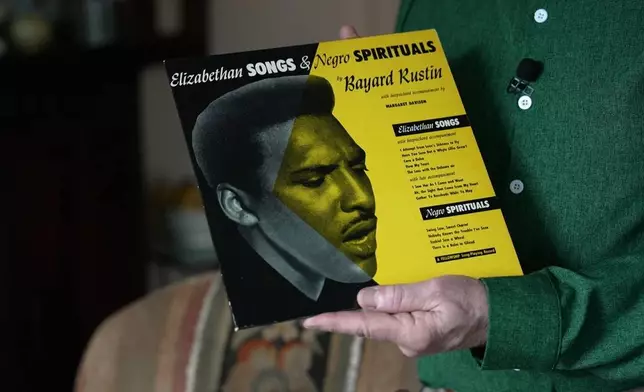
In this still image taken from video, Walter Naegle, Bayard Rustin's partner and a consultant on projects related to his life and work, holds a vinyl record in his home on Saturday, June 28, 2025, in New York. (AP Photo/Mary Conlon)
In this still image taken from video, Walter Naegle, Bayard Rustin's partner and a consultant on projects related to his life and work, holds a vinyl record in his home on Saturday, June 28, 2025, in New York. (AP Photo/Mary Conlon)

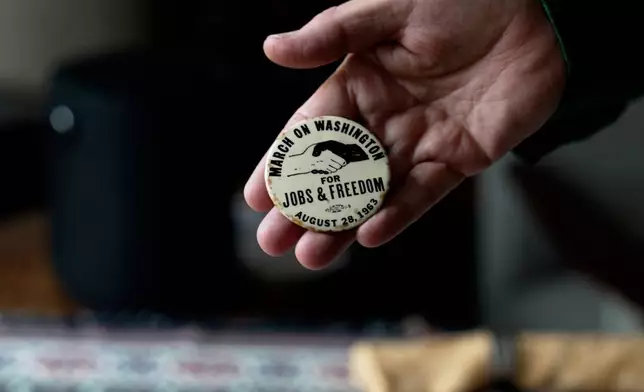
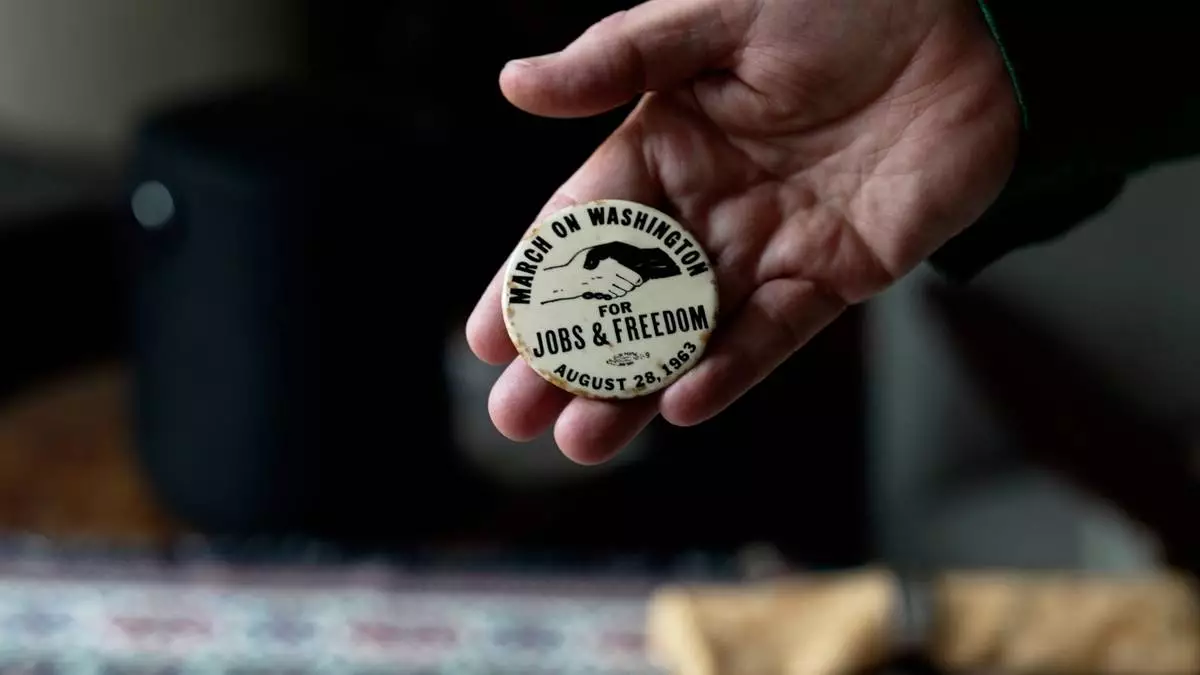
In this still image taken from video, a button from the March on Washington for Jobs an Freedom is held by Walter Naegle, Bayard Rustin's partner and a consultant on projects related to his life and work, on Saturday, June 28, 2025, in New York (AP Photo/Mary Conlon)
In this still image taken from video, a button from the March on Washington for Jobs an Freedom is held by Walter Naegle, Bayard Rustin's partner and a consultant on projects related to his life and work, on Saturday, June 28, 2025, in New York (AP Photo/Mary Conlon)

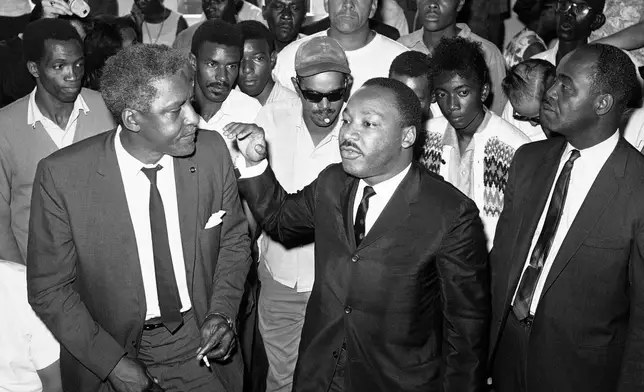
FILE - Dr. Martin Luther King Jr., center, with his aide, Bayard Rustin, left, addresses a gathering in the riot-torn area of Los Angeles, in one of many meetings King attended in an attempt to solve the problems connected with the uprising, Aug. 18, 1965. (AP Photo/Don Brinn, File)
FILE - Dr. Martin Luther King Jr., center, with his aide, Bayard Rustin, left, addresses a gathering in the riot-torn area of Los Angeles, in one of many meetings King attended in an attempt to solve the problems connected with the uprising, Aug. 18, 1965. (AP Photo/Don Brinn, File)

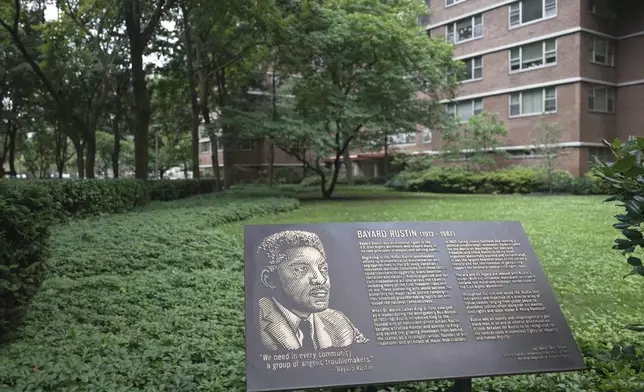
In this still image taken from video, a plaque honoring Bayard Rustin is pictured outside of partner Walter Naegle's home on Saturday, June 28, 2025, in New York. (AP Photo/Mary Conlon)
In this still image taken from video, a plaque honoring Bayard Rustin is pictured outside of partner Walter Naegle's home on Saturday, June 28, 2025, in New York. (AP Photo/Mary Conlon)

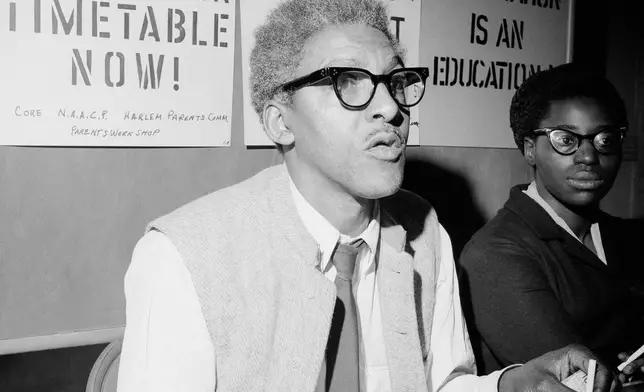
FILE - Bayard Rustin, director of the scheduled school boycott in New York City, is shown during a press conference in the Brooklyn borough, of New York, Feb. 1, 1964. (AP Photo/Jacob Harris, File)
FILE - Bayard Rustin, director of the scheduled school boycott in New York City, is shown during a press conference in the Brooklyn borough, of New York, Feb. 1, 1964. (AP Photo/Jacob Harris, File)

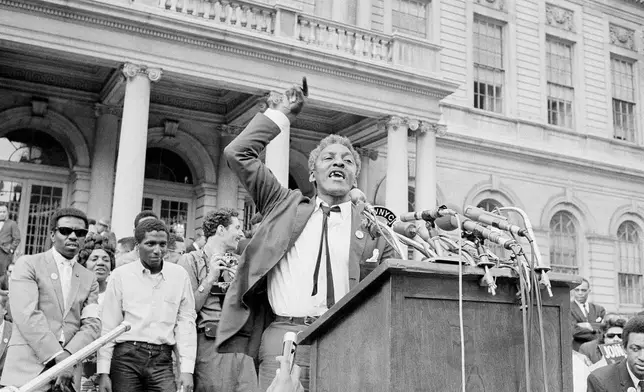
FILE - Bayard Rustin, civil rights organizer, speaks from a platform erected in front of New York's City Hall, May 18, 1964, as a crowd of some 3,000 persons rallied that was high point of day-long activities by civil rights groups seeking school integration. (AP Photo, File)
FILE - Bayard Rustin, civil rights organizer, speaks from a platform erected in front of New York's City Hall, May 18, 1964, as a crowd of some 3,000 persons rallied that was high point of day-long activities by civil rights groups seeking school integration. (AP Photo, File)

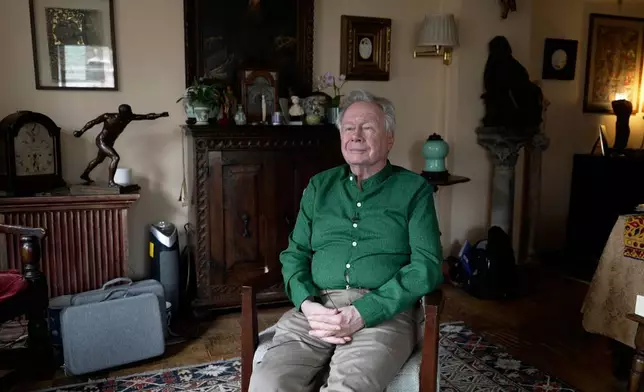
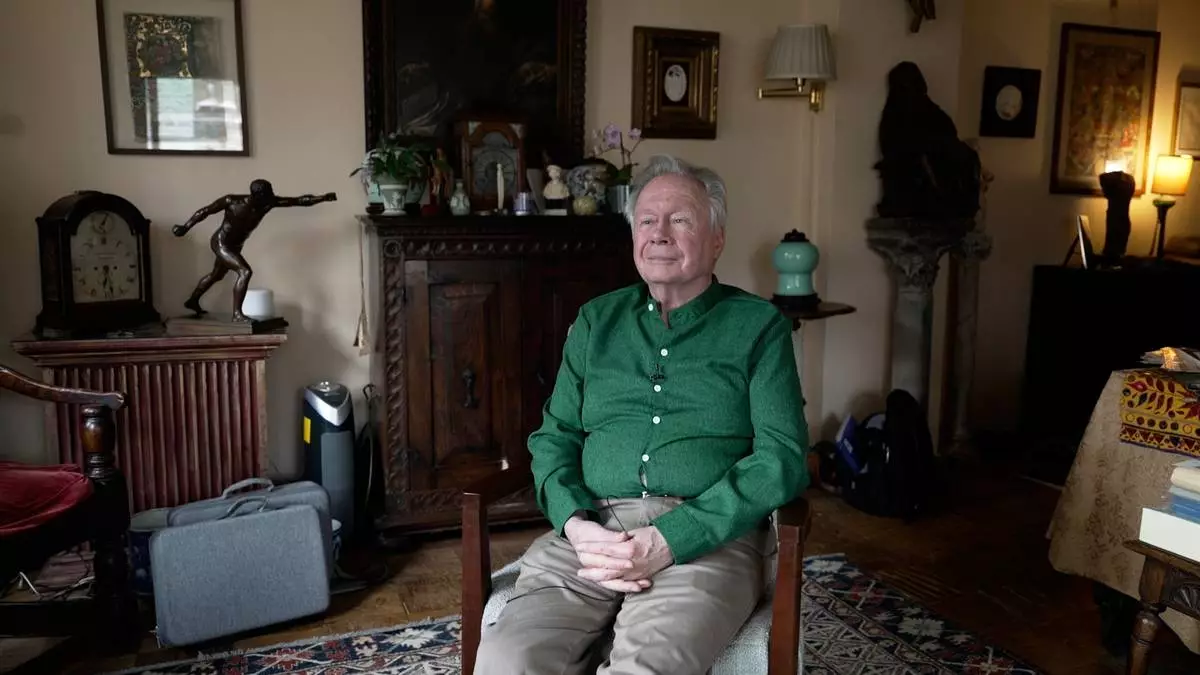
In this still image taken from video, Walter Naegle, Bayard Rustin's partner and a consultant on projects related to his life and work, is pictured his home on Saturday, June 28, 2025, in New York. (AP Photo/Mary Conlon)
In this still image taken from video, Walter Naegle, Bayard Rustin's partner and a consultant on projects related to his life and work, is pictured his home on Saturday, June 28, 2025, in New York. (AP Photo/Mary Conlon)

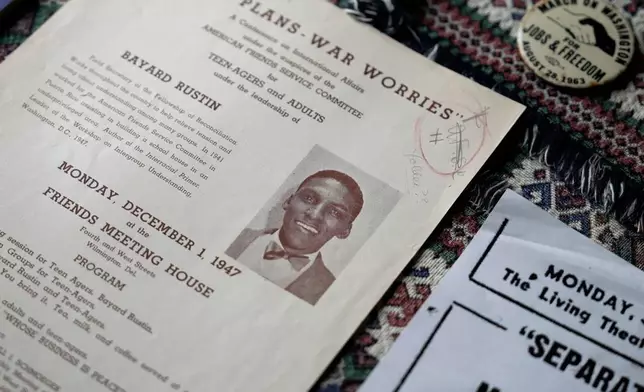
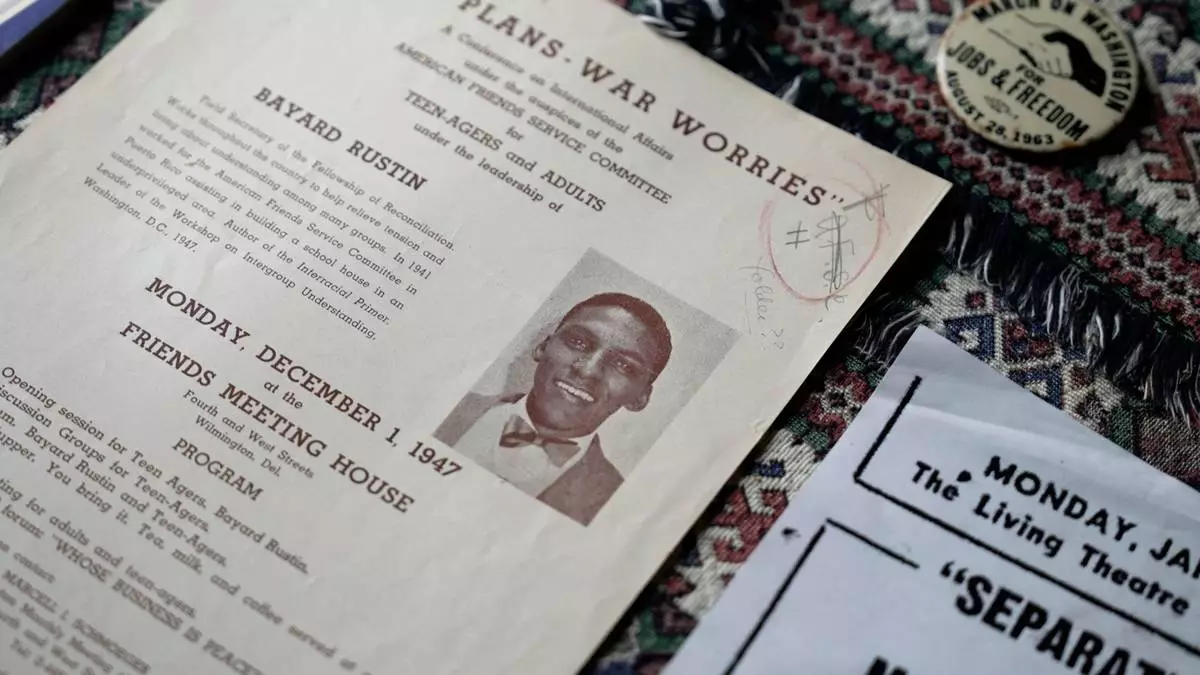
In this still image taken from video, mementos belonging to civil rights leader Bayard Rustin are pictured at his partner Walter Naegle's home, on Saturday, June 28, 2025, in New York. (AP Photo/Mary Conlon)
In this still image taken from video, mementos belonging to civil rights leader Bayard Rustin are pictured at his partner Walter Naegle's home, on Saturday, June 28, 2025, in New York. (AP Photo/Mary Conlon)

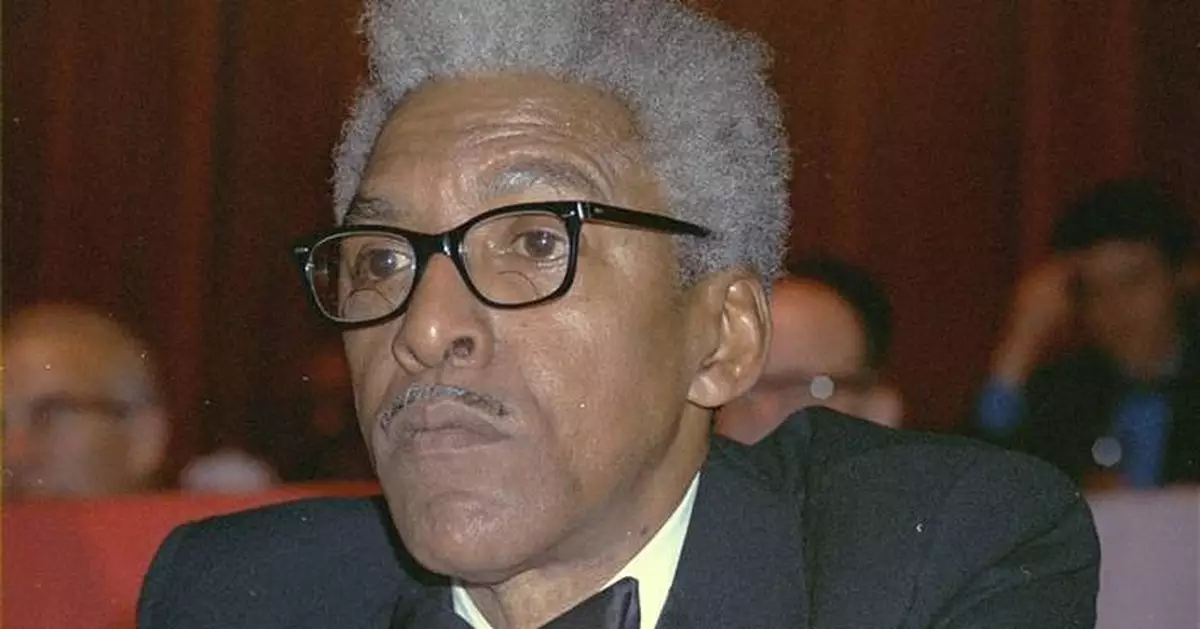
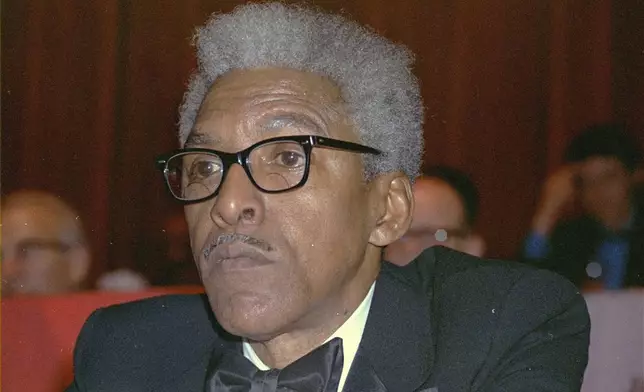
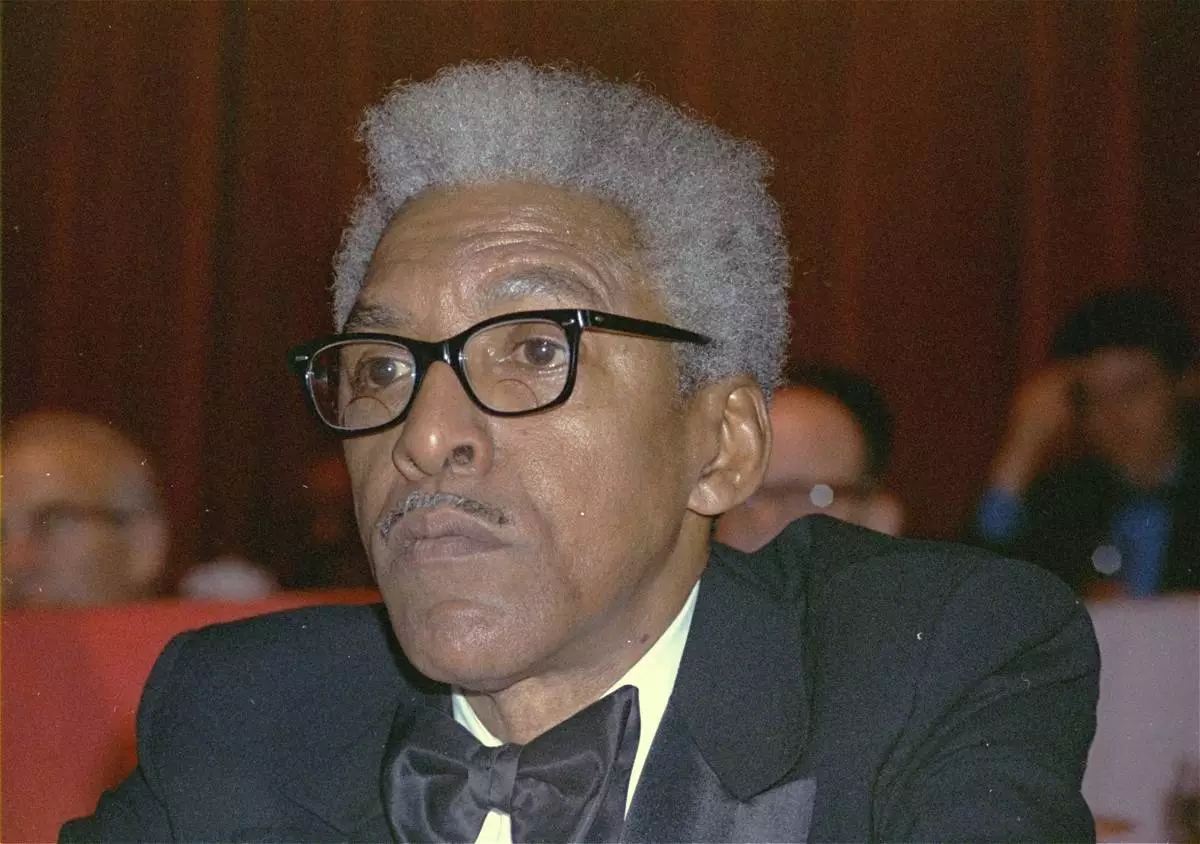
FILE - Civil rights leader Bayard Rustin is seen on Dec. 14, 1970, in New York. (AP Photo/File)

FILE - Civil rights leader Bayard Rustin is seen on Dec. 14, 1970, in New York. (AP Photo/File)

“There’s this hole in our history,” said Robt Martin Seda-Schreiber, the center's founder and chief activist. “And there are great resources about Bayard, but they’re all spread out, and none of it has been collected and put together in the way that he deserves, and more importantly, the way the world deserves to see him.”

Rare footage of Rustin speaking at a 1964 New York rally for voting rights marchers who were beaten in Selma, Alabama, was recently uncovered and digitized by Associated Press archivists. Other AP footage shows him addressing a crowd during a 1967 New York City teachers strike.

“We are here to tell President Johnson that the Black people, the trade union movement, white people of goodwill and the church people — Negroes first — put him where he is,” Rustin states at the 1964 rally. “We will stay in these damn streets until every Negro in the country can vote!”

The legacy of Rustin — who died in 1987 aged 75 — reaches far beyond the estimated 250,000 people he rallied to attend the March on Washington in 1963, when the Rev. Martin Luther King Jr. delivered his “I Have A Dream” speech. Rustin also played a pivotal role behind the scenes, mentoring King and orchestrating the Montgomery bus boycott.

And his influence still guides activism today, reminding younger generations of the power the community holds in driving lasting change through nonviolence, said David J. Johns, a queer Black leader based in Washington, D.C.

“Being an architect of not just that moment but of the movement, has enabled so many of us to continue to do things that are a direct result of his teaching and sacrifice,” said Johns. He is the CEO and executive director of the National Black Justice Collective, which attributes its advocacy successes in the Black queer space to Rustin’s legacy.

Rustin was born into activism, according to the Martin Luther King, Jr. Research & Education Institute. His grandparents, Julia Davis and Janifer Rustin, instilled in him and his 11 siblings the value of nonviolence. His grandmother was a member of the NAACP, so Rustin was surrounded and influenced by leaders including the activist and scholar W.E.B. Du Bois and James Weldon Johnson, who wrote “Lift Every Voice and Sing.”

Rustin was expelled from Wilberforce University in 1936 after he organized a strike against racial injustice. He later studied at Cheyney University of Pennsylvania, the nation’s first historically Black college, then moved to New York during the Harlem Renaissance to engage more deeply with political and social activism. He attended the City College of New York and joined the Young Communist League for its stance against segregation.

Rustin was arrested 23 times, including a 1953 conviction in Pasadena, California, for vagrancy and lewd conduct — charges commonly used then to criminalize LGBTQ+ people. He served 50 days in jail and lost a tooth after being beaten by police. California Gov. Gavin Newsom issued a posthumous pardon in 2020, acknowledging Rustin had been subjected to discrimination.

Rustin and figures such as Marsha P. Johnson, a prominent transgender activist during the gay rights movement, continue inspire the LGBTQ+ community because they “were super intentional and unapologetic in the ways in which they showed up,” Johns said.

“I often think about Bayard and the March on Washington, which he built in record time and in the face of a whole lot of opposition,” Johns said.

Walter Naegle, Rustin's partner and a consultant on projects related to his life and work, said it's important for the queer community to have access to the history of social movements.

“There wasn’t very much of an LGBTQ+ movement until the early 50s,” said Naegle. “The African American struggle was a blueprint for what they needed to do and how they needed to organize. And so to have access to all of the Civil Rights history, and especially to Bayard’s work — because he was really the preeminent organizer — I think it’s very important for the current movements to have the ability to go back and look at that material.”

Rustin's sexuality and his former association with the Young Communist League forced him to step away as a Civil Rights leader for several years.

In 1960, New York congressman Adam Clayton Powell Jr. threatened to spread false rumors that Rustin and King were intimately involved, weaponizing widespread homophobia to undermine their cause, according to the Martin Luther King, Jr. Research and Education Institute.

But Rustin resumed his work in 1963 as chief organizer of the March on Washington, which became a defining moment in the Civil Rights Movement and paved the way for the passage of the Civil Rights Act of 1964 and the Voting Rights Act of 1965.

In 2023, Netflix released the biopic, “ Rustin. ” Filmmaker and co-writer Julian Breece, who is Black and queer grew up in the ’90s when, he said, being gay still correlated with the spread of AIDS, leading to shame and isolation. But he learned about Rustin’s impact on the Civil Rights Movement and found a peer to admire.

“Seeing a picture of Rustin with King, who is the opposite of all those things, it let me know there was a degree to which I was being lied to and that there was more for me potentially, if Bayard Rustin could have that kind of impact,” Breece said.

“I wanted Black gay men to have a hero they could look up to,” he said.

The story has been updated to correct the preferred spelling of Robt Martin Seda-Schreiber’s name.

The Associated Press receives financial support from the Sony Global Social Justice Fund to expand certain coverage areas. The AP is solely responsible for all content. Find the AP’s standards for working with philanthropies, a list of supporters and funded coverage areas at AP.org.
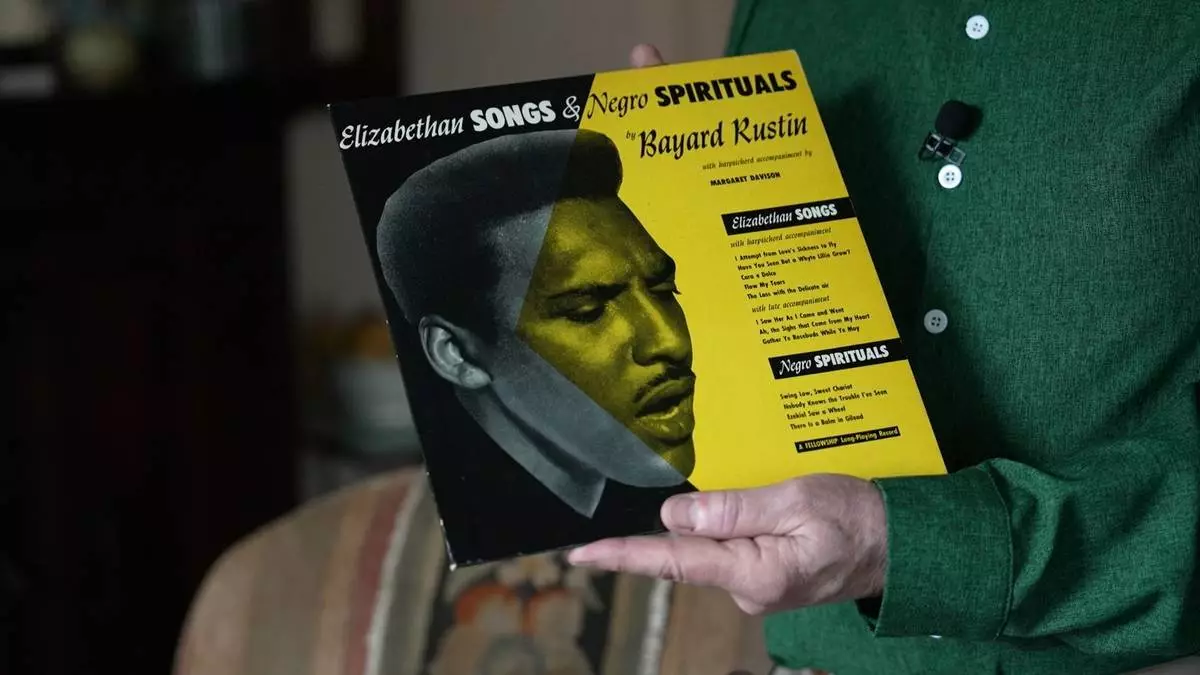
In this still image taken from video, Walter Naegle, Bayard Rustin's partner and a consultant on projects related to his life and work, holds a vinyl record in his home on Saturday, June 28, 2025, in New York. (AP Photo/Mary Conlon)
In this still image taken from video, Walter Naegle, Bayard Rustin's partner and a consultant on projects related to his life and work, holds a vinyl record in his home on Saturday, June 28, 2025, in New York. (AP Photo/Mary Conlon)

In this still image taken from video, a button from the March on Washington for Jobs an Freedom is held by Walter Naegle, Bayard Rustin's partner and a consultant on projects related to his life and work, on Saturday, June 28, 2025, in New York (AP Photo/Mary Conlon)
In this still image taken from video, a button from the March on Washington for Jobs an Freedom is held by Walter Naegle, Bayard Rustin's partner and a consultant on projects related to his life and work, on Saturday, June 28, 2025, in New York (AP Photo/Mary Conlon)

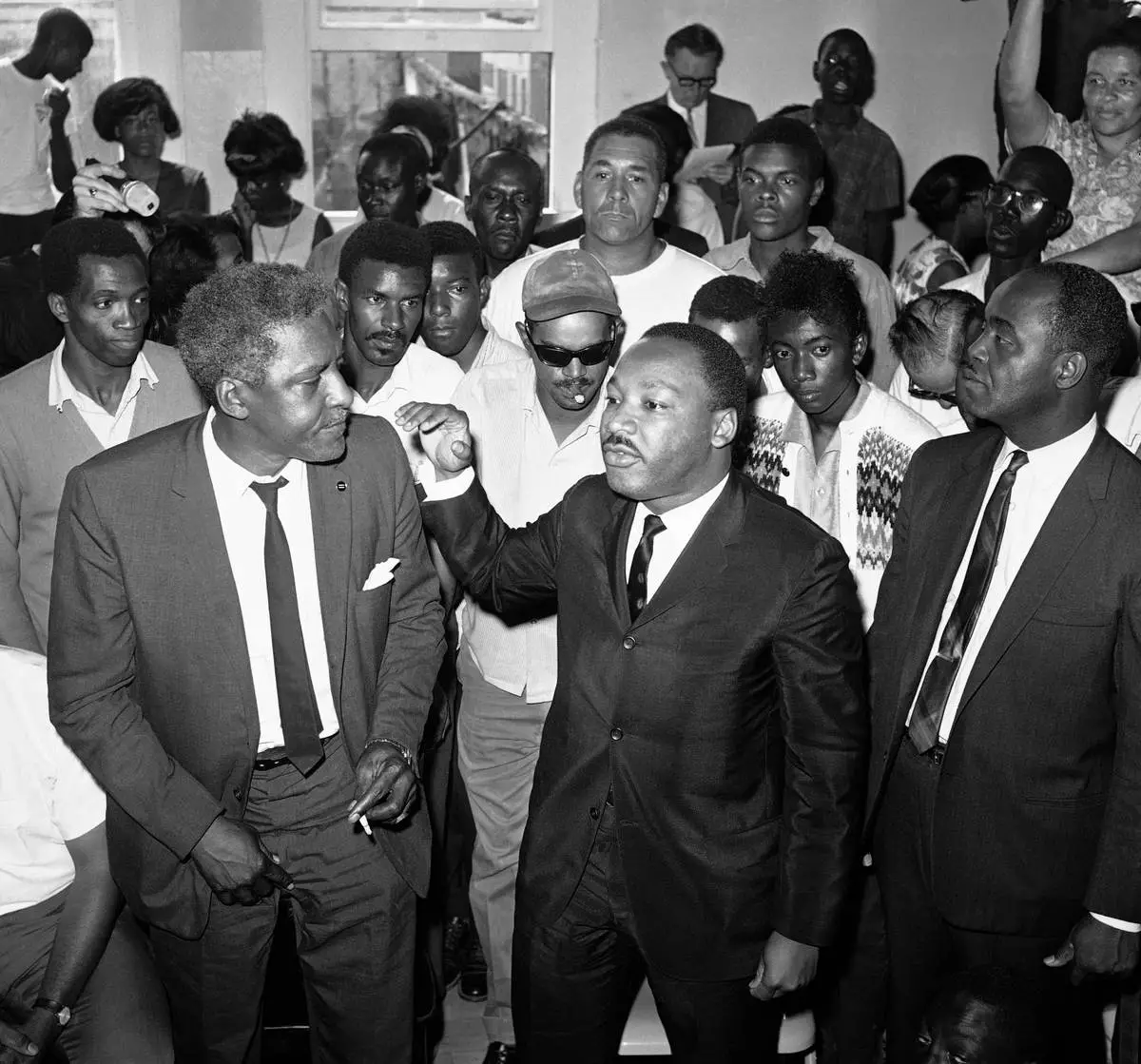
FILE - Dr. Martin Luther King Jr., center, with his aide, Bayard Rustin, left, addresses a gathering in the riot-torn area of Los Angeles, in one of many meetings King attended in an attempt to solve the problems connected with the uprising, Aug. 18, 1965. (AP Photo/Don Brinn, File)
FILE - Dr. Martin Luther King Jr., center, with his aide, Bayard Rustin, left, addresses a gathering in the riot-torn area of Los Angeles, in one of many meetings King attended in an attempt to solve the problems connected with the uprising, Aug. 18, 1965. (AP Photo/Don Brinn, File)

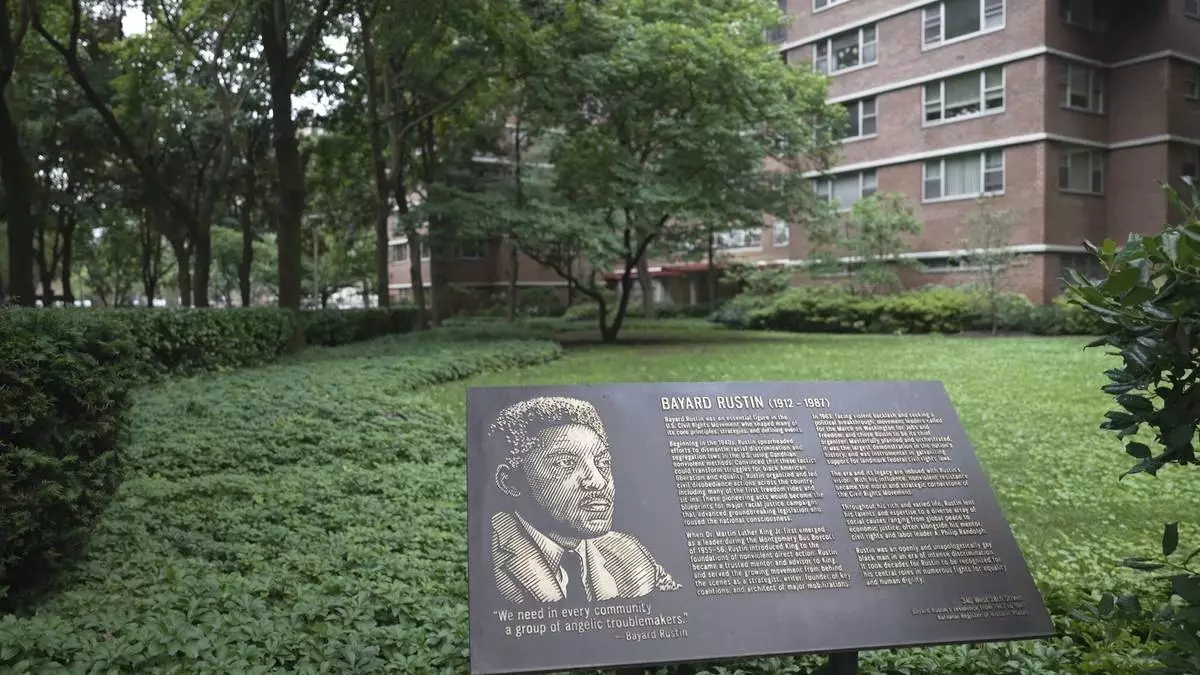
In this still image taken from video, a plaque honoring Bayard Rustin is pictured outside of partner Walter Naegle's home on Saturday, June 28, 2025, in New York. (AP Photo/Mary Conlon)
In this still image taken from video, a plaque honoring Bayard Rustin is pictured outside of partner Walter Naegle's home on Saturday, June 28, 2025, in New York. (AP Photo/Mary Conlon)

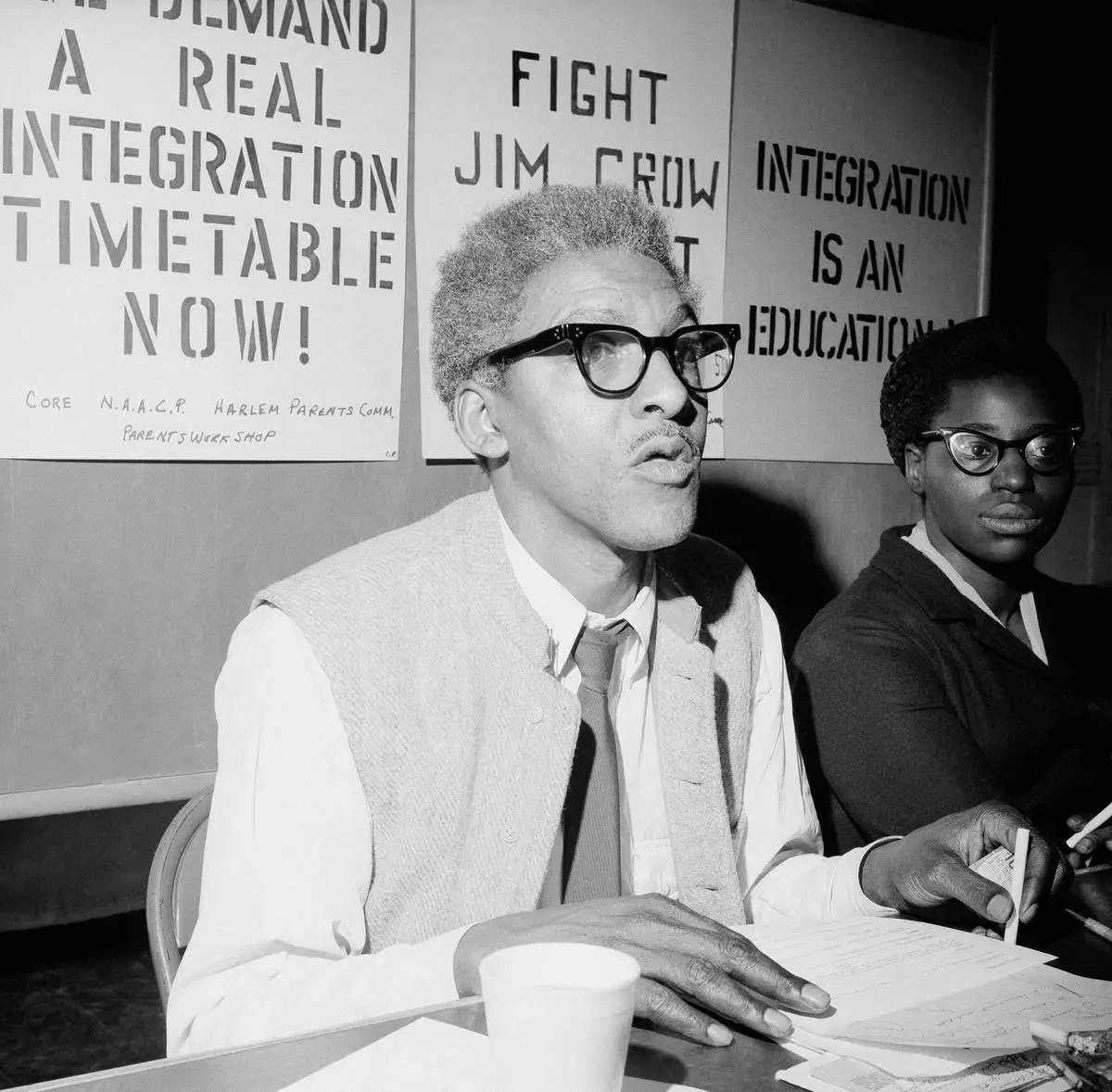
FILE - Bayard Rustin, director of the scheduled school boycott in New York City, is shown during a press conference in the Brooklyn borough, of New York, Feb. 1, 1964. (AP Photo/Jacob Harris, File)
FILE - Bayard Rustin, director of the scheduled school boycott in New York City, is shown during a press conference in the Brooklyn borough, of New York, Feb. 1, 1964. (AP Photo/Jacob Harris, File)

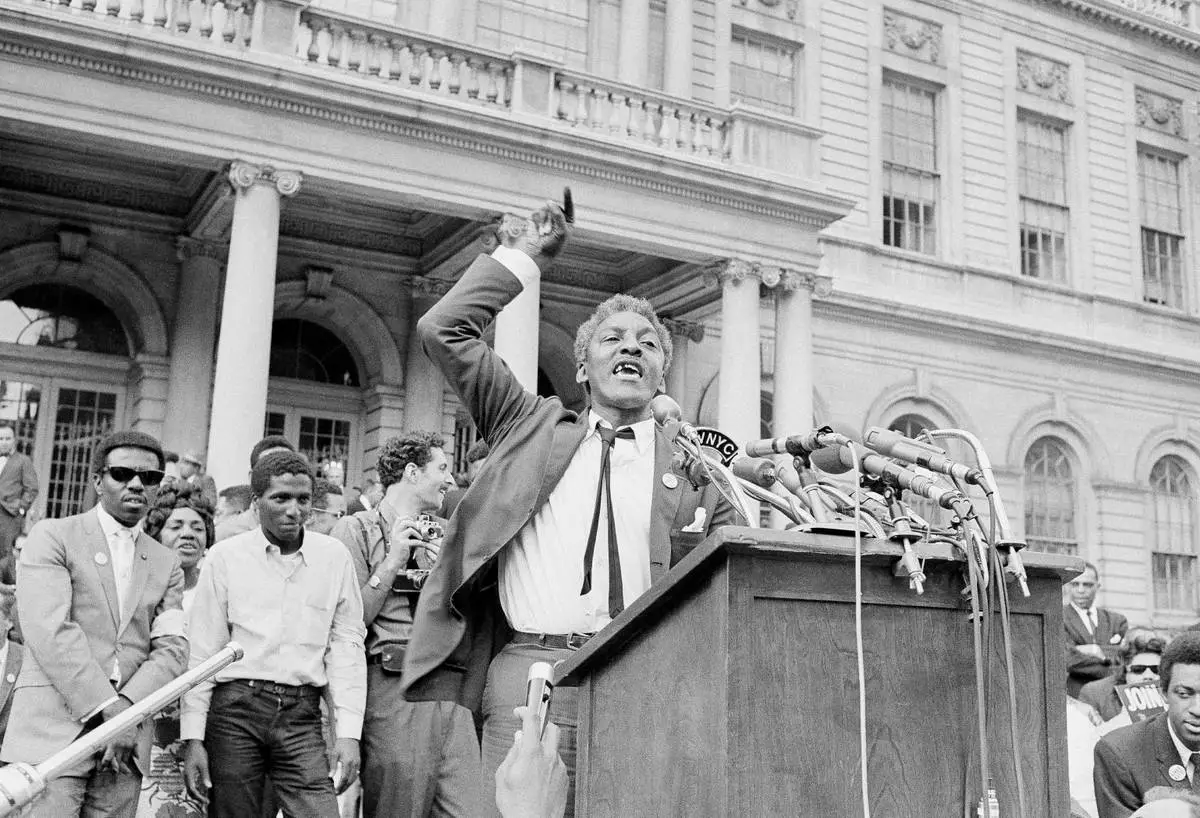
FILE - Bayard Rustin, civil rights organizer, speaks from a platform erected in front of New York's City Hall, May 18, 1964, as a crowd of some 3,000 persons rallied that was high point of day-long activities by civil rights groups seeking school integration. (AP Photo, File)
FILE - Bayard Rustin, civil rights organizer, speaks from a platform erected in front of New York's City Hall, May 18, 1964, as a crowd of some 3,000 persons rallied that was high point of day-long activities by civil rights groups seeking school integration. (AP Photo, File)

In this still image taken from video, Walter Naegle, Bayard Rustin's partner and a consultant on projects related to his life and work, is pictured his home on Saturday, June 28, 2025, in New York. (AP Photo/Mary Conlon)
In this still image taken from video, Walter Naegle, Bayard Rustin's partner and a consultant on projects related to his life and work, is pictured his home on Saturday, June 28, 2025, in New York. (AP Photo/Mary Conlon)

In this still image taken from video, mementos belonging to civil rights leader Bayard Rustin are pictured at his partner Walter Naegle's home, on Saturday, June 28, 2025, in New York. (AP Photo/Mary Conlon)
In this still image taken from video, mementos belonging to civil rights leader Bayard Rustin are pictured at his partner Walter Naegle's home, on Saturday, June 28, 2025, in New York. (AP Photo/Mary Conlon)

FILE - Civil rights leader Bayard Rustin is seen on Dec. 14, 1970, in New York. (AP Photo/File)
FILE - Civil rights leader Bayard Rustin is seen on Dec. 14, 1970, in New York. (AP Photo/File)
WASHINGTON (AP) — President Donald Trump's photo portrait display at the Smithsonian's National Portrait Gallery has had references to his two impeachments removed, the latest apparent change at the collection of museums he has accused of bias as he asserts his influence over how official presentations document U.S. history.

The wall text, which summarized Trump's first presidency and noted his 2024 comeback victory, was part of the museum's “American Presidents” exhibition. The description had been placed alongside a photograph of Trump taken during his first term. Now, a different photo appears without any accompanying text block, though the text was available online. Trump was the only president whose display in the gallery, as seen Sunday, did not include any extended text.

The White House did not say whether it sought any changes. Nor did a Smithsonian statement in response to Associated Press questions. But Trump ordered in August that Smithsonian officials review all exhibits before the nation celebrates the 250th anniversary of the Declaration of Independence on July 4. The Republican administration said the effort would “ensure alignment with the president’s directive to celebrate American exceptionalism, remove divisive or partisan narratives, and restore confidence in our shared cultural institutions.”

Trump's original “portrait label," as the Smithsonian calls it, notes Trump's Supreme Court nominations and his administration's development of COVID-19 vaccines. That section concludes: “Impeached twice, on charges of abuse of power and incitement of insurrection after supporters attacked the U.S. Capitol on January 6, 2021, he was acquitted by the Senate in both trials.”

Then the text continues: “After losing to Joe Biden in 2020, Trump mounted a historic comeback in the 2024 election. He is the only president aside from Grover Cleveland (1837– 1908) to have won a nonconsecutive second term.”

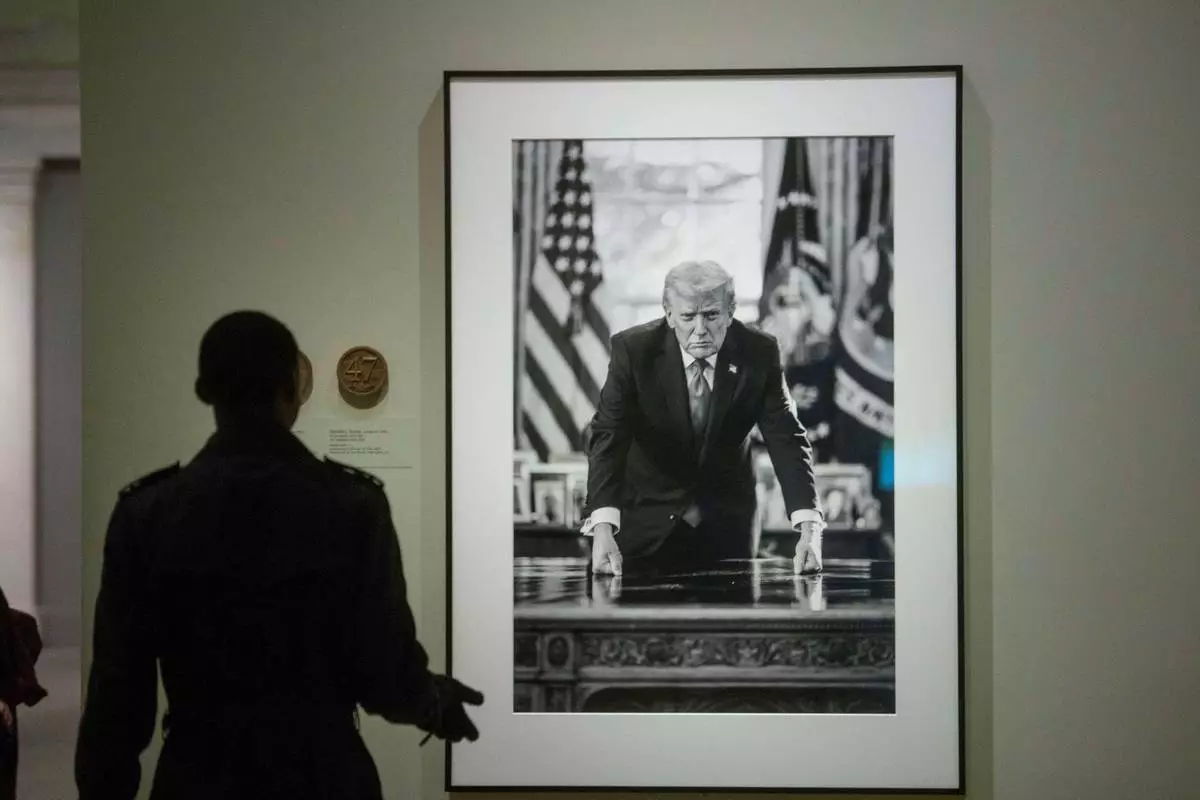
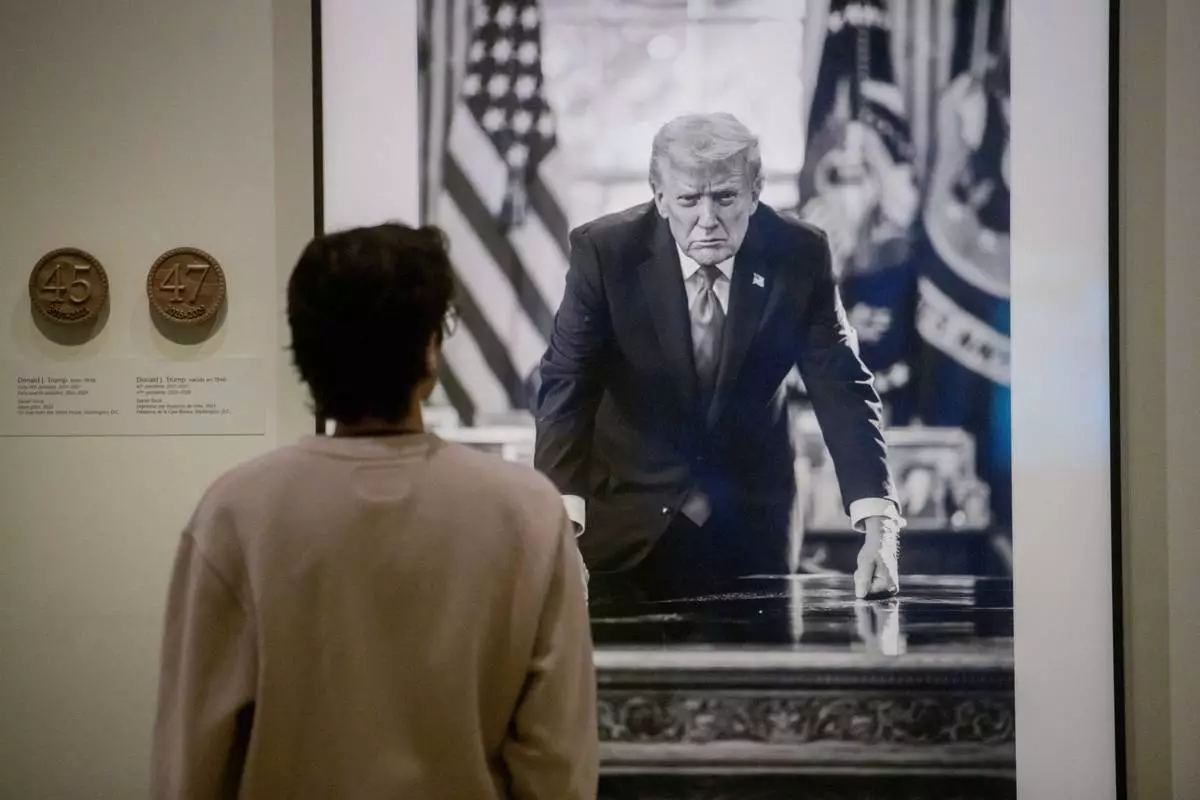
Asked about the display, White House spokesman Davis Ingle celebrated the new photograph, which shows Trump, brow furrowed, leaning over his Oval Office desk. Ingle said it ensures Trump's “unmatched aura ... will be felt throughout the halls of the National Portrait Gallery.”

The portrait was taken by White House photographer Daniel Torok, who is credited in the display that includes medallions noting Trump is the 45th and 47th president. Similar numerical medallions appear alongside other presidents' painted portraits that also include the more extended biographical summaries such as what had been part of Trump's display.

Sitting presidents are represented by photographs until their official paintings are commissioned and completed.

Ingle did not answer questions about whether Trump or a White House aide, on his behalf, asked for anything related to the portrait label.

The gallery said in a statement that it had previously rotated two photographs of Trump from its collection before putting up Torok's work.

“The museum is beginning its planned update of the America’s Presidents gallery which will undergo a larger refresh this Spring,” the gallery statement said. “For some new exhibitions and displays, the museum has been exploring quotes or tombstone labels, which provide only general information, such as the artist’s name.”

For now, references to Presidents Andrew Johnson and Bill Clinton being impeached in 1868 and 1998, respectively, remain as part of their portrait labels, as does President Richard Nixon's 1974 resignation as a result of the Watergate scandal.

And, the gallery statement noted, “The history of Presidential impeachments continues to be represented in our museums, including the National Museum of American History.”

Trump has made clear his intentions to shape how the federal government documents U.S. history and culture. He has offered an especially harsh assessment of how the Smithsonian and other museums have featured chattel slavery as a seminal variable in the nation's development but also taken steps to reshape how he and his contemporary rivals are depicted.

In the months before his order for a Smithsonian review, he fired the head archivist of the National Archives and said he was firing the National Portrait Gallery's director, Kim Sajet, as part of his overhaul. Sajet maintained the backing of the Smithsonian's governing board, but she ultimately resigned.

At the White House, Trump has designed a notably partisan and subjective “Presidential Walk of Fame” featuring gilded photographs of himself and his predecessors — with the exception of Biden, who is represented by an autopen — along with plaques describing their presidencies.

The White House said at the time that Trump himself was a primary author of the plaques. Notably, Trump's two plaques praise the 45th and 47th president as a historically successful figure while those under Biden's autopen stand-in describe the 46th executive as “by far, the worst President in American History” who “brought our Nation to the brink of destruction.”

Barrow reported from Atlanta.

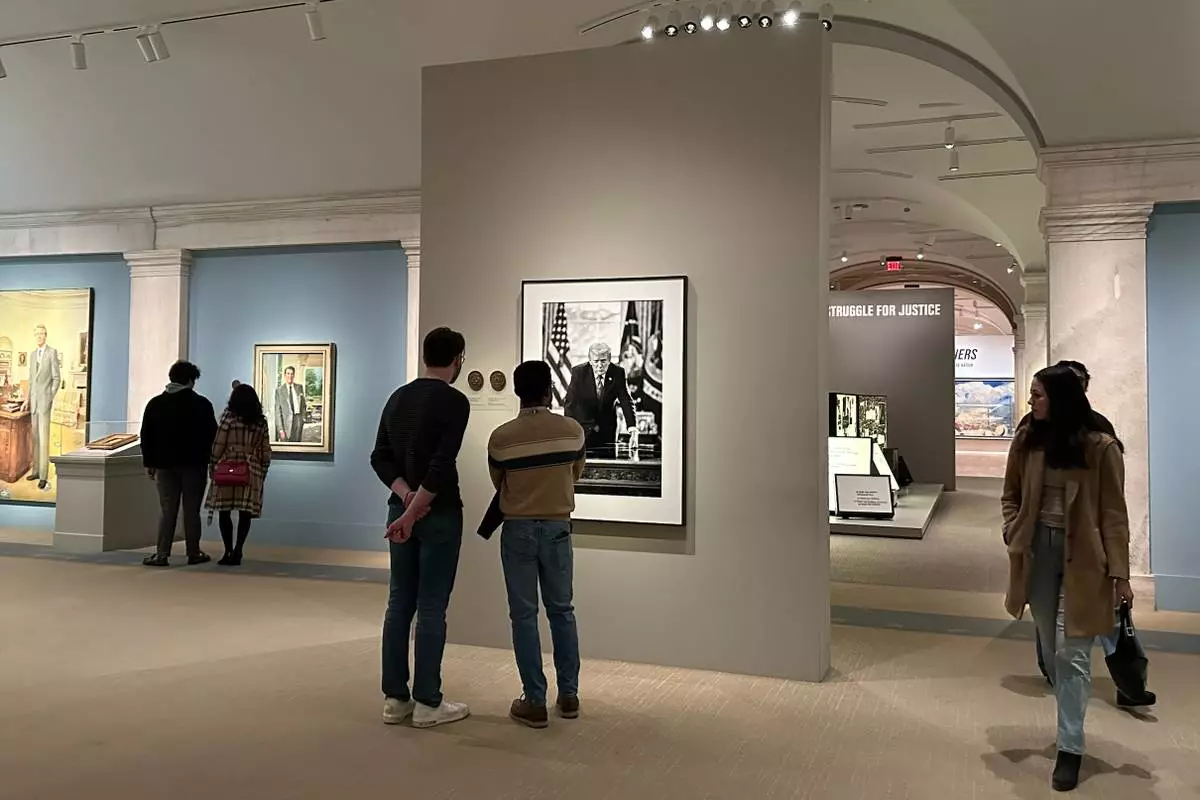
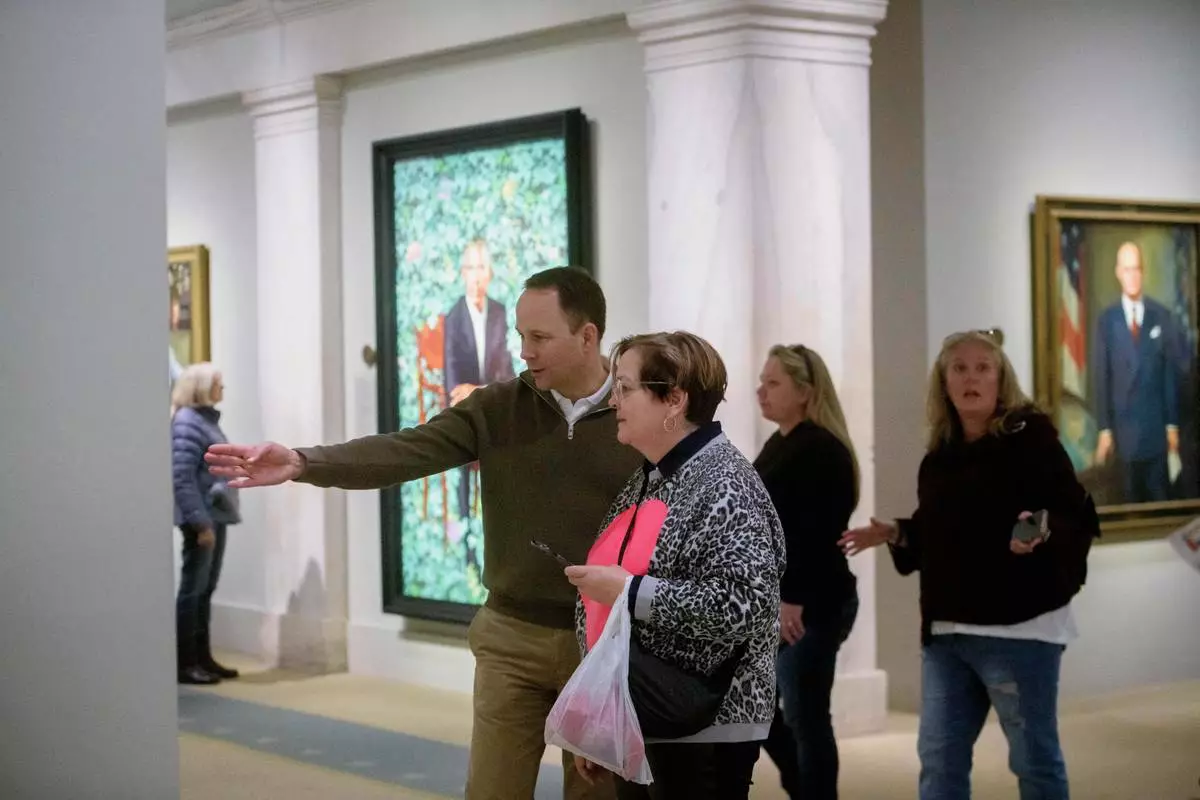
People react to a photograph of President Donald Trump on display at the Smithsonian's National Portrait Gallery's "American Presidents" exhibit on Sunday, Jan. 11, 2026 in Washington. (AP Photo/Rod Lamkey, Jr.)

People react to a photograph of President Donald Trump on display at the Smithsonian's National Portrait Gallery's "American Presidents" exhibit on Sunday, Jan. 11, 2026 in Washington. (AP Photo/Rod Lamkey, Jr.)

Visitors to the National Portrait Gallery walk past the portrait of President Donald Trump, Sunday, Jan. 11, 2026, in Washington. (AP Photo/Rod Lamkey, Jr.)

Visitors to the National Portrait Gallery walk past the portrait of President Donald Trump, Sunday, Jan. 11, 2026, in Washington. (AP Photo/Rod Lamkey, Jr.)

Visitors stop to look at a photograph of President Donald Trump and a short plaque next to it are on display at the Smithsonian's National Portrait Gallery's "American Presidents" exhibit on Sunday, Jan. 11, 2026 in Washington. (AP Photo/Rod Lamkey, Jr.)

Visitors stop to look at a photograph of President Donald Trump and a short plaque next to it are on display at the Smithsonian's National Portrait Gallery's "American Presidents" exhibit on Sunday, Jan. 11, 2026 in Washington. (AP Photo/Rod Lamkey, Jr.)

A photograph of President Donald Trump and a short plaque next to it are on display at the Smithsonian's National Portrait Gallery's "American Presidents" exhibit on Sunday, Jan. 11, 2026 in Washington. (AP Photo/Anna Johnson)

A photograph of President Donald Trump and a short plaque next to it are on display at the Smithsonian's National Portrait Gallery's "American Presidents" exhibit on Sunday, Jan. 11, 2026 in Washington. (AP Photo/Anna Johnson)

President Donald Trump speaks during a meeting with oil executives in the East Room of the White House, Friday, Jan. 9, 2026, in Washington. (AP Photo/Evan Vucci)

President Donald Trump speaks during a meeting with oil executives in the East Room of the White House, Friday, Jan. 9, 2026, in Washington. (AP Photo/Evan Vucci)

Recommended Articles