Ceremonies and events were held across China on Monday to commemorate the 88th anniversary of the start of the entire nation's resistance against Japanese aggression in 1937.
On Monday morning, air-raid sirens sounded across northwest China's Yan'an City, a former revolutionary base of the Communist Party of China (CPC). Moving vehicles came to a halt, and pedestrians stood silently, honoring the fallen heroes during the wartime and preserving the memory of this struggling period in China's history.
"We must never forget our national humiliation. We must remember the history, embrace the duty of this generation, and work together to build a better China," said a local youth Liu Sinan.
New evidence of Japan's biological warfare programs in China during its invasion time was made public on Monday. A complete video testimony CD from a former member of the infamous Unit 731, Japan's notorious germ warfare unit during World War II, was put on display for the first time at the Exhibition Hall of Evidences of Crime Committed by Unit 731 of the Japanese Imperial Army in northeast China's Heilongjiang Province.
Besides, Guangdong Provincial Archives unveiled key historical documents that further verify the war crimes done by the Unit 8604 in southern China, another Japanese biological warfare unit, over 80 years ago.
In southwest China's Chongqing, residents visited the local historical exhibition hall to learn about the Japanese bombing of the city on June 5, 1941, a tragic event that caused massive civilian casualties. The somber display is a memorial to the victims and reminder of this painful chapter in China's history.
"I want my child to learn about this history, to understand how hard-won our peaceful life was. May he study diligently and grow up to contribute to our country," said Pei Yuan, a Chongqing resident.
In Shanghai, residents laid flower baskets at the local memorial hall, paying solemn tribute to martyrs who sacrificed their lives during the War of Resistance Against Japanese Aggression.
In Beijing, visitors walked through the historic battle tunnel site, gaining a deeper understanding of the harsh combat conditions soldiers endured at that time.
At the Museum of the Northeast Anti-Japanese United Army in Jilin Province, the historical exhibitions showcased the soldiers' remarkable bravery and unyielding spirit.
"A visit to the Northeast Anti-Japanese United Army Museum offers me deep insights into the Party's spirit. We should also integrate the stories of the Northeast Anti-Japanese United Army into our ideological education and literature courses, instilling this kind of fighting spirit through education," said Xu Jianwei, a student at Yang Jingyu Cadre College.
In addition to commemoration from civilians, the Chinese military organized nationwide memorial activities in various forms, enabling the troops to reflect on wartime sacrifices and reaffirm their commitment to national defense.
"We will carry forward the martyrs' legacy, uphold their revolutionary spirit with hard training and unbreakable discipline. We will transform our deep remembrance for the revolutionary martyrs into powerful motivation for military training, fulfilling our duty as the new generation of soldiers through concrete actions," said Cui Yanyan, a soldier.
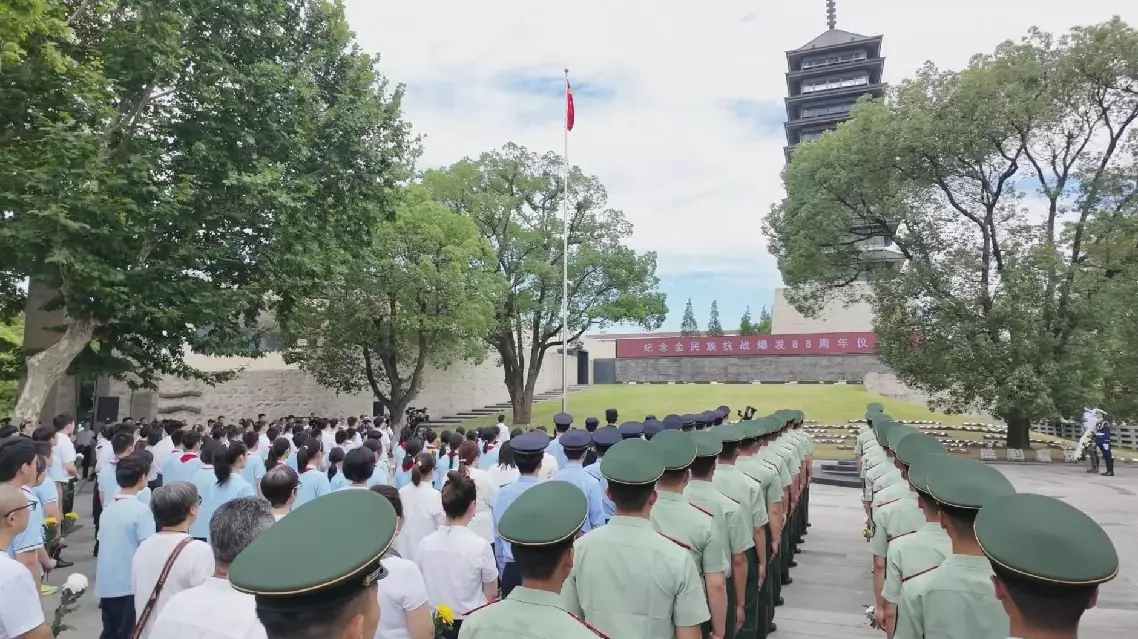
China marks 88th anniversary of whole-nation resistance against Japanese aggression