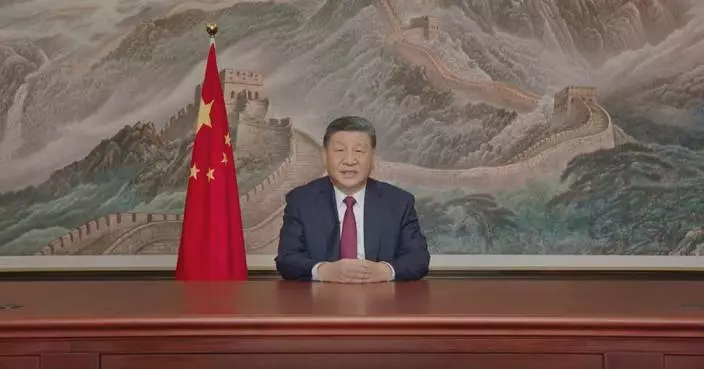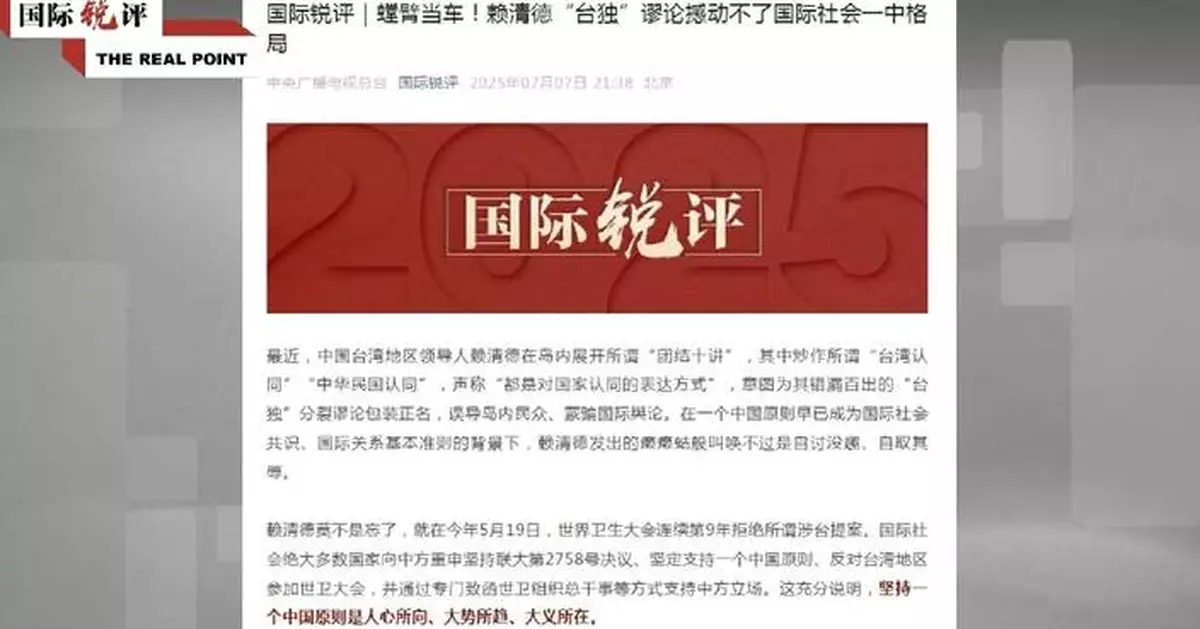
The recent speeches made by leader of China's Taiwan region Lai Ching-te cannot shake the one-China principle universally recognized by the international community, a China Media Group (CMG) commentary said on Monday, slamming Lai's so-called "10 Lectures on Unity" campaign launched in recent days.
An edited English-language version of the commentary is as follows:
Recently, Lai launched what he called the "10 lectures on unity" on the island.
His fallacy of "Taiwan separatism", full of mistakes and omissions, misled the people on the island and deceived international public opinion. Against the backdrop that the one-China principle has long been a consensus of the international community and a basic norm of international relations, Lai 's remarks are nothing but self-humiliation.
The World Health Assembly rejected the so-called Taiwan-related proposals for the ninth consecutive year on May 19 this year. The vast majority of countries in the world have reaffirmed their commitment to UN General Assembly Resolution 2758, their firm support for the one-China principle, their opposition to Taiwan region's participation in the World Health Assembly, and their support for China's position through special letters to the director-general of the World Health Organization, fully demonstrating that adhering to the one-China principle is where global opinion trends and the arc of history bends, and what the greater national interests entail. In fact, Lai's claims are absurd and deceptive from the perspectives of international law and international practice.
From the perspective of international law, a series of legal documents including the Cairo Declaration and the Potsdam Proclamation formed an important part of the post-World War II international order and have also laid the legal foundation of Taiwan being an inalienable part of China in the international law.
Resolution 2758 was adopted in 1971 by the U.N. General Assembly. It decided to restore all the lawful rights of the People's Republic of China at the United Nations and expelled forthwith the representatives of Chiang Kai-shek from the United Nations and all the organizations related to it.
From the perspective of international practice, the vast majority of UN member states observed UN General Assembly Resolution 2758 and severed "official ties" with the Taiwan authorities, recognizing that the government of the People's Republic of China is the only legitimate government representing China.
Any issue regarding Taiwan region's participation in the activities of international organizations must be resolved under the One-China principle.
Therefore, certain countries have repeatedly run into obstacles in their support for Taiwan's “participation in international organizations”. The United States has recently passed the "Taiwan Non-Discrimination Act", which requires the government to support the Taiwan region of China to join the International Monetary Fund. In response, the Chinese Ministry of Foreign Affairs explicitly urged the United States to earnestly abide by the one-China principles and the three China-U.S. joint communiques, uphold international law and the basic norms of international relations, and stop promoting relevant bills.
The one-China principle is also the fundamental premise and political foundation for the development of relations between China and other countries.
Now a total of 183 countries across the world have established diplomatic relations with China, and all of them have politically committed to adhering to the one-China principle. Some have explicitly opposed "Taiwan separatism", supported China's reunification and had them written into political documents such as the communique on the establishment of diplomatic relations with China and the joint statement. It fully proves that the one-China principle is the consensus of the international community and the basic norm of international relations.
According to the latest poll conducted by Taiwan's Formosa News, public satisfaction with Lai's governance has dropped to 44.7 percent, the lowest since he took office in May last year, and his trust level has also hit a new low since he took office.
Taiwan is an inalienable part of China, and this is the consensus of more than 1.4 billion Chinese people, including 23 million Taiwan compatriots, and also the consensus of the international community.
Lai's speeches cannot shake one-China principle: commentary