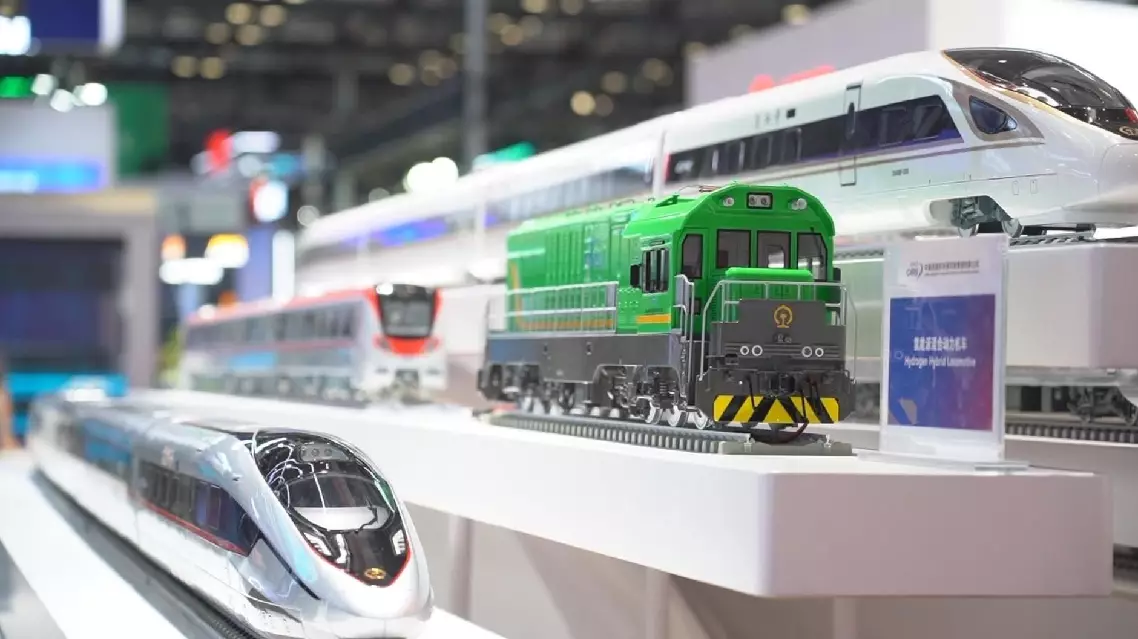
Global industry leaders are gathering in Beijing for the four-day 12th World Congress on High-Speed Rail which started on Tuesday, as they actively seek business partnerships in a country that has built the world's largest network of high-speed railways in just two decades.
More than 2,000 participants from over 60 countries, including railway technical professionals, enterprise leaders, government officials, and representatives from international organizations, attended the opening ceremony of this year's congress on the day, held under the theme "High-Speed Rail: Innovation and Development for a Better Life."
Many have come for the cutting-edge railway technology that has transformed intercity travel in China, which has evolved from a country with zero high-speed rail line at the beginning of the 21st century to the operator of the world's most extensive high-speed rail network with a combined length of 48,000 kilometers as of the end of 2024.
Today, Chinese-built high-speed rail lines is seen as a symbol of the country's economic strength, rapid modernization, growing technological prowess, and increasing prosperity.
At this year's congress, Chinese expertise and more importantly, cases of China's successful cooperation with other countries in this endeavor, are on display, as the country looks to share its state-of-the-art high-speed rail technology and innovation with the rest of the world.
Nicolas Lange, a member of the Executive Board of Knorr-Bremse, a German manufacturer of braking systems for rail and commercial vehicles, is showcasing his company's collaboration with China during this year's congress.
"This is the CAB-C brake control, which we have developed for the Chinese locomotives and this is fully developed in China. It's the first brake control of our services. It's entirely developed in China, not only the hardware you are seeing, also the electronics," he told China Global Television Network (CGTN) at the exhibition.
When China built its first railway tracks in the late 19th century, technology had to be brought in from Europe and Japan. The country has caught up fast and nowadays, what took decades in the 19th and early 20th centuries is being achieved in just a few years.
According to Lange, European countries now see Chinese high-speed rail technology as a source of inspiration and expect to build closer win-win partnerships with the country's top industry players.
"We were introducing the European technology first into China and then it evolved in China. The Chinese partners were getting more experienced, stronger, so we were influenced by China, vice versa. And nowadays our technology is a fusion out of what we brought from Europe plus the experience we gained in China. We can help also our Chinese partners to bring in their technology into Europe. So, it is for me a classical win-win," he said. After accomplishing an engineering feat on an unprecedented scale, China plans to expand its high-speed rail network to 70,000 kilometers by 2035. The 12th World Congress on High-Speed Rail is jointly organized by the China State Railway Group Corporation Limited and the International Union of Railways (UIC).
Initiated by the UIC in 1992, the congress has been held every two to three years since.
Global high-speed railway companies seek partnership with China for innovations