Against a backdrop of broad but vague assertions by President Donald Trump that the United States is going to “run” Venezuela after the ouster of Nicolás Maduro, a briefing by Secretary of State Marco Rubio and other top officials left questions among lawmakers about the administration’s next steps in the South American country.
Seemingly contradictory statements from Trump and Rubio have suggested at once that the U.S. now controls the levers of Venezuelan power or that the U.S. has no intention of assuming day-to-day governance and will allow Maduro’s subordinates to remain in leadership positions for now.
House Speaker Mike Johnson told reporters after Rubio's briefing late Monday that he does not expect the U.S. to deploy troops there.
The lack of clarity has wrought mounting concerns from lawmakers, Democrats especially, that Trump is embarking on a new era of U.S. expansionism without consultation of Congress or a clear vision for running Venezuela.
Here's the latest:
Venezuelan opposition leader and Nobel Peace Prize winner María Corina Machado spoke with Florida Republican Senator Rick Scott over the phone on Tuesday after being snubbed by President Donald Trump.
Scott said in a video posted to X that Machado told him over the phone that she was grateful for Trump’s “bold action to hold Maduro and his thugs accountable and work to restore freedom and democracy in Venezuela.”
It comes after Machado publicly thanked Trump for his “firmness and determination” and said she would give him her Nobel Prize, despite the president saying he didn’t believe she would be able to govern Venezuela after Maduro was ousted.
Trump’s comments over the weekend represented a major snub for Venezuela’s opposition, which the U.S. has maintained won the 2024 presidential election. Scott also said Machado asked that “political prisoners in Venezuela, including Americans, are immediately released.” Venezuela’s government denies holding political prisoners.
Spanish Prime Minister Pedro Sánchez on Tuesday said the U.S.’ military operation in Venezuela had set “a terrible precedent” that will “push the world toward a future of uncertainty and insecurity.”
“Spain never recognized Maduro’s government because it infringed on rules, because his election was illegitimate and precisely for that reason, it cannot recognize the legitimacy of a military action that is clearly illegal, violates international law and whose only objective seems to be none other than changing the government of another country to seize its natural resources,” he told reporters in Paris.
The vice president said in an interview on “The Scott Jennings Show” that when he was presented with details for the potential operation, “I think all of us were kind of skeptical, like can you actually do this, go into a foreign country, take zero dead Americans and actually, you know, take this indicted narcoterrorist, Nicholas Maduro?”
He said the operation was carried out “flawlessly.”
Vance said the ouster of Maduro will result in, among other things, cheaper gas and energy for Americans.
“Most importantly, it’s going to mean that we have more control over the energy resources that exist in the world, to achieve better economic results for our people and to use those energy resources as leverage to achieve greater peace and prosperity,” Vance said.
The South Carolina Republican, a close ally of Trump, said Tuesday that there is a regime change in Venezuela, but that it is taking place “through an election.”
“We’re going to build the country up – infrastructure wise – crescendoing with an election that will be free,” said Graham.
He added that the U.S. is now “in charge” of Venezuela and that “nothing’s going to happen in Venezuela that runs counter to our goal.” The new leaders in Venezuela, Graham pressed, “will do business with” the U.S. going forward.
Republican Sen. Lindsey Graham said he hopes the Trump administration’s tactics in Venezuela “spread to Cuba,” but expressed more caution when it comes to Greenland, calling the situation “a different deal.”
Democratic Sen. Chris Murphy said that in the wake of Venezuela and Trump’s recent comments, “you have to take these Greenland threats seriously now.” Asked about the implications of an invasion of Greenland, Murphy said it would be “the end of NATO.”
“If I’m a European member of NATO, I would reassess my participation in the endeavor if NATO countries are being invaded,” Murphy said.
The vast crowds of people in Venezuela’s capital marched, danced and pumped their fists Tuesday in a state-organized display of support for the government of toppled President Nicolas Maduro.
The streets of Caracas, deserted for days as fear descended following the Trump administration’s stunning capture of Maduro Saturday, briefly filled with masses of people waving Venezuelan flags and bouncing to patriotic music.
Marchers flashed V-for-victory signs in support of the autocratic government that remains in power despite Maduro’s ouster and President Donald Trump’s vow to “run” the country.
Hard-line Interior Minister Diosdado Cabello, one of the defendants named in the U.S. indictment unsealed Saturday, projected nonchalance as he waded through the crowd.
Wearing a blue cap emblazoned with the slogan “to doubt is to betray,” Cabello high-fived supporters and reveled in the festive atmosphere.
Typically, such rallies are orchestrated by the government, and many of those attending are bused in.
At least 24 Venezuelan security officers were killed in a U.S. military operation on Saturday, Venezuela’s military announced, bringing the official death count up to at least 56.
More civilians were killed in the strikes, Associated Press reporting shows, but it was immediately unclear how many.
Venezuela Attorney General Tarek William Saab said on Tuesday that “dozens” of officials and civilians were killed and that prosecutors would investigate the deaths in what he described as “war crime.” He didn’t specify if the estimate was specifically referring to Venezuelans.
The number is on top of an announcement by Cuba’s government on Sunday that 32 Cuban military and police officers working in Venezuela had died in the operation, prompting two days of mourning on the Caribbean island.
A video tribute to the slain Venezuelan security officials posted to the military’s Instagram features faces of many of those killed video layers over black-and-white videos of soldiers, American aircraft flying over Caracas and armored vehicles destroyed by the blasts.
It happened Tuesday while U.S. Ambassador Leandro Rizzuto was speaking at the headquarters of the Organization of American States in Washington as the regional body met for the first time since the U.S. attacked Venezuela and arrested President Nicolás Maduro.
“The majority of people are against this!” cried out Madea Benjamin, co-founder of Code Pink, a U.S.-based anti-war nonprofit. “Hands off Venezuela!”
She continued to cry out as OAS officials called for security guards who eventually led Benjamin out of the room.
“If you care enough about the Venezuelan people, you will lift the brutal sanctions!” Benjamin yelled.
Rizzuto resumed his speech after Benjamin was removed: “I understand there are many raw emotions.”
He called the strike a “targeted law enforcement action” against an “indicted criminal.”
“Let me be clear, the U.S. did not invade Venezuela,” Rizzuto said. “President Trump offered Maduro multiple offramps. This was not an interference in democracy … it actually removed the obstacle to it.”
The president, in remarks that neared 90 minutes, told House Republicans on Tuesday that the military operation in Venezuela was an “amazing military feat” and “brilliant tactically,” while also joking that Maduro, before he was deposed, had been imitating Trump’s style of dancing. But he offered few new details in his broad political remarks, nor any updates on the U.S. troops who were injured.
He also criticized Democrats for not praising him for the operation and said they should tell him he did a great job.
“I would say that if they did a good job, their philosophies are so different,” Trump said. “But if they did a good job, I’d be happy for the country.”
The South Dakota Republican was part of a group of congressional leaders briefed last night on the Trump administration’s plans in the South American country.
Thune says he was satisfied with those plans but that the next few days would show Venezuela’s “government structure and how willing they are to work with the U.S.”
Thune also called interim President Delcy Rodríguez a “practical person, pragmatic person and will understand the importance of figuring out a path forward to where America’s national security priorities can be prioritized by Venezuela.”
Florida Attorney General James Uthmeier is looking at whether a state criminal case can be built against Maduro for sending criminals to the state of Florida, the Republican governor said Tuesday at a news conference in Clearwater, Florida.
“He would empty his prisons and send them to America, across the border, and we’d end up with some of these people in Florida,” DeSantis said. “So, to me, that is a very hostile act, so we’re looking at statues to see.”
Florida’s Venezuelan population of under a half million people is the largest among any U.S. state.
Maduro pleaded not guilty Monday to federal drug trafficking charges in New York, two days after he and his wife were seized from their Caracas home in a middle-of-the-night military operation.
Colombia’s Foreign Affairs Minister Rosa Villavicencio said Tuesday she’ll meet with the U.S. embassy’s Charge D’Affaires in Bogota to present him with a formal complaint over the recent “threats” issued by the United States against Colombia.
On Sunday, Trump said he wasn’t ruling out an attack on Colombia and described its president, who’s been an outspoken critic of U.S. operations in Venezuela, as a “sick man who likes making cocaine and selling it to the United States.”
At a news conference, the Colombian Foreign Affairs Minister said however, that she’s hoping to strengthen relations with the United States and improve cooperation in the fight against drug trafficking, echoing comments made Monday by several members of Colombia’s cabinet.
“It is necessary for the Trump administration to know in more detail, about all that we are doing in the fight against drug trafficking,” Villavicencio said.
She was speaking during her morning press briefing Tuesday.
The leftist leader has been incredibly diplomatic in navigating larger regional geopolitical tensions, seeking to maintain a strong relationship with Trump while also firmly opposing American intervention in the region.
When asked by journalists, Sheinbaum described Maduro’s declaration that he was innocent in a New York court as “interesting.”
“Now that President Maduro has been detained, what we are asking for is a fair trial, as always,” she said after once again condemning the U.S. intervention.
The Trump administration is focused on intervention abroad. But headed into this year, Americans were less likely to want the government to focus on foreign policy than they had been in recent years.
About one-quarter of U.S. adults listed foreign policy topics, such as the Russia-Ukraine conflict, Israel or general involvement overseas, as something they wanted the government to prioritize in 2026 in a December AP-NORC poll. That was down from the prior two years, when roughly one-third of Americans considered foreign issues an important focus. Almost no one specifically named Venezuela.
Instead, Americans overall were more focused on domestic issues — including health care, economic worries and cost-of-living concerns — as top priorities for the government.
The discrepancy between what Trump and Rubio have said publicly hasn’t sat well with some former diplomats.
“It strikes me that we have no idea whatsoever as to what’s next,” said Dan Fried, a retired career diplomat, former assistant secretary of state and sanctions coordinator who served under both Democratic and Republican administrations.
“For good operational reasons, there were very few people who knew about the raid, but Trump’s remarks about running the country and Rubio’s uncomfortable walk back suggests that even within that small group of people, there is disagreement about how to proceed,” said Fried who’s now with the Atlantic Council think tank.
President Trump has made broad but vague assertions that the United States is going to “run” Venezuela after the ouster of Nicolás Maduro but has offered almost no details about how it will do so, raising questions among some lawmakers and former officials about the administration’s level of planning for the country after Maduro was gone.
Seemingly contradictory statements from Trump and Secretary of State Marco Rubio have suggested at once that the U.S. now controls the levers of Venezuelan power or that the U.S. has no intention of assuming day-to-day governance and will allow Maduro’s subordinates to remain in leadership positions for now.
Rubio said the U.S. would rely on existing sanctions on Venezuela’s oil sector and criminal gangs to wield leverage with Maduro’s successors.
The uncertainty on definitive next steps in Venezuela contrasts with the years of discussions and planning that went into U.S. military interventions that deposed other autocratic leaders, notably in Iraq in 2003, which still did not often lead to the hoped-for outcomes.
▶ Read more about U.S. planning for Venezuela
Only about 2 in 10 Venezuelans approved of the U.S. government, according to a 2025 Gallup World Poll conducted over the summer.
That measure was among the lowest approval ratings from Venezuela recorded in the poll going back to 2006. About two-thirds of Venezuelans disapproved of the U.S. government, which is in line with declines across Latin America between 2024 and 2025.
Maduro wasn’t especially popular at home, either. About 4 in 10 Venezuelans approved of Maduro’s leadership and the country’s leadership overall, according to that poll.
The country’s financial situation has been a point of concern for many Venezuelans. About 6 in 10 said they didn’t have enough money to afford food in the past 12 months, and roughly half said that about shelter. Just 1 in 10 Venezuelans reported they were living comfortably on their incomes, among the lowest in the region.
In her first televised interview since the U.S. capture of Nicolás Maduro, the Venezuelan opposition leader extensively praised the US. president, even saying she hoped to personally offer him her Nobel Peace Prize.
She did not acknowledge Trump’s snub of her opposition movement in favor of working with Maduro loyalist Delcy Rodríguez.
“I spoke with President Trump on Oct. 10, the same day the prize was announced, not since then,” she said on Fox News late Monday. “What he has done as I said is historic, and it’s a huge step toward a democratic transition.”
Trump hasn’t said if or when democratic elections will be held in Venezuela.
Speaking to Fox News host Sean Hannity on Monday night, Machado said she’d try to return “as soon as possible.”
Machado, in hiding for more than a year, also sharply criticized Venezuela’s new interim leader, Delcy Rodríguez, calling her unfit to lead any transitional authority and “one of the main architects of torture, persecution, corruption, narco trafficking.”
Shortly before Trump’s Saturday news conference on Maduro’s capture, Machado called on her ally Edmundo González — a retired diplomat widely considered to have won the country’s disputed 2024 presidential election — to “immediately assume his constitutional mandate and be recognized as commander in chief.”
Asked about Machado, Trump said he felt it would be “very tough” for her to lead.
Americans were split about the U.S. capturing Maduro — with many still forming opinions — according to a poll conducted by The Washington Post and SSRS using text messages over the weekend.
About 4 in 10 approved of the U.S. military being sent to capture Maduro, while roughly the same share were opposed. About 2 in 10 were unsure.
Nearly half of Americans, 45%, were opposed to the U.S. taking control of Venezuela and choosing a new government for the country. About 9 in 10 Americans said the Venezuelan people should be the ones to decide the future leadership of their country.
Republicans broadly approved of capturing Maduro, while a Quinnipiac poll from December found that Republicans were more divided on military action in Venezuela. About half were in support, while about one-third were opposed and 15% didn’t have an opinion.
Rubio, Hegseth and other top Trump administration officials are set to brief all senators as questions mount over the Venezuela operation.
That’s according to a person familiar with the private meeting who insisted in anonymity to discuss it.
It comes ahead of a war powers vote this week in the Senate that would prohibit further military action in the South American country without approval from Congress.
The classified briefing is set for Wednesday.
— Lisa Mascaro
The United Nations human rights office warns the military operation made “all states less safe around the world.”
Speaking to reporters Tuesday in Geneva, Ravina Shamdasani, the spokesperson for U.N. human rights chief Volker Türk, said that far from being a justified response to the Venezuelan government’s appalling human rights record, the Trump administration’s seizure of President Nicolás Maduro “damages the architecture of international security.”
“Accountability for human rights violations cannot be achieved by unilateral military intervention in violation of international law,” Shamdasani said.
There are few signs that President Trump’s supporters wanted the United States to become more embroiled in foreign conflicts ahead of its military actions in Venezuela — even as many Republicans show initial support for his military strike there, according to an Associated Press analysis of recent polling.
Most Americans wanted the U.S. government to focus in 2026 on domestic issues, such as health care and high costs, rather than foreign policy issues, an AP-NORC poll conducted last month found. Meanwhile, polling conducted in the immediate aftermath of the military operation that captured Venezuelan President Nicolás Maduro suggests many Americans are unconvinced the U.S. should step in to take control of the country.
And despite Trump’s suggestion that the U.S. may take a more expansive role in the Western Hemisphere, Republicans in polling last fall remained broadly opposed to the U.S. getting more involved in other countries’ problems.
▶ Read more about the recent polling
Cuban officials on Monday lowered flags before dawn to mourn 32 security officers they say were killed in the U.S. weekend strike in Venezuela, the island nation’s closest ally, as residents here wonder what it means for their future.
The two governments are so close that Cuban soldiers and security agents were often the Venezuelan president’s bodyguards, and Venezuela’s petroleum has kept the economically ailing island limping along for years. Cuban authorities over the weekend said the 32 had been killed in the surprise attack “after fierce resistance in direct combat against the attackers, or as a result of the bombing of the facilities.”
The Trump administration has warned outright that toppling Maduro will help advance another decades-long goal: Dealing a blow to the Cuban government. Severing Cuba from Venezuela could have disastrous consequences for its leaders, who on Saturday called for the international community to stand up to “state terrorism.”
On Saturday, Trump said the ailing Cuban economy will be further battered by Maduro’s ouster.
“It’s going down,” Trump said of Cuba. “It’s going down for the count.”
▶ Read more about the impact of the strikes on Cuba
In the wake of last weekend’s U.S. military action in Venezuela, the news media got something it has seldom heard from the Trump administration: a “thank you.”
Rubio credited news organizations that had learned in advance about last Saturday’s strike with not putting the mission in jeopardy by publicly reporting on it before it happened.
Rubio’s acknowledgment was particularly noteworthy because Defense Secretary Pete Hegseth has cited a mistrust of journalists’ ability to responsibly handle sensitive information as one of the chief reasons for imposing restrictive new press rules on Pentagon reporters. Most mainstream news organizations have left posts in the Pentagon rather than agree to Hegseth’s policy.
Speaking on ABC’s “This Week” on Sunday, Rubio said the administration withheld information about the mission from Congress ahead of time because “it will leak. It’s as simple as that.” But the primary reason was operational security, he said.
“Frankly, a number of media outlets had gotten leaks that this was coming and held it for that very reason,” Rubio said. “And we thank them for doing that or lives could have been lost. American lives.”
▶ Read more about Rubio’s comments
Republican leaders entered the closed-door session at the Capitol largely supportive of Trump’s decision to forcibly remove Madurofrom power, but many Democrats emerged with more questions as Trump maintains a fleet of naval vessels off the Venezuelan coast and urges U.S. companies to reinvest in the country’s underperforming oil industry.
A war powers resolution that would prohibit U.S. military action in Venezuela without approval from Congress is heading for a vote this week in the Senate.
“We don’t expect troops on the ground,” said House Speaker Mike Johnson, R-La., said afterward.
“This is not a regime change. This is demand for a change in behavior,” Johnson said. “We don’t expect direct involvement in any other way beyond just coercing the new, the interim government, to get that going.”
But Sen. Jeanne Shaheen of New Hampshire, the ranking Democrat on the Senate Foreign Relations Committee, emerged saying, “There are still many more questions that need to be answered.”
▶ Read more about the briefing
Both allies and adversaries of the United States on Monday used an emergency meeting of the U.N. Security Council to voice opposition to the audacious U.S. military operation in Venezuela that captured leader Nicolás Maduro.
Before the U.N.’s most powerful body, countries critiqued — if sometimes obliquely — President Donald Trump’s intervention in the South American country and his recent comments signaling the possibility of expanding military action to countries like Colombia and Mexico over drug trafficking accusations. The Republican president also has reupped his threat to take over the Danish territory of Greenland for the sake of U.S. security interests.
Denmark, which has jurisdiction over the mineral-rich island, carefully denounced U.S. prospects for taking over Greenland without mentioning its NATO ally by name.
“The inviolability of borders is not up for negotiation,” said Christina Markus Lassen, Danish ambassador to the U.N.
She also defended Venezuela’s sovereignty, saying “no state should seek to influence political outcomes in Venezuela through the use of threat of force or through other means inconsistent with international law.”
▶ Read more about the UN’s emergency meeting
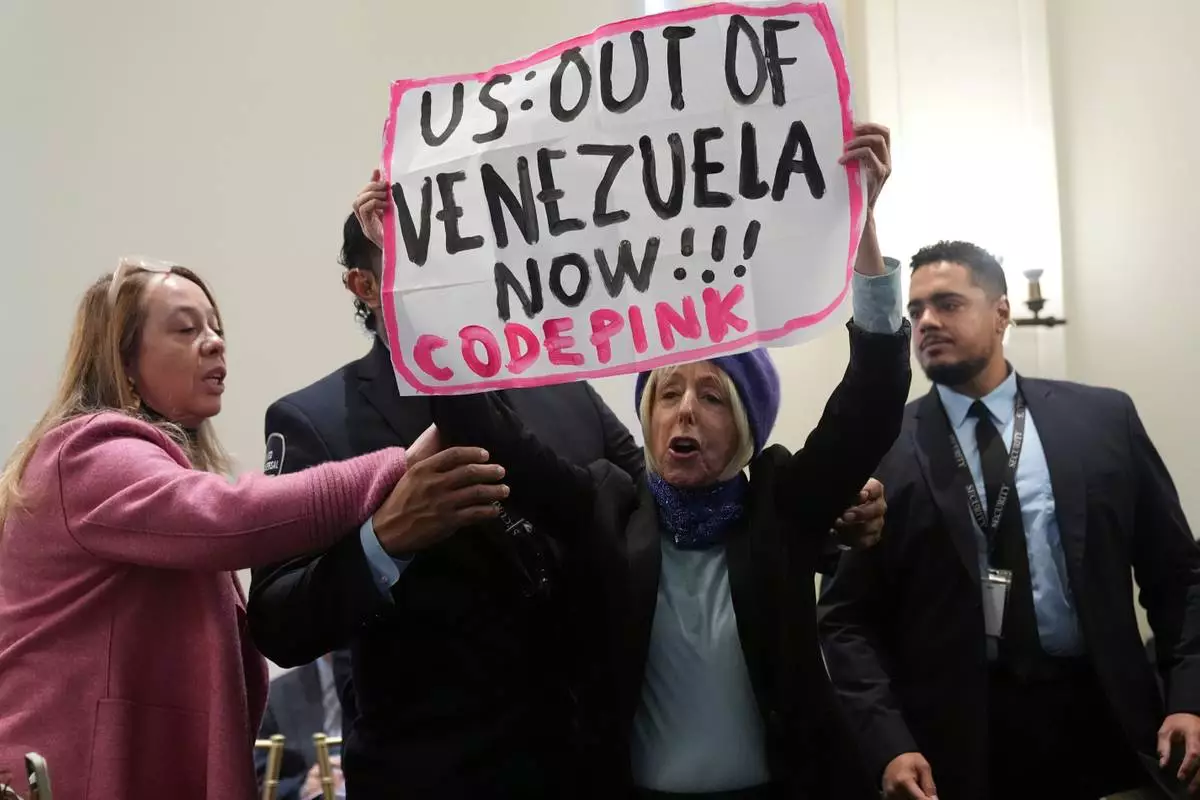
CORRECTS SPELLING TO MEDEA NOT MADEA Medea Benjamin, co-founder of Code Pink, interrupts a meeting at the Organization of American States (OAS) about Venezuela, Tuesday, Jan. 6, 2026, at the OAS in Washington. (AP Photo/Jacquelyn Martin)
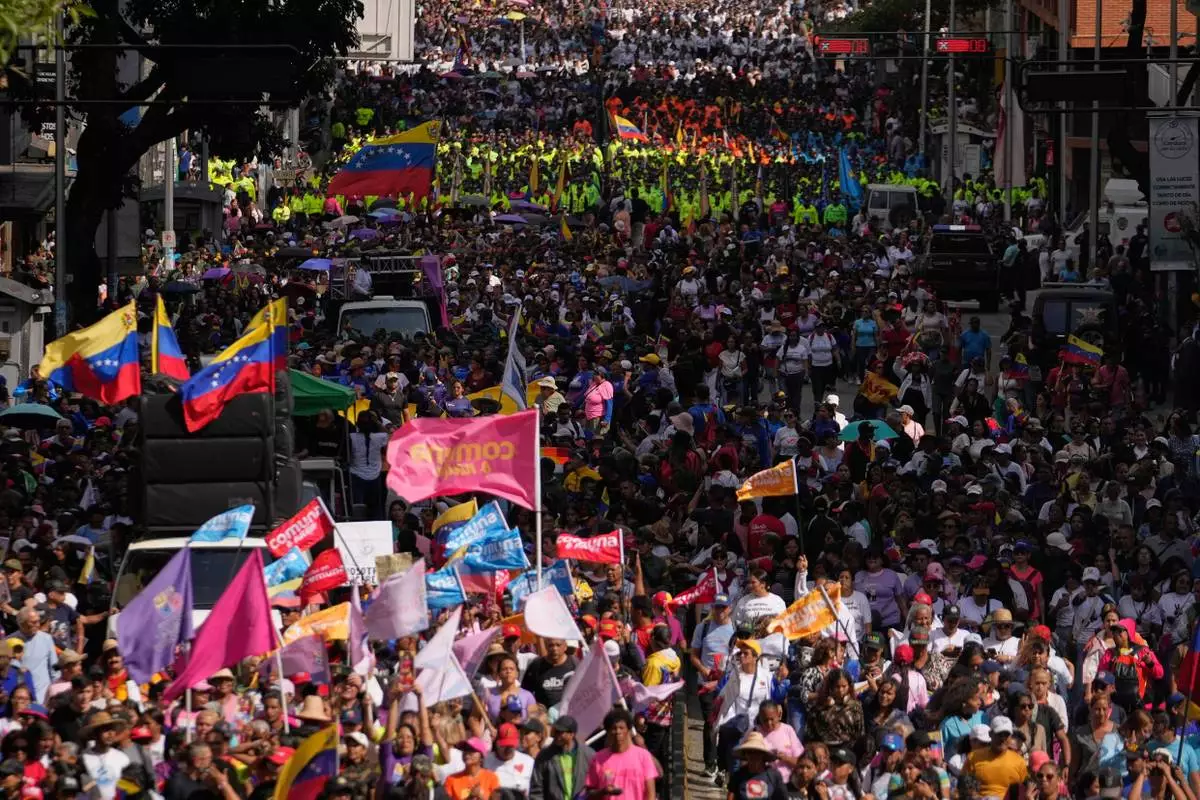
Government supporters gather for a women's march to demand the return of Venezuelan President Nicolas Maduro in Caracas, Venezuela, Tuesday, Jan. 6, 2026, three days after U.S. forces captured him and his wife. (AP Photo/Matias Delacroix)
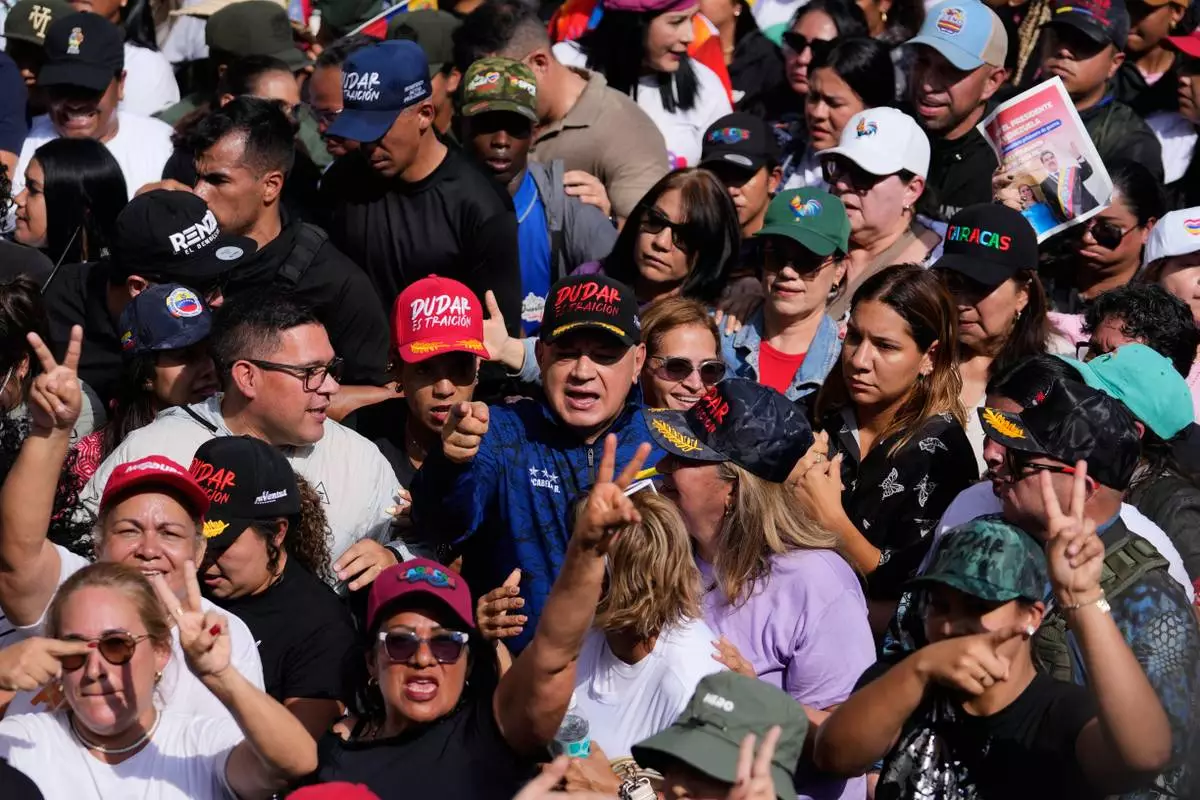
Interior Minister Diosdado Cabello, center, attends a women's march to demand the return of Venezuelan President Nicolas Maduro in Caracas, Venezuela, Tuesday, Jan. 6, 2026, three days after U.S. forces captured him and his wife. (AP Photo/Matias Delacroix)
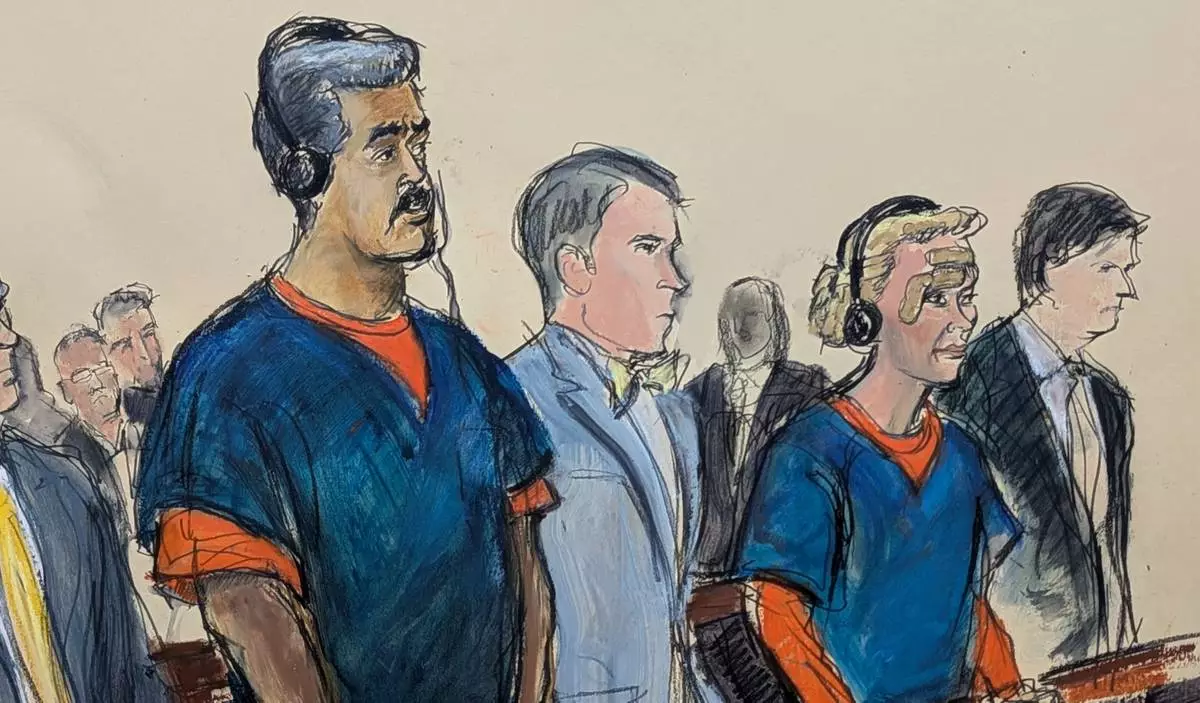
In this courtroom sketch, Venezuelan President Nicolas Maduro, left, and his wife, Cilia Flores, second from right, appear in Manhattan federal court with their defense attorneys Mark Donnelly, second from left, and Andres Sanchez, Monday, Jan. 5, 2026, in New York. (Elizabeth Williams via AP)
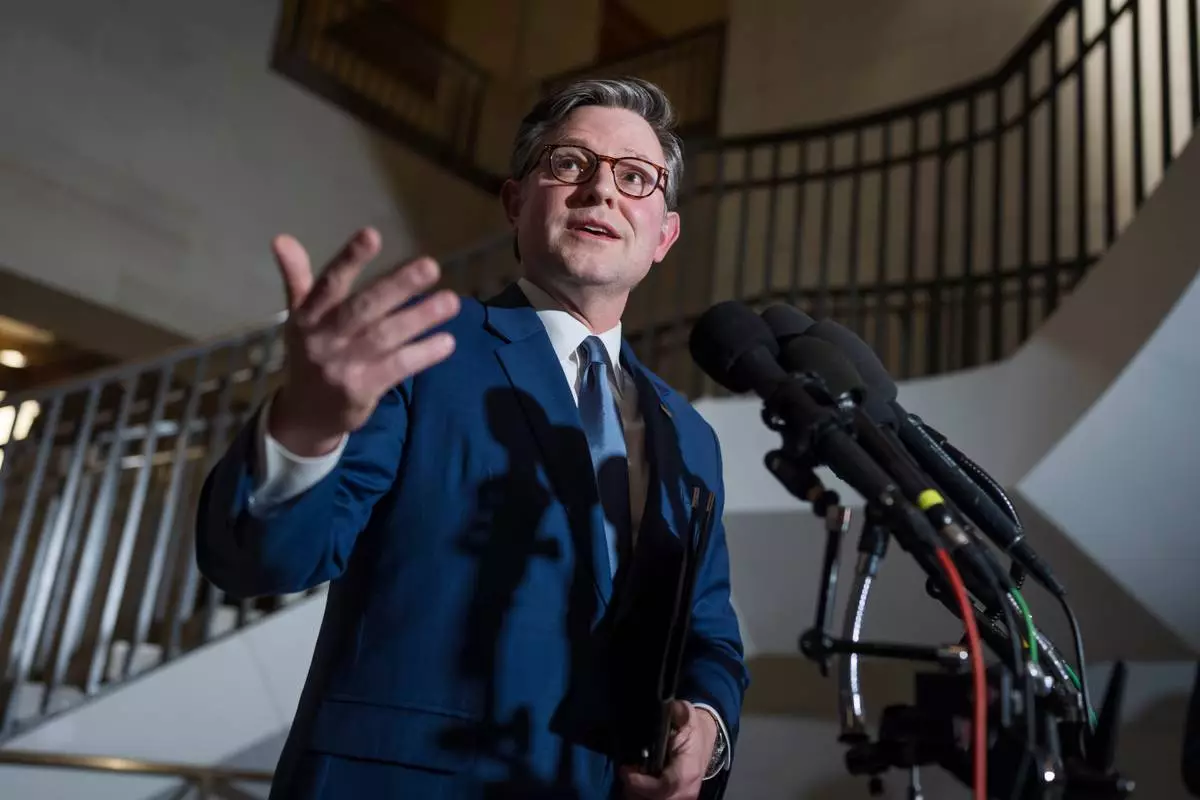
Speaker of the House Mike Johnson, R-La., answers questions from reporters following a closed-door briefing from Secretary of State Marco Rubio, Defense Secretary Pete Hegseth, and others about the U.S. military operation in Venezuela ordered by President Donald Trump, at the Capitol in Washington, Monday, Jan. 5, 2026. (AP Photo/J. Scott Applewhite)