GENEVA (AP) — Two-time Olympic champion runner Caster Semenya won a partial victory at the European Court of Human Rights on Thursday in her seven-year legal fight against track and field’s sex eligibility rules.
The court’s 17-judge highest chamber said in a 15-2 vote that Semenya had some of her rights to a fair hearing violated at Switzerland’s Supreme Court, where she had appealed against a ruling by the Court of Arbitration for Sport in favor of track's World Athletics.
Click to Gallery

South Africa's Caster Semenya, center, answers reporters with lawyer Gregory Nott, left, after Semenya won a partial victory at the European Court of Human Rights on in her seven-year legal fight against track and field's sex eligibility rules, Thursday, July 10, 2025 in Strasbourg, eastern France. (AP Photo/Antonin Utz)
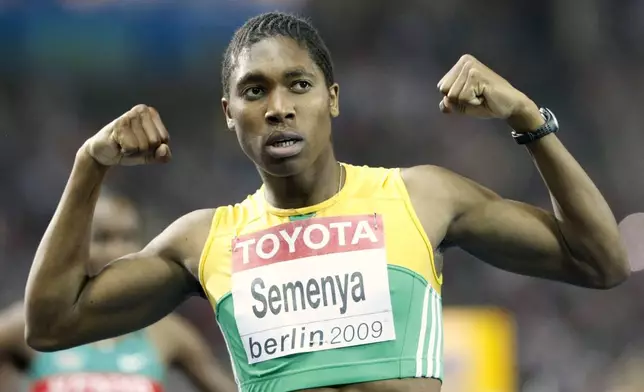
FILE -South Africa's Caster Semenya celebrates after winning the gold medal in the final of the Women's 800m during the World Athletics Championships in Berlin on Aug. 19, 2009. (AP Photo/Anja Niedringhaus, File)

South Africa's Caster Semenya, center, answers reporters with lawyers Gregory Nott, left, and Shona Jolly KC after Semenya won a partial victory at the European Court of Human Rights on in her seven-year legal fight against track and field's sex eligibility rules, Thursday, July 10, 2025 in Strasbourg, eastern France. (AP Photo/Antonin Utz)

South Africa's Caster Semenya sits in the European Court of Human Rights before its decision over sex eligibility rules in sports, Thursday, July 10, 2025 in Strasbourg, eastern France. (AP Photo/Antonin Utz)

South Africa's Caster Semenya speaks to lawyer Gregory Nott, right, in the European Court of Human Rights before a decision over sex eligibility rules in sports, Thursday, July 10, 2025 in Strasbourg, eastern France. (AP Photo/Antonin Utz)

South Africa's Caster Semenya leaves in the European Court of Human Rights Thursday, July 10, 2025 in Strasbourg, eastern France. (AP Photo/Antonin Utz)
However, the court declined to rule on several other aspects of Semenya’s case, including on the question of whether she was discriminated against in Swiss courts. The European court in Strasbourg, France, said those issues were outside Switzerland's jurisdiction, although four of the 17 judges gave a partial dissent to the majority view.
Semenya's case should now go back to the Swiss federal court in Lausanne. It will be watched closely by other sports which have passed or are reviewing their own rules on eligibility in women's events.
Semenya later posted on social media a photo of herself in the court chamber with a message a three raised fists symbolizing her fight for justice.
“Today, my patience in this journey has been rewarded with a result that will pave the way for all athletes’ human rights to be protected,” she said in a statement.
The original case between Semenya and track’s governing body based in Monaco was about whether athletes like her — who have specific medical conditions, a typical male chromosome pattern and naturally high testosterone levels — should be allowed to compete freely in women’s sports.
The European court’s ruling does not overturn the World Athletics rules that effectively ended Semenya’s career running the 800 meters after she won two Olympic and three world titles since emerging on the global stage as a teenager in 2009.
The judges also did not take up other aspects of the appeal filed by Semenya, who was in court to hear their judgment read. It awarded her 80,000 euros ($94,000) from the state of Switzerland “in respect of costs and expenses.”
The key legal point in Semenya's win was that the Swiss Federal Court had not carried out a “rigorous judicial review.” This was required because Semenya had no choice but to pursue her case through the CAS's “mandatory and exclusive jurisdiction.” the Strasbourg judges ruled.
Governing bodies of sports oblige athletes and national federations to take their disputes to the sports court in the International Olympic Committee's home city Lausanne.
“The court considered, however, that the Federal Supreme Court’s review had fallen short of that requirement,” it said in a statement.
In dismissing other elements of the South African runner’s case, including if she had been discriminated against, the court judged it “did not fall within Switzerland’s jurisdiction in respect of those complaints.”
World Athletics, led by its president Sebastian Coe, has said its rules maintain fairness because Semenya has an unfair, male-like athletic advantage from her higher testosterone. Semenya argues her testosterone is a genetic gift.
World Athletics and CAS did not immediately respond to the ruling. The IOC declined to comment on a case it is not directly involved in.
Thursday's win followed a legal victory from the same court two years ago for Semenya.
That judgment which said she had faced discrimination opened a way for the Swiss supreme court to reconsider its decision to dismiss her appeal against the CAS verdict in favor of World Athletics.
At CAS in 2019, three judges ruled 2-1 that discrimination against Semenya was “necessary, reasonable and proportionate” to maintain fairness in women’s track events.
World Athletics drew up its rules in 2018 forcing Semenya and other female athletes with Differences in Sex Development to suppress their testosterone to be eligible for international women’s events.
Four of the 17 judges filed a partial dissent to the majority opinion, arguing their court should have been able to pronounce on “substantive conclusions” reached by the CAS that went against Semenya.
World Athletics eligibility rules “specifically targeted the applicant, since they concerned only the events in which she competed — indeed, the fact that they amounted to a kind of ‘lex Semenya’ clearly demonstrates the arbitrariness of those regulations as a whole,” the four judges wrote.
“We are disappointed that her expectations have not been met,” said the dissenting judges, who included the chamber president, Marko Bošnjak from Slovenia.
Semenya refused to take medication to lower her natural testosterone levels and so last competed internationally in the 800 in 2019, winning at the Prefontaine Classic meeting on the Diamond League circuit in Eugene, Oregon. It extended her winning streak to more than 30 consecutive races when the rules made her ineligible.
Her winning time then of 1 minute, 55.70 seconds was faster than the gold medal-winning time at the 2024 Paris Olympics but not the 1:55.21 run by Athing Mu of the United States at the Tokyo Olympics held in 2021.
Semenya returned to Eugene in 2022 to race in the world championships over 5,000 but did not advance from the heats.
She is now 34 and has moved into coaching. She said recently her ongoing legal fight is about a principle rather than her own running career.
“I have given up what I wanted in the hope that others may have what they need,” Semenya said Thursday. "I hope this victory will inspire young women to be and to accept themselves in all their diversity.”
Imray reported from Cape Town, South Africa
AP Sports: https://apnews.com/sports

South Africa's Caster Semenya, center, answers reporters with lawyer Gregory Nott, left, after Semenya won a partial victory at the European Court of Human Rights on in her seven-year legal fight against track and field's sex eligibility rules, Thursday, July 10, 2025 in Strasbourg, eastern France. (AP Photo/Antonin Utz)
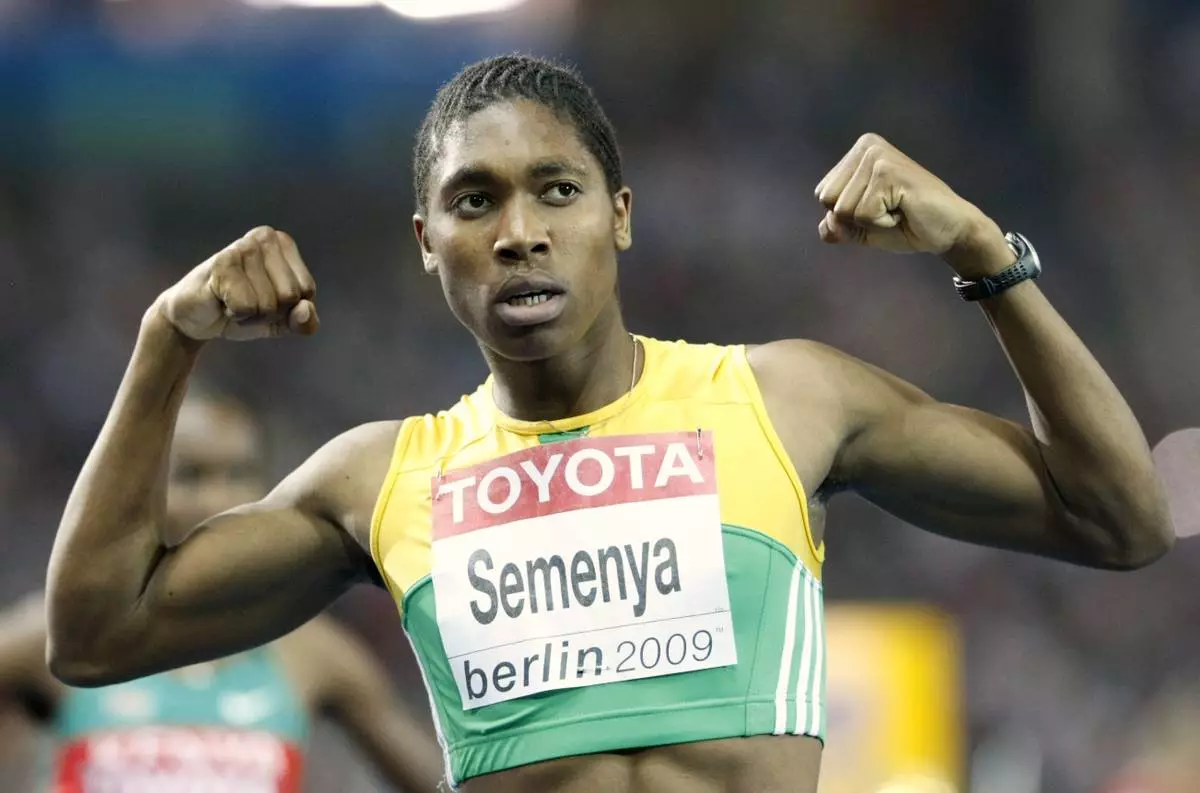
FILE -South Africa's Caster Semenya celebrates after winning the gold medal in the final of the Women's 800m during the World Athletics Championships in Berlin on Aug. 19, 2009. (AP Photo/Anja Niedringhaus, File)

South Africa's Caster Semenya, center, answers reporters with lawyers Gregory Nott, left, and Shona Jolly KC after Semenya won a partial victory at the European Court of Human Rights on in her seven-year legal fight against track and field's sex eligibility rules, Thursday, July 10, 2025 in Strasbourg, eastern France. (AP Photo/Antonin Utz)

South Africa's Caster Semenya sits in the European Court of Human Rights before its decision over sex eligibility rules in sports, Thursday, July 10, 2025 in Strasbourg, eastern France. (AP Photo/Antonin Utz)

South Africa's Caster Semenya speaks to lawyer Gregory Nott, right, in the European Court of Human Rights before a decision over sex eligibility rules in sports, Thursday, July 10, 2025 in Strasbourg, eastern France. (AP Photo/Antonin Utz)

South Africa's Caster Semenya leaves in the European Court of Human Rights Thursday, July 10, 2025 in Strasbourg, eastern France. (AP Photo/Antonin Utz)