The Philippines' recent infringing activities in the South China Sea are primarily driven by domestic political needs and strategic miscalculations, according to experts.
According to the Chinese military, Philippine aircraft made multiple illegal and dangerous intrusions recently into the airspace of China's Nansha Qundao (Islands) in the South China Sea. And it says China's naval forces remain on high alert to defend national sovereignty and maintain peace and stability in the area.
On February 18, 2025, a Philippine aircraft entered the airspace of China's Huangyan Dao in the South China Sea, triggering a swift response from the Southern Theater Command of the People's Liberation Army of China.
The Chinese military stated that the aircraft intruded erratically, dangerously altering altitudes to fly close to a Chinese patrol helicopter.
Such air intrusions began in August last year. They have become more frequent since November when the Philippines signed its "Maritime Zones Act" into law, claiming China's Huangyan Dao and most of the islands and reefs of China's Nansha Qundao, and their relevant waters were inside the Philippines' maritime zones.
The Chinese government says this seriously infringes upon China's sovereignty and seriously violates international law and relevant provisions of Chinese laws. China demands that the Philippines immediately cease all acts of infringement and provocations.
The Chinese government issued a statement immediately after this and declared the baselines of the territorial sea adjacent to Huangyan Dao.
The baselines were delineated and published in accordance with the UN Convention on the Law of the Sea and other international laws, as well as the Law of the People's Republic of China on the Territorial Sea and the Contiguous Zone.
"Now with the baselines of the territorial sea in place, China's maritime police enforcement and control have become very strict. No one is allowed to approach within six nautical miles. Otherwise, they will be driven away," said Wu Shicun, chairman of the Huayang Research Center for Maritime Cooperation and Ocean Governance.
Experts on the issue say the current Philippine government is gambling with the timing of its recent moves.
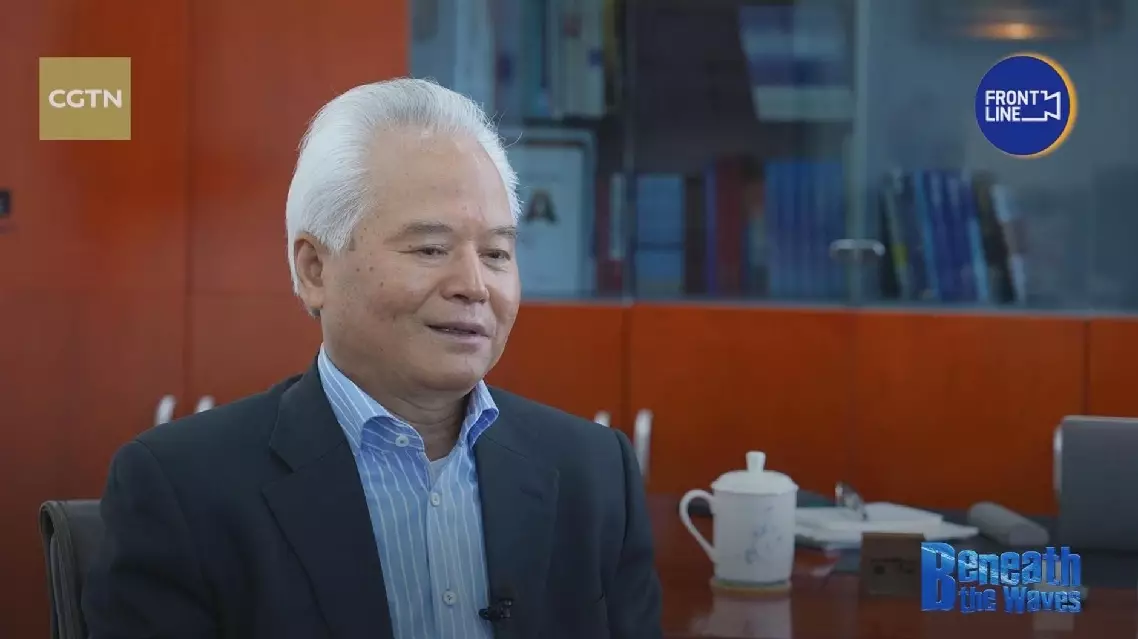
Hu Bo, research professor and director of the Center for Maritime Strategy Studies at Peking University, identified two critical misjudgments by the Philippines, First, the China-U.S. competition created exploitable opportunities and Washington would offer unequivocal support for the Philippines. Second, it miscalculated that China's focus on multiple challenges would preclude it from making decisive responses to Philippine provocations.
China, however, clearly shows its determination to defend its sovereignty over Huangyan Dao, not only in the waters but also in airspace.
"The Chinese government has sovereignty over the airspace above Huangyan Dao. So if the Philippines wants to go into the airspace above Huangyan Dao, it would need to apply for approval," said Shi Yubing, dean of the South China Sea Institute at Xiamen University.
It is also believed that the Philippines' recent moves in the South China Sea could be a reflection of the current government's attempt to increase its popularity because it faces pressure in elections this year.
Experts warn against the serious consequences of such provocations.
"If the Philippines continues to make provocations, I think the possibility of an accident occurring over Huangyan Dao is increasing. However, the biggest problem for the Philippines is that its decision-makers simply haven't considered other factors and haven't realized the consequences," said Prof. Hu.
In the meantime, the China Coast Guard says that it will coordinate with the air response to form a sea-air collaborative system, safeguarding China's territorial sovereignty and maritime rights and interests in the South China Sea.
Domestic politics, strategic misjudgment behind Philippine air intrusions in South China Sea: experts