President Donald Trump has pledged to deport “the worst of the worst.” He frequently speaks at public appearances about the countless “dangerous criminals” — among them murderers, rapists and child predators — from around the world he says entered the U.S. illegally under the Biden administration. He promises to expel millions of migrants in the largest deportation program in American history to protect law-abiding citizens from the violent threats he says they pose.
But government data around ongoing detentions tells a different story.
There has been an increase of arrests by U.S. Immigration and Customs Enforcement since Trump began his second term, with reports of raids across the country. Yet the majority of people currently detained by ICE have no criminal convictions. Of those who do, relatively few have been convicted of high-level crimes — a stark contrast to the chilling nightmare Trump describes to support his border security agenda.
“There's a deep disconnect between the rhetoric and the reality,” said Ahilan Arulanantham, co-faculty director of the UCLA Law School's Center for Immigration Law and Policy. “This administration, and also in the prior Trump administration, they consistently claim to be going after the worst of the worst and just talk about immigration enforcement as though it is all about going after violent, dangerous people with extensive criminal histories. And yet overwhelmingly, it's people they're targeting for arrest who have no criminal history of any kind.”
The latest ICE statistics show that as of June 29, there were 57,861 people detained by ICE, 41,495 — 71.7% — of whom had no criminal convictions. That includes 14,318 people with pending criminal charges and 27,177 who are subject to immigration enforcement, but have no known criminal convictions or pending criminal charges.
Each detainee is assigned a threat level by ICE on a scale of 1 to 3, with one being the highest. Those without a criminal record are classified as having “no ICE threat level.” As of June 23, the latest data available, 84% of people detained at 201 facilities nationwide were not given a threat level. Another 7% had been graded as a level 1 threat, 4% were level 2 and 5% were level 3.
“President Trump has justified this immigration agenda in part by making false claims that migrants are driving violent crime in the United States, and that's just simply not true,” said Lauren-Brooke Eisen, senior director of the justice program at the Brennan Center for Justice. “There's no research and evidence that supports his claims.”
Tricia McLaughlin, an assistant secretary at the Department of Homeland Security, called the assessment that ICE isn't targeting immigrants with a criminal record “false" and said that DHS Secretary Kristi Noem has directed ICE “to target the worst of the worst—including gang members, murderers, and rapists.” She counted detainees with convictions, as well as those with pending charges, as “criminal illegal aliens.”
Nonpublic data obtained by the Cato Institute shows that as of June 14, 65% of the more than 204,000 people processed into the system by ICE since the start of fiscal year 2025, which began Oct. 1, 2024, had no criminal convictions. Of those with convictions, only 6.9% had committed a violent crime, while 53% had committed nonviolent crimes that fell into three main categories — immigration, traffic, or vice crimes.
Total ICE arrests shot up at the end of May after White House Deputy Chief of Staff Stephen Miller gave the agency a quota of 3,000 arrests a day, up from 650 a day in the first five months of Trump’s second term. ICE arrested nearly 30% more people in May than in April, according to the Transactional Records Clearinghouse, or TRAC. That number rose again in June, by another 28%.
The Cato Institute found that between Feb. 8 and May 17, the daily average of “noncriminals” processed into the system ranged from 421 to 454. In the following two weeks at the end of May, that number rose to 678 and then rose to 927 in the period from June 1 through 14.
“What you're seeing is this huge increase in funding to detain people, remove people, enforce immigration laws," Eisen said. "And what we're seeing is that a lot of these people back to sort of the original question you asked, these are not people who are dangerous.”
Abigail Jackson, a White House spokesperson, said the administration is intensely focused on rooting out unvetted criminals who are in the country illegally.
“Just this week, the Administration conducted a successful operation rescuing children from labor exploitation at a marijuana facility in California, and continued arresting the worst of the worst – including murderers, pedophiles, gang members, and rapists,” she wrote in an email. "Any suggestion that the Administration is not laser focused on these dangerous criminals is flat out wrong.”
While most ICE detainees are not convicted criminals, there are detainees who have committed serious crimes. On Friday, the administration released information on five high-level offenders who had been arrested.
During his campaign, Trump highlighted several cases where immigrants in the country illegally were arrested for horrific crimes. Among them: The killing of 22-year-old Laken Riley, a Georgia nursing student who was slain last year by a Venezuelan man in the U.S. illegally. Jose Ibarra was found guilty of murder and other crimes in Riley’s February 2024 killing and sentenced him to life in prison without the possibility of parole. Ibarra is seeking a new trial.
Trump in January signed into law the Laken Riley Act, which requires the detention of unauthorized immigrants accused of theft and violent crimes.
Research has consistently found, however, that immigrants are not driving violent crime in the U.S. and that they actually commit fewer crimes than native-born Americans. A 2023 working paper from the National Bureau of Economic Research, for example, reported that immigrants for 150 years have had lower incarceration rates than those born in the U.S. In fact, the rates have declined since 1960 — according to the paper, immigrants were 60% less likely to be incarcerated.
Experts say the false rhetoric coming out of the Trump administration creates real harm.
“It makes people in immigrant communities feel targeted and marginalized,” Arulanantham said. “It creates more political and social space for hate in all its forms, including hate crime against immigrant communities.”
Eisen noted that the impact extends to other communities as well.
“All Americans should want safe and thriving communities and this idea that the president of the United States is making misleading statements about the truth and distorting reality is not the way to deliver public safety,” she said.
Find AP Fact Checks here: https://apnews.com/APFactCheck.
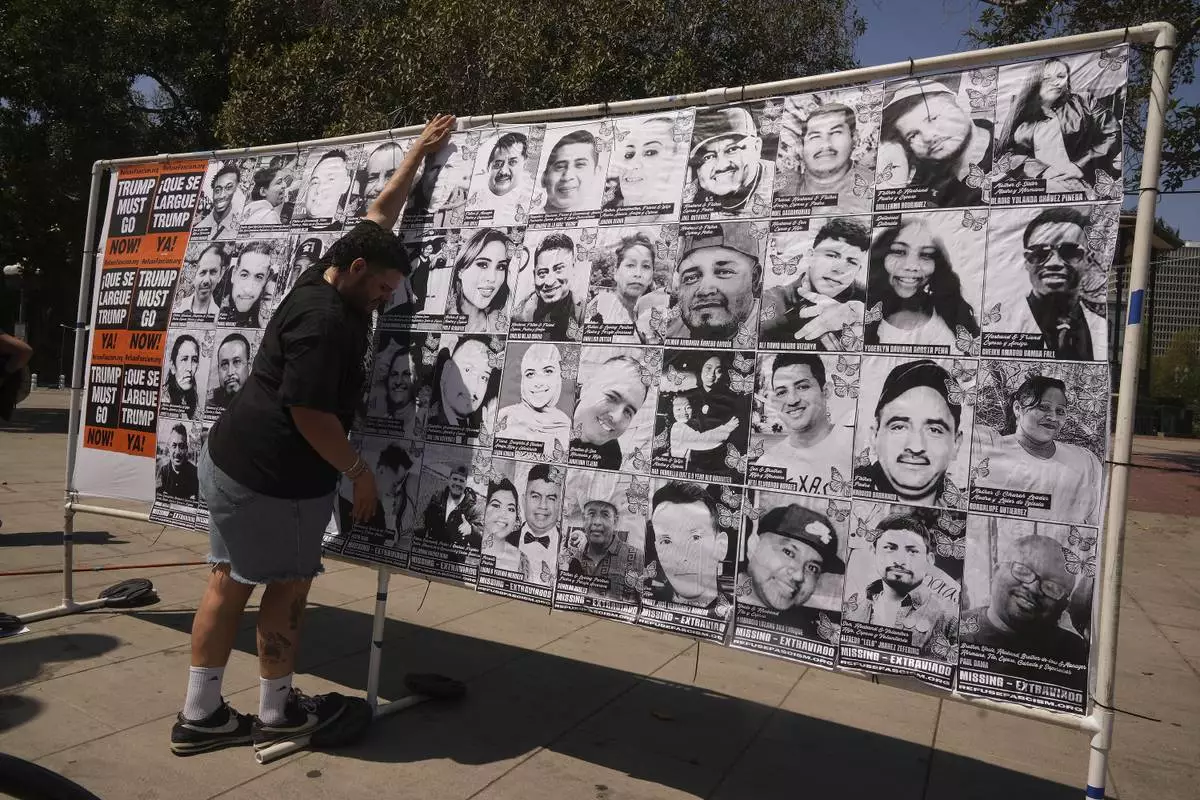
A volunteer sets up an art installation displaying names and faces of people who have been detained, deported, or sent to offshore camps during ICE raids in Southern California, at Olvera Street Plaza in Los Angeles, on Thursday, July 3, 2025. (AP Photo/Damian Dovarganes)