GQEBERHA, South Africa (AP) — South Africa smothered Italy 45-0 with only 14 men at Nelson Mandela Bay Stadium and swept their two-test rugby series on Saturday.
No. 8 Jasper Wiese was sent off in the 22nd minute for head-butting Italy prop Danilo Fischetti. His first international red card spoiled the chance to play with his younger brother Cobus, who made his Springboks debut in the second half.
Click to Gallery
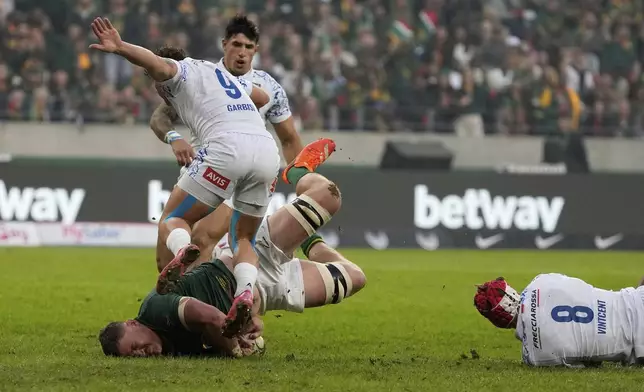
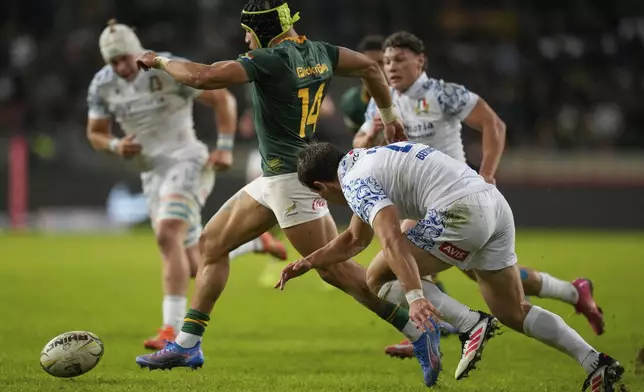
South Africa's Jasper Wiese, left, falls to the ground after by Italy's Ross Vintcent, right, during a rugby championship test match between South Africa and Italy, at the Nelson Mandela Bay stadium in Gqeberha, South Africa, Saturday, July 12, 2025. (AP Photo/Themba Hadebe)
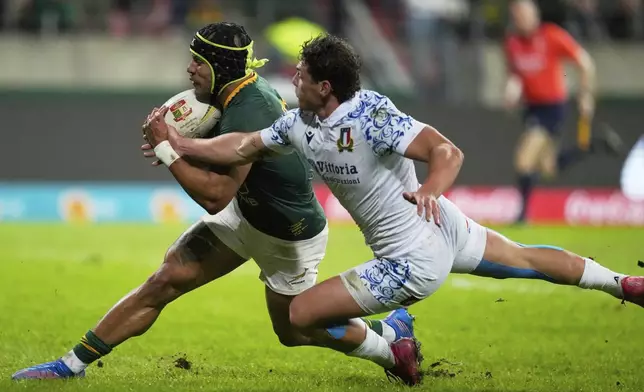
South Africa's Edwill van der Merwe, left, scores a try as Italy's Alessandro Garbisi tries to defend during a rugby championship test match between South Africa and Italy, at the Nelson Mandela Bay stadium in Gqeberha, South Africa, Saturday, July 12, 2025. (AP Photo/Themba Hadebe)
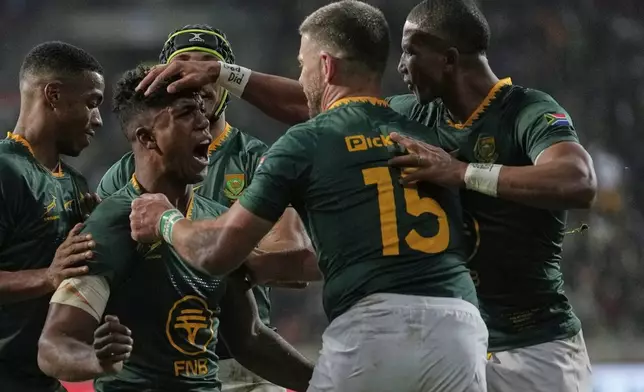
South Africa's Canan Moodie, left, celebrates with teammates after scoring a try during a rugby championship test match between South Africa and Italy, at the Nelson Mandela Bay stadium in Gqeberha, South Africa, Saturday, July 12, 2025. (AP Photo/Themba Hadebe)
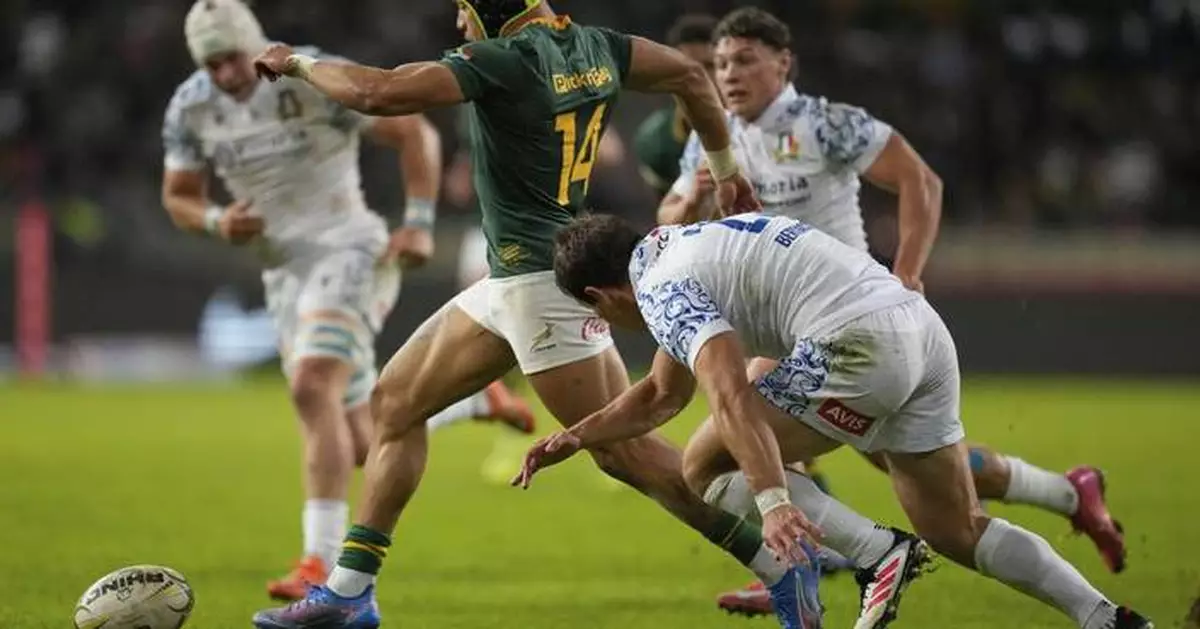
South Africa's Edwill van der Merwe, centre, kicks the ball to score a try as Italy's Alessandro Garbisi try during a rugby championship test match between South Africa and Italy, at the Nelson Mandela Bay stadium in Gqeberha, South Africa, Saturday, July 12, 2025. (AP Photo/Themba Hadebe)
South Africa had two tries by then and scored five more. Even when it had 13 players for 10 minutes after prop Wilco Louw was sin-binned for head-on-head contact, South Africa still scored. Winger Edwill van der Merwe was denied a hat-trick try by a forward pass so the pack engineered a lineout drive for Malcolm Marx to dot down.
Its the third time South Africa has blanked Italy. The last time was 17 years ago.
A depleted Italy — 10 players in single caps — never looked like scoring a try and didn't have a shot at the posts.
“To keep them to nil with 13 players on the field was pretty cool,” Springboks coach Rassie Erasmus said.
A strong response was expected from world champion South Africa after it was humbled by Italy's fightback in Pretoria last weekend. South Africa led 28-3 at halftime but won only 42-24.
This time, the Springboks led 24-0 at halftime and never let their foot off Italy's throat.
They even tried some innovative plays. The opening kickoff deliberately didn't go 10 meters to have a go at Italy's scrum. But Italy got a free kick. And in open play they twice created a driving maul by lifting a player lineout style, both times leading to tries.
“Sometimes those things work and sometimes they don't, and you have to take it on the chin if they don't work,” Erasmus said. “We won't be able to do them again for a few games as people have seen them now.”
The Springboks retained from Pretoria only seven players, including fullback Willie le Roux, who became the eighth Bok to play 100 tests, 12 years after his debut against the same side. Even with a much changed team, South Africa still started 11 Rugby World Cup winners.
One of them, scrumhalf Grant Williams, scored the opening try thanks to his Sharks clubmates on the wings, Van der Merwe and Makazole Mapimpi.
Van der Merwe dived beside the right corner flag for the second try and his second in his second test. After Jasper Wiese was marched, the winger also got the third try, the best of the match.
Loosehead Ox Nche had just arrived to shore up the Boks front row and destroyed an Italy scrum. Le Roux then chipped the ball and a kind bounce allowed Van der Merwe to dribble the ball to behind the posts and score.
Center Canan Moodie bagged the fourth try just before halftime when he smashed through two defenders.
Yellow cards dropped both teams to 14 players when Marx scored. But as the benches cleared the game lost its shape and it took more than 20 minutes for the Boks to score again. Beautiful handling set up Mapimpi's 33rd test try.
In the dying seconds, replacement hooker Jan-Hendrik Wessels scored in the corner and Mannie Libbok converted from the sideline, his fifth success from seven shots.
South Africa plays Georgia next Saturday in Mbombela.
AP rugby: https://apnews.com/hub/rugby
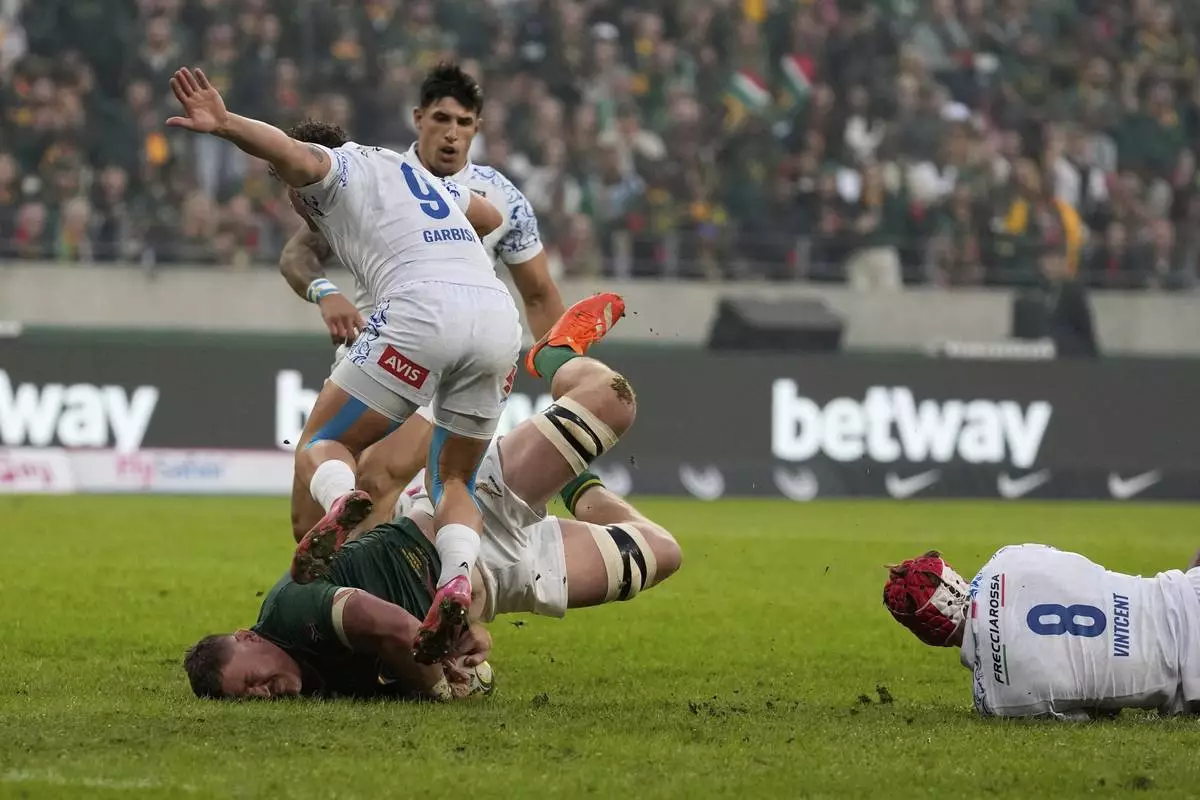
South Africa's Jasper Wiese, left, falls to the ground after by Italy's Ross Vintcent, right, during a rugby championship test match between South Africa and Italy, at the Nelson Mandela Bay stadium in Gqeberha, South Africa, Saturday, July 12, 2025. (AP Photo/Themba Hadebe)
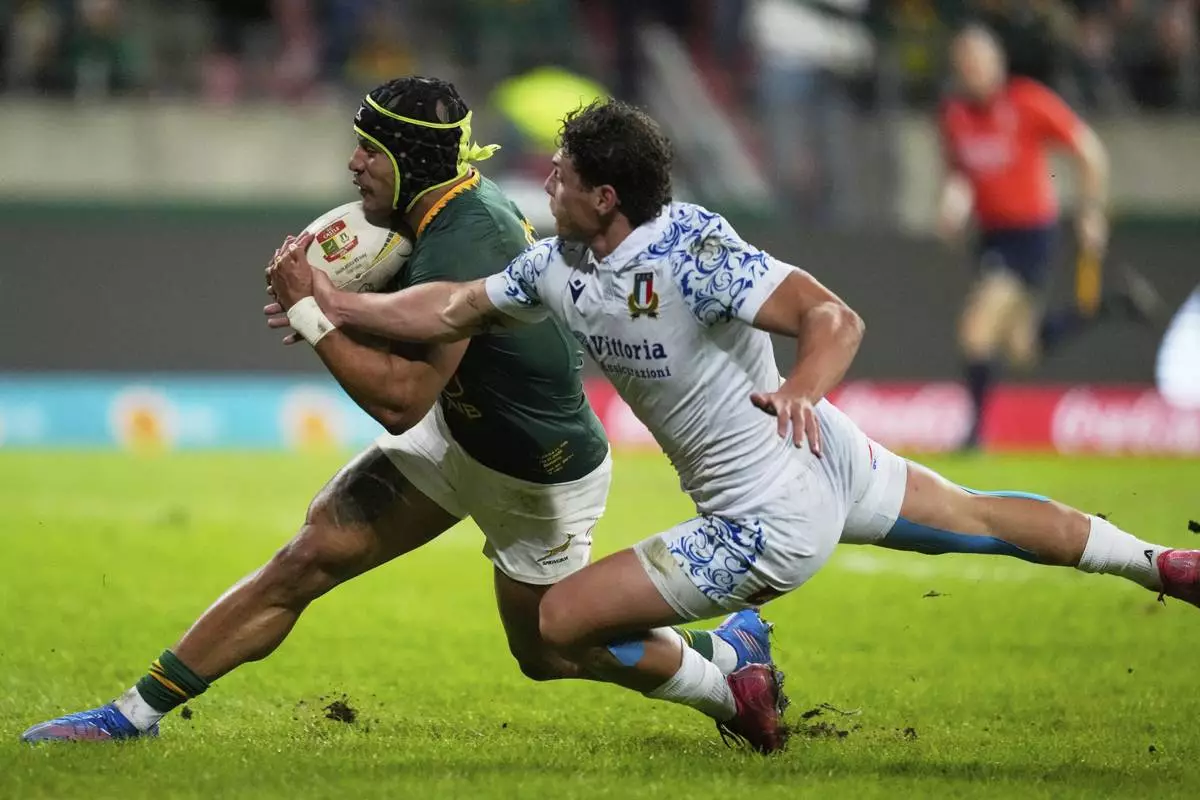
South Africa's Edwill van der Merwe, left, scores a try as Italy's Alessandro Garbisi tries to defend during a rugby championship test match between South Africa and Italy, at the Nelson Mandela Bay stadium in Gqeberha, South Africa, Saturday, July 12, 2025. (AP Photo/Themba Hadebe)
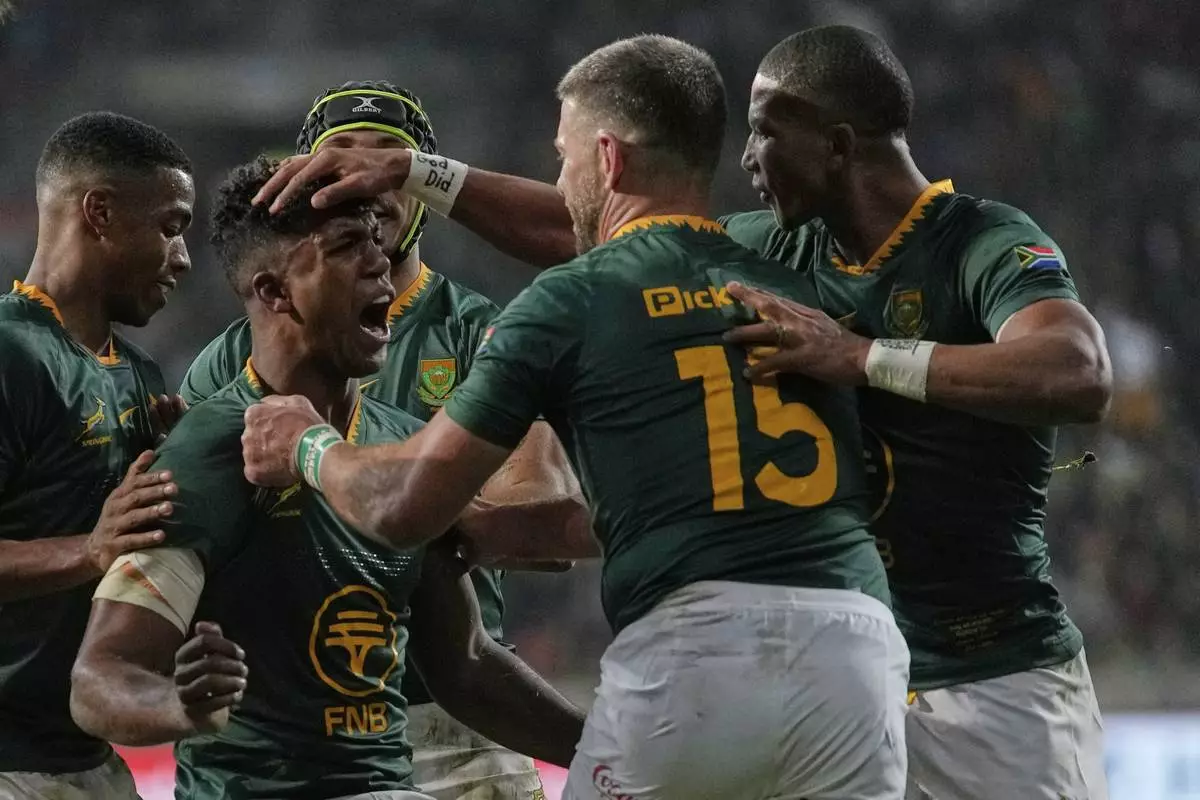
South Africa's Canan Moodie, left, celebrates with teammates after scoring a try during a rugby championship test match between South Africa and Italy, at the Nelson Mandela Bay stadium in Gqeberha, South Africa, Saturday, July 12, 2025. (AP Photo/Themba Hadebe)
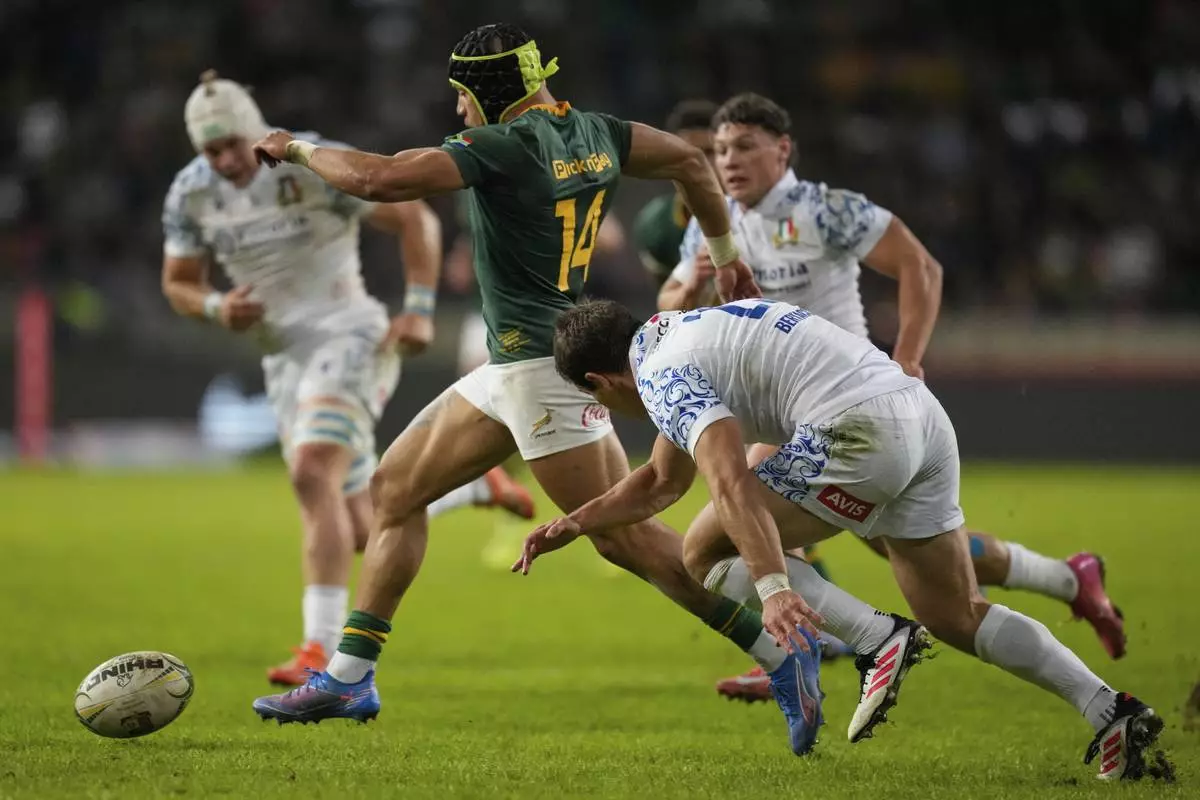
South Africa's Edwill van der Merwe, centre, kicks the ball to score a try as Italy's Alessandro Garbisi try during a rugby championship test match between South Africa and Italy, at the Nelson Mandela Bay stadium in Gqeberha, South Africa, Saturday, July 12, 2025. (AP Photo/Themba Hadebe)
MILWAUKEE (AP) — Giannis Antetokounmpo says he’s healthy and wants to play even as the Milwaukee Bucks continue to say the two-time MVP is too injured to take the floor.
Antetokounmpo missed a 10th straight game on Friday night against the Boston Celtics due to what the team has described as a left knee hyperextension and bone bruise. Antetokounmpo hasn’t played since landing awkwardly during a March 15 victory over the Indiana Pacers.
“I’m healthy,” Antetokounmpo told the Milwaukee Journal Sentinel and The Athletic before Friday’s game. “I hate it when people force me to do things against my nature. I’m a player. I get paid to play.”
For the last couple of weeks, Antetokounmpo has participated in pregame warmups without showing any apparent signs of injury.
Antetokounmpo also noted that the Bucks should have known this about him since the 31-year-old has spent his entire 13-year career in Milwaukee.
Throughout that time, Antetokounmpo has had a reputation for rapid returns from injury, most notably when he hyperextended his knee during Milwaukee’s 2021 playoff run but missed two games before returning to lead the Bucks to their first title in half a century.
“You know who you’re dealing with,” Antetokounmpo told reporters. “So, for somebody to come and tell me to not play or to not compete, it’s like a slap in my face.”
Bucks coach Doc Rivers addressed Antetokounmpo's comments after the 133-101 loss to Boston.
“The tough part about all this is that I’m in the middle and I have nothing to do with it,” Rivers said. “Coaches don’t decide any of this. The problem with our league is the coaches are the ones sitting out front. And we have to sit here and answer this stuff. I think there are two sides to this, I will tell you that, but I don’t want to get too involved in it.”
The Bucks still had a remote chance of earning a 10th straight playoff berth at the time of that Indiana game, but they were officially eliminated from contention last week. There’s also the possibility of Antetokounmpo getting hurt again if he returns to action — he has missed a career-high 41 games this season and had two extended absences due to calf strains.
“I understand the circumstances — yes, we’re not going to be in the playoffs,” Antetokounmpo said. “For some people’s eyes, it’s not worth it for me to be out there. But for me, it’s something that goes against my nature.”
Rivers said he has a “great relationship” with Antetokounmpo and that he often talks to the superstar about what to work on and what to add to his game. Rivers added that he didn't like the “he-said, she-said” nature of this dispute and added that “this is a grown man's game, and it should be handled that way by everybody.”
“I just don’t like that this is so public," Rivers said. "This is where grown men get in a room and they talk it out. Whether they agree or disagree, that doesn’t matter. But this should not be public, and I don’t like that.”
Antetokounmpo also wanted the opportunity to play alongside his younger brother, Alex, who made his NBA debut Sunday. There was a possibility of three Antetokounmpo brothers playing alongside each other in the same game, since Giannis’ older brother, Thanasis, also is on the Bucks.
“When my dad passed away, I pretty much raised (Alex),” Antetokounmpo said. “He’s able to be on the team and suit up and chase an opportunity to be great. You really think I don’t want to suit up and play with my brother? Anybody who thinks that is an idiot.”
Thanasis and Alex both played in the closing minutes Friday night, the first time the two brothers had played together in an NBA game.
Antetokounmpo’s desire to play — and the Bucks’ wishes to rest him — drew the attention of the National Basketball Players Association last month.
“The Player Participation Policy was designed by the league to hold teams accountable and ensure that when an All-Star like Giannis Antetokounmpo is healthy and ready to play, he is on the court,” the union said in a statement. “Unfortunately, anti-tanking policies are only as effective as their enforcement; fans, broadcast partners, and the integrity of the game itself will continue to suffer as long as ownership goes unchecked. We look forward to collaborating with the NBA on meaningful new proposals that will directly address and discourage tanking.”
This dispute between Antetokounmpo and the Bucks comes at a time when his future in Milwaukee is uncertain. Antetokounmpo’s name dominated league-wide discussions leading up to the trade deadline, though the Bucks ultimately kept him.
Antetokounmpo becomes eligible to sign a four-year contract extension worth up to $275 million in October. If he doesn’t sign the extension, Antetokounmpo could become a free agent after the 2026-27 season, or the Bucks could decide to trade him beforehand.
Now they find themselves at odds over how to handle the rest of this season.
“I don't think there's a bad person in this group - none of the guys that I'm talking about,” Rivers said. "They're all good people. But we've got to figure out how to put good people on the same page, and it stays inside. I've never been a fan of negotiating in the media. I don't think it's good for anybody.
Antetokounmpo had his own take on how this could be resolved.
“I don’t know where the relationship goes from there,” Antetokounmpo said. “We’ve got to go to couples therapy.”
AP NBA: https://apnews.com/hub/nba
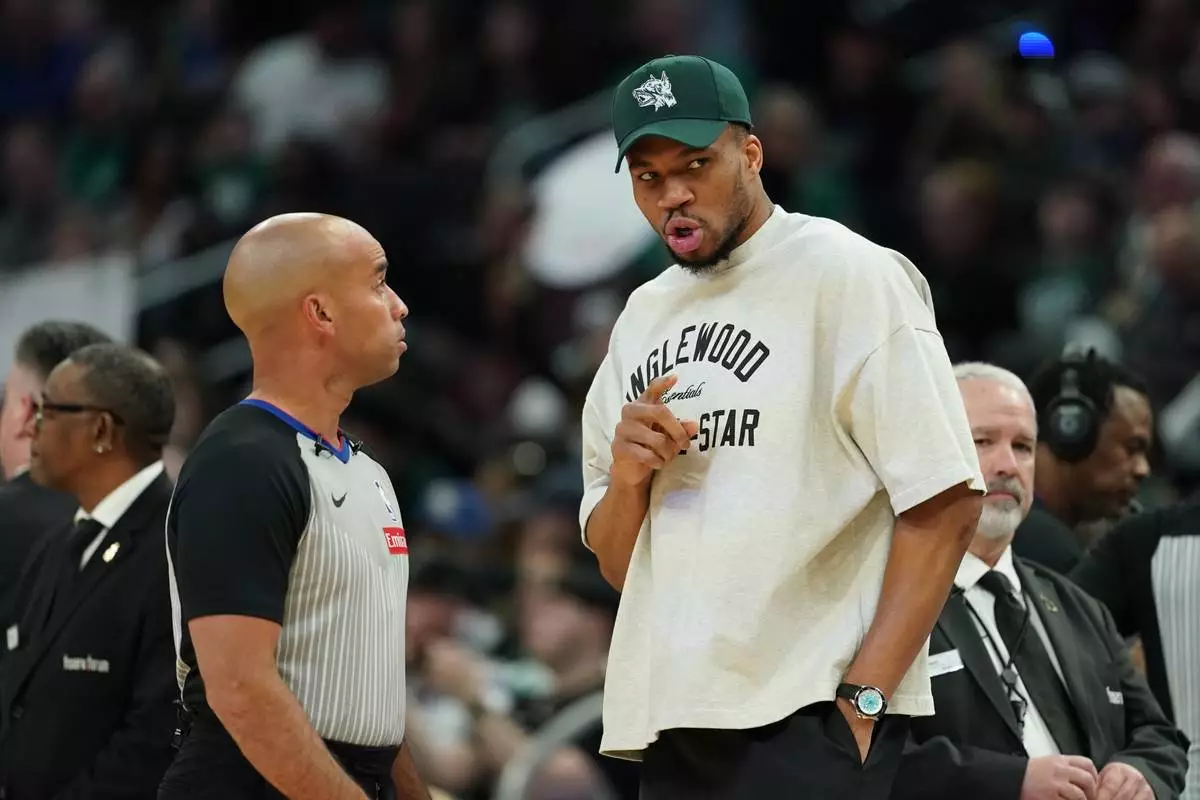
Injured Milwaukee Bucks' Giannis Antetokounmpo, center right, talks with an official, center left, during the first half of an NBA basketball game against the Boston Celtics, Friday, April 3, 2026, in Milwaukee. (AP Photo/Aaron Gash)