COLORADO SPRINGS, Colo. (AP) — In some ways, one of the longest-serving members of the International Olympic Committee, Anita DeFrantz, paved the way for the new president of the IOC, Kirsty Coventry, to get to where she is today.
That why Coventry, the first female leader of the IOC, pulled a big surprise Saturday. She traveled to Colorado Springs to watch DeFrantz, a trailblazing Olympic rower in 1976 and IOC member since 1986, get inducted into the Team USA Hall of Fame.
“She opened up so many doors, for me and for so many others,” said Coventry, who took over as president last month, in an interview with The Associated Press before the ceremony. “I'm extremely grateful for that. I know that I've got to make sure I do that for other women.”
The 72-year-old DeFrantz is part of a class that includes eight individual women — among them 11-time Olympic medalist Allyson Felix, four-time Olympic champion Serena Williams, three-time Olympic champion Kerri Walsh Jennings and 2012 all-around gymnastics champion Gabby Douglas.
Also inducted Saturday were Bode Miller, Mike Krzyzewski, Phil Knight, Steve Cash, Susan Hagel, Flo Hyman and Marla Runyan, along with the 2010 four-man bobsled team and the 2004 women’s wheelchair basketball team.
Coventry showed up for DeFrantz, who played an important role in moving votes toward the five-time Olympic swimmer from Zimbabwe in the seven-person race to succeed Thomas Bach earlier this year.
This was one of Coventry's first big — albeit low-key — trips in the new role, and DeFrantz was shocked to see the new president standing there as she got out of her car to head into the ceremony at the Broadmoor.
DeFrantz described herself as a little lonely when she went to her first IOC meeting in 1986.
“I walked in and I thought, ‘This is odd,’” she said. “It was this cavernous room” and she was one of only five female committee members there.
One of her main goals in becoming a shaper of world sports policy: “We had to help people open their minds a little."
While, in some ways, the Olympics has been ahead of its time in the effort to bring women into big-time sports — 22 women participated in the 1900 Olympics while, for instance, it took until 1981 for the NCAA to sanction women’s basketball — it has also shined a global spotlight on some inequities that have existed for decades.
Women’s rowing didn’t debut at the Games until the 1976 Olympics where DeFrantz and her teammates won bronze. Only last year did the Olympics achieve gender parity, with women making up half of the approximately 10,500 athletes, according to the IOC.
DeFrantz, a vice president of the 1984 LA organizing committee, helped spark that progress. She served as chair of the IOC's women in sport commission for 20 years. She became a member of the IOC executive board in 1992 and was elected as the IOC’s first female vice president in 1997.
A generation later, Felix began her own fight to highlight the way women were treated when they became pregnant. She forced a seismic change in contract terms that, for decades, had given little leeway to female track stars who put careers on hold to have babies.
Felix is now a member of the IOC, as well — following in the footsteps of both DeFrantz and Coventry as Olympic athletes who now have seats at the decision-making table.
“I feel really blessed to come after Anita and I've told her this many times, she has paved the way,” Felix said. “She's a game-changer. Just what she's seen and contributed to is incredible. For someone like me, it's just wanting to carry on her legacy."
DeFrantz's honor comes at yet another tenuous time for women in sports, punctuated by headline-grabbing debates about eligibility and gender testing in track, boxing, swimming and other sports that will likely bring leaders like Coventry and DeFrantz into the mix.
Coventry said it's important to “protect the female category,” and has signaled that the IOC will take a more active role in setting guidelines for participation.
But for the 41-year-old president, this was a night for celebrating a mentor who made her role in today's debates possible.
“It's all about letting people have opportunities,” DeFrantz said. “You can't make an Olympian. But you can open the door to possibilities.”
AP sports: https://apnews.com/sports
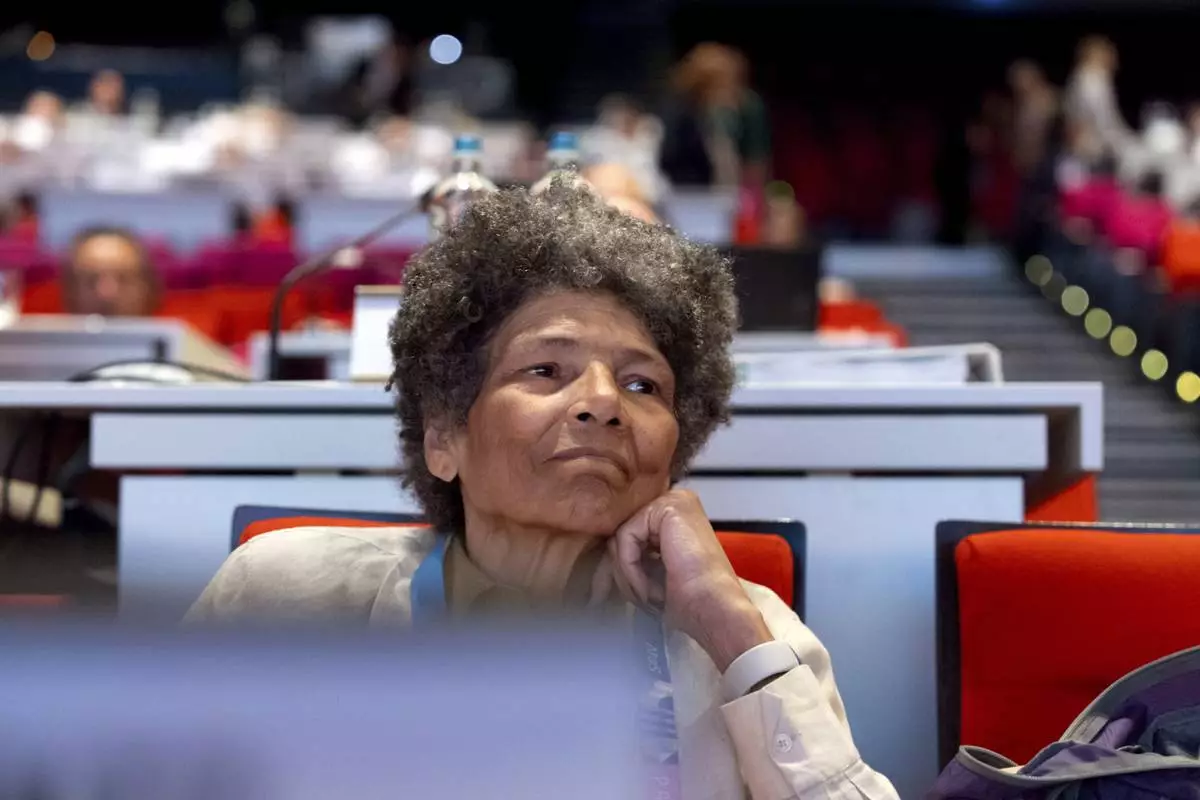
FILE - IOC member Anita DeFrantz, of the United States, attends the start of the 142nd IOC session at the 2024 Summer Olympics, Tuesday, July 23, 2024, in Paris. (AP Photo/David Goldman, File)
WASHINGTON (AP) — Sluggish December hiring concluded a year of weak employment gains that have frustrated job seekers even though layoffs and unemployment have remained low.
Employers added just 50,000 jobs last month, nearly unchanged from a downwardly revised figure of 56,000 in November, the Labor Department said Friday. The unemployment rate slipped to 4.4%, its first decline since June, from 4.5% in November, a figure also revised lower.
The data suggests that businesses are reluctant to add workers even as economic growth has picked up. Many companies hired aggressively after the pandemic and no longer need to fill more jobs. Others have held back due to widespread uncertainty caused by President Donald Trump’s shifting tariff policies, elevated inflation, and the spread of artificial intelligence, which could alter or even replace some jobs.
Still, economists were encouraged by the drop in the unemployment rate, which had risen in the previous four straight reports. It had also alarmed officials at the Federal Reserve, prompting three cuts to the central bank's key interest rate last year. The decline lowered the odds of another rate reduction in January, economists said.
“The labor market looks to have stabilized, but at a slower pace of employment growth,” Blerina Uruci, chief economist at T. Rowe Price, said. There is no urgency for the Fed to cut rates further, for now."
Some Federal Reserve officials are concerned that inflation remains above their target of 2% annual growth, and hasn't improved since 2024. They support keeping rates where they are to combat inflation. Others, however, are more worried that hiring has nearly ground to a halt and have supported lowering borrowing costs to spur spending and growth.
November's job gain was revised slightly lower, from 64,000 to 56,000, while October's now shows a much steeper drop, with a loss of 173,000 positions, down from previous estimates of a 105,000 decline. The government revises the jobs figures as it receives more survey responses from businesses.
The economy has now lost an average of 22,000 jobs a month in the past three months, the government said. A year ago, in December 2024, it had gained 209,000 a month. Most of those losses reflect the purge of government workers by Elon Musk's Department of Government Efficiency.
Nearly all the jobs added in December were in the health care and restaurant and hotel industries. Health care added 38,500 jobs, while restaurants and hotels gained 47,000. Governments — mostly at the state and local level — added 13,000.
Manufacturing, construction and retail companies all shed jobs. Retailers cut 25,000 positions, a sign that holiday hiring has been weaker than previous years. Manufacturers have shed jobs every month since April, when Trump announced sweeping tariffs intended to boost manufacturing.
Wall Street and Washington are looking closely at Friday's report as it's the first clean reading on the labor market in three months. The government didn’t issue a report in October because of the six-week government shutdown, and November’s data was distorted by the closure, which lasted until Nov. 12.
The hiring slowdown reflects more than just a reluctance by companies to add jobs. With an aging population and a sharp drop in immigration, the economy doesn't need to create as many jobs as it has in the past to keep the unemployment rate steady. As a result, a gain of 50,000 jobs is not as clear a sign of weakness as it would have been in previous years.
And layoffs are still low, a sign firms aren't rapidly cutting jobs, as typically happens in a recession. The “low-hire, low-fire” job market does mean current workers have some job security, though those without jobs can have a tougher time.
Ernesto Castro, 44, has applied for hundreds of jobs since leaving his last in May. Yet the Los Angeles resident has gotten just three initial interviews, and only one follow-up, after which he heard nothing.
With nearly a decade of experience providing customer support for software companies, Castro expected to find a new job pretty quickly as he did in 2024.
“I should be in a good position,” Castro said. “It’s been awful.”
He worries that more companies are turning to artificial intelligence to help clients learn to use new software. He hears ads from tech companies that urge companies to slash workers that provide the kind of services he has in his previous jobs. His contacts in the industry say that employees are increasingly reluctant to switch jobs amid all the uncertainty, which leaves fewer open jobs for others.
He is now looking into starting his own software company, and is also exploring project management roles.
December’s report caps a year of sluggish hiring, particularly after April's “liberation day” tariff announcement by Trump. The economy generated an average of 111,000 jobs a month in the first three months of 2025. But that pace dropped to just 11,000 in the three months ended in August, before rebounding slightly to 22,000 in November.
Last year, the economy gained just 584,000 jobs, sharply lower than that more than 2 million added in 2024. It's the smallest annual gain since the COVID-19 pandemic decimated the job market in 2020.
Subdued hiring underscores a key conundrum surrounding the economy as it enters 2026: Growth has picked up to healthy levels, yet hiring has weakened noticeably and the unemployment rate has increased in the last four jobs reports.
Most economists expect hiring will accelerate this year as growth remains solid, and Trump's tax cut legislation is expected to produce large tax refunds this spring. Yet economists acknowledge there are other possibilities: Weak job gains could drag down future growth. Or the economy could keep expanding at a healthy clip, while automation and the spread of artificial intelligence reduces the need for more jobs.
Productivity, or output per hour worked, a measure of worker efficiency, has improved in the past three years and jumped nearly 5% in the July-September quarter. That means companies can produce more without adding jobs. Over time, it should also boost worker pay.
Even with such sluggish job gains, the economy has continued to expand, with growth reaching a 4.3% annual rate in last year's July-September quarter, the best in two years. Strong consumer spending helped drive the gain. The Federal Reserve Bank of Atlanta forecasts that growth could slow to a still-solid 2.7% in the final three months of last year.
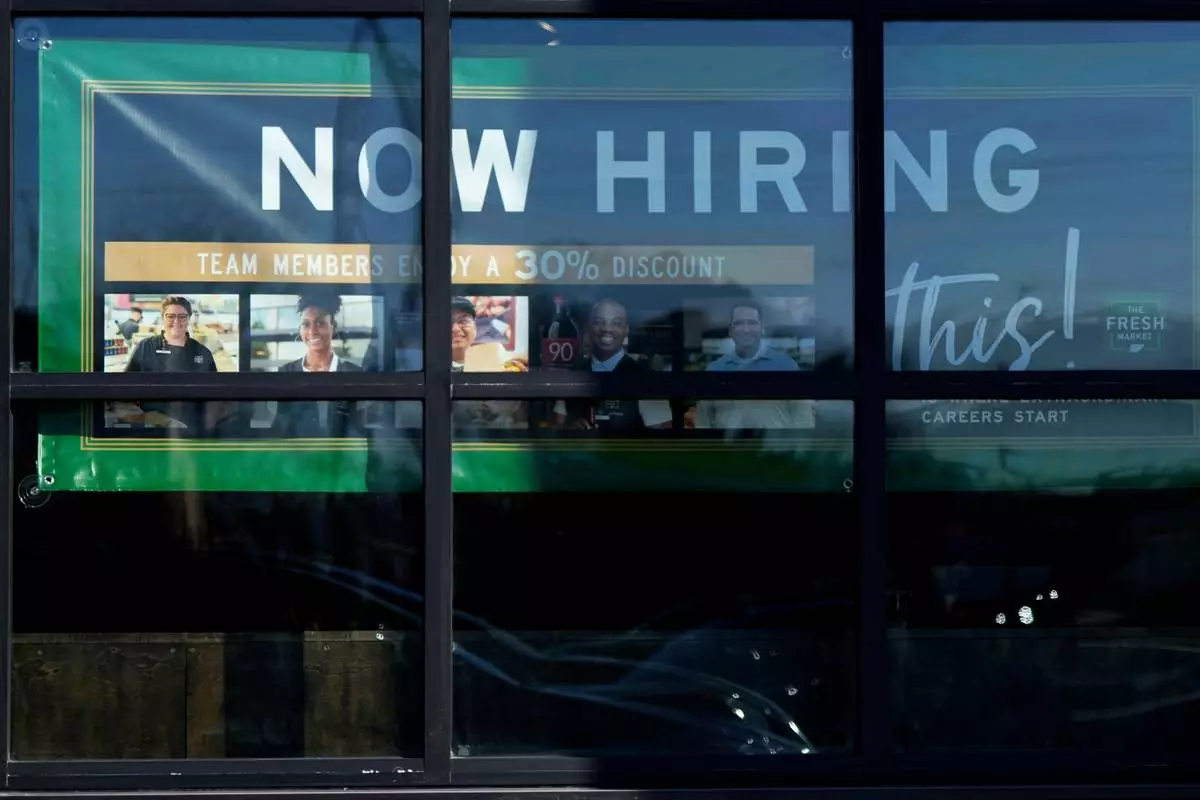
FILE - A hiring sign is displayed at a grocery store in Northbrook, Ill., Tuesday, Jan. 21, 2025. (AP Photo/Nam Y. Huh)