BENGALURU, India (AP) — India’s government is seeking to limit temperature settings on new air conditioners to save electricity in the country that is considered the fastest-growing market for them.
The power minister proposed a rule in June requiring air conditioners sold in the country to have thermostats that can be set no lower than 20 Celsius (68 Fahrenheit).
Officials hope the small change will create massive energy savings in the country of more than 1.4 billion people. About 10 million to 15 million air conditioners are sold annually as incomes and urbanization increase along with the temperatures.
The current lowest setting is 17 C (62 F). Officials say each degree an air conditioner is turned up saves about 6% on energy.
Energy experts said the proposal is a positive step, but that requiring units to be more energy efficient would help more.
Power Minister Manohar Lal Khattar said the proposed rule would take effect soon but wasn't specific about timing.
The proposal has gotten mixed reviews from people living in India's sweltering cities.
“Overall, I think it’s good to try and save energy, but at the same time I hope the government makes sure people are not too inconvenienced,” said Vikram Kannan, a 37-year-old teacher who lives in the humid southern city of Chennai with his wife and 4-year-old daughter. “Sometimes there is no choice but to set a low air conditioner temperature in cities like Chennai because it’s just way too hot and humid. My daughter gets heat pimples at times if we don’t do this."
Air conditioners are fast becoming some of the biggest energy guzzlers in India. Room air conditioners accounted for as much as one quarter of the electricity needed in India during times of the highest usage in 2024, a measure known as peak demand, according to estimates by researchers at the University of California, Berkeley. New AC units added between 2019 and 2024 have increased India’s peak demand by an amount roughly equivalent to what it would take to power New Delhi for a year, the researchers estimated.
Energy demand is typically highest during the summer when temperatures can reach 51 degrees Celsius (124 degrees Fahrenheit) in parts of the country.
If changes are not made, India is expected to have power shortages by next year. India’s hunger for energy is also a key reason the country is one of the highest emitters of planet-heating gases. Clean energy use is growing, but most of India’s electricity is provided by climate-polluting fossil fuels such as coal.
Nikit Abhyankar, a leader of the India Energy and Climate Center at the University of California, Berkley, said that Delhi, like other major Indian cities, now experiences dual peaks in electricity use — one in the afternoon and another around midnight — driven largely by air conditioners. While solar energy can help offset daytime demand, nighttime cooling still relies heavily on fossil fuels.
The air conditioner proposal is the latest in a series of government measures over the past decade aimed at saving energy, such as mandating that government offices be cooled at no less than 24 degrees Celsius (75 degrees Fahrenheit). In 2022, the government launched the Mission Life program that includes public service messages encouraging people to reduce emissions by cutting electricity use or skipping unnecessary car trips. The initiative announced with much fanfare has received mixed responses.
Some are supportive of the proposed change to air conditioner settings. Sunil Kumar, a 47-year-old from East Delhi, said the rule could prevent fire hazards and lower bills.
“People used to live without air conditioners. We can adjust,” said Kumar, who drives a small commercial vehicle known as a tuk-tuk.
New Delhi-based businessperson Surjeet Singh said turning air conditioners down to their current lowest setting was “unnecessary.”
“People have gotten too comfortable,” he said, suggesting that cities invest in planting trees to tackle urban heat.
Abhyankar, the California professor, said that while changing temperature settings will help, requiring air conditioners to be energy efficient would do more.
“Tightening the minimum efficiency standards can change things pretty significantly,” said Abhyankar, who has also studied the energy sector in the U.S., China, Indonesia and Vietnam.
Calling the proposed air conditioner rule a “step in the right direction,” Pramod Singh, an energy savings expert with New Delhi-based Alliance for an Energy Efficient Economy, said replacing the country’s estimated 80 million older generation, inefficient air conditioners is a key challenge for the government.
Many units available in India are so inefficient they couldn't be sold in many other countries, Abhyankar said.
“Although India imports most key components for its air conditioners from China, nearly 80% of the air conditioners that are currently sold in India would be banned in China,” he said.
Energy experts said other small changes can reduce energy use and customer costs, such as making sure new buildings have adequate ventilation, combining air conditioners with other cooling methods and using smart technologies to run air conditioners.
“Air conditioner use reduces significantly if users also run their ceiling fans, as the room cools much faster,” said Abhyankar.
Follow Sibi Arasu on X at @sibi123
The Associated Press’ climate and environmental coverage receives financial support from multiple private foundations. AP is solely responsible for all content. Find AP’s standards for working with philanthropies, a list of supporters and funded coverage areas at AP.org.
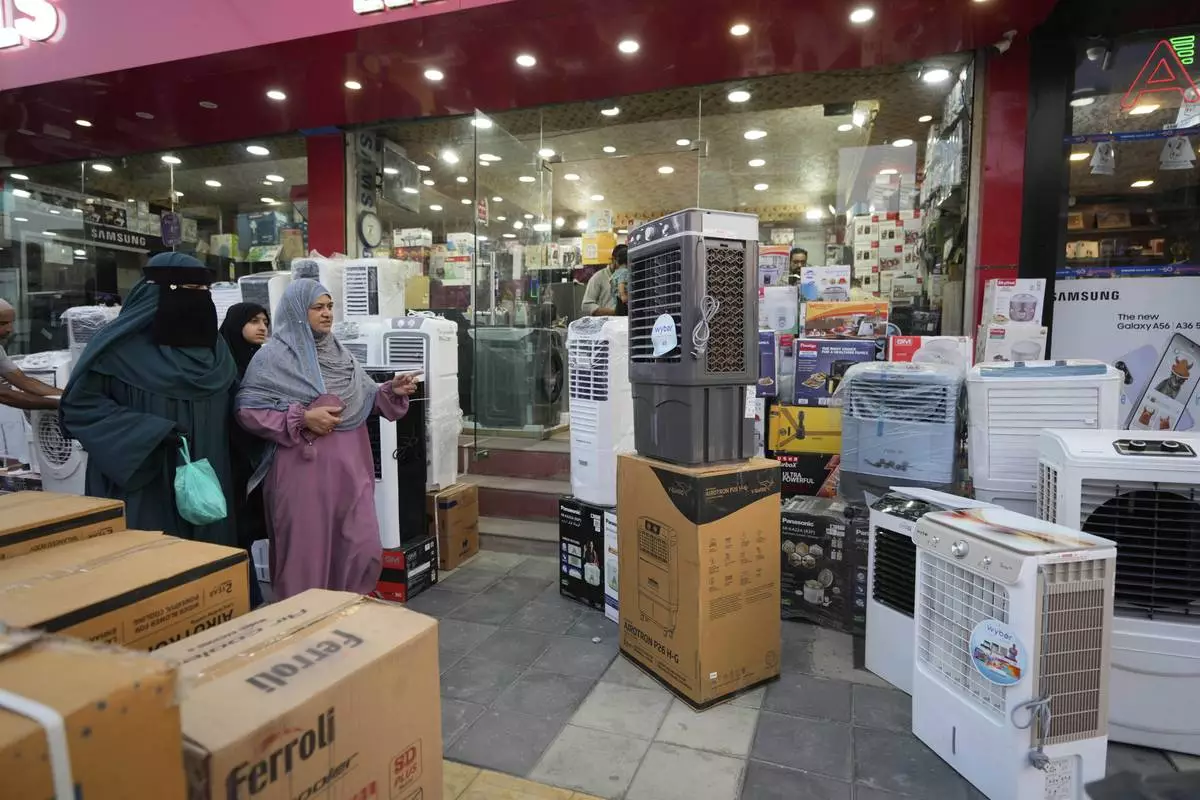
FILE - People purchase air conditioners at a shop on a hot summer day in Srinagar, Indian-controlled Kashmir, June 24, 2025. (AP Photo/Mukhtar Khan, File)