Skip to Content Facebook Feature Image

Private firms post 21 straight quarters of foreign-trade growth: customs data

China

China

China

Private firms post 21 straight quarters of foreign-trade growth: customs data

2025-07-14 14:05 Last Updated At:16:37

China's private businesses remained at the forefront of the country's foreign trade in the first half of 2025, registering growth in total imports and exports for 21 consecutive quarters as of the end of June, a senior official with the General Administration of Customs (GAC) said on Monday.

Wang Lingjun, deputy head of the GAC, made the statement at a press conference in Beijing in elaborating on the robust performance of China's privately-owned foreign trade firms in the first six months.

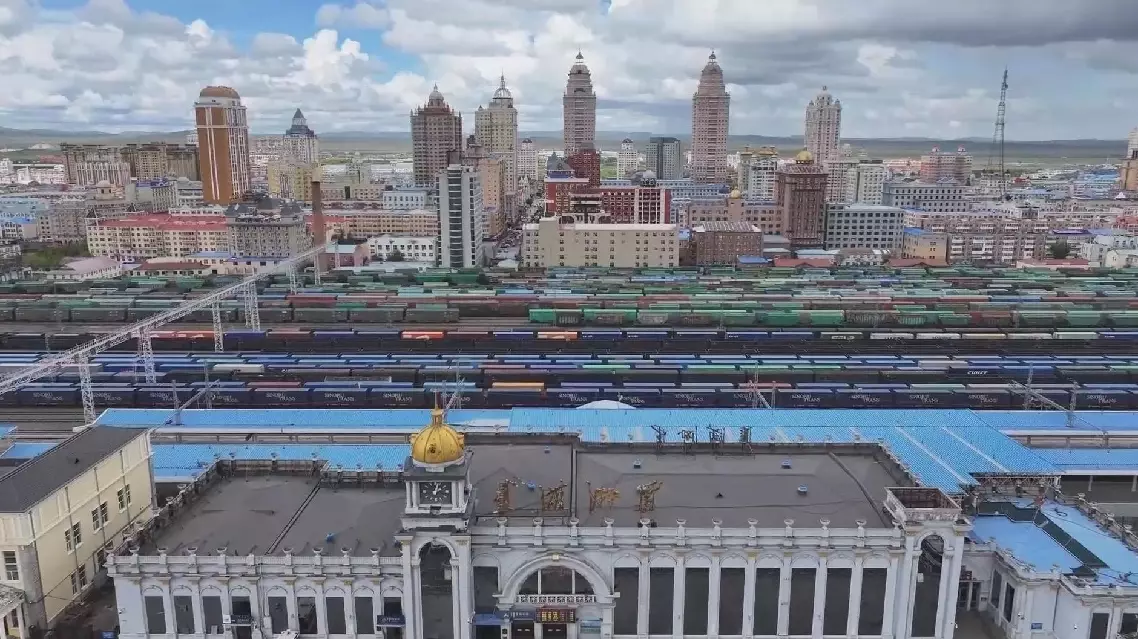
"In the first half of the year, the imports and exports operated by China's private businesses totaled 12.48 trillion yuan (about 1.74 trillion U.S. dollars), up 7.3 percent year over year. Their share in China's overall foreign trade reached 57.3 percent, 2.3 percentage points higher compared with the same period of last year. Their exports and imports both expanded in the six-month period," Wang said.

China's foreign trade grew by 2.9 percent year on year to 21.79 trillion yuan (3.04 trillion U.S. dollars) in the first half of 2025, according to data released by the GAC.

In addition to their continued lead in foreign trade, China's private firms also sustained their strong innovation capabilities and overall high-quality development in the January-June period, the official said.

"As of the end of the second quarter of this year, the imports and exports operated by China's private businesses had grown year-on-year for 21 consecutive quarters, maintaining their lead in growth rate. So far this year in particular, the private businesses in the country have overcome the adverse effects resulting from the external environment, with the scale of their imports and exports exceeding 12 trillion yuan (1.67 trillion U.S. dollars) for the first time -- a record high -- and a growth rate 4.4 percentage points higher than the national average in the first half of the year," Wang said.

"In the first half of the year, of the 'little giant' enterprises in the country that apply special, sophisticated techniques to produce unique and novel products with solid foreign trade achievements, 80 percent were foreign-funded enterprises. In the six-month period, private businesses' exports of high-tech products rose 12.5 percent. In the same period, private firms actively promoted equipment upgrades, maintaining a sound growth rate in the imports of petrochemical, electronic, and other high-end products," he continued.

"In the first six months, private businesses accounted for half of China's overall output of equipment manufacturing products, with a double-digit growth rate registered in the export of ships, automobiles, special equipment and other products that represent the manufacturing hard power of China. More and more private businesses have been growing amid the ups and downs of the international market. In the first half of the year, 218 of the top 500 foreign trade enterprises in China were privately owned," he said.

The official also said that the GAC will continue to implement the various government policies aimed at promoting high-quality development of the private sector of the economy by enhancing services in areas such as customs clearance, inspection and quarantine, law enforcement, and protection of private businesses' legitimate rights and interests.
Private firms post 21 straight quarters of foreign-trade growth: customs data

Private firms post 21 straight quarters of foreign-trade growth: customs data
China's Qingming Festival holiday has turned flower viewing into a showcase of cultural heritage, drawing tourists and boosting local economies.

From references to "The Book of Songs", a treasured Confucian classic and China's oldest poetry collection, to longstanding flower festivals, organizers are promoting flower viewing as cultural tourism, weaving poetry and tradition into spring outings.

Hebi City in central China's Henan Province is drawing crowds with magnolias, tulips and crabapples, alongside 87 cherry blossom varieties. The blooms have become a major Qingming Festival attraction, prompting local authorities to pair tourism with cultural heritage.

As one of the birthplaces of The Book of Songs, Hebi has launched a campaign offering free entry to scenic spots for visitors who recite verses from the ancient classic. The initiative links flower viewing with a text long regarded as a cornerstone of Chinese literature.

In Binzhou, east China's Shandong Province, a park spanning 240 hectares, roughly the size of 330 football fields, is covered in blossoms, making it one of the largest spring displays in the region. The park uses smart drip irrigation to keep flowers hydrated and extend their peak season.

Originating in the Southern Song Dynasty (1127-1279), the Huazhao (Flower Deities) Festival in Xinzhou District of Wuhan boasts more than 800 years of history. Listed as a provincial intangible cultural heritage in 2011, it remains the largest folk celebration in eastern Hubei, drawing thousands of visitors each spring. A parade featuring 12 flower deities winds through the streets, anchoring the festival as both a cultural showcase and a tourism draw.

"The plum blossom represents noble character, the peach blossom radiant beauty. We hope more people will come to discover the Huazhao Festival," said Qinghuan, a performer portraying the Osmanthus Deity.

Outside the Shanxi Museum in Taiyuan City, apricot trees are in full bloom. Their pale pink petals flutter in the breeze, lining the museum's corridors and echoing the deep history within. Visitors pause to photograph the unique blend of ancient architecture and fleeting spring beauty.

During the Qingming Festival holiday, the Beijing Garden of World's Flowers turned into a "spring palette." A nearly 2,000-square-meter sea of flowers burst into color. Against this floral backdrop, traditional experiences such as archery, tea whisking and movable-type printing drew crowds seeking a holiday filled with blossoms and cultural charm.

The garden features over 40 varieties of alpine and deciduous rhododendrons in shades of purple, pink and white, layered like clouds of silk. Along the flower-lined paths, colorful benches and ribbons create picture-perfect spots. Visitors wander, stop to admire, or raise their phones to capture a moment of spring romance.

"We hope these vibrant, contrasting floral colors bring a little healing and joy to people's lives, a space to relax and find peace amid the spring bloom," said Shi Wenfang, director of the Beijing Garden of World's Flowers. Beyond flower viewing, the garden is hosting its annual Huazhao Festival during the holiday. Now in its fifth year, the event has attracted nearly 300,000 visitors in total. The festivities run through April 6.

Falling on April 5 this year, the Qingming Festival, or Tomb-Sweeping Day, is a traditional Chinese festival for honoring the deceased and paying tributes to ancestors. The three-day holiday from Saturday to Monday also provides a short break for Chinese citizens to enjoy outdoor activities and sightseeing in pleasant springtime temperatures.

Compiled between the Western Zhou Dynasty and the Spring and Autumn Period (1100 B.C. - 476 B.C.), "The Book of Songs" contains at least 305 poems and is recognized as a Confucian classic.

Flower viewing draws holiday crowds across China during Qingming Festival

Flower viewing draws holiday crowds across China during Qingming Festival

Recommended Articles