Skip to Content Facebook Feature Image

US manufacturers are stuck in a rut despite subsidies from Biden and protection from Trump

News

US manufacturers are stuck in a rut despite subsidies from Biden and protection from Trump
News

News

US manufacturers are stuck in a rut despite subsidies from Biden and protection from Trump

2025-07-14 18:00 Last Updated At:18:30

WASHINGTON (AP) — Democrats and Republicans don’t agree on much, but they share a conviction that the government should help American manufacturers, one way or another.

Democratic President Joe Biden handed out subsidies to chipmakers and electric vehicle manufacturers. Republican President Donald Trump is building a wall of import taxes — tariffs — around the U.S. economy to protect domestic industry from foreign competition.

Yet American manufacturing has been stuck in a rut for nearly three years. And it remains to be seen whether the trend will reverse itself.

The U.S. Labor Department reports that American factories shed 7,000 jobs in June for the second month in a row. Manufacturing employment is on track to drop for the third straight year.

The Institute for Supply Management, an association of purchasing managers, reported that manufacturing activity in the United States shrank in June for the fourth straight month. In fact, U.S. factories have been in decline for 30 of the 32 months since October 2022, according to ISM.

“The past three years have been a real slog for manufacturing,’’ said Eric Hagopian, CEO of Pilot Precision Products, a maker of industrial cutting tools in South Deerfield, Massachusetts. “We didn’t get destroyed like we did in the recession of 2008. But we’ve been in this stagnant, sort of stationary environment.’’

Big economic factors contributed to the slowdown: A surge in inflation, arising from the unexpectedly strong economic recovery from COVID-19, raised factory expenses and prompted the Federal Reserve to raise interest rates 11 times in 2022 and 2023. The higher borrowing costs added to the strain.

Government policy was meant to help.

Biden’s tax incentives for semiconductor and clean energy production triggered a factory-building boom – investment in manufacturing facilities more than tripled from April 2021 through October 2024 – that seemed to herald a coming surge in factory production and hiring. Eventually anyway.

But the factory investment spree has faded as the incoming Trump administration launched trade wars and, working with Congress, ended Biden’s subsidies for green energy. Now, predicts Mark Zandi, chief economist at Moody’s Analytics, “manufacturing production will continue to flatline.”

“If production is flat, that suggests manufacturing employment will continue to slide,” Zandi said. “Manufacturing is likely to suffer a recession in the coming year.’’

Meanwhile, Trump is attempting to protect U.S. manufacturers — and to coax factories to relocate and produce in America — by imposing tariffs on goods made overseas. He slapped 50% taxes on steel and aluminum, 25% on autos and auto parts, 10% on many other imports.

In some ways, Trump’s tariffs can give U.S. factories an edge. Chris Zuzick, vice president at Waukesha Metal Products, said the Sussex, Wisconsin-based manufacturer is facing stiff competition for a big contract in Texas. A foreign company offers much lower prices. But “when you throw the tariff on, it gets us closer,’’ Zuzick said. “So that’s definitely a situation where it’s beneficial.’’

But American factories import and use foreign products, too – machinery, chemicals, raw materials like steel and aluminum. Taxing those inputs can drive up costs and make U.S producers less competitive in world markets.

Consider steel. Trump’s tariffs don’t just make imported steel more expensive. By putting the foreign competition at a disadvantage, the tariffs allow U.S. steelmakers to raise prices – and they have. U.S.-made steel was priced at $960 per metric ton as of June 23, more than double the world export price of $440 per ton, according to industry monitor SteelBenchmarker.

In fact, U.S. steel prices are so high that Pilot Precision Products has continued to buy the steel it needs from suppliers in Austria and France — and pay Trump’s tariff.

Trump has also created considerable uncertainty by repeatedly tweaking and rescheduling his tariffs. Just before new import taxes were set to take effect on dozens of countries on July 9, for example, the president pushed the deadline back to Aug. 1 to allow more time for negotiation with U.S. trading partners.

The flipflops have left factories, suppliers and customers bewildered about where things stand. Manufacturers voiced their complaints in the ISM survey: “Customers do not want to make commitments in the wake of massive tariff uncertainty,’’ a fabricated metal products company said.

“Tariffs continue to cause confusion and uncertainty for long-term procurement decisions,’’ added a computer and electronics firm. “The situation remains too volatile to firmly put such plans into place.’’

Some may argue that things aren’t necessarily bad for U.S. manufacturing; they’ve just returned to normal after a pandemic-related bust and boom.

Factories slashed nearly 1.4 million jobs in March and April 2020 when COVID-19 forced many businesses to shut down and Americans to stay home. Then a funny thing happened: American consumers, cooped up and flush with COVID relief checks from the government, went on a spending spree, snapping up manufactured goods like air fryers, patio furniture and exercise machines.

Suddenly, factories were scrambling to keep up. They brought back the workers they laid off – and then some. Factories added 379,000 jobs in 2021 — the most since 1994 — and then tacked on another 357,000 in 2022.

But in 2023, factory hiring stopped growing and began backtracking as the economy returned to something closer to the pre-pandemic normal.

In the end, it was a wash. Factory payrolls last month came to 12.75 million, almost exactly where they stood in February 2020 (12.74 million) just before COVID slammed the economy.

“It’s a long, strange trip to get back to where we started,’’ said Jared Bernstein, chair of Biden’s White House Council of Economic Advisers.

Zuzick at Waukesha Metal Products said that it will take time to see if Trump’s tariffs succeed in bringing factories back to America.

“The fact is that manufacturing doesn’t turn on a dime,’’ he said. “It takes time to switch gears.’’

Hagopian at Pilot Precision is hopeful that tax breaks in Trump’s One Big Beautiful Bill will help American manufacturing regain momentum.

“There may be light at the end of the tunnel that may not be a locomotive bearing down,’’ he said.

For now, manufacturers are likely to delay big decisions on investing or bringing on new workers until they see where Trump’s tariffs settle and what impact they have on the economy, said Ned Hill, professor emeritus in economic development at Ohio State University.

“With all this uncertainty about what the rest of the year is going to look like,’’ he said, “there’s a hesitancy to hire people just to lay them off in the near future.’’

“Everyone,'' said Zuzick at Waukesha Metal Products, ”is kind of just waiting for the new normal.’’
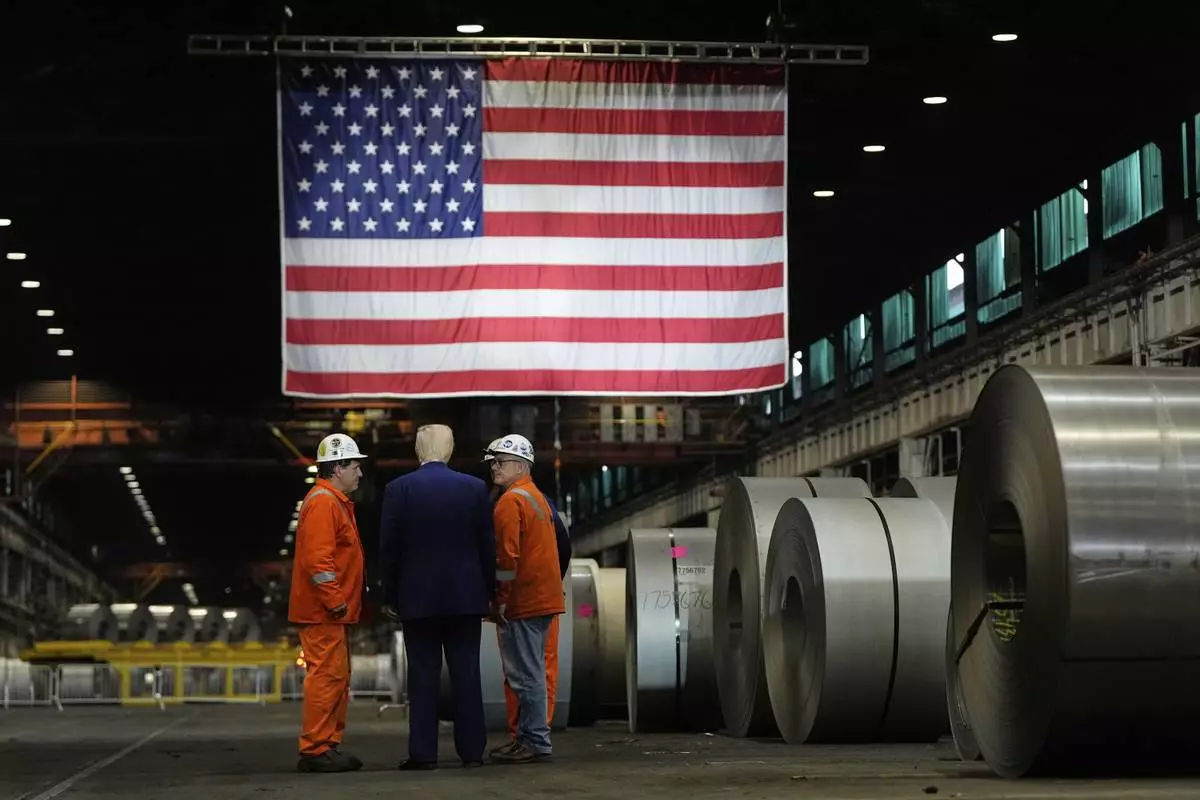
FILE - President Donald Trump talks to workers as he tours U.S. Steel Corporation's Mon Valley Works-Irvin plant, Friday, May 30, 2025, in West Mifflin, Pa. (AP Photo/Julia Demaree Nikhinson, File)

FILE - President Donald Trump talks to workers as he tours U.S. Steel Corporation's Mon Valley Works-Irvin plant, Friday, May 30, 2025, in West Mifflin, Pa. (AP Photo/Julia Demaree Nikhinson, File)

WASHINGTON (AP) — Sluggish December hiring concluded a year of weak employment gains that have frustrated job seekers even though layoffs and unemployment have remained low.

Employers added just 50,000 jobs last month, nearly unchanged from a downwardly revised figure of 56,000 in November, the Labor Department said Friday. The unemployment rate slipped to 4.4%, its first decline since June, from 4.5% in November, a figure also revised lower.

The data suggests that businesses are reluctant to add workers even as economic growth has picked up. Many companies hired aggressively after the pandemic and no longer need to fill more jobs. Others have held back due to widespread uncertainty caused by President Donald Trump’s shifting tariff policies, elevated inflation, and the spread of artificial intelligence, which could alter or even replace some jobs.

Still, economists were encouraged by the drop in the unemployment rate, which had risen in the previous four straight reports. It had also alarmed officials at the Federal Reserve, prompting three cuts to the central bank's key interest rate last year. The decline lowered the odds of another rate reduction in January, economists said.

“The labor market looks to have stabilized, but at a slower pace of employment growth,” Blerina Uruci, chief economist at T. Rowe Price, said. There is no urgency for the Fed to cut rates further, for now."

Some Federal Reserve officials are concerned that inflation remains above their target of 2% annual growth, and hasn't improved since 2024. They support keeping rates where they are to combat inflation. Others, however, are more worried that hiring has nearly ground to a halt and have supported lowering borrowing costs to spur spending and growth.

November's job gain was revised slightly lower, from 64,000 to 56,000, while October's now shows a much steeper drop, with a loss of 173,000 positions, down from previous estimates of a 105,000 decline. The government revises the jobs figures as it receives more survey responses from businesses.

The economy has now lost an average of 22,000 jobs a month in the past three months, the government said. A year ago, in December 2024, it had gained 209,000 a month. Most of those losses reflect the purge of government workers by Elon Musk's Department of Government Efficiency.

Nearly all the jobs added in December were in the health care and restaurant and hotel industries. Health care added 38,500 jobs, while restaurants and hotels gained 47,000. Governments — mostly at the state and local level — added 13,000.

Manufacturing, construction and retail companies all shed jobs. Retailers cut 25,000 positions, a sign that holiday hiring has been weaker than previous years. Manufacturers have shed jobs every month since April, when Trump announced sweeping tariffs intended to boost manufacturing.

Wall Street and Washington are looking closely at Friday's report as it's the first clean reading on the labor market in three months. The government didn’t issue a report in October because of the six-week government shutdown, and November’s data was distorted by the closure, which lasted until Nov. 12.

The hiring slowdown reflects more than just a reluctance by companies to add jobs. With an aging population and a sharp drop in immigration, the economy doesn't need to create as many jobs as it has in the past to keep the unemployment rate steady. As a result, a gain of 50,000 jobs is not as clear a sign of weakness as it would have been in previous years.

And layoffs are still low, a sign firms aren't rapidly cutting jobs, as typically happens in a recession. The “low-hire, low-fire” job market does mean current workers have some job security, though those without jobs can have a tougher time.

Ernesto Castro, 44, has applied for hundreds of jobs since leaving his last in May. Yet the Los Angeles resident has gotten just three initial interviews, and only one follow-up, after which he heard nothing.

With nearly a decade of experience providing customer support for software companies, Castro expected to find a new job pretty quickly as he did in 2024.

“I should be in a good position,” Castro said. “It’s been awful.”

He worries that more companies are turning to artificial intelligence to help clients learn to use new software. He hears ads from tech companies that urge companies to slash workers that provide the kind of services he has in his previous jobs. His contacts in the industry say that employees are increasingly reluctant to switch jobs amid all the uncertainty, which leaves fewer open jobs for others.

He is now looking into starting his own software company, and is also exploring project management roles.

December’s report caps a year of sluggish hiring, particularly after April's “liberation day” tariff announcement by Trump. The economy generated an average of 111,000 jobs a month in the first three months of 2025. But that pace dropped to just 11,000 in the three months ended in August, before rebounding slightly to 22,000 in November.

Last year, the economy gained just 584,000 jobs, sharply lower than that more than 2 million added in 2024. It's the smallest annual gain since the COVID-19 pandemic decimated the job market in 2020.

Subdued hiring underscores a key conundrum surrounding the economy as it enters 2026: Growth has picked up to healthy levels, yet hiring has weakened noticeably and the unemployment rate has increased in the last four jobs reports.

Most economists expect hiring will accelerate this year as growth remains solid, and Trump's tax cut legislation is expected to produce large tax refunds this spring. Yet economists acknowledge there are other possibilities: Weak job gains could drag down future growth. Or the economy could keep expanding at a healthy clip, while automation and the spread of artificial intelligence reduces the need for more jobs.

Productivity, or output per hour worked, a measure of worker efficiency, has improved in the past three years and jumped nearly 5% in the July-September quarter. That means companies can produce more without adding jobs. Over time, it should also boost worker pay.

Even with such sluggish job gains, the economy has continued to expand, with growth reaching a 4.3% annual rate in last year's July-September quarter, the best in two years. Strong consumer spending helped drive the gain. The Federal Reserve Bank of Atlanta forecasts that growth could slow to a still-solid 2.7% in the final three months of last year.

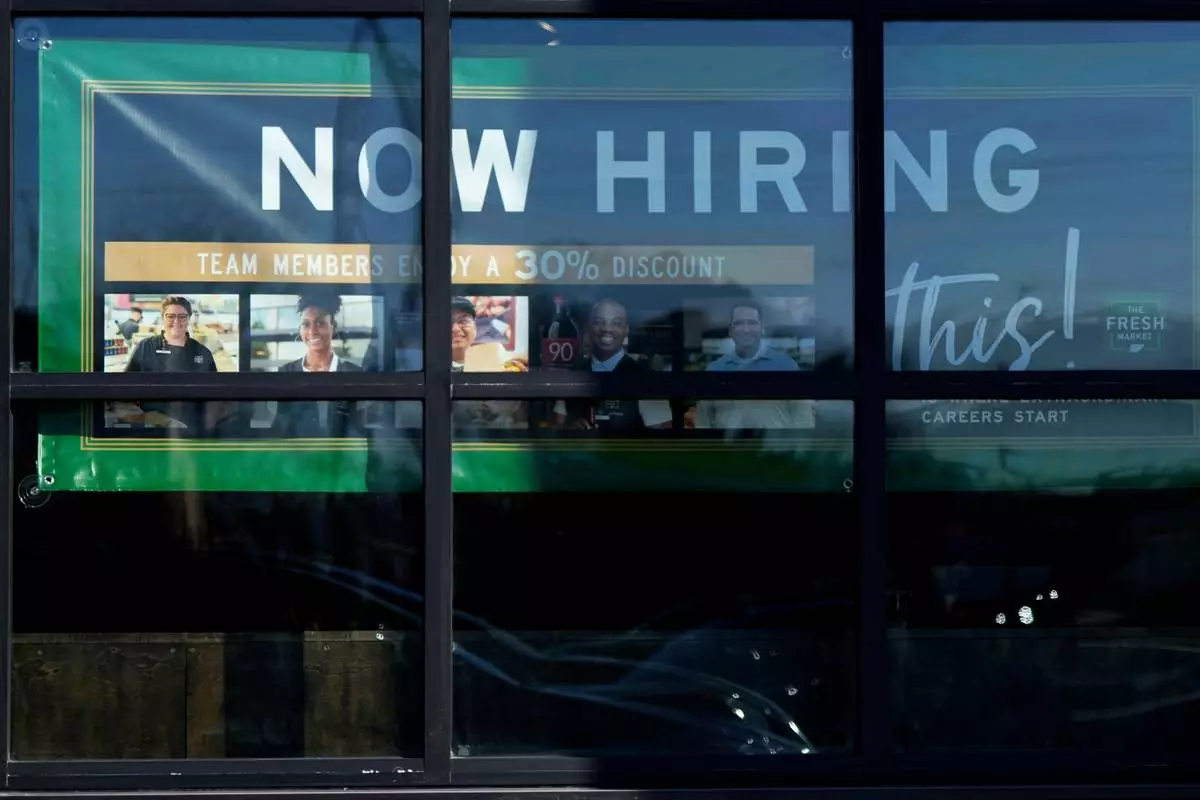
FILE - A hiring sign is displayed at a grocery store in Northbrook, Ill., Tuesday, Jan. 21, 2025. (AP Photo/Nam Y. Huh)

FILE - A hiring sign is displayed at a grocery store in Northbrook, Ill., Tuesday, Jan. 21, 2025. (AP Photo/Nam Y. Huh)

Recommended Articles