ALBUQUERQUE, N.M. & MONTREAL & STØVRING, Denmark & WASHINGTON--(BUSINESS WIRE)--Jul 14, 2025--
AIRO (Nasdaq: AIRO), a global leader in advanced aerospace and defense technologies, today announced plans to expand its U.S. footprint with the addition of a new manufacturing and engineering development facility. This strategic move builds on the success of AIRO’s existing operations and is driven by the growing global demand for AIRO’s flagship product, the RQ-35 ISR Drone.
This press release features multimedia. View the full release here: https://www.businesswire.com/news/home/20250714695595/en/
The RQ-35 ISR Drone has rapidly gained international recognition for its reliability, performance, and mission versatility across defense and security sectors. Known in military applications as the RQ-35 Heidrun, the system offers significant advantages over existing micro-ISR drones due to its combination of full autonomy, long flight endurance, and ease of operation. It has been rigorously tested and deployed in harsh electronic warfare and GPS-denied environments, including active conflict zones, where it has demonstrated exceptional resilience and effectiveness.
With hundreds of thousands of operational hours to date, the RQ-35 has proven to be a critical asset in intelligence, surveillance, and reconnaissance missions. Its robust supply chain and seamless integration with other battlespace systems make it a vital link between frontline intelligence gathering and real-time decision-making. These capabilities have made the RQ-35 an essential tool for modern military forces seeking reliable, scalable ISR solutions in dynamic and contested environments.
The planned U.S. facility will not only enable AIRO to scale production efficiently and compete for American-made defense and commercial opportunities — it will also serve as a hub for future innovation. To support new product development, AIRO is designing and engineering efficient, reliable, and low-carbon-emission unmanned aircraft systems for both commercial and military markets. This includes ongoing enhancements to the RQ-35 and the development of the next generation of fully autonomous mini drones.
“Like our current manufacturing facilities in the U.S. and Europe, which are AS9100-certified, our intent is for this new site to meet the same rigorous aerospace quality standards,” said Joe Burns, CEO of AIRO. “This commitment to quality not only strengthens our internal processes and systems, but more importantly, it allows our clients to receive consistent and reliable products. It’s a win-win that reinforces our role as a trusted partner in mission-critical projects.”
“The growth of our drone business has been formidable,” added Dr. Chirinjeev Kathuria, Executive Chairman of AIRO. “Fueled by the global acceptance and operational deployment of the RQ-35 by NATO countries, this segment has expanded rapidly. These systems are not only proving essential in active conflict zones but have the potential to be a cornerstone of homeland security strategies across allied nations. This expansion reflects our commitment to meeting that demand with unmatched quality and responsiveness.”
About AIRO
AIRO (Nasdaq: AIRO) is a technologically differentiated aerospace, autonomy, and air mobility platform targeting 21st century aerospace and defense opportunities. AIRO is organized into four operating segments, each of which represents a critical growth vector in the aerospace and defense market: Drones, Avionics, Training, and Electric Air Mobility.
Forward-Looking Statements
The statements contained in this press release that are not historical facts are forward-looking statements. You can identify forward-looking statements because they contain words such as “believes,” “expects,” “may,” “will,” “should,” “seeks,” “intends,” “plans,” “estimates,” or “anticipates,” or similar expressions which concern our strategy, plans, projections or intentions. These forward-looking statements may be included throughout this press release, and include, but are not limited to, statements relating to AIRO’s operational landscapes, demand for AIRO’s systems and products, AIRO’s plans for a manufacturing and engineering development facility, expectations concerning future products and developments, the market acceptance and opportunity of AIRO’s products and services, and other statements that are not historical fact. By their nature, forward-looking statements are not statements of historical fact or guarantees of future performance and are subject to risks, uncertainties, assumptions or changes in circumstances that are difficult to predict or quantify, including those described in the section titled “Risk Factors” in AIRO’s prospectus filed with the Securities and Exchange Commission (“SEC”) on June 16, 2025, as well as in other filings AIRO may make with the SEC in the future.. AIRO’s expectations, beliefs and projections are expressed in good faith and we believe there is a reasonable basis for them. However, there can be no assurance that management’s expectations, beliefs and projections will result or be achieved and actual results may vary materially from what is expressed in or indicated by the forward-looking statements. Any forward-looking statement in this press release speaks only as of the date of this release. AIRO undertakes no obligation to publicly update or review any forward-looking statement, whether as a result of new information, future developments or otherwise, except as may be required by any applicable securities laws.

AIRO RQ-35 Heidrun - ISR Drone
WASHINGTON (AP) — Sluggish December hiring concluded a year of weak employment gains that have frustrated job seekers even though layoffs and unemployment have remained low.
Employers added just 50,000 jobs last month, nearly unchanged from a downwardly revised figure of 56,000 in November, the Labor Department said Friday. The unemployment rate slipped to 4.4%, its first decline since June, from 4.5% in November, a figure also revised lower.
The data suggests that businesses are reluctant to add workers even as economic growth has picked up. Many companies hired aggressively after the pandemic and no longer need to fill more jobs. Others have held back due to widespread uncertainty caused by President Donald Trump’s shifting tariff policies, elevated inflation, and the spread of artificial intelligence, which could alter or even replace some jobs.
Still, economists were encouraged by the drop in the unemployment rate, which had risen in the previous four straight reports. It had also alarmed officials at the Federal Reserve, prompting three cuts to the central bank's key interest rate last year. The decline lowered the odds of another rate reduction in January, economists said.
“The labor market looks to have stabilized, but at a slower pace of employment growth,” Blerina Uruci, chief economist at T. Rowe Price, said. There is no urgency for the Fed to cut rates further, for now."
Some Federal Reserve officials are concerned that inflation remains above their target of 2% annual growth, and hasn't improved since 2024. They support keeping rates where they are to combat inflation. Others, however, are more worried that hiring has nearly ground to a halt and have supported lowering borrowing costs to spur spending and growth.
November's job gain was revised slightly lower, from 64,000 to 56,000, while October's now shows a much steeper drop, with a loss of 173,000 positions, down from previous estimates of a 105,000 decline. The government revises the jobs figures as it receives more survey responses from businesses.
The economy has now lost an average of 22,000 jobs a month in the past three months, the government said. A year ago, in December 2024, it had gained 209,000 a month. Most of those losses reflect the purge of government workers by Elon Musk's Department of Government Efficiency.
Nearly all the jobs added in December were in the health care and restaurant and hotel industries. Health care added 38,500 jobs, while restaurants and hotels gained 47,000. Governments — mostly at the state and local level — added 13,000.
Manufacturing, construction and retail companies all shed jobs. Retailers cut 25,000 positions, a sign that holiday hiring has been weaker than previous years. Manufacturers have shed jobs every month since April, when Trump announced sweeping tariffs intended to boost manufacturing.
Wall Street and Washington are looking closely at Friday's report as it's the first clean reading on the labor market in three months. The government didn’t issue a report in October because of the six-week government shutdown, and November’s data was distorted by the closure, which lasted until Nov. 12.
The hiring slowdown reflects more than just a reluctance by companies to add jobs. With an aging population and a sharp drop in immigration, the economy doesn't need to create as many jobs as it has in the past to keep the unemployment rate steady. As a result, a gain of 50,000 jobs is not as clear a sign of weakness as it would have been in previous years.
And layoffs are still low, a sign firms aren't rapidly cutting jobs, as typically happens in a recession. The “low-hire, low-fire” job market does mean current workers have some job security, though those without jobs can have a tougher time.
Ernesto Castro, 44, has applied for hundreds of jobs since leaving his last in May. Yet the Los Angeles resident has gotten just three initial interviews, and only one follow-up, after which he heard nothing.
With nearly a decade of experience providing customer support for software companies, Castro expected to find a new job pretty quickly as he did in 2024.
“I should be in a good position,” Castro said. “It’s been awful.”
He worries that more companies are turning to artificial intelligence to help clients learn to use new software. He hears ads from tech companies that urge companies to slash workers that provide the kind of services he has in his previous jobs. His contacts in the industry say that employees are increasingly reluctant to switch jobs amid all the uncertainty, which leaves fewer open jobs for others.
He is now looking into starting his own software company, and is also exploring project management roles.
December’s report caps a year of sluggish hiring, particularly after April's “liberation day” tariff announcement by Trump. The economy generated an average of 111,000 jobs a month in the first three months of 2025. But that pace dropped to just 11,000 in the three months ended in August, before rebounding slightly to 22,000 in November.
Last year, the economy gained just 584,000 jobs, sharply lower than that more than 2 million added in 2024. It's the smallest annual gain since the COVID-19 pandemic decimated the job market in 2020.
Subdued hiring underscores a key conundrum surrounding the economy as it enters 2026: Growth has picked up to healthy levels, yet hiring has weakened noticeably and the unemployment rate has increased in the last four jobs reports.
Most economists expect hiring will accelerate this year as growth remains solid, and Trump's tax cut legislation is expected to produce large tax refunds this spring. Yet economists acknowledge there are other possibilities: Weak job gains could drag down future growth. Or the economy could keep expanding at a healthy clip, while automation and the spread of artificial intelligence reduces the need for more jobs.
Productivity, or output per hour worked, a measure of worker efficiency, has improved in the past three years and jumped nearly 5% in the July-September quarter. That means companies can produce more without adding jobs. Over time, it should also boost worker pay.
Even with such sluggish job gains, the economy has continued to expand, with growth reaching a 4.3% annual rate in last year's July-September quarter, the best in two years. Strong consumer spending helped drive the gain. The Federal Reserve Bank of Atlanta forecasts that growth could slow to a still-solid 2.7% in the final three months of last year.
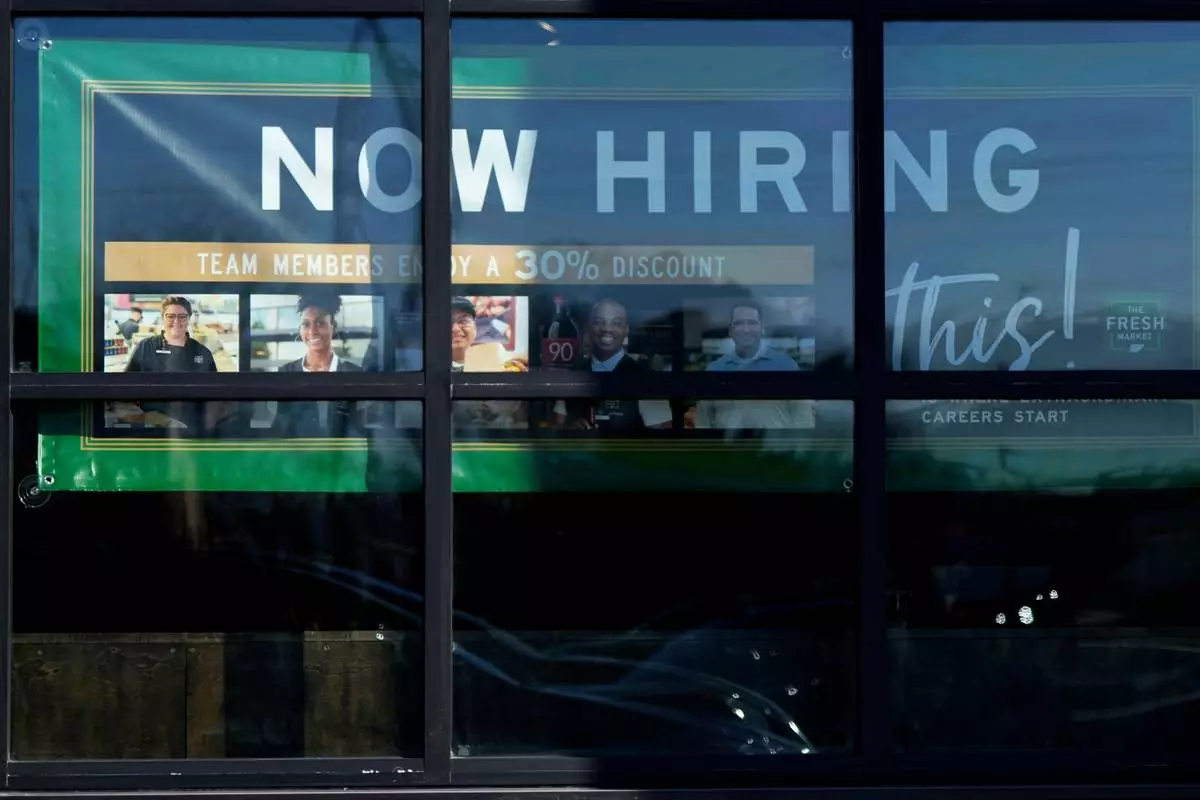
FILE - A hiring sign is displayed at a grocery store in Northbrook, Ill., Tuesday, Jan. 21, 2025. (AP Photo/Nam Y. Huh)