Skip to Content Facebook Feature Image

A Senate vote this week will test the popularity of DOGE spending cuts

ENT

A Senate vote this week will test the popularity of DOGE spending cuts
ENT

ENT

A Senate vote this week will test the popularity of DOGE spending cuts

2025-07-14 20:09 Last Updated At:20:11

WASHINGTON (AP) — Senate Republicans will test the popularity of Department of Government Efficiency spending cuts this week by aiming to pass President Donald Trump’s request to claw back $9.4 billion in public media and foreign aid spending.

Senate Democrats are trying to kill the measure but need a few Republicans uncomfortable with the president's effort to join them.

Trump's Republican administration is employing a rarely used tool that allows the president to transmit a request to cancel previously approved funding authority. The request triggers a 45-day clock under which the funds are frozen. If Congress fails to act within that period, then the spending stands. That clock expires Friday.

The House has already approved Trump's request on a mostly party line 214-212 vote. The Senate has little time to spare to beat the deadline for the president's signature. Another House vote will be needed if senators amend the legislation, adding more uncertainty to the outcome.

Here's a closer look at this week's debate.

Trump has asked lawmakers to rescind nearly $1.1 billion from the Corporation for Public Broadcasting, which represents the full amount it’s due to receive during the next two budget years.

The White House says the public media system is politically biased and an unnecessary expense.

The corporation distributes more than two-thirds of the money to more than 1,500 locally operated public television and radio stations, with much of the remainder assigned to National Public Radio and the Public Broadcasting System to support national programming.

The potential fallout from the cuts for local pubic media stations has generated concerns on both sides of the political aisle.

Sen. Mike Rounds, R-S.D., said he's worried about how the rescissions will hit radio stations that broadcast to Native Americans in his state. He said the vast majority of their funding comes from the federal government.

“They're not political in nature,” Rounds said of the stations. “It's the only way of really communicating in the very rural areas of our state, and a lot of other states as well."

Sen. Lisa Murkowski, R-Ala., said that for the tribal radio stations in her state, “almost to a number, they’re saying that they will go under if public broadcasting funds are no longer available to them.”

To justify the spending cuts, the Trump administration and Republican lawmakers have cited certain activities they disagree with to portray a wide range of a program’s funding as wasteful.

In recent testimony, Office of Management and Budget Director Russ Vought criticized programming aimed at fostering diversity, equity, and inclusion. He said NPR aired a 2022 program entitled “What ‘Queer Ducks’ can teach teenagers about sexuality in the animal kingdom." He also cited a special town hall that CNN held in 2020 with “Sesame Street” about combatting racism.

As part of the package, Trump has asked lawmakers to rescind about $8.3 billion in foreign aid programs that aim to fight famine and disease and promote global stability.

Among the targets:

— $900 million to combat HIV/AIDS, malaria and other diseases and strengthen detections systems to prevent wider epidemics.

— $800 million for a program that provides emergency shelter, water and sanitation and family reunification for those forced to flee their own country.

— $4.15 billion for two programs designed to boost the economies and democratic institutions in developing and strategically important countries.

— $496 million to provide humanitarian assistance such as food, water and health care for countries hit by natural disasters and conflicts.

Some of the health cuts are aimed at a program known as PEPFAR, which President George W. Bush, a Republican, began to combat HIV/AIDS in developing countries. The program is credited with saving 26 million lives and has broad bipartisan support.

On PEPFAR, Vought told senators "these cuts are surgical and specifically preserve life-saving assistance.” But many lawmakers are wary, saying they've seen no details about where specifically the administration will cut.

The administration also said some cuts, such as eliminating funding for UNICEF, would encourage international organizations to be more efficient and seek contributions from other nations, “putting American taxpayers first.”

U.S. leaders have often argued that aiding other nations through “soft power” is not just the right thing to do but also the smart thing.

Sen. Mitch McConnell, R-Ky., told Vought there is “plenty of absolute nonsense masquerading as American aid that shouldn’t receive another bit of taxpayer funding,” but he called the administration's attempt to root it out “unnecessarily chaotic.”

"In critical corners of the globe, instead of creating efficiencies, you’ve created vacuums for adversaries like China to fill," McConnell told Vought.

The president has issued a warning on his social media site directly aimed at individual Senate Republicans who may be considering voting against the cuts.

He said it was important that all Republicans adhere to the bill and in particular defund the Corporation for Public Broadcasting.

“Any Republican that votes to allow this monstrosity to continue broadcasting will not have my support or Endorsement,” he said.

For individual Republicans seeking reelection, the prospect of Trump working to defeat them is reason for pause and could be a sign the package is teetering.

Sen. Thom Tillis, R-N.C., opted to announce he would not seek reelection recently after the president called for a primary challenger to the senator when he voted not to advance Trump's massive tax and spending cut bill.

Spending bills before the 100-member Senate almost always need some bipartisan buy-in to pass. That's because the bills need 60 votes to overcome a filibuster and advance. But this week's effort is different.

Congress set up a process back when Republican Richard Nixon was president for speedily considering a request to claw back previously approved spending authority. Under those procedures, it takes only a simple Senate majority to advance the president's request to a final vote.

It's a rarely employed maneuver. In 1992, President George H.W. Bush, a Republican, had some success with his rescissions request, though the final bill included some cuts requested by the president and many that were not. Trump proposed 38 rescissions in 2018, but the package stalled in the Senate.

If senators vote to take up the bill, it sets up the potential for 10 hours of debate plus votes on scores of potentially thorny amendments in what is known as a vote-a-rama.

Democrats see the president's request as an effort to erode the Senate filibuster. They warn it's absurd to expect them to work with GOP lawmakers on bipartisan spending measures if Republicans turn around a few months later and use their majority to cut the parts they don't like.

Senate Democratic leader Chuck Schumer offered a stern warning in a letter to colleagues: “How Republicans answer this question on rescissions and other forthcoming issues will have grave implications for the Congress, the very role of the legislative branch, and, more importantly, our country,” Schumer said.

Senate Majority Leader John Thune, R-S.D., took note of the warning.

“I was disappointed to see the Democrat leader in his recent Dear Colleague letter implicitly threaten to shut down the government," Thune said.

The Trump administration is likening the first rescissions package to a test case and says more could be on the way if Congress goes along.
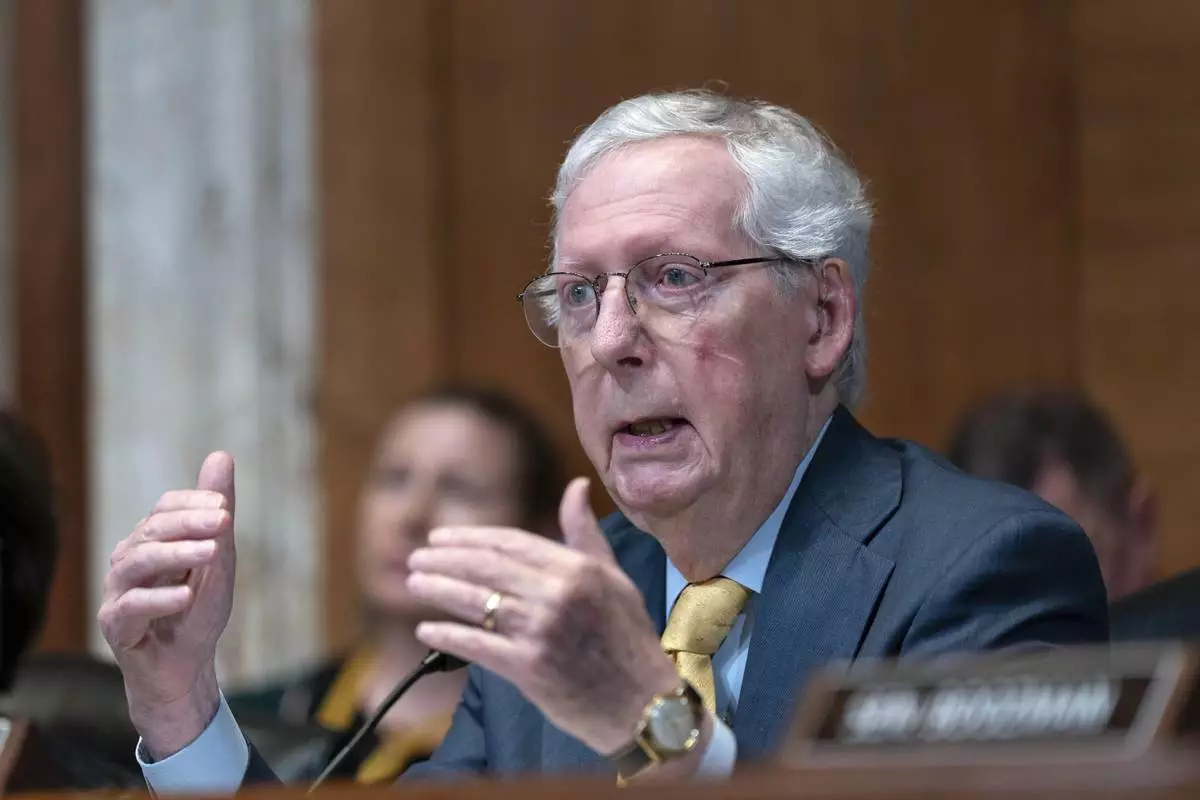
FILE - Sen. Mitch McConnell, R-Ky., speaks during a Senate Committee on Appropriations subcommittee hearing to review the Fiscal Year 2026 budget request for the U.S. Department of State on Capitol Hill in Washington, May 20, 2025. (AP Photo/Jose Luis Magana, File)


FILE - Sen. Mitch McConnell, R-Ky., speaks during a Senate Committee on Appropriations subcommittee hearing to review the Fiscal Year 2026 budget request for the U.S. Department of State on Capitol Hill in Washington, May 20, 2025. (AP Photo/Jose Luis Magana, File)

U.S. forces have boarded another oil tanker in the Caribbean Sea. The announcement was made Friday by the U.S. military. The Trump administration has been targeting sanctioned tankers traveling to and from Venezuela.

The pre-dawn action was carried out by U.S. Marines and Navy, taking part in the monthslong buildup of forces in the Caribbean, according to U.S. Southern Command, which declared “there is no safe haven for criminals” as it announced the seizure of the vessel called the Olina.

Navy officials couldn’t immediately provide details about whether the Coast Guard was part of the force that took control of the vessel as has been the case in the previous seizures. A spokesperson for the U.S. Coast Guard said there was no immediate comment on the seizure.

The Olina is the fifth tanker that has been seized by U.S. forces as part of a broader effort by Trump’s administration to control the distribution of Venezuela’s oil products globally following the U.S. ouster of President Nicolás Maduro in a surprise nighttime raid.

The latest:

Richard Grenell, president of the Kennedy Center, says a documentary film about first lady Melania Trump will make its premiere later this month, posting a trailer on X.

As the Trumps prepared to return to the White House last year, Amazon Prime Video announced a year ago that it had obtained exclusive licensing rights for a streaming and theatrical release directed by Brett Ratner.

Melania Trump also released a self-titled memoir in late 2024.

Some artists have canceled scheduled Kennedy Center performances after a newly installed board voted to add President Donald Trump’s to the facility, prompting Grenell to accuse the performers of making their decisions because of politics.

Mexico President Claudia Sheinbaum says that she has asked her foreign affairs secretary to reach out directly to U.S. Secretary of State Marco Rubio or Trump regarding comments by the American leader that the U.S. cold begin ground attacks against drug cartels.

In a wide-ranging interview with Fox News aired Thursday night, Trump said, “We’ve knocked out 97% of the drugs coming in by water and we are going to start now hitting land, with regard to the cartels. The cartels are running Mexico. It’s very sad to watch.”

As she has on previous occasions, Sheinbaum downplayed the remarks, saying “it is part of his way of communicating.” She said she asked her Foreign Affairs Secretary Juan Ramón de la Fuente to strengthen coordination with the U.S.

Sheinbaum has repeatedly rebuffed Trump’s offer to send U.S. troops after Mexican drug cartels. She emphasizes that there will be no violation of Mexico’s sovereignty, but the two governments will continue to collaborate closely.

Analysts do not see a U.S. incursion in Mexico as a real possibility, in part because Sheinbaum’s administration has been doing nearly everything Trump has asked and Mexico is a critical trade partner.

Trump says he wants to secure $100 billion to remake Venezuela’s oil infrastructure, a lofty goal going into a 2:30 meeting on Friday with executives from leading oil companies. His plan rides on oil producers being comfortable in making commitments in a country plagued by instability, inflation and uncertainty.

The president has said that the U.S. will control distribution worldwide of Venezuela’s oil and will share some of the proceeds with the country’s population from accounts that it controls.

“At least 100 Billion Dollars will be invested by BIG OIL, all of whom I will be meeting with today at The White House,” Trump said Friday in a pre-dawn social media post.

Trump is banking on the idea that he can tap more of Venezuela’s petroleum reserves to keep oil prices and gasoline costs low.

At a time when many Americans are concerned about affordability, the incursion in Venezuela melds Trump’s assertive use of presidential powers with an optical spectacle meant to convince Americans that he can bring down energy prices.

Trump is expected to meet with oil executives at the White House on Friday.

He hopes to secure $100 billion in investments to revive Venezuela’s oil industry. The goal rides on the executives’ comfort with investing in a country facing instability and inflation.

Since a U.S. military raid captured former Venezuelan leader Nicolás Maduro on Saturday, Trump has said there’s a new opportunity to use the country’s oil to keep gasoline prices low.

The full list of executives invited to the meeting has not been disclosed, but Chevron, ExxonMobil and ConocoPhillips are expected to attend.

Attorneys general in five Democratic-led states have filed a lawsuit against President Donald Trump’s administration after it said it would freeze money for several public benefit programs.

The Trump administration has cited concerns about fraud in the programs designed to help low-income families and their children. California, Colorado, Minnesota, Illinois and New York states filed the lawsuit Thursday in the U.S. District Court for the Southern District of New York.

The lawsuit asks the courts to order the administration to release the funds. The attorneys general have called the funding freeze an unconstitutional abuse of power.

Iran’s judiciary chief has vowed decisive punishment for protesters, signaling a coming crackdown against demonstrations.

Iranian state television reported the comments from Gholamhossein Mohseni-Ejei on Friday. They came after Supreme Leader Ayatollah Ali Khamenei criticized Trump’s support for the protesters, calling Trump’s hands “stained with the blood of Iranians.”

The government has shut down the internet and is blocking international calls. State media has labeled the demonstrators as “terrorists.”

The protests began over Iran’s struggling economy and have become a significant challenge to the government. Violence has killed at least 50 people, and more than 2,270 have been detained.

Trump questions why a president’s party often loses in midterm elections and suggests voters “want, maybe a check or something”

Trump suggested voters want to check a president’s power and that’s why they often deliver wins for an opposing party in midterm elections, which he’s facing this year.

“There’s something down, deep psychologically with the voters that they want, maybe a check or something. I don’t know what it is, exactly,” he said.

He said that one would expect that after winning an election and having “a great, successful presidency, it would be an automatic win, but it’s never been a win.”

Hiring likely remained subdued last month as many companies have sought to avoid expanding their workforces, though the job gains may be enough to bring down the unemployment rate.

December’s jobs report, to be released Friday, is likely to show that employers added a modest 55,000 jobs, economists forecast. That figure would be below November’s 64,000 but an improvement after the economy lost jobs in October. The unemployment rate is expected to slip to 4.5%, according to data provider FactSet, from a four-year high of 4.6% in November.

The figures will be closely watched on Wall Street and in Washington because they will be the first clean readings on the labor market in three months. The government didn’t issue a report in October because of the six-week government shutdown, and November’s data was distorted by the closure, which lasted until Nov. 12.

FILE - President Donald Trump dances as he walks off stage after speaking to House Republican lawmakers during their annual policy retreat, Tuesday, Jan. 6, 2026, in Washington. (AP Photo/Evan Vucci, File)

FILE - President Donald Trump dances as he walks off stage after speaking to House Republican lawmakers during their annual policy retreat, Tuesday, Jan. 6, 2026, in Washington. (AP Photo/Evan Vucci, File)

Recommended Articles