Skip to Content Facebook Feature Image

Water Quality Incident at Queen's Hill Estate: DWSAC Reviews WSD Investigation and Improvement Measures

HK

Water Quality Incident at Queen's Hill Estate: DWSAC Reviews WSD Investigation and Improvement Measures
HK

HK

Water Quality Incident at Queen's Hill Estate: DWSAC Reviews WSD Investigation and Improvement Measures

2025-07-16 21:08 Last Updated At:21:18

Drinking Water Safety Advisory Committee accepts investigation report for water quality incident at Queen's Hill Estate and Shan Lai Court

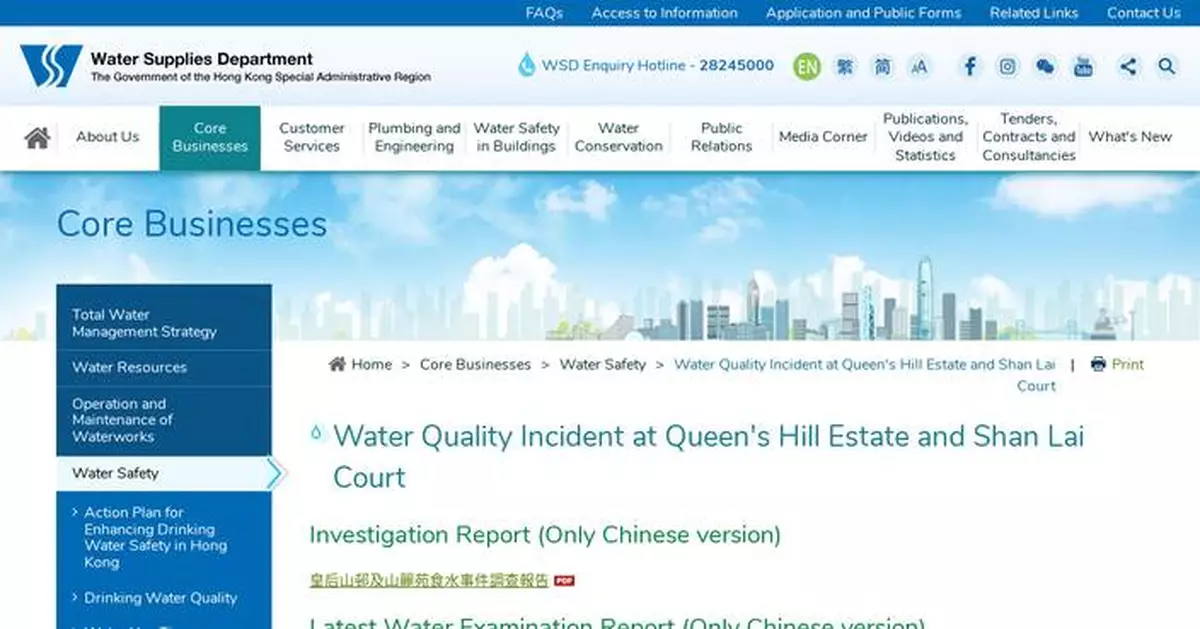
The Drinking Water Safety Advisory Committee (DWSAC) held a meeting today (July 16) and received a briefing from the Water Supplies Department (WSD) on the investigation report concerning the water quality incident at Queen's Hill Estate and Shan Lai Court. The report aims to outline the WSD's tracing work, covering the entire fresh water supply network from the Ping Che Fresh Water Service Reservoir to Queen's Hill Estate and Shan Lai Court, along with related analysis and findings, and recommendations to prevent similar incidents in the future.

The Chairman of the DWSAC, Dr Chan Hon-fai, said that the tracing work conducted by the WSD was objective and scientific. The DWSAC agreed with the WSD's findings that the black sediments in fresh water, identified as bituminous materials, originated from a 400-metre-long steel pipe with internal bituminous protective lining at Ping Che Road, which is located upstream in the water supply network of the estates. The sediments also contained a trace amount of blue fragments, which were identified as resin from the internal protective coating of valves in the water pipelines. A source of the fragments was found to be a valve located at Lung Ma Road outside the estates. The DWSAC agreed to continue the identification and replacement of any defective valves in the estates.

The DWSAC noted that the WSD and the Housing Department had carried out a series of joint operations over the past month. These included increasing the frequency of flushing the underground fresh water pipes along Lung Ma Road and within the estates, cleansing the water tanks in each building of the estates, and installing additional strainers at the existing filtering devices within the estates. The DWSAC noted that the prevailing water quality had resumed normal. The WSD will explore whether new technologies can be adopted to ensure effective cleansing and eliminate the possibility of sediment in the water pipes.

In addition, the DWSAC agreed with several recommendations put forward by the WSD, including the gradual replacement of steel water pipes with bituminous protective lining. This can effectively prevent recurrence of similar incidents in the future. The WSD reported to the DWSAC that it had promptly replaced a section of the underground water pipe with bituminous protective lining at Ping Che Road with an exposed temporary water pipe, and would strive to complete the laying of a new permanent underground water pipe by the end of this year.

The DWSAC asked the WSD to expedite the implementation of these improvement measures and expected the WSD to provide further progress updates before the end of this year.

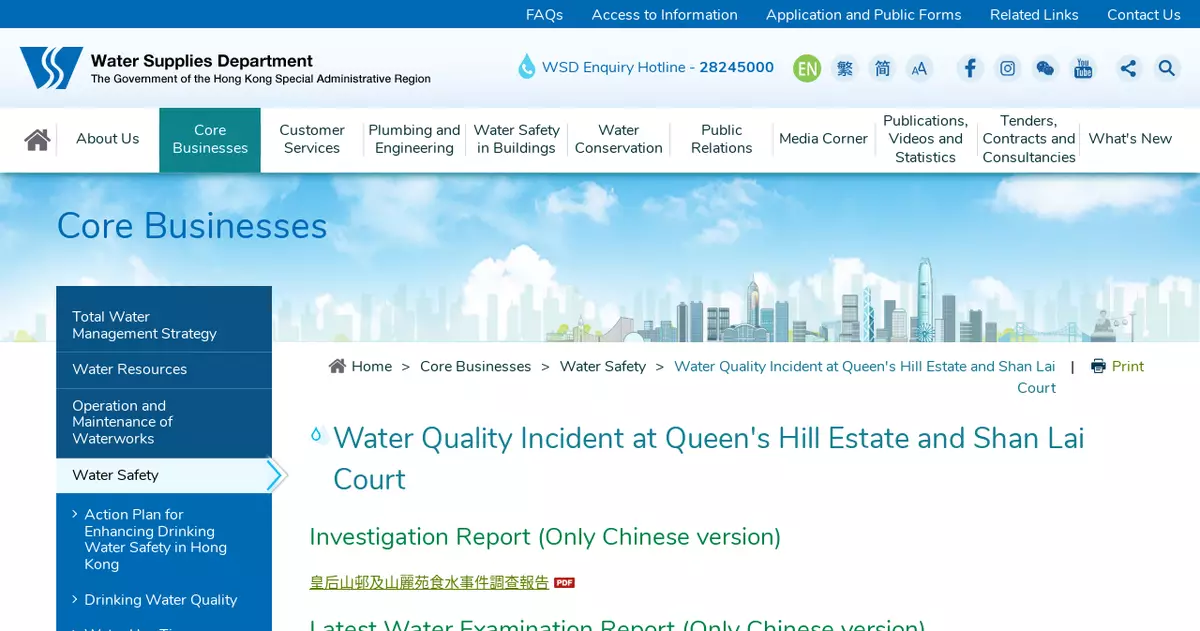
The WSD's investigation report (Chinese only) has been uploaded to the following website: www.wsd.gov.hk/en/core-businesses/water-quality/water-quality-incident/index.html
Source: AI-found images


Source: AI-found images

EDB reminds parents to choose primary schools under Central Allocation process for their children

The Education Bureau (EDB) today (January 12) reminded parents that children who have joined the Primary One Admission (POA) System for 2026 but have not yet secured a discretionary place can take part in the Central Allocation process for a Primary One (P1) place in a government or aided primary school. Parents concerned should make their choice of schools within the period from January 19 to 25.

Digitalisation of POA

---------------------------

In line with the Smart Government strategy, the EDB has fully implemented digitalisation of the POA. Parents who have registered as POA e-Platform (ePOA) users and have bound their account to "iAM Smart+" may submit the Choice of Schools Form for Central Allocation from January 19 to 25 through the ePOA. Please refer to the related videos and Parent's Guide on the EDB's website (www.edb.gov.hk/en/edu-system/primary-secondary/spa-systems/primary-1-admission/poa_eplatform/index.html) for details of the procedures for activating and logging into an ePOA account and for making school choices for the Central Allocation of POA via the e-Platform.

Making school choices at Central Allocation Centres

-----------------------------------------------------------------

The EDB will send letters to parents on January 14 inviting them to make their choice of schools. To cater for the needs of different parents, parents can still submit the Choice of Schools Form in paper form by visiting the designated Central Allocation Centre at the suggested time slot (i.e. 9.30am to 12.30pm or 1.30pm to 4.30pm on January 24 (Saturday) or 9.30am to 12.30pm on January 25 (Sunday)) stated in the letter.

Parents who are ePOA users may choose to submit the Central Allocation Application via the ePOA or in paper form to the Central Allocation Centre but should not submit duplicate applications. Parents who have not yet received the letter by January 19 should call the School Places Allocation Section of the EDB (Hotline: 2832 7700) as soon as possible.

Only one parent of an applicant child is required to complete the school choice-making procedures. Parents are advised not to take their children to the Central Allocation Centre if possible. Parents who cannot make school choices within the suggested time slot can go to the designated Central Allocation Centre from 1.30pm to 4.30pm on January 25. The Choice of Schools Form will be sent together with the letter to parents who have submitted a paper Application Form at the Discretionary Places stage for filling out in advance.

In the event of adverse weather or other special conditions on any day during the period of making school choices, please pay heed to radio or television announcements on the relevant special arrangements.

Unable to submit application within specified choice-making period

------------------------------------------------------------------------------------

For individual parents who are unable to use the ePOA or go to the Central Allocation Centre to make school choices, they can authorise in writing a representative to bring the completed Choice of Schools Form and their signed Letter of Authorisation to the Central Allocation Centre to proceed with the related procedures.

To apply for POA 2026 for their children after January 25, parents need to complete necessary procedures with the School Places Allocation Section, which will separately arrange P1 places for the applicant children in June.

Change of residential address

--------------------------------------

An EDB spokesman reminded parents that, if they have recently moved their residence or have such plans in the near future, they are required to inform the School Places Allocation Section as soon as possible so that they can make school choices in the POA School Net where their new home is located. Parents should fill in the actual residential address of their child. If they provide a false address for securing a P1 place, the POA application of their child will be rendered void and the P1 place allocated will be withdrawn.

The EDB has put in place a monitoring mechanism to verify the residential addresses of applicant children as given by the parents. Random checks have also been stepped up. The public may call the School Places Allocation Section to report suspected cases of using a false address by parents for their children's POA application. The EDB will take action against false address cases.

Mechanism of Central Allocation

----------------------------------------

Central Allocation is composed of two parts. Part A, which takes up 10 per cent of the P1 places earmarked for Central Allocation, is for unrestricted school choices. Parents can choose up to three government or aided primary schools in any school net. Part B takes up the remaining 90 per cent of the P1 places earmarked for Central Allocation. Parents of applicant children residing in the school net concerned are to select schools from the "Choice of Schools List for Central Allocation (Primary One Admission 2026)" of their school net, while parents of applicant children who intend to commute daily to schools in Hong Kong are to select schools from the "2026 Choice of Schools List for Central Allocation (For Applicant Children who intend to commute daily to schools in Hong Kong)". Parents should fill in the Choice of Schools Form in the order of their preference.

The mechanism of the Central Allocation is based on parents' choices in general. The computer-programmed allocation will first process the school choices in Part A and then the school choices in Part B. For oversubscribed schools, the order of priority in allocating places will be determined by random numbers generated by the computer for individual applicants to ensure fairness.

For information about the procedures for Central Allocation, please call the EDB's 24-hour automatic telephone enquiry service at 2891 0088.

Release of Central Allocation results

----------------------------------------------

For parents who have already activated their ePOA account via "iAM Smart" or "iAM Smart+", they will receive their Central Allocation results through the ePOA from 10am on June 3. Parents who wish to receive the allocation results via SMS on June 3 may choose such an option in the Choice of Schools Form. In addition, the allocation results will be sent to parents by post on June 3 and 4.

Source: AI-found images

Source: AI-found images

Recommended Articles